DD
MM
YYYY

PAGES

DD
MM
YYYY

spot_img

PAGES

Home Blog Page 7521

Wall Street and Global Fund Managers See Growth in These Two Areas in Nigeria in 2017

0

Since Donald Trump became President-elect of the United States, emerging market stocks are down nearly 7.0%, based on the Morgan Stanley Capital Index. That could indicate that U.S. fund managers will be moving away from emerging economies. If you think so, you will be wrong.

The fact is that a number of global fund managers say they are buying emerging market assets for 2017 after the beating the sector has taken since the U.S. election in November, even though credit rating agencies have a less positive outlook.

One of those moneymen is Michel Del Buono, head of portfolio strategy at Makena Capital Management LLC, who oversees $18 billion across asset classes. He is bullish on emerging markets. According to Reuters, this is where his mind is right now:

“If you’re exposed in the right way and you have a long-term perspective you should keep a significant weighting to emerging markets,” he said.

Del Buono said he favors investments in things like healthcare, retail and for-profit education in places like Nigeria, Indonesia and the United Arab Emirates.

Since Nigeria does not have for-profit universities, the areas Del Buono will be deploying capital are largely healthcare and retail. So, if you want to track the moneymen in Nigeria, get into these two areas.

Begin Your Cybersecurity Career Today, Facyber Publishes Detailed Table of Contents of Programs

0

US-based First Atlantic Cybersecurity Institute, Pittsburgh USA (www.Facyber.com) has unveiled an online cybersecurity training program designed for professionals in the financial sector (bankers and insurers).

The following are the detailed table of contents for Certificate Programs which are required prerequities for the Diploma and Nanodegree programs.


ENROLL TODAY.

This is the future of consumer electronics miniaturization

0

Scientists have created the world’s thinnest wires yet—and they’re made of atoms coated in diamonds. These nanometer-scale wires could help cram more computing power into even-smaller devices.

A team of scientists from Stanford University and the US Department of Energy recently took molecule-sized diamond fragments, attached them to atoms of sulfur, and dropped them into a solution with copper atoms. The result: a wire three atoms across sheathed in diamond. In addition, the wire assembled itself, like a set of Lego bricks spontaneously coming together to make a structure. The team published the results of their work Dec. 26 in Nature Materials.

As QZ has it, “put together diamonds, copper, and sulfur, and you can make the thinnest wires humanly possible. These nanometer-scale wires could help shrink electronic circuits, cramming more computing power into ever-smaller devices, and allow researchers to explore exotic material physics”

How artificial intelligence will grow the Nigerian economy in 2017

0

The U.S. Government just released how artificial intelligence will affect the U.S. economy in a new report.

Accelerating artificial intelligence (AI) capabilities will enable automation of some tasks that have long required human labor.1 These transformations will open up new opportunities for individuals, the economy, and society, but they have the potential to disrupt the current livelihoods of millions of Americans. Whether AI leads to unemployment and increases in inequality over the long-run depends not only on the technology itself but also on the institutions and policies that are in place. This report examines the expected impact of AI-driven automation on the economy, and describes broad strategies that could increase the benefits of AI and mitigate its costs.

The deal is that  jobs will be automated  – in such millions of jobs could be displaced. However, AI will provide opportunities for people to learn new things.  The report notes that researchers’ estimates about jobs threatened ranges widely from 9 to 47 percent and the impact will be uneven: “AI is not a single technology, but rather a collection of technologies that are applied to specific tasks, the effects of AI will be unevenly felt throughout the economy.”

The key thing here is that the jobs which will go are the jobs which can be done by those with minimal education. Taxi drivers will be affected via self-driving cars. About 2.2 million to 3.1 million existing jobs in the United States on overall will be affected by AI and its variants.

AI-driven automation will continue to create wealth and expand the American economy in the coming years, but, while many will benefit, that growth will not be costless and will be accompanied by changes in the skills that workers need to succeed in the economy, and structural changes in the economy.
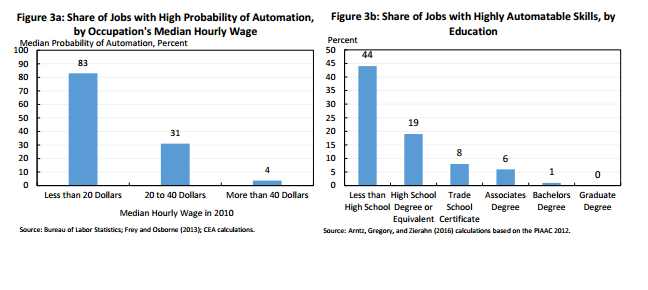
Nevertheless, the report did not model the possibilities AI could bring which could be new jobs in new areas. There is no way to have these numbers since the field is still emerging..

That said, we do think AI will affect Nigeria even more. We see the application of AI in agriculture and that will be the most important area in Nigeria and Africa. AI will bring intelligence in the crop farming business and open a new dawn in how farmers make decisions. That will improve yield and accelerate innovation in Nigeria across all value chains.

Zenvus, a leading AgTech company in Nigeria, is leading that future and its efforts will radically improve the agriculture sector which will have overall impact in the Nigerian economy. We do not think that this AI application in agriculture will affect jobs because it is not designed to displace workers. The key is to improve decision making for the farmers.


Nigeria receives huge credit alert from MTN …

0

It looks like MTN will help Nigeria close its budget funding gaps!

According to Nigeria’s Minister of Communications, Adebayo Shittu, MTN has paid N80 billion of the N330 billion fine imposed on it by the Nigerian government for failing to deactivate more than five million unregistered SIM cards. The minister noted that the payment was for this first year and is the first tranche of the total payment.

MTN, Nigeria’s largest mobile operator, was initially fined 5.2 billion dollars (N1.04 trillion) for failing to deactivate more than five million unregistered SIM cards.

The fine on the South Africa-owned company was later reduced to N330 billion.