DD
MM
YYYY

PAGES

DD
MM
YYYY

spot_img

PAGES

Home Blog Page 7523

How African can move from always planning to constantly executing: from Think Tank to Do Tank

0

Most major corporations struggle with developing a business strategy that works. Fifty percent of business leaders don’t believe they have a winning strategy to begin with and almost all report missing major opportunities in the market. About two-thirds of business executives say that their company’s capabilities don’t support the way they create value in the market. And 80% of senior executives say that their overall strategy is not well understood – even within their own company. These problems are not caused by external forces. They are the outcome of the way most companies are managed. These are some of the findings of ongoing global research on senior executives carried out by Strategy&, PwC’s strategy consulting capability.

Jorge Camarate, Strategy& Partner, says: “Worldwide and across the African continent we are seeing companies battle with how to develop strategies that keep them competitive in an increasingly complex global marketplace. All too often companies don’t think about strategy and execution together.

“We have a number of business leaders who understand this problem, but very few who know how to overcome this.”

There are few companies that are able to successfully close the gap between their strategy and their execution. Those companies that are successful – referred to as ‘coherent’ companies – are the ones that are able to bridge this strategy-to-execution gap by applying the unique capabilities that distinguish them from their peers.

Coherent companies usually have the ability to align their value proposition with their distinctive capabilities and their portfolio of products and services. These elements shape a company’s identity, culture and approach to managing resources.

Traditionally, firms formulate a strategy by looking for growth opportunities in the market. For large enterprises, such an approach would include expansion into Africa. However, attempts to build businesses in Africa frequently result in value destruction. A recent study conducted by Strategy& on M&A activity in Africa, shows that of the business expansions into Africa, as many as 66% resulted in negative shareholder returns. The study also shows that deals with no capability alignment (32% of the total number) significantly underperform compared to those that a have a clear capability alignment.

The results of the study suggest that there is a need for a new growth strategy that builds on and enhances companies’ existing capabilities. This will create more shareholder value than purely seeking out markets based on their intrinsic attractiveness.

It is critical that companies expanding into Africa should focus on their own capabilities. They need to align their efforts in order to successfully execute their strategy with what they are best at. One of the key success factors is that it takes unconventional leadership to foster the behavior required of coherent companies. In other words, organisations need to bridge the gap between strategy and execution. Our independent research of multinationals that have expanded across the African continent demonstrates how the effective execution of a winning strategy is what sets successful companies apart.

In the process, we see the following acts of unconventional leadership as being of fundamental importance:

  1. Commit to an identity: A true identity expresses what a company does best and why it matters. Choosing and developing an identity requires some reflection, where your company can go in the market- what products and services you can offer and to whom – is a function of who you are and what you do well. Companies should only compete in those markets where they believe their identity and distinctive capabilities will give them the edge over their competitors.
  2. Translate the strategic into the everyday: In order to achieve its targeted identity, an organisation must create a blueprint of its capabilities. It must integrate diverse processes and technologies while preserving the strategic value of the enterprise.
  3. Put culture to work: An organisation’s culture is multidimensional, complex and influential. Most business leaders understand the power of a company’s culture – but it’s not always clear how to harness that culture. A company’s culture should reinforce the distinctive capabilities and strengths that differentiate it from the competition. Africa poses some challenges when it comes to culture, as labour markets usually lack people with the necessary technical skills and relevant industry experience. Consequently, companies have to develop their own talent. Since relying heavily on expatriates is not financially sustainable or positively viewed by African governments, finding local human capital is essential.
  4. Cut costs to grow stronger: Coherent companies tend to invest heavily in activities that support their identity and distinctive capabilities. They will need to regard costs as an investment and focus on investing in those areas that are necessary for executing strategy. In middleincome African countries with strong institutions, aspirational customers demand premium products and services – but these need to be delivered at a lower cost point.
  5. Shape the future: Coherent companies acknowledge that their value proposition is never fully achieved and their capabilities system should always be open for further progression.

Although the African continent offers much potential for investors, it also carries a number of risks and challenges. “It takes a coherent company to successfully and sustainably close the gap between strategy and execution in Africa. Conventional leadership practices of seeking growth at all costs have resulted in many unsuccessful attempts at penetrating this market.

“Coherent companies, on the other hand, improve the likelihood of successful expansion and strategy execution in one of the fastest-growing regions in the world,” concludes Camarate.

[PwC Newsletter as Five components to move from strategy to execution in Africa]

How the Best Digital Bank In The World uses hackathons to replace executive training

0

Putting digital priorities at the heart of what a traditional bank does is easier said than done. At Singapore’s DBS, actions are speaking louder than the words of its rivals. Many organizations are noticing their strides.

This year, financial services magazine Euromoney is one of those that have recognized DBS, honoring it in. their inaugural pick for best digital bank. The Singapore-based DBS Bank is the best bank in digital, globally for 2016.

DBS did this through transformation that took about 7 years. Part of it was going back to the startup mentality of innovation. They took their leaders into hackathons to mingle with entrepreneurs and learn how to be efficient.

Achieving greater efficiency and customer focus is only part of the transformation battle. The big win is driving better innovation, as it leads to strategic advantage.

Cobban realized that to drive innovation within DBS, he had to change the culture. “We recognized innovation was all about culture and behavior,” he says. “So we took our leaders and put them in ‘hackathons’ with startups. Hackathons replaced the executive training budget.”

Exposing executives to the startup mentality opened their eyes to new ways of doing business – a good start, but Cobban realized he had to spread such thinking across the organization.

Once again, Cobban defied conventional wisdom: “I told our innovation team: don’t innovate,” he says. “Instead, teach the rest of the organization to innovate.”

For African banks, digital offers them the best roadmap to growth. They need to innovate and cut-off millions of wasted customer hours not just in banking halls but around the ecosystems of their businesses.

Intel sees possibilities of cyber-warfare as Obama retaliates against Russia over election hacking

0
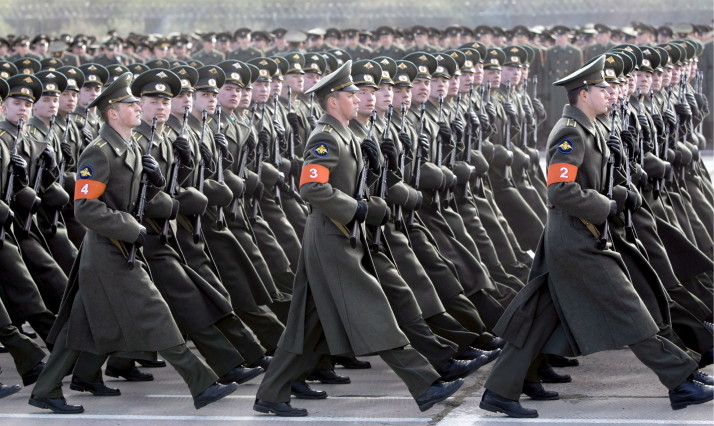
epa01716659 (FILE) A file photograph showing Russian troops marching in the village of Alabino outside Moscow on 22 April 2008 during the rehearsal of the military parade which will take place on the Red Square on 09 May 2008, devoted to the victory of the Soviet Union over Nazi Germany in the WWII . A plan to replace Soviet-era Russian military uniforms with ones by a leading fashion designer has been abandoned because of a lack of money, media reports on 01 May 2009. The plan to bring in the new uniforms, designed by Valentin Yudashkin, was supported by Russian Prime Minister Vladimir Putin. There is now only enough money to pay for uniforms for soldiers taking part in the forthcoming Victory Day parade. EPA/YURI KOCHETKOV

President is planing to announce his response against Russia for meddling through hacking in the U.S. presidential election. This act is expected to trigger avalanche of many unknowns even as Russia has challenged Obama to go ahead as they promised to respond in kind.

In a statement, Intel Security’s chief technology officer, Steve Grobman, warned about the unintended consequences of any plans to retaliate, including inciting actual war.

“The administration, fellow lawmakers, and general public must understand the potentially catastrophic consequences of a digital cyber conflict escalating into a kinetic, conventional shooting war,” Grobman said. “Impacting digital infrastructure beyond the intended target opens the door to draw additional nation states into a conflict. This increases risk to civilian populations as countries see the need to retaliate or escalate.”

It is expected that U.S. could attack Russia’s internet infrastructure.  If that happens, the chance of full-blown cyber-warfare will happen.

Nevertheless, Grobman urged U.S. officials to tighten security around the nation’s digital election systems. 

“We strongly encourage any effort to expand the definition of the country’s digital infrastructure to include the nation’s election systems,” he said in a statement. “We usually consider critical infrastructure to include life-sustaining services such as water, power, transportation, and first responder communications. But, given that election systems are the foundational organs of democracy, we must protect them accordingly.”

The main reason this car company is going into mobile payment

0

The business of transportation is being redesigned. It is all over us with Uber and peers changing what it means to move from one location to another.

It does seem that the business of making cars may not be a profitable one in the far future. So car manufacturers are diversifying.

Volkswagen has bought PayByPhone, a company that lets drivers pay for parking using their mobile phones. Volkswagen says it plans to bundle PayByPhone’s capabilities with other mobile payment services into a separate business built around parking.

Earlier this month, Volkswagen launched a digital business division called Moia that will offer, among other services, an on-demand shuttle for commuters living in urban areas in an aim to expand beyond its traditional focus of making and selling cars.

Just note that when it comes to transportation, no one can predict what will happen next. The sector is experiencing many new transformations beginning with the pioneering Uber business model.

Jyoti And Kiran Matharoo apologize to Femi Otedola; read their histories

0

Things happen and Nigeria is puzzling. It seems like he recession has brought a new dimension on the survival strategies for ladies. Mount a big camera, lure big men into your room. Then post photos and pictures of the hell-room on a website. Follow up with the men to buy you out. It looks like Nollywood needs a new movie called  Making Me Rich with Big Men in my Hotel Room.

Two Toronto sisters reportedly embroiled in an international sex scandal have been taken into Nigerian prison custody over cyberbullying and extortion charges. The ladies had apologized to billionaire Femi Otedola.

Jyoti and Kiran Matharoo are facing allegations they’re high-society prostitutes accused of running of a website aimed to extort money from Nigeria’s wealthiest people, according to Nigerian news site Politics Nigeria.

The Matharoo sisters were caught with laptops and iPads containing videos of themselves having sex with men, according to CityNews Toronto.

The two allegedly recorded conversations and sexual trysts with their high-profile clients. It’s claimed they used a third party to blackmail targets to pay thousands of dollars for their privacy, or face release of the material on the sisters’ website.

Jyoti and Kiran have a combined 50,000 followers on their Instagram accounts, both curate snapshots from their lavish and luxurious lifestyles.

They are accused of trying to blackmail Femi Otedola, one of Nigeria’s richest men.

Politics Nigeria said the two immediately confessed to running the blackmail website after their arrest, and admitted to having sex with over 100 wealthy men.

The sisters are believed to be Canadian citizens, and listed a Toronto home address on court documents.