DD
MM
YYYY

PAGES

DD
MM
YYYY

spot_img

PAGES

Home Blog Page 7527

Startup is selling subscription-based weather forecast to improve crop yield in Africa

0

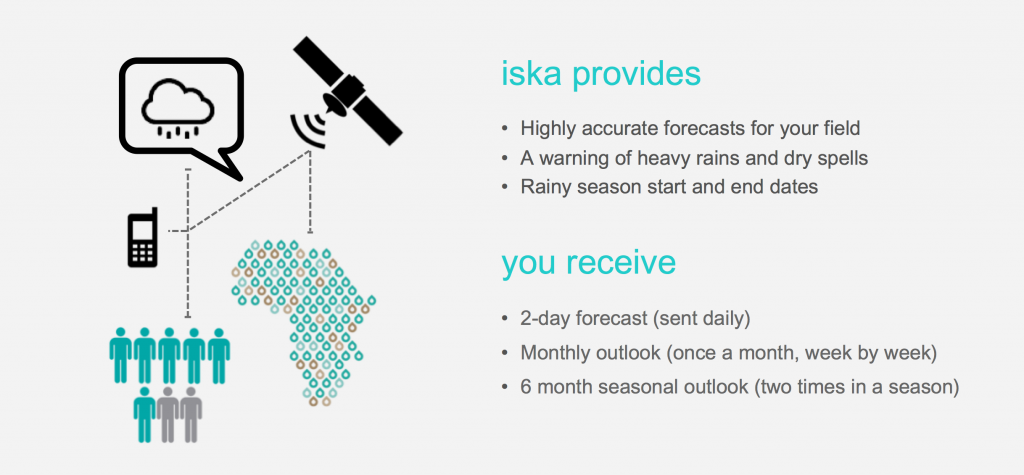
The majority of sub Saharan countries have no access to reliable weather forecasts, which is a serious constraint for farmers’ planning and timing of farming activities (e.g planting). The lack of accurate forecasts is particularly distressing given the recent changes in weather patterns, exacerbated by global climate change, negatively impacting traditional farming practices, where indigenous knowledge is no longer relevant.

As a result of climate change, large parts of West Africa is experiencing changing weather conditions and increasing occurrence of extreme weather events (e.g. floods and droughts). These changes are disrupting typical farming patterns, and a lack of knowledge of how to protect against effects makes smallholder farmers particularly vulnerable.

This is where iska comes in.

iska is built on a disruptive technology allowing for much more accurate prediction than seen before in West Africa. Iska™ has shown an 84% accuracy rate over 2 rainy seasons during 2013 and 2014, compared with global competitors that only reach 39% in West Africa.

Unlike most weather service providers, Ignitia does not only repackage existing weather forecast data for customization, but has developed its products from scratch; since no reliable weather forecast system existed in the region.

The governing physics driving the tropical atmosphere differs from existing model practices and occurs on a different scale. Ignitia’s tropical weather forecast is based on proprietary algorithms developed over 15 man-years by its scientists.

Iska was created by Sweden-based Ignitia, and it came second at the first Agricultural Innovation Investment Summit run by USAID held in Washington, DC in June.

Ignitia now wants to expand into other West Africa countries using a $2.5 million grant from the Securing Water for Food challenge funded by the governments of the United States, Sweden, South Africa, and the Netherlands.
Ericsson Board fires CEO Hans Vestberg

0

The board of telecommunications equipment giant Ericsson has forced its CEO, Hans Vestberg, to step down today with immediate effect after the board agreed that he wasn’t the person to turn Ericsson around.

Ericsson said that Vestberg, who led the Swedish firm for seven years, would be replaced in the short term by chief financial officer Jan Frykhammar.

It’s a tough period for the company that had sacked thousands of workers this year alone following the stagnant nature of the market for its product. In addition to the lay offs, it added that it is still looking to drastically cut costs.

Buhari nominates MIT Prof Akintunde Ibitayo Akinwande as new NERC Chair

0

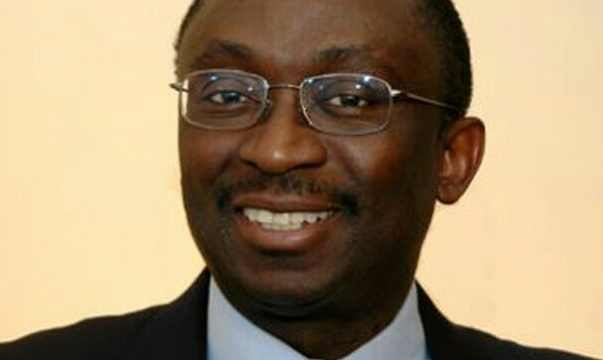
President Muhammadu Buhari has nominated Akintunde Ibitayo Akinwande, a professor in the electrical engineering and computer science department of the Massachusetts Institute of Technology (MIT), as the executive chairman of the Nigerian Electricity Regulatory Commission (NERC).

He is a professor in the electrical engineering and computer science department of the Massachusetts Institute of Technology, Cambridge, MA. He received a B.Sc. (1978) in electrical and electronic engineering from the University of Ife, Nigeria, a MS (1981) and Ph.D. (1986) in electrical engineering from Stanford University, Stanford, California, according to his academic profile.

He joined Honeywell Inc. in 1986 where he initially conducted research on GaAs Complementary FET technology for very high speed and low power signal processing. He later joined the Si Microstructures group where he conducted research on pressure sensors, accelerometers, thin-film field emission and display devices.

Akinwande joined MIT’s Microsystems Technology Laboratories (MTL) in January 1995 where his research focuses on micro-fabrication and electronic devices with particular emphasis on smart sensors and actuators, intelligent displays, large area electronics (macro-electronics), field emission & field ionization devices, mass spectrometry and electric propulsion.

He is a recipient of the 1996 National Science Foundation (NSF) Career Award. He has served a number of technical program committees for various conferences, including the Device Research Conference, the International Electron Devices Meeting, the International Solid-State Circuits Conference, the International Display Research Conference and the International Vacuum Microelectronics Conference.

Akinwande holds numerous patents in MEMS, Electronics on Flexible Substrates, Display technologies and has authored more than 100 journal publications. He was a visiting professor at the Cambridge University engineering department and an Overseas Fellow of Churchill College in 2002-2003. He is a current member of the IEEE Nanotechnology Council.

He is from Offa, Kwara state.

The commissioners:

Musiliu Olalekan Oseni (south-west nominee): BSc economics (first class) from University of Ibadan in 2007; MSc energy economics and policy (with distinction) from University of Surrey, UK, 2010 and PhD in business energy economic in 2015 from the University of Cambridge, UK. His doctorate thesis was on “Self-Generation and Payments for Quality of Service in Electricity Markets”.

Dafe C. Akpeneye (south-south nominee): A 2001 law graduate from Obafemi Awolowo University. Currently the Director, Regulatory Services/General Counsel, West Africa for PricewaterCoopers Nigeria.

Okafor Frank Nwoye (south-east nominee): He is a professor in the department of electrical engineering, University of Lagos. He is a specialist in power systems and control.

Sanusi Garba (north-west nominee): Bsc engineering, ABU, Zaria, 1974; master’s in industrial management, University of Birmingham, 1980.

Nathan Rogers Shatti (north-east nominee): Former commissioner for finance in Adamawa state. Fellow of Chartered Accountants, Shatti was formerly with Exxon Mobil in several countries in Europe and East Africa before becoming manager, treasury and banking services in Mobil Oil Nigeria PLC in 2006. He graduated in accounting from ABU in 1990.

Moses Arigu (north-central nominee): Currently the GCS Partner vice-president (capital markets technology and operations), Royal Bank of Canada. Before then (between 2007 and 2010), he was with JPMorgan Chase (Investment Bank, New York). He was also with Credit Suisse (Swiss Bank, New York), from 2005 to 2007.

Verizon acquires Yahoo for $4.8 billion

0

Verizon acquires Yahoo for $4.8 billion. The US wireless carrier has been expanding online content and advertising since last year’s AOL deal, and sees value in Yahoo’s billion users, even though other investors do not. The deal will be announced before markets open in New York.

Under the deal Verizon will get Yahoo’s online assets including search, mail and instant messaging, along with its ad technology. Various real estate holdings will also be included.

We hope they keep the name Yahoo!

U.S. invested $6.9B in Africa in 2015

0

According to EY’s 2016 Africa attractiveness program 2016, Staying the course, despite a relative slow down, Sub-Saharan Africa remains one of the fastest growing regions in the world. This is reflected in the foreign direct investment (FDI) levels in 2015, where FDI project numbers increased by seven percent. Although, the capital value of projects was down year-on-year — from US$88.5b in 2014 to US$71.3b in 2015 — this was still higher than the 2010–2014 average of US$68b. Similarly, jobs created were down year-on-year, but, again ahead of the average for 2010–2014.

In 2015, East Africa recorded its highest share of FDI across Africa, achieving 26.3% of total projects. Southern Africa remained the largest investment region on the continent, although projects were down 11.6% from 2014 levels. The West Africa region saw a rebound in FDI projects by 16.2%, and interestingly in 2015, the region became the leading recipient of capital investment on the continent, outpacing Southern Africa.

North Africa experienced 8.5% year-on-year growth in FDI projects. Furthermore, while projects are increasing in North Africa, they are increasing at a much faster rate in Sub-Saharan Africa.

The US retained its position in 2015, as the largest investor in the continent, with 96 investment projects valued at US$6.9b. During 2015, traditional investors such as the UK and France, as well as the UAE and India, also showed renewed interest in Africa.

Over the past decade, there has been a shift in sector focus in FDI from extractive to consumer-facing industries. Mining and metals, coal, oil and natural gas, which were previously the key sectors attracting major FDI flows, have given way to consumer products and retail (CPR), financial services and technology, media and telecommunications (TMT), accounting for 44.7% of FDI projects in 2015. In 2015, further evidence of sector diversification came through, with business services, automotive, cleantech and life sciences all rising in significance and becoming the likely “next wave” for investors.