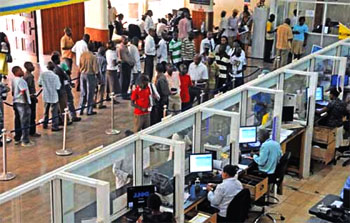
Recent developments are making it increasingly clear that the very fundamental privileges that have helped traditional banks retain their century-old dominance of the sector is about to come to an end.
From San Francisco to London to South Africa, giant tech startups such as Google, Apple, Facebook, and far less known financial technology innovators such as Simple Pay have begun introducing digital financial products and services so innovative that traditional banking along with its many service offerings have now begun to pale excessively when compared with the former.
Actually, it didn’t start today. Two decades ago, telcos such as Telstra and software goliaths like Microsoft began to realize that the financial services sector needed a technological makeover and since the tools the banks needed to make that happen lied largely in the tech innovators’ hands, a race to take over banking from banks began. This was a time when the banks’ major competitors—especially in developing countries— were mattresses in poor people’s homes. The banks understood what this meant. They would now either innovate or perish. Quickly, the banks fixed what needed to be fixed.
When the dust eventually settled and it was obvious that customers elected to take sides with banks—most of who had earned the trust of their numerous savers at a time when borrowers had little option outside banks— the lesson was not lost on the banks.
But that was two decades ago—a time when Africa had little or no tech startup eyeing the admittedly little economic pie the banks that existed at that time had almost exclusively to themselves, but today both savers and borrowers now have a thousand and one other options. Unfortunately, technology is back again and is already forcing major banks in many places to undergo major seismic transformations or quietly take its place in the dustbins of oblivion.
On Your Mat, Set, Disrupt
From bitcoin to blockchain to Google Pay to payment options that allow for free credit card-to-credit card transfers without leaving the Facebook environment, one doesn’t need the brain of an astronaut to see where all these are headed— the once-separate worlds of smartphones, internet and money are fast converging to birth such innovative possibilities that now make traditional branch-based banking more and more irrelevant.
In a report published in February, David Furlonger agreed that globally, revenue from digital banking products and services is estimated to grow to almost half of banks’ revenue over the next 5 years. He also admitted that financial technology innovators (fintechs) and challenger banks often have an IT cost per user that is 10% that of traditional banks. It didn’t therefore come as a surprise when Brett King, CEO of Moven, said “In five years, the biggest banks in the world won’t be banks, they’ll be tech companies.” while addressing Singularity University’s Exponential Finance conference in New York.
After what happened in Kenya with M-Pesa and in a few other States, it has become altogether clear that the technological fix banks need to remain relevant is far more than their current concern of having their apps installed on a few million mobile devices or starting a remittances arm. If traditional banks must survive, something seismic must change concerning the inherently costly infrastructure of branches, regulatory capital and vast teams of employees which presently are largely seen as unsustainable in the long run. The bank of the future must be both lean and downright technology-driven and innovative.
Are African Banks Buying It?
There seems to be an agreement among experts that African banks would be disrupted faster that their European and American counterparts owing to the large amount of unbanked population which numbers in excess of tens of millions coupled with the fact that there is yet to be a regional legal tender for the continent.
In Nigeria, where the banks are admittedly late to the fintech party, it is a completely different ball game altogether. Instantly motivated with the success of M-Pesa in Kenya, and leveraging on access to a whopping 39.7% of the unbanked adult population, local telcos soon began warming up for a disruptive kill. It didn’t take long for the Central Bank to step in, read them their right, and bam—telcos were effectively barred from driving mobile money they had much hoped for.
Where telcos failed, fintech startups blossomed. In a short while, a flurry of fintech startups such as Cash Envoy, Simplepay4u, VoguePay, Quickteller, Etranzact, Paga, Ready Cash, Cowrie Pay and a host of others flooded the landscape and begun rolling out much needed services, wooing both individuals and SMEs alike.
While most Nigerian banks are busy falling over themselves in a race to key into the ecommerce boom by establishing ecommerce stores, Guaranty Trust Bank, one of the most innovative of the pack, has begun both investing in innovations and partnering with startups which has led to a recently commissioned service that allows customers conduct transactions by just dialing Unstructured Supplementary Service Data (USSD) codes from any dumb mobile phone.
In South Africa, Barclays Bank looks to home-grown startups to figure out innovative solutions. In December 2015, it opened the first African branch of Rise, its global network of innovation spaces.
Standard Chartered on the other hand has begun—or is at least considering— leveraging the power of blockchain. In a LinkedIn post made in mid-2015, its Chief Innovation Officer had argued blockchain could open up access to financial services to millions of Africans who can’t currently afford them by simply slicing off the bulk of the costs associated with money transfers, credit cards, remittances, etc.
After months and months of theoretically experimenting with the idea of how bitcoin could be the magic wand needed to fix the Zimbabwean economy, Savannah Fund finally made a brave move to invest in the Zimbabwean bitcoin startup, BitFinance after the collapse of the country’s national currency gave rise to adoption of over nine currencies including US dollars.
Whether policymakers and governmental financial and banking supervision agencies are willing to quickly switch from their current extremely inflexible and complex regulation and control of all possible banking and market risks—as seen in places such as Nigeria— to present-day-realities-reflecting method of active monitoring of financial platforms remains to be seen.
One thing, however, is sure: disruption is here and only the smart ones will survive it.
by Ifeanyi Igbokwe