

DD
MM
YYYY

PAGES

DD
MM
YYYY

spot_img

PAGES

Home Blog Page 7551

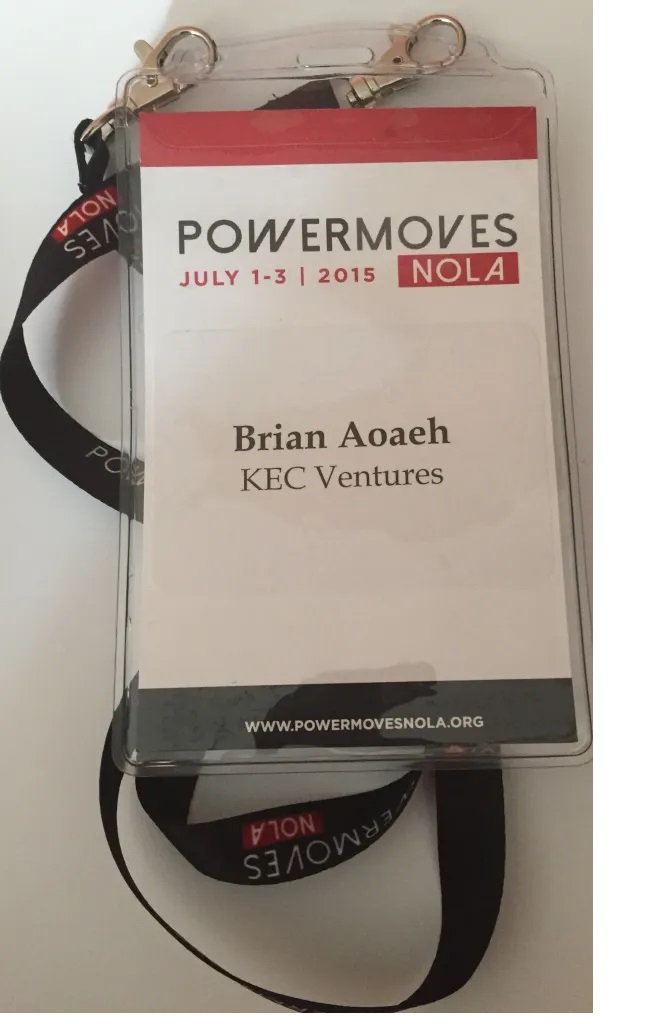
Recap: My 3 Days at #PowerMoves.NOLA 2015

0

I checked in, and then got some coffee.

I rarely like to travel; I hate having to go through security. I hate going to conferences. Most of the time I come away feeling I did not accomplish what I set out to accomplish. On Wednesday morning I left NYC on a JetBlue flight. I was heading to New Orleans for the 2nd annual PowerMoves.NOLA conference. I had to change my plans to attend the 1st installment of the conference last year at the last minute. I am glad I was able to attend this year.

In this post I will highlight the work that PowerMoves.NOLA is doing, the startups that were at the conference as part of the program, and some of the conversations I had with founders, and other investors while I was there.

About PowerMoves.NOLA

PowerMoves.NOLA is a national initiative to deploy innovative ideas, fresh approaches, and an overall commitment to equity and diversity as a growth strategy to address the generational obstacles that prevent minority entrepreneurship. Leveraging the thriving entrepreneurial ecosystem, resources, and culture of New Orleans, PowerMoves.NOLA’s mission is to increase the number of venture-backed minority-founded companies locally and nationally.

Through its fellowship program, pitch competitions, and boot camp, PowerMoves.NOLA acts as a catalyst, providing early-stage and high-growth minority entrepreneurs with access to capital, advisors, and the support they need to succeed. The national conference events showcases some of the top minority entrepreneurs from around the country.

PowerMoves.NOLA’s objective is to make the national conference the premier event for minority entrepreneurs to support their companies, learn from experts, and build visibility of their products, and attract early stage investors.

PowerMoves.NOLA is an initiative of the New Orleans Startup Fund (NOSF), sponsored by Chevron, and in a promotional partnership with ESSENCE Festival™ presented by Coca-Cola®.

PowerMovesNOLA Program Book

PowerMovesNOLA Program Book


While there is danger in the venture business in getting too far away from the crowd, it can often pay to be unconventional. Don Valentine, the founder of Sequoia Capital, told me to trust my instincts, which lets you avoid getting dragged into conventional thinking and trying to please others.

In order to outperform any given market, it is mathematically true that you must not essentially be that market.  In other words, a venture capitalist can’t outperform other venture capitalist if they act just like them. This may seem like common sense but you would be surprised how much herding happens anyway, since many people would rather fail conventionally than succeed unconventionally.

– Tren Griffin, A Dozen Things I’ve Learned From Michael Moritz About Venture Capital. Accessed on Jul 5, 2015 at http://25iq.com/2014/06/07/a-dozen-things-ive-learned-from-michael-moritz-about-venture-capital/


Day 1 – Wednesday, July 1

The flight from JFK was shorter than I had thought it would, I did not realize New Orleans is that close. I arrived in the morning, and had a bit of time to catch up on work before activities related to the conference began.

The conference began with a networking reception and dinner at the New Orleans Museum of Art. I spent my bus ride from the hotel to the museum chatting with Rachelle Oribio who runs the Techstars++ Mayo Clinic program. Before Techstars Rachelle worked at Defy Ventures, and before that she helped convince communities in the Amazon to give up cultivating coca and instead to grow coffee and cocoa. We had a great conversation about early-stage investing, and startups. Our conversation got most animated when we were talking about startups we both got to see up-close, but in which KEC Ventures did not make an investment. It was interesting to hear what they are up to now, after going through Techstars++ Mayo Clinic and how the vision has evolved into what I assumed it would become.

I also ran into Chinedu Echeruo. He is the founder of HopStop, which was bought by Apple in 2013. We have been corresponding by email for about 3 years, but have never met or spoken on the phone. It was great to finally meet him in real life. Also, I always have a lot of fun when I meet a Nigerian or a Ghanaian . . . They get my jokes about Nigerians and Ghanaians.

Before that I had been chatting with Nnamdi and Aaron from 645 Ventures and also with Karl Bell and Adrian Ohmer from Invest Detroit. During dinner we listened to a presentation by LISNR’s Rodney William’s. LISNR is a high frequency, inaudible smart-tone technology; a new communication protocol that sends data over audio. LISNR aims to eventually be a technology standard for user authentication, peer-to-peer communication, and secure data transfer for connected devices in the evolving internet of things. I had seen him pitch in NYC about 9 months ago, so it was great to see how much progress LINR has made since then. It is in the midst of raising a Series B Round of financing.

Next time I visit New Orleans, I will try to visit the New Orleans Museum of Art again.

New Orleans Museum of Art - Jul 1, 2015

New Orleans Museum of Art – Jul 1, 2015

After dinner I went back to my room, did some work, and then went to sleep around midnight.


There’s nothing more invigorating than being deeply involved with a small company and everybody’s betting against us.

Great venture capitalists love the process of creating companies and more importantly creating customer value. Venture capital is a service business. Making others successful is the driving activity in the work.  Finding vicarious joy in the success of others is essential.

– Tren Griffin, A Dozen Things I’ve Learned From Michael Moritz About Venture Capital. Accessed on Jul 5, 2015 at http://25iq.com/2014/06/07/a-dozen-things-ive-learned-from-michael-moritz-about-venture-capital/


Day 2 – Thursday, July 2

I was up early. At 4:00 AM. So I did some work, showered, and then I emailed the attendees around 5:30 AM to say I’d be down at Starbucks between 6:00 AM and 8:45 AM, if anyone wanted to chat. The response was overwhelming. I got to chat with about 20 of the founders who were attending the conference during that time as they stopped by to chat for a few minutes each. Through out the rest of the day, and the rest of the conference founders identified me by my obnoxious neon orange sneakers, and my puma t-shirt and my black baseball cap. I got to chat with lots of people I might not have met otherwise.

#Coffee&AMeeting @PowerMovesNOLA 2015

#Coffee&AMeeting @PowerMovesNOLA 2015

My Uniform – Orange sneakers + jeans, puma t-shirt, black cap

Some of the people who stopped by that morning to chat; the ones with whom I had conversations that went a bit in-depth on a specific question they wanted to talk through; Edward Morgan of Revitalize Charging Solutions – he has a sales pipeline of about $8.7M and described his revenue model to me. Of course, I immediately suggested he run an experiment to see if the market will embrace another revenue model that would make his business model more attractive to investors. He currently has a payback period of two months on each device, I suggested he should see if he could reduce that to zero. I made the suggestion based on what I have learned from a startup I have been working on since August 2010, and in which KEC Ventures is an investor. I also chatted with Rudi from Joicaster, K.G from Quarrio, Craig Lewis from Visage Payroll, Larry Lawal from HealthFundIt, and Toni Okolo from PracticeGigs. I also had a long conversation with Harold Jean-Louis from SmartCoos about the market for business-to-consumer apps designed to help parents educate their young children. We spent a lot of time chatting about opportunities abroad, especially in China.

I bet the baristas and other folks at SBUX must have wondered what was going on . . . Our table was packed, some people had to pull up more chairs from other tables because the 6 at our table were taken. I’m glad I hit send on that email instead of deleting it for fear of pissing people off. There was a lot of laughter. That’s always a good sign.

Around 8:45 I walked over to Champion Square with Aaron Holiday of 645 Ventures. He was a judge for the #EntergyAngelPitch so he wanted to get there a little early.

#Entergy #AngelPitch @PowerMovesNOLA

#Entergy #AngelPitch @PowerMovesNOLA

These are the startups that pitched – 3 of the 5 are startups I had not heard about before.2

  • bluField is an interconnected system of Bluetooth® beacon networks, which creates a high-resolution grid of a real-world geographic area.
  • FoodTrace is a powerful software platform providing food businesses with tools for next-level sourcing management. We help farmers and artisans sell more and buyers buy better. A platform built on proven solutions for businesses to locate and attract new customers, utilize data as insights and food trends for better strategy, and increase revenue with sharing tools for the value-added marketability of quality sourcing.
  • Joicaster is a video syndication platform that enables content creators to schedule, manage, and distribute live content across multiple platforms to yield larger audiences in a simpler cost effective manner. JOICASTER simplifies the process of syndicating live video to multiple online streaming platforms.
  • Lineapple turns smart phones into a mobile buzzer which in turn helps businesses increase profits by converting lost shopping time into new opportunities to increase and close sales. Lineapple is unique because it works inside the micro sales and non-revenue producing windows that are generally controlled by wait-times not during the already profitable active shopping time.
  • [N]tensify provides a branded in-app merchandise store as an additional revenue stream for mobile app developers, integrated via a software development kit (“SDK”). Ntensify creates apparel, plush, and other unique merchandise based on app designs. Ntensify provides a full service production chain, handling all customer data, payment processing, design, manufacturing, and fulfillment.

The #AngelPitch was followed by the #SeriesAPitch – 3 of the 5 are startups I had not heard about before.

  • Maker’s Row is an online B2B marketplace that connects brands with US-based factories. Maker’s Row was founded in November 2012 and currently hosts over 75,000 brands and 6,000 US-based factories. For brands, Maker’s Row provides a transparent community for any size brand to connect with US manufacturers by viewing their factory profile and messaging directly through the Maker’s Row platform. For Factories, Maker’s Row provides a platform for factories to showcase their capabilities and generate inquiries and leads in our community of brands and designers
  • Quarrio is Conversational Analytics. Users ask questions in ordinary English and the system answers instantaneously in plain English with auto-generated graphs and charts. More importantly, the user can then ask follow-up questions and quickly drill down to the important information they seek. The software is a broad artificial intelligence platform that works with any enterprise data source, launching first to sales managers using salesforce.com. Quarrio has created a Learning Natural Language Interface to Databases delivered as a SaaS platform that enables ordinary people to do advanced reporting and analytics.
  • Upswing partners with colleges to provide an easy-to-use virtual learning center for students (for free) and a real-time comprehensive analytics for administrators. Each day, over 200,000 students have access to live, 24/7 tutoring via Upswing. Each student can choose which tutor to connect with among both their college support staff and Upswing’s coaches. Sessions take place online within Upswing. Each session is recorded, aggregated, and reported back to administrators so they can become equipped with the tools necessary to fight student attrition.
  • Partpic is an enterprise software solution that simplifies the search and purchase process of replacement parts using visual recognition technology. It’s as simple as 1. Snap 2. Discover 3. Purchase with Partpic’s API integrated on your retail website or mobile application. Partpic simplifies the part-search process by allowing a purchaser to simply snap a picture of the part she is looking to replace. Using a collection of visual recognition algorithms, Partpic matches the user-generated image with a part in our extensive database. It then returns the name of the part and its specifications. Partpic makes it easy. Consumers upload a picture of a part either via the company’s Partpic powered mobile application or the company’s website. Partpic handles identifying the part and only leaves the sales rep with the responsibility of confirming and processing the order for the consumer, eliminating purchase errors in the process.
  • Nexercise is a digital health company with the goal of disrupting the exercise industry with the only platform that provides personalized on-demand video workouts for any need to any screen anywhere. Sworkit, which is the consumer facing brand, has achieved over 1 million monthly active users with a 5X growth since January 2015 and see over 15K downloads per day. Nexercise is the first all African American leadership team to graduate from the TechStars accelerator in Chicago 2013. Sworkit is currently available on iOS and Android for both phones and tablets. They offer a “lite” version that is free and ad-supported, and a “pro” version costing a one-time fee that delivers an ad-free experience and enhanced customization. In Q2 2015, they are introducing subscriptions for both professionals and general users. Don’t quote me, but my sources tell me Sworkit hit the $100K revenue milestone for monthly revenue in June, last month.

I have been tracking Partpic since March/April 2013 when I saw Jewel pitch at NYC Seed. So I was not surprised when I heard the judge’s decision.

View image on Twitter

View image on Twitter

We had lunch after the #SeriesAPitch . . . I ate a lot – I usually do not eat very much, if at all. Shrimp and grits, more shrimp and grits, blackened pork chop with rice and beans, beef brisket sandwich, more beef brisket sandwich. I also talked with Nnamdi and Aaron about some of the startups, and possibly tag-teaming on due diligence in anticipation of their next round. I also caught up with Rudiger Ellis from Joicaster, he had come down for coffee at Starbucks early in the morning, so it was great to reconnect and chat about his experience attending the conference. It was his first time too. Danielle from Lineapple talked us into getting snowcones . . . shaved ice with syrup drizzled over it, helps cool down from the heat.

I decided to head back to my hotel room in order to make sure nothing work-related was falling through the cracks. Also, my wife decided to come down from NYC for one day, and I had not yet seen her since she arrived early that morning.

So, I did some work. Showered, and got ready for the cocktail reception that evening. It was hosted by Liberty Bank. On the bus ride over I sat next to Uchechi Kalu Jacobson of Wedocracy – before that I would never have thought I would be chatting with anyone anywhere about the logistical challenges involved in planning and having a Nigerian-American-Jewish wedding in Mexico. But, we did talk about that and it was helpful that I have been following “WeddingTech” for some time. Later that evening I met Peter, Uchechi’s husband at the cocktail party.

I went back to the hotel after the cocktail party – on the bus ride back to the hotel I got to catchup with Candace Mitchell from Techturized/Myavana who I have known since October 2014 when we met at Digital Undivided’s FOCUS100 in NYC. I told Candace about Indie dot vc when it launched. Techturized/Myavanna is in the 1st Indie.vc cohort. It was my first time seeing her since the program began and so I was eager to hear about the kinds of issues she and her co-founder are wrestling with now that fundraising is not as much of the desperate emergency it used to be.

Once at the hotel, I did some work and then went to sleep around 10:30 PM.

Day 3 – Friday, July 3

I woke up at 1:00 AM and did some work, mainly responding to emails . . . . and trying to fix appointments that had somehow fallen through the cracks because of a misunderstanding between me and Amy, my assistant. I also got caught up on news, and did a bit of reading. I emailed the #PowerMoves.NOLA attendees again, around 3:00 AM that morning. It had occurred to me that since it was Friday, and since I usually would be holding @KECVentures Investor Office Hours if were home in NYC, I ought to do the same @PowerMoves.NOLA. So I decided to hold @KECVentures Investor Office Hours @PowerMoves.NOLA, fuelled by Starbucks, from 6:00 AM – 9:00 AM. I had a large coffee with 3 shots of espresso. The barista thought I was crazy.

@KECVentures Investor Office Hours @PowerMoves.NOLA 2015, fuelled by Starbucks

@KECVentures Investor Office Hours @PowerMoves.NOLA 2015, fuelled by Starbucks

The most fascinating conversation I had during office hours was with Candace from Myavana. They are grappling with a problem that I think could form a great foundation for a ph.d thesis in combinatorial analysis – this would combine math, economics, finance, and business strategy. I suggested she chat with some of the graduate students in the Mathematics, Statistics, and Economics departments at Georgia Tech. There may be a ph.d candidate in one of those departments looking for an interesting problem to study who is also interested in this specific class of problems.

I also chatted with Sterling Smith. He and his team at Keystoke are building Sandbox, which is a system they believe will enable anyone anywhere in the world to build a mobile app to accompany an ecommerce store on the web. I expect to follow up with him when he visits NYC to try to meet investors, he’s raising a seed round.

Kofi Frimpong from Branslip also stopped by . . . I later remembered that I had read about him in 2012, and tried to connect with him then. At the time he was working on a different idea, mentoring high school students in the Philadelphia area to help them complete the journey from high school to college. Brandslip is different. It’s a social network for social media influencers and content creators.

Craig Lewis from Visage Payroll, and Samuel Lemu-Johnson from Sein Analytics also stopped by, though we could not chat for long because they were headed to an invitation only FinTech event from 8:30 AM to 10:00 AM. I was not invited to the FinTech showcase so I decided to use that time to try to catch up on some work in my hotel room between 9:00 and 10:00. That was a bad idea because I missed the bus to the next event, so I had to catch a cab. Fortunately I made it there on time.

These are the startups that pitched at the Morgan Stanley Fintech Showcase – 4 of the 5 startups that pitched are startups I had not heard about before.

  • eMoneyPool is an online community where members pool funds to borrow and save together. The concept is based on a centuries-old financial practice where your reputation within a community is your credit. Millions of people in the United States, and billions worldwide rely on money pools because they don’t have access to traditional credit, so they instead turn to each other and leverage the capital resources of a community. eMoneyPool has formalized this practice and created a high-tech solution that is efficient and familiar to our target market.
  • The municipal bond industry has grown significantly over the past 30 years, but the technology to support the industry has not kept pace. Munivestor offers financial software that tracks news, trades, and market events for more than 2 million individual municipal bonds. The information that we collect informs investors and assists them with maintaining their portfolio value.
  • Visage Payroll is a SaaS payroll startup established on the belief that small businesses shouldn’t have to pay to pay their employees or their taxes. There are 28 million small businesses in the US and 4M of those have less than 4 employees. We can help owners save an average of 10 hours/month and $1,800/year. Using back of the napkin math, that’s $50.4B in US small business savings and 280M hours a month being lost.
  • LendStreet combines credit counseling and distressed debt buying in a social lending platform to help distressed debtors proactively refinance existing debt into a low interest loan. Borrowers on our site do not receive cash; instead, the money invested by investors goes directly to paying the existing creditors at an agreed-upon discount. The discount is shared with the debtor in the form of lower debt, a reduced interest rate, and monetary incentives for financial literacy.
  • Sein Analytics helps investors, advisory firms, and issuers accurately value credit securities. Sein has developed a scalable cloud infrastructure specifically designed to manage complex mortgage and asset-backed securities (ABS).

You are the asshole who added me on LinkedIn and then did not respond to my follow up email!

– Toni Oloko, founder & ceo at PracticeGigs. PracticeGigs is in the current cohort of the MassChallenge Accelerator Program. Toni deferred starting his freshman year at Wharton in order to build PracticeGigs. We connected on LinkedIn in May. He joined me and other #PowerMoves attendees for coffee on Thursday. I responded: “I can tell we’ll get along really well.”


Time for the start of PowerUp Demo Day presented by #IberiaBank. @guydon is warming up the crowd with funny intros pic.twitter.com/JC3XsNjmZk

— PowerMovesNOLA (@PowerMovesNOLA) July 3, 2015

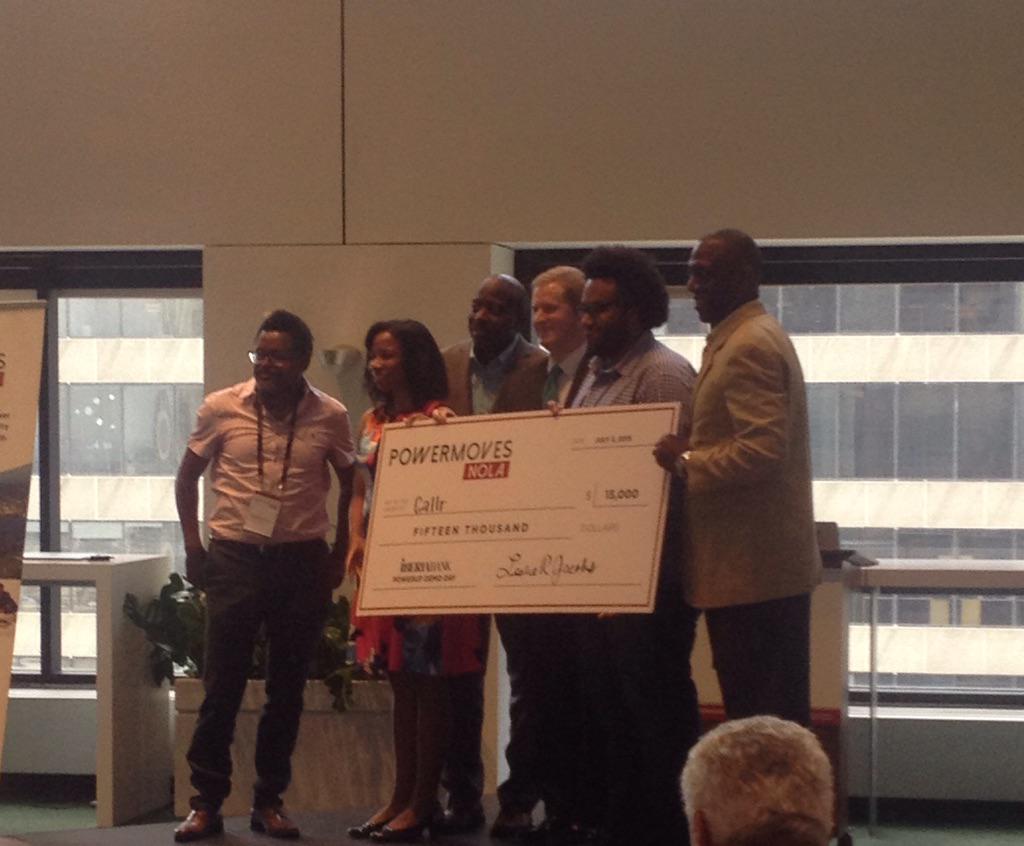
These are the startups that pitched at the PowerUP Demo Day, it was the culmination of the PowerUpBootcamp, which is part of PowerMovesNOLA programming. PowerUp is administered by PowerMovesNOLA in partnership with Startups Illustrated.

  • BIOEYE – puts a mass spectrometer in your smartphone.
  • Black&Sexy.TV – building the “Netflix + HBO” for the global black diaspora.
  • BrandSlip – a marketplace for social media stars to connect, collaborate, succeed and make money.
  • Callr – AI for connecting to every conference call you ever have to participate in, never dial into a conference call again. Ever. Techcrunch wrote about Callr.
  • Drivio – makes it less of a hassle for you to pay fines, and makes it easier for the government to collect fines.
  • HealthFundIt – improving the world’s collective health by connecting the people most passionate about a health condition with the scientists studying it so that people can directly support medical research in which they have a vested interest.
  • InstaSneaks – a social marketplace for the $100B+ street wear market. It enables peer-to-peer and business-to-consumer transactions.
  • Sandbox.io by Keystoke – build an ecommerce store on the web, then create a mobile version of your ecommerce store in about 10 minutes. Pay nothing, unless you actually sell stuff through the mobile app.
  • Legasyst – make interacting with the legal system as easy and seamless as using a mobile app.
  • NetworkingOut – a social networking platform that acts as a virtual athletic club for professionals.
  • Nomsy – food curation and discovery, to enable people with food allergies easily find food that suits them while on the go.
  • Paver – helps restaurants create, manage, and track their specials.
  • PracticeGigs – enables people to discover players and schedule practice sessions through a mobile social network. Initially focused on tennis in the Boston area.
  • ProSquire – a platform that enables small law firms to operate as if they have the infrastructure of their much larger peers.
  • RawShorts – a DIY builder for explainer videos, no need for a studio. If you know how to use powerpoint you know how to use RawShorts.
  • Revitalize Charging Solutions – is building a network of charging stations for electric vehicles. The charging stations also act as an advertising platform. Pilots underway with cities in Texas.
  • Roho – a media company that curates and distributes religious content. The initial product is focused on sermons for Black-American Christians.
  • RxCUE – enables patient savings through electronic medical rebates.
  • Solace – a seamless search and customization experience for home decor, initially focused on bedding, pillows, tapestries etc.
  • The Dime – makes local buying, selling, and promotion safer and more interactive with unedited video ads.
  • WedOcracy – a social wedding planning platform built by an engaged couple while they were planning their own wedding. The wedding hub of the future, today.

View image on Twitter
View image on Twitter

I spent some time chatting with Nichelle McCall, founder and ceo of BOLD Guidance. We first met at FOCUS100 in NYC, but never had a chance to chat at any length. So it was great to hear about what she’s trying to accomplish over the next 12 months. She’ll be fundraising soon. I wolfed down some lunch, and I am sure a few people must have thought I was scarfing down the food like there’s no tomorrow. I tend to eat very fast . . . I’d rather not waste time eating. I went back to the hotel and checked out. Then we headed to the Center Stage at the Ernest N. Memorial Convention Center for the #BigBreak Power Pitch – I arrived just as Dawn from Flat Out of Heels was wrapping up. These are the contestants.

  • Flat Out of Heels, LLC is the creator of the Flat Out rollable flat and the Flat Out shoe vending machine. Their rollable flats can be discretely carried for emergencies or worn all stay for stylish, durable comfort. Flat Out of Heels rollable flats are the solution to stiletto sore feet. Placed in venues like airports, nightclubs, malls, and hotels, where many women are wearing heels, the vending machines make it convenient to get emergency shoes when needed.
  • GemPhones is a fashion focused, jewelry inspired electronic accessory company that provides the most beautiful product designs in the consumer electronic industry. Every aspect of its product design is dual purpose, providing the look of a necklace and function for the usability of the device.
  • SmartCoos helps young children take advantage of their first 2,000 days and learn Mandarin, Spanish, French or English through 1:1 language sessions with a native speaker, e-books, and text nudges. Its product provides children with four critical web-based tools to learn Mandarin, Spanish, French, or English. Each child follows a tailored language curriculum based on the child’s age (0-2; 3-5; 6-8) in order to effectively use, coach, and reinforce the second language. Each child 1) Interacts with a native speaker on a weekly basis 2) Is provided with quality read-aloud eBooks 3) Learns the 200 most common words with baby sign language (“BSL”) 4) Are given daily text nudges, which increase the use of the language.
  • FashionTEQ manufactures a collection of smart jewelry for women. Its first product, Zazzi, keeps the user connected to her smartphone all day by notifying her of incoming texts, calls, emails, and more in a discreet and private display attached to a bracelet, pendant, or ring. The display provides imagery that lets the user know exactly what the notification is without having to access her phone.

I ran into Dawn Dickson, founder and ceo of Flat Out of Heels at the hotel when we went back to pick up our bags enroute to the airport. It was great to run into her since I had previously corresponded with her by email about a year ago through AngelList. We got to chat for about 10 minutes or so.

With Dawn Dickinson, ceo and founder of Flat Out of Heels, at the Hyatt Regency in NOLA after she won the #PowerMoves #BigBreak Pitch at #EssenceFest. Image Credit: Tasha Kersey Aoaeh

With Dawn Dickinson, ceo and founder of Flat Out of Heels, at the Hyatt Regency in NOLA after she won the #PowerMoves #BigBreak Pitch at #EssenceFest. Image Credit: Tasha Kersey Aoaeh

To close, for every founder who was at #PowerMoves.NOLA  and any founder who was not there, but wishes they could have been . . . This is one of the songs I listen to when I need to refuel my spirits after encountering obstacles that would otherwise knock me off my stride.


  1. Source: PowerMoves.NOLA website. Accessed on Jul 5, 2015. Slightly edited.

  2. Source: PowerMoves.NOLA website. Accessed on Jul 5, 2015. Slightly edited.

  3. Source: PowerMoves.NOLA website. Accessed on Jul 5, 2015. Slightly edited.

Fatoumata BA Is Now Managing Director of Jumia Nigeria

0

AIG-backed online store Jumia Côte d’Ivoire today formalized the appointment of Francis Dufay as the head of its subsidiary in Ivory Coast.

According to the firm in a statement, this appointment marks a new phase of growth for JUMIA Côte d’Ivoire.

The firm aims to launch new branches inside the country, increase its inventory and launch a marketplace for local distributors.

“Everything we do has one goal: Always improve our service and satisfy our customers. It is the only way JUMIA will gain the confidence of the population and strengthen its position as the leading e-commerce destination in Côte d’Ivoire”, said Francis DUFAY after the official announcement of his appointment.

His co-MD Fatoumata BA with has been appointed Managing Director at JUMIA Nigeria. The two began in April 2014 as Co-Managing Directors Jumia Ivory Coast.

Francis DUFAY will be responsible for driving the expansion Jumia Côte d’Ivoire and grow and position JUMIA as a major player in retail in the country.

DUFAY has worked for consulting firm McKinsey & Company and holds a Master of Science from HEC Paris management school, a Master in Management of Cologne University and, an MBA from the Northwestern University – Kellogg School of Management.

Jumia Had $32M Loses in 2014, Revenue was $28M

0

People, be ready for the long-haul if you are going into the e-commerce sector. It demands a lot of efforts and money. You need to build logistics and become your own Post Office. Unlike in America, where there are postal systems, in Africa, you need to build your own.


So, these e-commerce companies are not making money. They are there because they have war-chest of tons of cash to burn. Never think you can do same unless you have a big-time backer. You need millions of dollars.


Tekedia predicts that it will take at least five years for these e-commerce companies like Konga and Jumia to break even. Shipping a book of N2,000 ($10) across Lagos on motorbikes will need many miracles to be profitable.


According to a great piece in Fortune, Jumia is burning cash.


Given the nascence of Nigeria’s tech sector, it’s hard to say which company is dominating. For online traffic, Jumia ranks sixth and Konga seventh in a list of top-visited Nigerian sites. Konga has yet to release financials but claims revenues grew 450 percent in 2014. Per Rocket Internet’s 2014 public listing, Jumia had $28 million in net revenues, with $32 million in losses.


Now you know the strategy. It is market share and not profitable. This is not a website business. This is a logistics business.  You need cash to participate!

Question Everything; My Remarks At FOCUS100 2014

0

Background: I gave these remarks at Digital Undivided’s FOCUS100 2014 Conference which was held between October 3rd and October 4th in New York City. A number of investors were invited to explain to the audience how they ought to pitch venture capitalists in order to win funding. Digital Undivided is a social enterprise that develops programs that increase the active participation of urban communities in technology. It has a particular focus on women.1

I am not very good at listening to what other people tell me to do, so rather than outline what I think you should do in order to get funded by a venture capitalist, I thought I should instead share with you some of my beliefs about founders, and startups, and how I think about my responsibilities as an early stage investor. I hope in doing so you will question some of the assumptions you hold about how you should go about raising capital.

  1. The kind of founder that really excites me does not need a venture capitalist. She simply needs some capital to enable her build her vision and transform the world. My job is to give that founder sufficient reason to decide that she wants to undertake that journey with KEC Ventures as a companion.
  2. To get past the first meeting, a founder has to inspire confidence. She has to make me want to follow her over the edge of a cliff, or into a burning building. She has to make me feel I could trust her with my life because come hell or high water, she’s going to figure things out. She’s smart, hard working, can process an enormous amount of unfamiliar information and take action based on what she’s learned, she knows or can learn how to build and lead a team that’s going to do something ambitious. She might be an introvert, or an extrovert. She gets me to buy into her vision of how things should be, and how she will use technology to accomplish that. She wants to win, and she knows how to win. I do not believe in “pattern matching” in the way some well known investors have described it. I don’t pattern match people. That’s an intellectually lazy approach to picking investments. Instead I pay attention to ideas, problems, and the characteristics of successful businesses. Meeting and investing in startups led by founders with a vision to make the world a better place is what makes me eager to wake up each morning and endure the cognitive dissonance that is a daily and ever present aspect of my job as an early stage investor.
  3. I do not believe in founders who lack the intellectual and emotional fortitude to debate and argue honestly about what is best for the startup with their investors and with others who might have opinions about what they should do. I believe that the best decisions are made when one can debate issues with one’s self, and when founders and investors can engage in healthy, critical and honest debates with one another and subsequently reflect and contemplate on everything they have learned through that process. I get frightened by founders who cheerily agree with everything investors say. If the founder is indeed creating something new, or solving a widely-overlooked problem, there’s no way the average investor has considerable experience and expertise in that area – by definition the founder is “the expert”. I expect the entrepreneur to know far more than the average investor about what will work, what will not work, and why. Cheery agreement with everything an “ignorant” investor suggests acts as a red flag to me that perhaps this founder does not understand the problem she is solving, or her market, as well as is required to do what she says she wants to accomplish.
  4. My primary responsibility to investors in KEC Ventures is to be skeptical; Skeptical about myself, and what I think I know, and skeptical about the founders I meet and the claims they make. This is the only way I can minimize the chance that I pass on an idea that seems inconsequential at the outset, but goes on to form the basis for a transformative business. I hope another consequence of my skepticism is that I also minimize the probability that I am too eager to invest in startups that fail because they are built on ideas that are obvious. (Note: I also need to be optimistic.)
  5. Most startups fail. Let me rephrase that, the overwhelming majority of startups fail. My only task is to find those that will succeed before they become well known by other people. Further, we should not invest in a startup unless we believe that our investment in that startup can return our entire fund. One founder at the conference suggested he could “guarantee” a 10x return if KEC Ventures would invest $250,000 in his seed round. That would be great, if we were investing from a $2,500,000 fund.
  6. The type of startup I want to invest in is a very specific thing; it is a temporary organization that has been created to search for a profitable, repeatable, and scalable business model while it solves a problem that has been overlooked in a certain market. It is designed for fast growth once that solution is developed and the business model has been found, and if it succeeds it completely transforms and overwhelmingly dominates the market in which it operates before it moves into adjacent markets.2
  7. Accepting the definition of a startup that I use as my guide, there are certain things that I listen for when I am speaking with a founder. Collectively, they are described as “Economic Moats” . . . Intellectual Property, Network Effects, Efficient Scale, Switching Costs and Branding. Even if these do not exist at the very outset, it has to be clear that they can be designed into the startup’s business model as it matures and that the founder has already been thinking about them. Also, I am not interested in situations where only 1 of those sources of an economic moat is present. I prefer 3 at a minimum, all 5 ideally. The durability of a moat is a something I worry about. Also, how wide or narrow that moat can be made is something I think about constantly. Essentially, I want to avoid the detrimental effects of competition.
  8. A venture capitalist does not provide capital to people who need it. A venture capitalist has a fiduciary responsibility to make the best effort possible to generate a positive return for investors in the fund.

  1. I have edited it by adding comments based on questions people at the conference asked me after I had spoken, mainly adding a little more context. ?
  2. This definition is a composite that combines elements from definitions other investors have used. It is primarily derived from a definition that Steve Blank and Bob Dorf use in The Startup Owner’s Manual. ?

Revisiting What I Know About Network Effects & Startups

0

‘One IPO that is probably worth the hype.’ – Chris Beauchamp on the #AlibabaIPO with @kerushton in the Telegraph. http://www.telegraph.co.uk/finance/newsbysector/retailandconsumer/11066048/Alibaba-on-course-for-record-flotation.html 

Alibaba on course for record flotation

Chinese shopping giant gears up for IPO next month by revealing it made profits of £1.3bn in the last quarter

telegraph.co.uk

The recently announced IPO of Alibaba got me thinking last week about network effects1 – what they are, how they develop and evolve, and how network effects can help or hurt a startup.2

That is something I think about a lot, practically every day. In other words each time I am sitting across from a founder listening to that founders’ explanation of a startup’s market, the problem it is solving, and its business model, I am also thinking about the economic moats it might build around itself in order to sustainably fend off competition. One way it might do that is through network effects.

To ensure we are on the same page, let’s start with some definitions. In the rest of this discussion I am primarily focused on early stage technology startups.

Definition #1: What is a startup? A startup is a temporary organization built to search for the solution to a problem, and in the process to find a repeatable, scalable and profitable business model that is designed for incredibly fast growth. The defining characteristic of a startup is that of experimentation – in order to have a chance of survival every startup has to be good at performing the experiments that are necessary for the discovery of a successful business model.3 As an investor, I hope that each early stage startup in which I have made an investment matures into a company.

Definition #2: What is an economic moat? An economic moat is a structural barrier that protects a company from competition.4 In my case, when I am studying a startup, I am interested in the economic moats that will enable the startup to mature into a great business, and hence a great company – one that can keep competition at bay while earning great returns for its investors. Morningstar identifies 5 moat sources; Intangibles, Cost Advantage, Switching Costs, Network Effect, and Efficient Scale.

Definition #3: What is a network? Any group or system of interconnected people or things. Think; my nuclear family is a network to which I belong. My extended family is a larger network which includes my nuclear family, as well as the nuclear families of each of my relatives. A small business exists in a network that is comprised of its customers, its suppliers, its competitors, its regulators, and so on and so forth. A large network might be formed by a collection of smaller networks.5

Definition #4: What is a Network Effect? A network effect occurs when the value of a good or service increases for both new and existing users as more customers use that good or service.6The network effect is a virtuous cycle that allows strong companies to become even stronger.7Network effects are also known as direct-benefit effects. I think direct-benefit effects makes it easier to remember why network effects can be such a powerful economic moat.

How do network effects develop? Direct-benefit effects develop and become stronger in settings where some form of interaction, or compatibility with others is important.8 In other words, the number of other people using the technology has a direct impact on how valuable that technology is to each individual user. Direct-benefit effects contribute to the strengthening of an economic moat only in so far as they directly contribute to increasing positive externalities for the members of the network. What is an externality? It is “any situation in which the welfare of an individual is affected by the actions of other individuals, without a mutually agreed-upon compensation.”9 One can have positive or negative externalities. A positive externality occurs when individual and aggregate welfare increases with the addition of more users to the network. A negative externality occurs when welfare decreases with the addition of more users.10Network effects evolve positively for a startup if the members or users of the network derive both inherent value and network value from their use of the product. Inherent value is value that an individual user derives because of that individual user’s consumption of the product or service. For example, even if I were in a network compromising only me, I would derive inherent value from owning one copy of MS Office running on Windows because I could now more easily do word-processing using MS Word or analyze quantitative data using MS Excel. I derive network value from MS Office and Windows because if other people buy and use those products, it becomes easier for me to share my work with them and for them to share their work with me. I derive network value from being able to collaborate with every other person who also uses MS Office and Windows.

Types of Direct-benefit Effects: To fully parse through how a startup I am studying might build an economic moat based on network effects I need to be able to understand the subtle nuances that differentiate one type of network effect from another.11

  1. Direct network effects or one-sided network effects occur when increased usage leads explicitly to increased welfare for the members of the network. Think fax machines, telephones, messaging apps.
  2. Indirect network effects occur when the proliferation of network members leads to the proliferation of complementary goods and services such that the welfare of the network’s members increases significantly. Think iOS, Android, smartphones and apps.
  3.  Two-sided network effects are distinct from indirect network effects. A two sided network effect occurs when an increase in usage of the product by one group of network members increases the welfare of a separate and distinct group of other members of the same network. Think marketplaces, platforms that combine hardware and software, and software pairings in which there’s a reader and writer.
  4. Local network effects occur when an individual network member’s welfare increases not because of an increase in the overall network user base, but as a result of growth in the users within a  localized subset of the network’s membership. Think; as a user of Whatsapp, my welfare increases when more people in my cellphone’s contact list join the Whatsapp network. So, while I think it’s great that Whatsapp has 500 Million users, my welfare has no positive correlation to the size of  Whatsapp’s network. However, it does have a positive correlation with how many of my friends, family, colleagues, social and professional acquaintances become members of the Whatsapp network.

This diagram by Ray Stern conveys the power of positive network effects, and the corollary – negative network effects can help erode the competitive position an incumbent occupies.12

The Power of Network Effects (Image Credit: Ray Stern, former CMO of Intuit)

The Power of Network Effects (Image Credit: Ray Stern, former CMO of Intuit)

How might a startup start to experience negative network effects? One of the most exciting things about the Internet is that it has lowered the barriers to competitors entering a space in which they perceive an opportunity to earn economic profits. That is great if I invest in a startup that is earning such profits, but not so great if events unfold such that other startups can launch a credible attack in order to win business away from the startup in which I am an investor.

  1. Lock-in or switching costs occur when a member of one network cannot switch from that network to another without suffering substantial costs. The switching costs could be monetary and non-monetary. Often, the non-monetary switching costs far outweigh the monetary costs. Non-monetary costs might include the loss of massive amounts of information and data, business process disruptions, and so on and so forth. Antitrust regulators do not like to see situations in which such costs bar new competitors from entering a market and create a monopoly for an incumbent – IBM, Microsoft and Apple have all faced antitrust action. Switching costs can also exist in physical goods industries, for example razors and blades, and also printers and printer-cartridges. Switching costs are not an issue as long as users perceive that they derive more value from being within the network than the inconvenience they suffer as a result of lock-in or switching costs.
  2. Network congestion occurs when the experience of each member of the network deteriorates as the network’s membership grows. In other words the network becomes less efficient from the users’ perspective. As a result of this each member of the network derives decreasing inherent and network value from the network. Think; A website, web or mobile app that is consistently unavailable because too many people are trying to access it simultaneously.
  3. Conflicts of interest occur when a network operator behaves in ways that limit or restrict the ability of network members to freely form sub-networks. According to David Reed:13

But many kinds of value are created within networks. While many kinds of value grow proportionally to network size and some grow proportionally to the square of network size, I’ve discovered that some network structures create total value that can scale even faster than that. Networks that support the construction of communicating groups create value that scales exponentially with network size, i.e. much more rapidly than Metcalfe’s square law. I will call such networks Group-Forming Networks, or GFNs.

That observation might be used to explain the demise of Friendster and Myspace in the face of competition from Facebook. It has also been used to predict the success of Ebay during a time when Yahoo was the most dominant web-portal.14

What exactly do I mean by conflicts of interest? I love to buy books from Amazon. To save money, I prefer to buy used books if that is at all possible. Amazon has allowed independent merchants to market their goods in its marketplace. many of these merchants sell used books at substantial discounts to the price of a new book offered by Amazon. Let us assume that each time I wanted to make a purchase Amazon compelled me to purchase its own offering of that item, or pay a penalty if I insisted on making the purchase from one of its independent sellers. What effect do you think that might have on my behavior? What effect might that have on the behavior of the independent sellers? What if an Amazon competitor did not impose that penalty? How might that shift the competitive landscape? That is a relatively simple example. It should illustrate the point. When the operator of a network platform starts to compete with its platform partners it is engaging in behavior that will lead to the destruction of the network.

What strategies should a startup that’s competing in a market in which network effects matter employ in order to win? There are a number of strategies that might be employed15 independently or in combination with one another by competitors seeking to compete effectively against a rival, or by market leaders seeking to maintain that position.

  1. First mover adoption matters – a lead of a few months can be the difference between winning the market and losing it.
  2. It can pay to subsidize adoption – in order to seed the network it might be worth it to subsidize adoption by providing an in-network benefit of some sort. Dropbox offers free storage to new users, and members who help it acquire new users also get rewarded with free extra storage. However, it is important to strike a balance between subsidizing adoption and maintaining a tight control on costs. Ideally, the marginal cost of subsidizing adoption should be far far less than the marginal benefit of acquiring a new network member.
  3. Viral marketing matters – the success of mobile and web products that benefit from network effects can be greatly enhanced by encouraging viral promotion through social networks like Facebook, Twitter, Pinterest, Instagram, Snapchat, etc etc.
  4. Redefine the market – this has the benefit of bringing in more users who might previously have been inaccessible. It also makes it possible to develop a product or service that envelopes several distinct markets into one. Think; smart phones becoming capable of performing the functions of a media player, a camera, an email editor, an internet browser, a gaming device, a phone, a medical diagnostic tool, a fitness tracker, a notebook, an alarm clock, a GPS navigation system etc. etc.
  5. Form alliances and partnerships – when competing with a powerful incumbent this might make it easier to gain a toehold from which the competitor can then launch an entry into the market. Think; Google’s Android strategy at a time when it appeared Apple’s iOS was an unstoppable force in the smartphone market.
  6. Leverage distribution channels – to pry an opening into a market think of non-obvious ways by which a distribution channel might be created. A popular approach is to bundle a new product with an existing product from the same provider.
  7. Seed the market – one way to do this is to subsidize adoption by making room in the budget for a financial outlay specifically geared towards acquiring new users. For example, a messaging app might pay people in a foreign country to download the app and start using it in hopes that enough of them fall in love with the app and tell their friends about it. Another strategy related to this is to give away product to one group of network participants.
  8. Encourage the development of complementary goods – this is now a widely used strategy through the publication of SDKs and APIs to encourage the development of complementary products and services.
  9. Leverage backward compatibility – to do the opposite would be foolish since that would mean that at the beginning of each upgrade cycle the incumbent has no advantage over a new entrant competitor.
  10. Build-in compatibility with the market leader – this changes users’ options from one in which they have an “either-or” decision to make to one in which they have an “and” decision to make. Who does not like “and”? Every new entrant rival should consider this. For example new social networks ought to build seamless integration with Twitter, Facebook and other leading social networks into the product from the very outset.
  11. Close-off access to new entrants and existing rivals and innovate constantly – this makes it nearly impossible for rivals to steal away business from the incumbent leader in the market.
  12. Pre-announcements – from a large, well known, and well liked producer of a product or service can have the effect of slowing down the adoption of a rival’s competing offering. Some people might want to wait till they can compare the options more directly against one another. Think; when one of Apple’s competitors quickly schedules its product announcement to precede a major product announcement by Apple, but only after after Apple announces an event at which it will discuss a new line of products. The extreme case is when a rival rushes to announce and release its product prior to Apple’s product release date once Apple makes an announcement. 

Understanding networks effects and how they unfold for an early stage startup is critical. Markets in which such effects are present are often characterised by fierce competition and a bandwagon effect tends to take hold thanks to positive-feedback loops. Also, the nature of these markets is that a winner can emerge in remarkably short order and that winner typically garners a commanding market share lead over its competitors. Furthermore, once a winner has been established it is extremely difficult for competitors to win users away from it.

Further Reading

  1. Platform Power – A free book by Sangeet Choudary,  available for download at Platform Thinking Lab’s website.
  2. The Power of Network Effects: Why They Make Such Valuable Companies, and How To Harness Them – blog post by Eric Jorgenson
  3. Exponential Organizations: Why new organizations are ten times better, faster, and cheaper than yours (and what to do about it) – by Salim Ismail, Michael S. malone, and Yuri van Geest

  1. Any errors in appropriately citing my sources are entirely mine. Let me know what you object to, and how I might fix the problem. Any data in this post is only as reliable as the sources from which I obtained them.
  2. You can find Alibaba’s SEC Form F-1 here. Accessed online; Sept. 12, 2014.
  3. I am paraphrasing Steve Blank and Bob Dorf, and the definition they provide in their book The Startup Owner’s Manual: The Step-by-Step Guide for Building a Great Company. I have modified their definition with an element from a discussion in which Paul Graham, founder of Y Combinator discusses the startups that Y Combinator supports.
  4. Heather Brilliant, Elizabeth Collins, et al. Why Moats Matter: The Morningstar Approach to Stock Investing. Wiley. Hoboken, NJ. 2014; p. 1
  5. I know this seems obvious. However, I was having a discussion via email with Kate Bradley Chernis while writing this. She and her co-founders are building a product to empower SMB’s manage their marketing campaigns. When I told her the topic of this blog post she stated that she finds that many SMB owners have no understanding of the networks that they belong to, or how they can use their networks to enhance their business. I added this definition after that exchange.
  6. Network effect is often colloquially referred to as network externality. However, the two are not precisely the same.
  7. Ibid; p. 27
  8. David Easley and Jon Kleinberg. Networks, Crowds, and Markets: Reasoning About a Highly Connected World. Cambridge University Press, June 10, 2010 draft version. P. 509. Accessed online on Sept. 12, 2014.
  9. Ibid.
  10. As an example, think of a website or app that starts to crash and become inaccessible due to capacity constraints as the number of users increases dramatically.
  11. This is based on the work of Prof. Arun Sundararajan. Accessed at http://oz.stern.nyu.edu/io/network.html on Sept. 12, 2014.
  12. Eric Jorgenson, The Power of Network Effects: Why They Make Such Valuable Companies, and How To Harness Them. Accessed on Jun 27, 2015 at https://medium.com/evergreen-business-weekly/the-power-of-network-effects-why-they-make-such-valuable-companies-and-how-to-harness-them-5d3fbc3659f8
  13. David Reed. That Sneaky Exponential – Beyond Metcalfe’s Law to the Power of Community Building. Context Magazine. Accessed at http://web.archive.org/web/20080526050751/http://www.contextmag.com/setFrameRedirect.asp?src=/archives/199903/digitalstrategy.asp on Sept. 12, 2014.
  14. David Reed. Weapon of Math Destruction: A Simple Formula Explains Why The Internet is Wreaking Havoc on Business Models. Context Magazine. Accessed at http://web.archive.org/web/20080526050751/http://www.contextmag.com/setFrameRedirect.asp?src=/archives/199903/digitalstrategy.asp on Sept. 12, 2014.
  15. Based on Prof. John M. Gallaugher’s Understanding Network Effects. Accessed at http://www.gallaugher.com/Network%20Effects%20Chapter.pdf on Sept. 12, 2014.