DD
MM
YYYY

PAGES

DD
MM
YYYY

spot_img

PAGES

Home Blog Page 7584

The future of cybersecurity education in Nigeria and entire Africa

0

With the advent of dangerous malicious codes like Flame and Stuxnet, it has become evident that cybersecurity poses existential threats to institutions if not properly managed. As the risks of traditional wars abate, Internet has since evolved as the 21st century battleground where malware, not rockets, can be used to launch attacks on infrastructures like power, telecoms, capital market and financial institutions. Also, through espionage and hacking, organized crimes by nations, corporate institutions and individuals can steal vital intellectual properties (IPs) that drive innovations in any economy.

When a country or an organization loses its competitive advantage, its market-winning capability will be weakened. Besides the malwares and worms, there is also the human element which poses risks to intellectual properties and business trade secrets owing to the ease to move digital wares. Our training programs are designed to equip learners with 21st century cybersecurity and digital forensics skills that will help them advance their careers and master major ways to Prepare, Detect, Defend, Defeat, and Harden their organizations’ critical digital and information assets.

Cybersecurity is not a game of choice – it is the new normal. Unlike in the past, modern hackers are coordinated, well-funded and operate like corporations. The Central Bank of Nigeria has noted that Nigerian financial institutions are losing millions of dollars to cybersecurity related frauds and threats. The 21st century will be a century of cyber warfare and will require strategic readiness for organizations. These institutions have to plan beyond dependence on state institutions for cybersecurity protections. Across Nigeria, the level of that preparation to secure and protect assets like power systems, telecoms, financial infrastructures, water systems, and more are still evolving.

Furthermore, the world has nuclear non- proliferation treaty, but none exists for cyberwar despite the potential economic dangers the latter poses to world commerce. Accordingly, many nations have started to deploy strategic commands to protect, defend and necessarily retaliate when their systems are attacked through cyber-means. The United States Pentagon has the Cyber Command inside the National Security Agency, the British has a similar unit inside the GCHQ. China, Iran, Russia, Israel, and many other nations have developed cyber-army to protect their economies. Our programs are designed to also help develop cybersecurity manpower for state institutions and governments. These institutions could be law enforcements, military, and industry regulators.

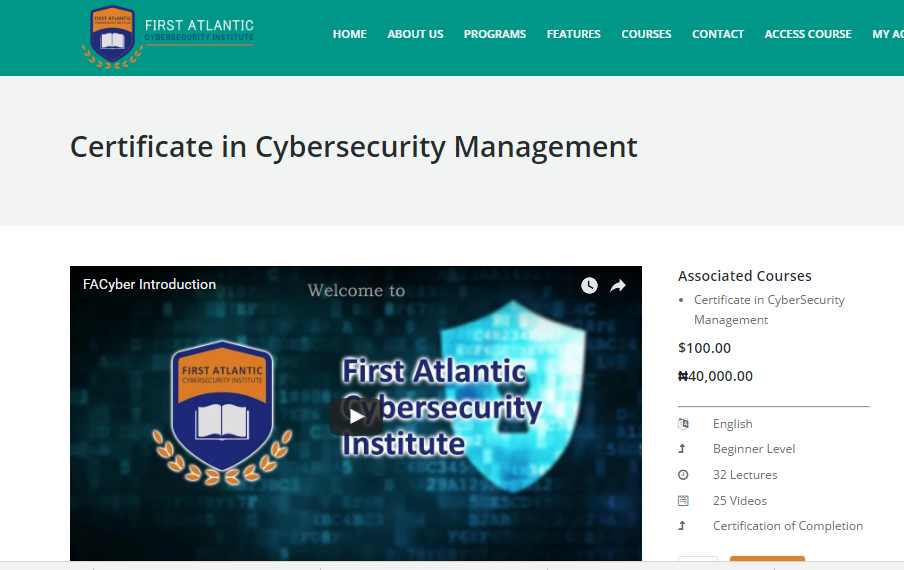
Our Firm, First Atlantic Cybersecurity Institute, works with organizations to deepen their internal cybersecurity and digital forensics capabilities by training their workforce. We also provide cybersecurity research and consultancy. Our programs cut across Cybersecurity Policy, Cybersecurity Management, Cybersecurity Technology and Cybersecurity Intelligence / Digital Forensics structured along Certificate, Diploma and Nanodegree programs. We have operated via Milioncs Analytics, an IBM PartnerWorld, and worked for government agencies like National Identity Management Commission (NIMC) and Nigerian Electricity Regulatory Commission (NERC) in addition to banks and insurance companies. Recently, we unveiled a portal (www.facyber.com) dedicated to cybersecurity/digital forensics education and training.
 

The promise of ICT in Nigeria and the challenges of cybersecurity

0

ICT is facilitating the process of socio-economic development of nations. It has offered new ways of exchanging information, and transacting businesses, efficiently and cheaply. It has also changed the dynamic natures of financial, entertainment and communication industries and provided better means of using the human and institutional capabilities of countries in both the public and private sectors. Increasingly, ICT is rapidly moving nations towards knowledge-based economic structures and information societies, comprising networks of individuals, firms and nations that are linked electronically and in interdependent relationships. As economic systems go digital, the risks posed by unsecured weakest links in financial systems at host, intermediary and client levels will become prominent.

Through digital combats in Estonia and Ukraine, it has been established that cyber-threats are not games of choice. As internet penetration continues to advance globally, so are the perils that come with the increased degree of digital connectivity. However, most organizations lack both proper security plans and trained in-house staff to counter or quickly recover from cyber attacks.

This is why a new startup, Facyber, is working to help provid the platform to train and equip Nigerians on cybersecurity. The goals of Facyber programs are to:

  • Develop business and government leaders with competence to create and manage effective cybersecurity practices
  • Understand and solve the evolving cybersecurity risks, equipping learners with cutting-edge skills in a fledgling industry even as nations/firms move into electronic societies with associated digital risks
  • Prepare learners to master ways to Prepare, Detect, Defend, Defeat, and Harden their critical information infrastructure
  • Prepare learners to have ability to develop national and enterprise cybersecurity policy, strategy and governance frameworks
  • Make excellent cybersecurity managers and policymakers across core areas of cybersecurity and digital forensics

Our course presents basic and advanced concepts in cybersecurity, forensics and digital security management. Topics cover cybersecurity technology, cyber policy, digital forensics, information assurance, cyber investigation and malware analysis. Presented with mix of technology, management and policy, the following areas are covered: business continuity management, protocols, OS security, vulnerabilities, architecture, cyber services, algorithms, hardware, software, languages, cyber mechanisms, policy, physical security, malware analysis tools, cyber terrorism, cyber espionage, national security and live labs.

Participants to our programs have included IT leaders, Bankers, Insurers, Lawyers, Engineers, Technologists, CEOs, Military, Law Enforcement, Students, Managers, Policymakers, Compliance Officers, Regulators, and more.

After all Germany does not want Nigerians, see how many the country turned back in 2016

0

It seems Nigerians are fleeing the country as the recession continues to bite.

According to German Federal Police, at least 1,237 Nigerians were stopped from entering Germany between January and November 2016.

The Nigerians were among 19,720 migrants stopped from entering Germany during the period, the Neue Osnabruecker Zeitung (NOZ) reported.

Scores of Nigerians travel out of the country daily illegally seeking greener pastures in Europe, U.S. and Asia.

There will not be any iPhone 8, according to Mac Otakara [See Photos}

0

According to new information from Mac Otakara, the 2017 iPhones could be very disappointing indeed. Citing a “Taiwan supplier”, the site says that instead of the so-called ‘iPhone 8’ Apple will instead follow tradition and simply release an iPhone 7S and iPhone 7S Plus which will be virtually identical to the iPhone 7 and iPhone 7 Plus.

If correct, this would be the fourth successive generation where Apple has stuck with the same design and the move would likely anger fans as iPhone rivals continue to cut down bezel sizes to fit larger displays into physically smaller phones.

This is how the 2017 iPhone will look like.

Concept render of the much rumoured 2017 10th anniversary iPhone 8 alongside iterative iPhone 7S models.

When will Nigeria start fining non-African companies? South Korea fined Qualcomm $853 million

0

Imagine in a country where there is no presence of local companies in manufacturing of the things used by the citizens. And there is no effort by the government to figure out how to make that change.  Maybe we will start fining non-African companies. Yes, beyond MTN. Of course you cannot because they are doing you a favor by being around. Our market is so small that most will neglect it.

Think about this:

South Korea fined Qualcomm $853 million. The country’s anti-trust regulator has accused the chipset designer of imposing unfair licensing fees on mobile device makers using its patents. The company has faced similar hurdles in China and Europe, but South Korea remains an important market—it generates 11% of its sales from Samsung.

The fine, the largest ever levied in South Korea, marks the latest antitrust setback for Qualcomm’s most profitable business of licensing wireless patents to the mobile industry, at a time when the business is facing headwinds from a cooling smartphone market.

Is there no area Nigerian companies are not being victimized under the hands of foreign firms? We make nothing and we are under the powers of these global giants. We need protection just as government protected Dangote Group in cement manufacturing.