Slow coax lines are fading fast in Columbus. Today you can stream a 4 K Braves game, ship multi-gig design files to the cloud, and keep every smart device chatting—all at once—without buffering. Because cable, fiber, and 5 G operators now compete on nearly every block, speeds and prices shift house to house. We sifted FCC availability data, neighborhood speed-tests, and hundreds of local reviews to uncover the seven services that truly deliver gigabit performance—and pinpoint when each one is the smarter pick for you. Use this guide to lock in the fastest, most reliable plan at your address.
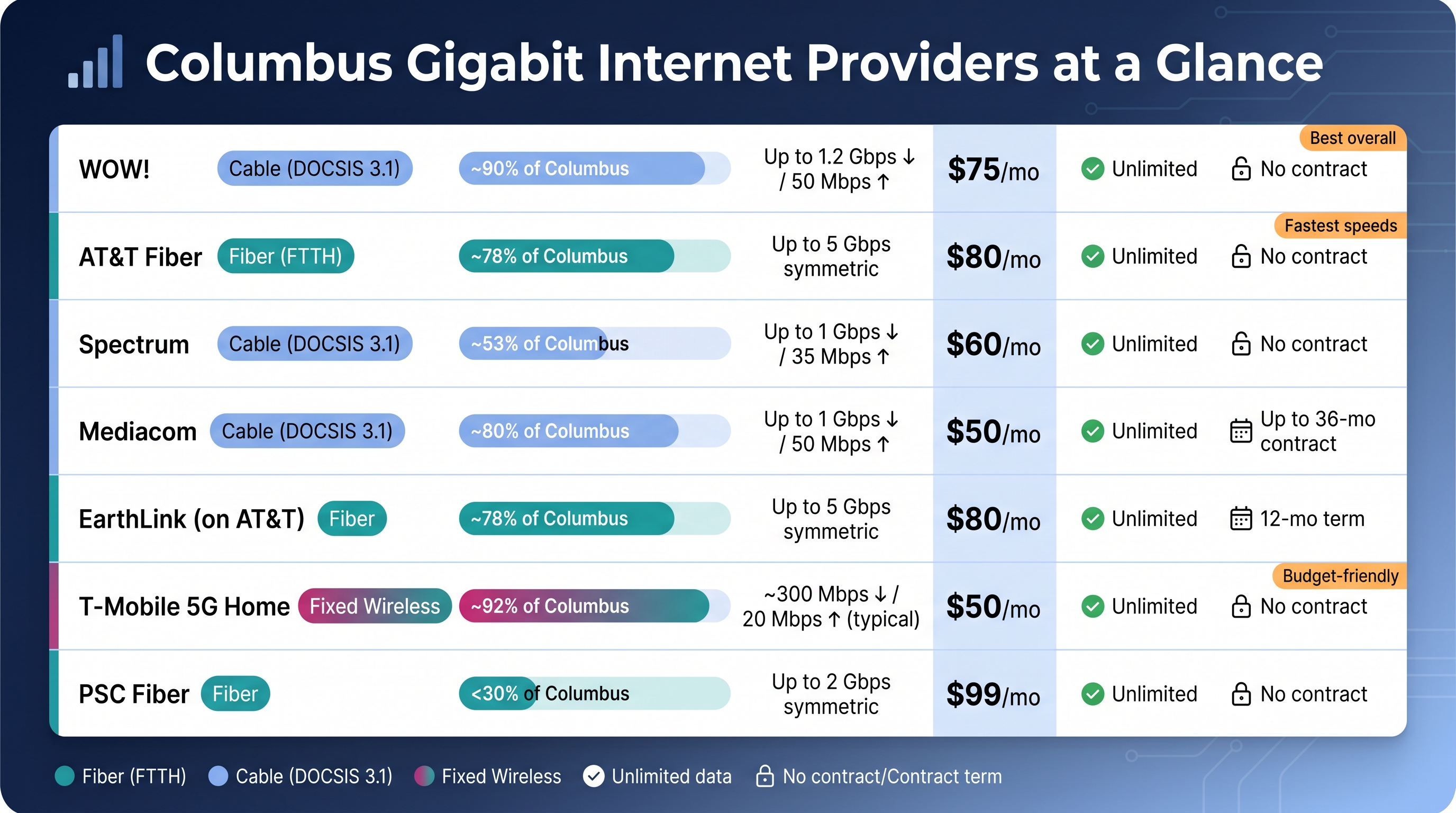
Columbus gigabit at a glance
Before we compare each provider in depth, review the grid below to see how their key metrics align with your priorities.
| Provider |
Connection |
Estimated coverage |
Top advertised speed |
Intro gig price* |
Data policy |
Contract |
| WOW! |
Cable (DOCSIS 3.1) |
~90 percent |
1.2 Gbps ? / 50 Mbps ? |
$75 mo |
Unlimited |
None |
| AT&T Fiber |
Fiber (FTTH) |
~78 percent |
5 Gbps symmetrical |
$80 mo |
Unlimited |
None |
| Spectrum |
Cable (DOCSIS 3.1) |
~53 percent |
1 Gbps ? / 35 Mbps ? |
$60 mo |
Unlimited |
None |
| Mediacom |
Cable (DOCSIS 3.1) |
~80 percent |
1 Gbps ? / 50 Mbps ? |
$50 mo |
Unlimited |
Up to 36 mo |
| EarthLink (on AT&T) |
Fiber |
same as AT&T |
5 Gbps symmetrical |
$80 mo |
Unlimited |
12 mo |
| T-Mobile 5 G Home |
Fixed wireless |
~92 percent |
~300 Mbps ? / 20 Mbps ? (typical) |
$50 mo |
Unlimited |
None |
| PSC Fiber |
Fiber |
<30 percent (selected areas) |
2 Gbps symmetrical |
$99 mo |
Unlimited |
None |
*Intro prices current as of June 2026. Spectrum increases after month 12 and Mediacom after month 36; WOW! offers a lifetime price lock for an extra $5 per month.
Keep this reference handy as we walk through each contender. Subtle differences behind these numbers can change which provider fits your household best.
How we ranked these providers
Raw speed alone can mislead. A line that advertises 1 Gbps but drops out or doubles in price after year one is no bargain.
We created a weighted scorecard based on what Columbus households value most:
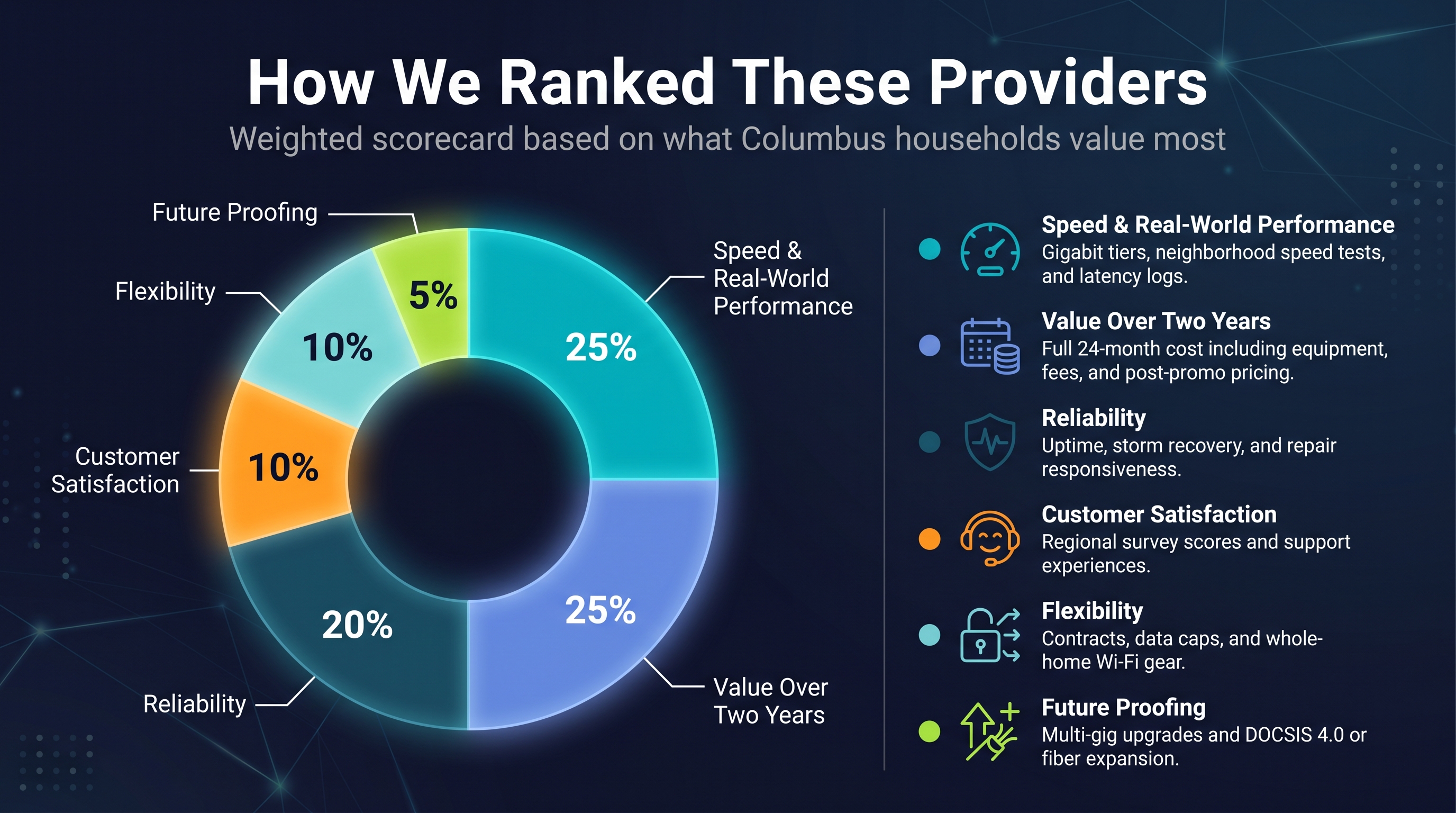
Speed and real-world performance (25 percent) – We confirmed each top tier, then compared it with neighborhood speed-test medians and latency logs. Providers that delivered less than half their promise during prime time lost credit.
Value over two years (25 percent) – We calculated the full twenty-four-month cost, including equipment, install fees, and the day promo pricing expires. A plan only wins when it stays affordable long term.
Reliability (20 percent) – Uptime and storm recovery matter. Fiber starts with an edge, but cable or wireless operators gain points if customer reports show quick repairs.
Customer satisfaction (10 percent) – We referenced the latest J.D. Power South Region scores, which link happier subscribers with fewer billing troubles and faster support.
Flexibility (10 percent) – No-contract terms, unlimited data, and Wi-Fi gear that sustains gigabit speeds throughout the home all push scores higher.
Future proofing (5 percent) – Providers rolling out multi-gig tiers or DOCSIS 4.0 upgrades earn bonus points, signaling their speeds will climb without another construction crew on your lawn.
We fed each data point into the rubric, tallied a composite score, and let the numbers decide the ranking you’ll read next. The outcome is clear and reader focused, not marketing puff.
1. WOW! Internet: best overall for most Columbus homes
Ask ten Columbus neighbors who keeps their Netflix humming and seven will point to WOW!. Coverage is its calling card; the hybrid-fiber coax network reaches roughly nine out of every ten addresses, making it the city’s widest wired footprint.
Speed is consistent, not just claimed. The 1.2 Gbps tier delivers near-gig downloads and sub-20 ms pings during the busy evening window. Uploads top out around 50 Mbps, which still supports steady Zoom calls and fast photo backups.
Billing stays predictable. As shown on WOW!’s Columbus, GA high speed internet page, adding five dollars to the monthly rate secures a lifetime price lock. No twelve-month hike, no retention calls. The modem is included, data stays unlimited, and you may cancel whenever you like.
Quick perks that sweeten the deal:
- Free self-install kits arrive within two days.
- A mobile bundle on Reach Mobile’s network can shave a few dollars from the household budget.
- Local technicians often restore service the same day after summer storms knock lines loose.
Uploads cannot match fiber, but if symmetric speed is not essential, WOW! offers the most balanced mix of reach, reliability, and long-term value for the majority of Columbus households.
2. AT&T Fiber: fastest speeds and symmetric uploads
When raw horsepower counts, fiber wins every speed test. AT&T reaches about seventy-eight percent of Columbus addresses, and the results impress: downloads and uploads both clear 940 Mbps on the entry gig plan, while households that need more can step up to 2 Gbps or 5 Gbps for a predictable increase in cost.
Symmetric design reshapes daily work. Cloud backups finish in minutes, live Twitch streams stay sharp, and large CAD files reach clients before the coffee cools. Gamers enjoy single-digit pings, and remote workers can share a 4 K screen without stutter.
Prices stay transparent. AT&T posts everyday rates—$80 for 1 Gig, $110 for 2 Gig, $180 for 5 Gig—and those figures hold steady. There is no contract, the Wi-Fi 6 gateway ships at no extra cost, and bundling an AT&T mobile unlimited line trims twenty dollars from the fiber bill.
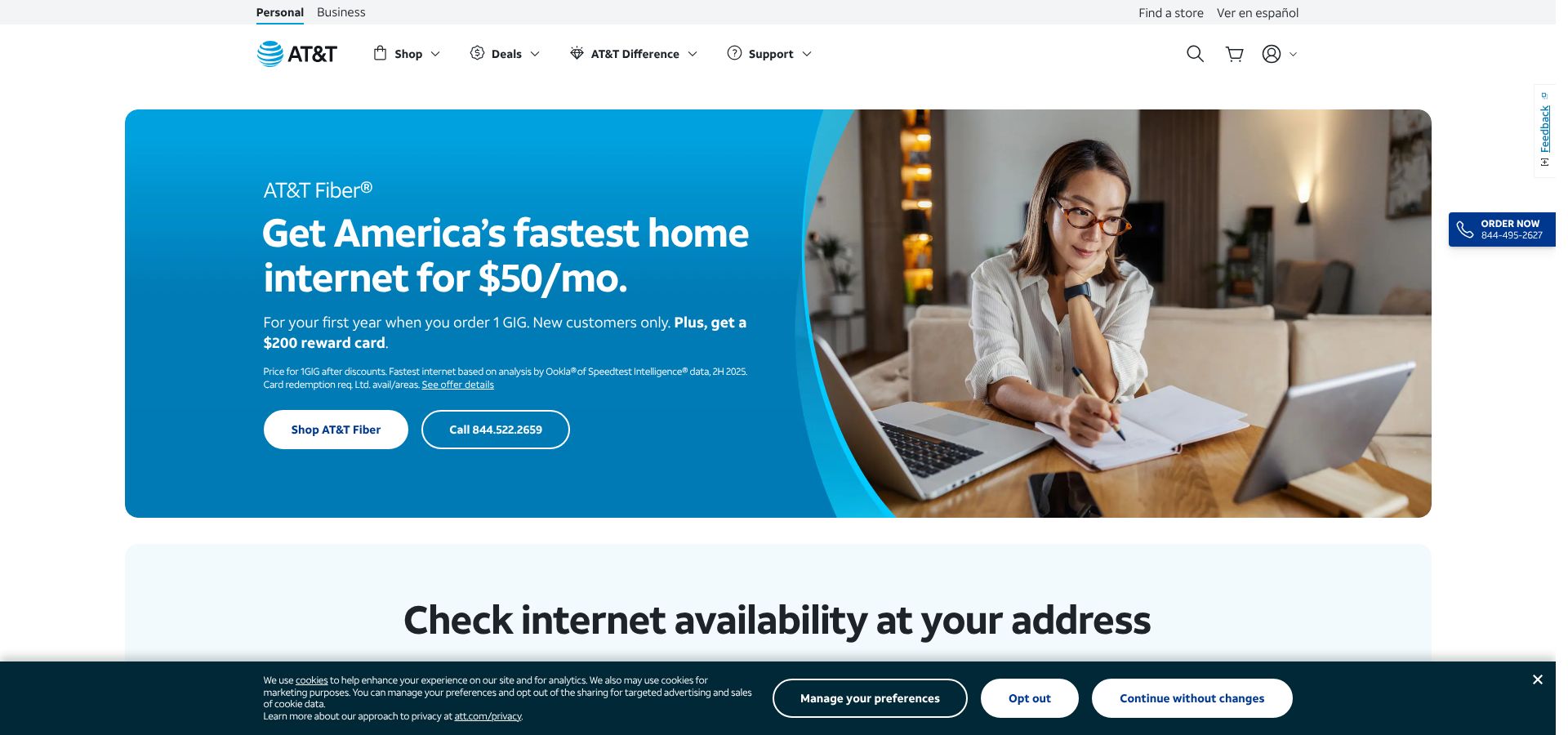
AT&T Fiber multi-gig internet plans and pricing page screenshot.
Reliability is strong. Fiber lines resist neighborhood congestion, and the company cites 99 percent uptime. Independent surveys support that claim with top customer-satisfaction marks across the South.
The only drawback is availability. One street may enjoy blazing fiber while the next still relies on legacy DSL. Build-outs move block by block, so enter your exact address in the checker. When service is live, AT&T Fiber is the clear choice for speed seekers, content creators, or anyone who needs uploads as fast as downloads.
3. Spectrum: unlimited data without the fine print
Spectrum wins fans by keeping things simple. Three speed tiers, zero data caps, and no contract. Pick the level you need, plug in the free modem, and stream without watching a usage meter.
The gig plan advertises 940 Mbps down and about 35 Mbps up. Neighborhood tests often record slightly faster downloads because Spectrum over-provisions bandwidth. Uploads stay cable-class, yet they cover video calls and cloud photo backups for most families.
Intro pricing starts at sixty dollars per month for the gig tier. The rate lasts twelve months, but a quick call to the retention department usually restores your discount. Many Columbus customers have kept the same bill for years with a short annual chat.
Unlimited data is Spectrum’s standout perk. A house full of 4 K screens or large game downloads will not incur overage fees, while some rival cable providers still meter usage.
Coverage reaches about fifty-three percent of Columbus, filling gaps where WOW! or Mediacom never built. Expect service downtown, near Columbus State University, and across several north-side suburbs. If fiber has not reached your street, Spectrum often becomes the straightforward fallback.
Weak spots exist. Uploads trail far behind fiber, and customer-service scores sit in the middle of the pack. Even so, for readers who want simple pricing, unlimited data, and the freedom to cancel at any time, Spectrum is the clear cable alternative.
4. Mediacom: wide reach, watch the calendar
Mediacom spans more ground than any cable operator after WOW!, extending into suburban subdivisions and rural edges where alternatives fade. If you live south of Fort Moore or north of Midland, it is often the only wired gigabit option.
Performance holds steady when the nodes stay quiet. The Xtream Gig plan delivers 1 Gbps down and about 50 Mbps up, enough for several 4 K streams, cloud backups, and large game downloads. Evening congestion can slow things, yet recent DOCSIS 3.1 work has eased the worst dips.
The caveat hides on page two of the offer sheet. The attractive fifty-dollar promo includes a three-year price lock and a contract. In month thirty-seven the bill can jump, sometimes past one hundred ten dollars, unless you renegotiate or downgrade. Data caps were a past concern, but Mediacom has removed them from its main plans, so the gig tier is now truly unlimited.
This model rewards vigilance. Mark your calendar, track usage in the Mediacom app, and you can keep costs predictable. Skip the reminders and the rate hike will hurt.
Customer support is uneven. Local technicians arrive on time and solve issues quickly, yet phone agents may transfer you between departments. Long-time subscribers suggest the text-chat option; those messages reach tier-two specialists who can adjust bills on the spot.
Choose Mediacom when it is the fastest line at your address and you are willing to manage the promo cycle. Set alerts for month eleven and you can enjoy gigabit speeds without an unwelcome surprise.
5. EarthLink Fiber: concierge service on AT&T’s lines
EarthLink rides the same fiber cables as AT&T, so speeds match the host network: 1 Gbps up and down, with 2 Gbps and 5 Gbps tiers for heavier workflows.
The difference is service. A U.S.-based agent answers in under a minute, schedules installation, and stays on your ticket until the connection is live. Billing is equally clear. Rates sit close to AT&T—about eighty dollars for gig—and the price on month one is the price on month twenty-four.
Concierge care brings a small trade-off. You agree to a twelve-month term, and an eighty-dollar install fee may appear when no promotion is active. Renting the router adds ten dollars unless you supply your own Wi-Fi 6 unit.
For freelancers, remote teams, or anyone who cannot risk an hour on hold during a deadline, the surcharge often pays for itself. You still enjoy symmetric fiber, unlimited data, and support that feels personal rather than industrial.
Coverage mirrors AT&T’s footprint. Enter your exact address in EarthLink’s checker; if fiber is live, decide whether you prefer AT&T’s do-it-yourself setup or EarthLink’s guided approach.
6. T-Mobile 5 G Home: cheapest path to good-enough broadband
If cable or fiber has not reached your street, T-Mobile’s fixed-wireless gateway can fill the gap for a flat fifty dollars per month, taxes, equipment, and unlimited data included. No installation crew, no holes in the siding. Place the gray cylinder near a sunny window and you are online within fifteen minutes.
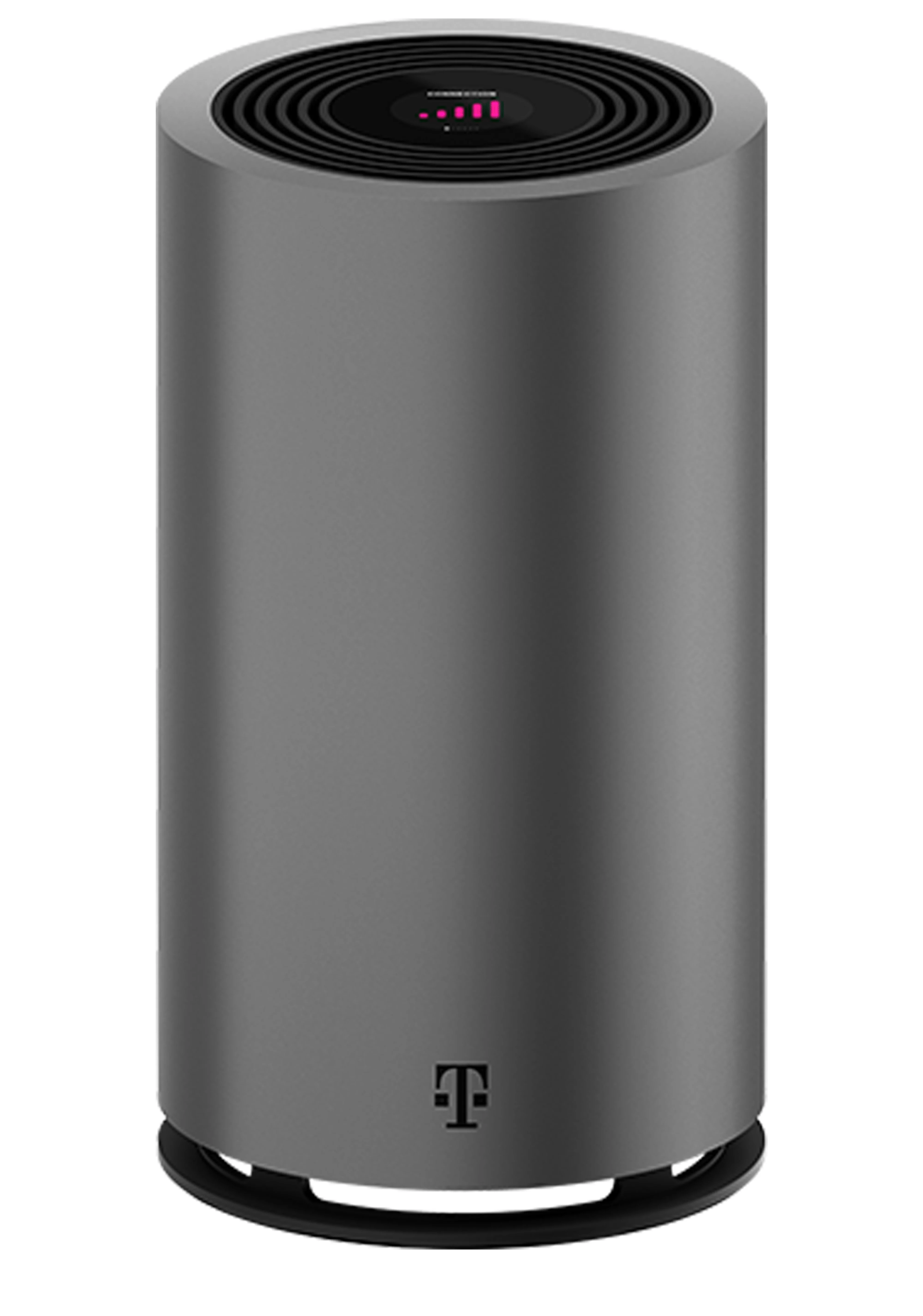
T-Mobile 5G Home Internet gray cylinder gateway official device photo.
Speeds typically land between 100 and 200 Mbps down with uploads around 15 Mbps when the 5 G Ultra Capacity signal is strong. That falls short of gigabit but covers multiple 4 K streams, large game downloads, and a house full of smart devices. Latency hovers near 30 milliseconds, fine for casual gaming and reliable video calls.
Coverage is the standout. About ninety-two percent of Columbus sits inside T-Mobile’s 5 G footprint, making it the most widely available high-speed choice after satellite. Renters appreciate the portability, and homeowners often use it as a quick bridge while waiting for a buried fiber line.
Risk stays low. There is no contract, and a fifteen-day trial lets you cancel free if tower congestion drags speeds below your comfort zone. Heavy users also benefit from truly unlimited data with no throttled lanes after a threshold.
Limitations remain. Performance can swing with tower load or weather. Tasks such as hosting a home server or opening an Xbox NAT may need extra tinkering. Uploads fall well below even entry cable tiers, so large media backups will take time.
Still, for fifty dollars and near-citywide reach, T-Mobile Home Internet can turn a DSL-only address into a modern home connection and often stays the long-term budget winner.
7. PSC Fiber: hidden gem multi-gig in select pockets
Public Service Telephone Company is not a household name unless you live on the far edge of Muscogee County, yet its new fiber build delivers impressive results. Where available, PSC offers symmetric tiers from 200 Mbps up to 2 Gbps, and the top plan costs ninety-nine dollars per month.
Value is easy to explain. There are no contracts, no data caps, and the monthly rate does not climb each anniversary. Need help? You speak with a representative in Georgia, not an overseas call center. Local technicians often arrive the same day, a level of service national carriers rarely match.
Coverage is the hurdle. PSC Fiber threads through clusters of north Columbus subdivisions, parts of the southeast county line, and several new developments larger ISPs skipped. Enter your exact address in the checker or call the office; availability can change block by block.
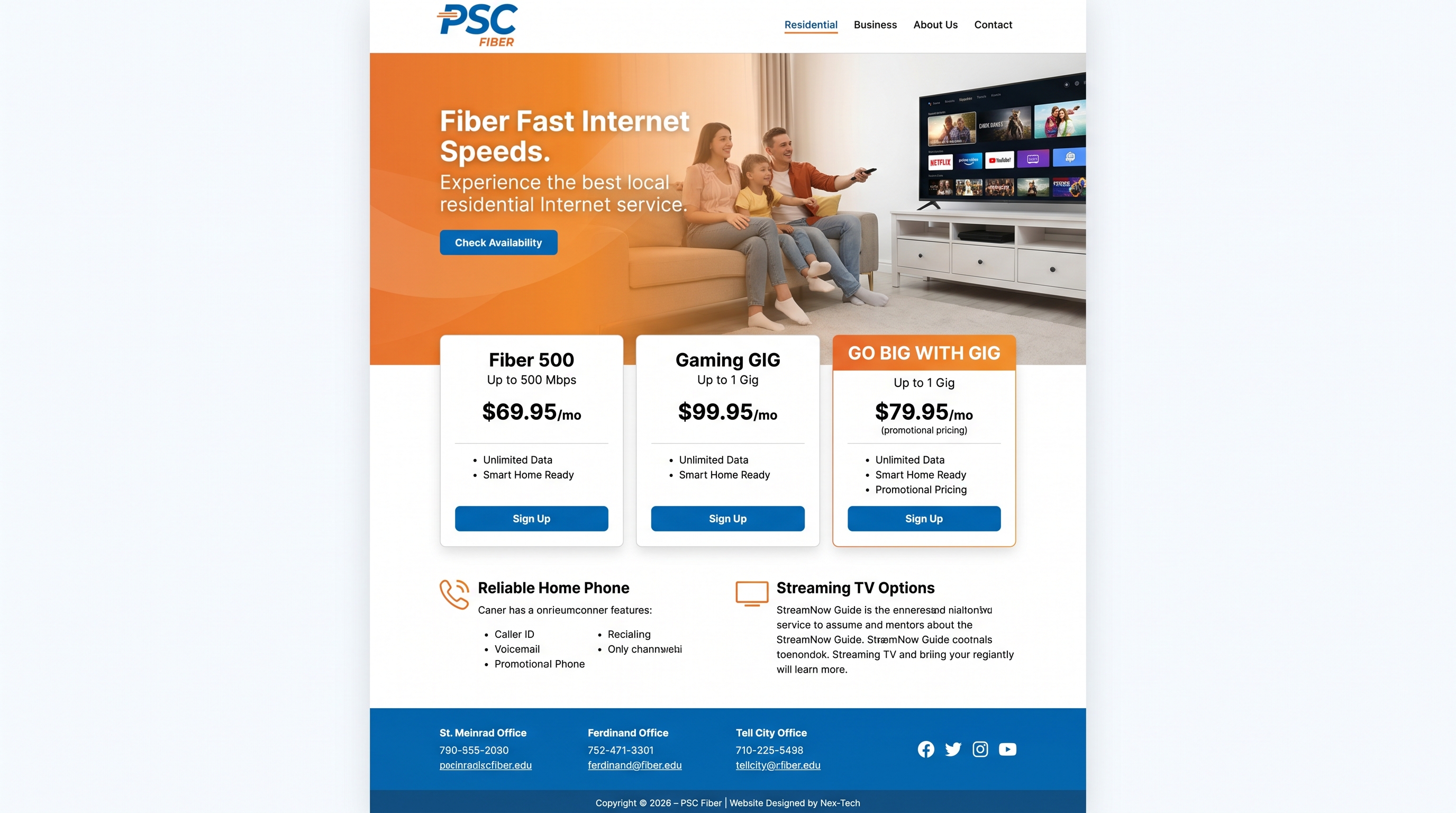
PSC Fiber Georgia residential fiber internet services page screenshot.
When the line is live, performance is excellent. Customers see full advertised speeds, single-digit pings, and none of the evening congestion that can slow cable. For creative professionals moving large files or households syncing terabytes to the cloud, PSC’s 2 Gbps tier rivals AT&T’s multi-gig service at a friendlier price.
If your block is lit, PSC deserves a spot at the top of your shortlist. If not, keep an eye on its expansion; connecting to hometown fiber often beats waiting years for a national build.
FAQs: picking the right gigabit plan in Columbus
What is the single best provider overall?
For sheer availability and a bill that never rises, WOW! is the safest default. If AT&T Fiber serves your address, its symmetric speeds edge out cable for power users.
Who delivers the fastest plan today?
AT&T’s 5 Gbps tier holds the speed crown. PSC’s 2 Gbps fiber offers a strong value where available, while cable tops out near 1 Gbps and 5 G wireless around 300 Mbps.
Which option costs the least over two years?
T-Mobile Home Internet stays flat at fifty dollars each month. Among true gigabit tiers, WOW!’s seventy-five-dollar plan (plus five dollars for the lifetime lock) often beats Spectrum’s yearly renegotiation and Mediacom’s post-promo increase.
Do data caps matter on a gigabit line?
Yes. A capped three-hundred-gigabyte plan can disappear in a weekend of 4 K streaming. Stick with unlimited offers—WOW!, Spectrum, AT&T, PSC, EarthLink, and Mediacom primary tiers.
Is fixed wireless good enough for gaming and video calls?
Usually. Expect about thirty-millisecond latency on T-Mobile 5 G, which works for Zoom and casual multiplayer. For esports or high-resolution Twitch uploads, a wired line’s sub-ten-millisecond ping and higher uploads feel smoother.
How do I confirm real availability instead of relying on marketing maps?
Enter your exact street address on each provider’s site. Fiber and cable footprints can change from house to house, and only the address checker confirms whether the port on your utility pole is live.
Conclusion
Selecting a gigabit plan in Columbus ultimately depends on your address, budget, and need for symmetric speeds. Compare availability with each provider’s checker, review total two-year costs, and choose the option that balances speed, reliability, and long-term value for your household.
Like this:
Like Loading...