DD
MM
YYYY

PAGES

DD
MM
YYYY

spot_img

PAGES

Home Blog Page 77

Nigeria’s GDP Grew 3.98% in Q3 2025 – NBS

0

Nigeria’s economy grew at a steady clip in the third quarter of 2025, with real GDP rising by 3.98 percent year-on-year, slightly above the 3.86 percent recorded in the same period of 2024.

Fresh figures released by the National Bureau of Statistics show that Q3 delivered broad-based improvements across segments of the economy, even as some sectors continued to feel the weight of structural challenges, weak investment flows, and persistent supply-side pressures.

In its Q3 GDP report, the bureau noted that agriculture expanded by 3.79 percent, marking a notable improvement from 2.55 percent in Q3 2024. The rebound came primarily from stronger crop production, which remains the backbone of the agricultural economy and accounted for 65.99 percent of the sector’s nominal output. The uptick offers some relief after earlier fears that climate disruptions and input shortages could drag the sector deeper into slow-growth territory.

Industry grew by 3.77 percent, climbing from 2.78 percent a year earlier. The performance was shaped largely by the oil sector’s modest improvement and selective gains in manufacturing and construction. The services sector grew by 4.15 percent, lower than the 4.97 percent recorded in Q3 2024 but still strong enough to keep its position as the economy’s largest contributor. Services accounted for 53.02 percent of total output, a touch higher than the 52.93 percent recorded a year earlier, underscoring the economy’s continued tilt away from commodity dependence.

Nigeria’s aggregate nominal GDP rose sharply to N113.59 trillion in Q3 2025, up from N96.16 trillion in Q3 2024. The year-on-year increase of 18.12 percent reflects a mix of higher prices, sectoral expansion, and the continuing impact of currency depreciation on nominal values.

The oil sector delivered a mixed performance. Average daily crude oil production rose to 1.64 million barrels per day in Q3, higher than the 1.47 mbpd recorded in the same quarter of 2024, though slightly below the 1.68 mbpd achieved in Q2 2025. Real growth in the sector stood at 5.84 percent, just above the 5.66 percent recorded a year earlier.

The figure represents a sharp slowdown from the 20.46 percent surge reported in Q2, pulling back by 14.62 percentage points quarter-on-quarter. The sector contracted by 5.53 percent compared to Q2, reflecting the volatility that continues to characterise oil output despite ongoing repairs to pipelines and renewed security measures in producing areas.

Oil contributed 3.44 percent to real GDP in Q3 2025. This was slightly above the 3.38 percent recorded in Q3 2024 but lower than the 4.05 percent recorded in the second quarter of the year. The share remains well below historical levels, showing how the broader economy has been forced to expand outside oil since disruptions intensified over the past decade.

The non-oil sector grew by 3.91 percent in real terms, outperforming the 3.79 percent recorded in Q3 2024 and the 3.64 percent posted in Q2 2025. Growth was powered by agriculture, telecommunications, real estate, financial institutions, trade, construction, and pockets of resilience in manufacturing.

The non-oil economy accounted for 96.56 percent of total output. This was slightly below the 96.62 percent recorded a year earlier, but higher than the 95.95 percent in Q2 2025, showing that non-oil activity still dominates the economy even as fluctuations in the oil sector shape broader sentiment.

A deeper dive into sectoral movements shows that Mining and Quarrying, which includes crude oil, coal, metal ores, and other minerals, recorded a steep nominal decline of 41.08 percent year-on-year. The slump reflects weaker global commodity prices, production disruptions, and limited new investments that have left mining activity subdued.

Agriculture’s nominal growth of 3.18 percent in Q3 represented a slowdown of 14.87 percentage points compared to the same period in 2024, although the sector performed better than in the previous quarter, improving by 1.34 percentage points. Crop production remained dominant, reinforcing the ongoing need for mechanization and improved supply chains to unlock productivity gains in livestock, forestry, and fisheries.

Manufacturing, one of the sectors most affected by high energy costs and foreign exchange constraints, grew by 1.25 percent year-on-year. The figure was higher than the growth rate recorded in Q3 2024, but it slipped by 0.34 percentage points compared with Q2 2025. The modest improvement suggests that factory output continues to struggle with elevated operating costs, imported input shortages, and tepid consumer demand.

For context, Nigeria recorded a stronger GDP performance earlier in the year. In the second quarter, real GDP grew by 4.23 percent year-on-year, outpacing the 3.48 percent posted in Q2 2024. Aggregate nominal GDP in that quarter stood at N100.73 trillion, markedly higher than the N84.48 trillion recorded in Q2 2024, representing nominal growth of 19.23 percent.

The Q3 figures show the economy is still expanding, but at a slower and more uneven pace than policymakers would prefer. Agriculture is improving but remains vulnerable to disruptions. Industry is stabilizing, but is weighed down by the erratic oil sector. Services continue to prop up growth, though some segments are facing declining momentum.

The overall picture is one of a fragile recovery that still needs stronger investment inflows, a more predictable business environment, and steadier crude oil production to sustain momentum into 2026.

The Big Reconstruction: Equipping Abia Youth for a New Era

0

In 1970, just months after the Biafra War ended, the elders of the Igbo Nation gathered across our communities to confront an existential question: What future awaits a people whose land has been reduced to rubble? Schools were gone. Hospitals destroyed. Markets burnt. Bank balances wiped out. No support was coming from the federal government. Yet, in that bleak moment, they rose and declared: this land must be rebuilt!

And they did. Our Greatest Generation – men and women who led the Igbo Nation in early and mid-1970s – demonstrated uncommon wisdom, discipline, sacrifice, and peerless execution, ushering a playbook that was elegant and powerful: every community must create a development union to rebuild its destiny.

And community after community answered the call. My village, Ovim, established the Ovim Community League (OCL). OCL became so influential that it paid teachers and posted them to public schools in Ovim. During my time in Secondary Technical School Ovim, the school offered Motor Vehicle Technology, Woodwork Technology, Shorthand, etc, funded largely by the community. OCL was not alone as most basic infrastructures in Igbo land were built through community effort then.

And the Greatest Generation did not stop with infrastructure. They engineered the Igbo Apprenticeship System, sending young men from our villages to Kano, Lagos, Accra, anywhere opportunity lived, because there was nothing left at home on the miry clay of Biafra. And they charged them with a sacred duty: “onye aghana nwanne ya” [do not leave your brethren behind] if success comes.

Those men listened. And within decades, the Igbo Nation rose from devastation and caught up with Nigeria’s economic trajectory. They ensured our homeland did not become a wasteland of penury or a museum of hopelessness. I salute that Generation for they saved the future that we enjoy today.

But now, our time has come. And our challenge is different: how do we give skills to our young people in an age where jobs are scarce? Certificates alone cannot feed families. Skills do. We must return to the old playbook of community-driven development but reimagine it for a new era. What ecosystems can we build in our communities to equip our young people with skills, not just paper qualifications? How do we unlock opportunities in digital technology, creative industries, agriculture, manufacturing, and trades?

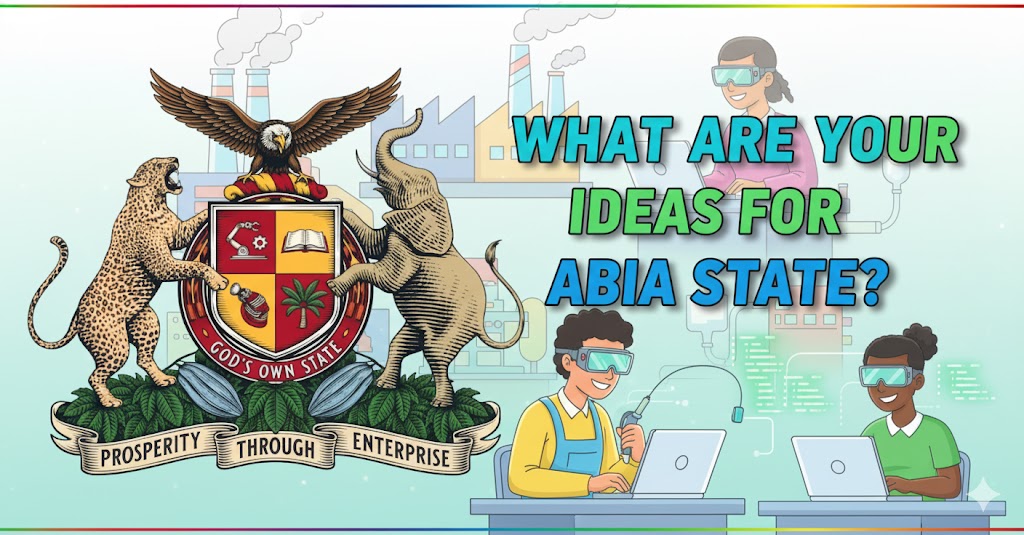
I am focusing on Abia State, but the model is relevant for any community in Nigeria and Africa. The Abia State Technological Skills Acquisition Centre (ATSAC) will unveil projects next year. But before then, we want to hear from you. Yes, your ideas, your insights, your dreams. When your ideas come in, we will refine the playbook and by early 2026, we will convene a Zoom Townhall Meeting. Afterward, we will begin implementation. Abia sons and daughters, please copy.

Our Governor, Dr. Alex Otti, has given us a clear mandate: equip young Abians with relevant skills across all communities. You in Lagos, London, Beijing, Boston, you carry knowledge that can transform futures. The question before us is simple: How can Abia youth benefit from your experience, and how do we build a system that gives them access? How do we make skills a right for young Abians?

The Greatest Generation rebuilt the Igbo Nation after war. Our generation must retool it for the opportunities of this era, and I want to know your ideas via this form: https://forms.gle/RTobYVnci5xYYpH27

SHIB’s Rebound Could Be Big; Ozak AI Price Projection Indicates Larger Multipliers

0

Shiba Inu is beginning to regain strong momentum as the meme-coin market shows signs of revival and broader crypto liquidity rotates back toward high-volatility assets. With retail traders returning, Shibarium development progressing, and market sentiment improving, analysts believe SHIB could be gearing up for a sizable rebound.

Yet even with SHIB’s potential for a powerful recovery rally, experts across multiple research desks continue pointing toward Ozak AI as the project with far larger multiplier potential. With early-stage pricing, deep AI-native utility, and a rapidly accelerating presale, Ozak AI is increasingly viewed as one of the highest-ROI projects for the next cycle—outperforming even the strongest meme-coin forecasts.

Shiba Inu (SHIB)

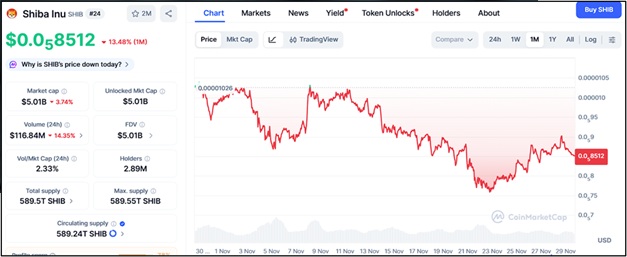
Shiba Inu (SHIB), buying and selling around $0.000008512, is forming a strong bullish foundation supported through steady buyer hobby across key ranges. SHIB maintains robust support at $0.00000826, $0.00000795, and $0.00000768, regions where long-term holders again and again gather during marketplace dips. These ranges spotlight SHIB’s resilience and growing community confidence as the following phase of marketplace expansion methods.

For SHIB to initiate a more potent continuation rally, it needs to conquer resistance at $0.00000882, $0.00000910, and $0.00000942. Historically, as soon as SHIB flips these tiers, it enters a period of fast upside driven through rising social sentiment, viral momentum, and renewed meme-coin speculation. Analysts say SHIB may want to realistically try a multi-x flow if the broader marketplace strengthens. Still, no matter this capacity, its already big market size limits the opportunity of extraordinarily high multipliers.

Ozak AI Emerges as the Strongest Large-Multiplier Project

While SHIB may deliver an impressive rebound, Ozak AI (OZ) is increasingly recognized as the asset with the steepest long-term growth curve. Unlike meme tokens that rely primarily on hype cycles, Ozak AI is built on real, powerful AI-native infrastructure designed to enhance trading, automation, and analytics across Web3.

Ozak AI integrates millisecond-speed AI prediction agents capable of scanning markets in real time, cross-chain intelligence engines that track activity across multiple blockchains simultaneously, ultra-fast 30 ms trading signals enabled through its HIVE partnership, and SINT-powered autonomous AI agents that execute trades, automate workflows, and perform voice-driven tasks. This level of functionality transforms Ozak AI into a foundational intelligence layer rather than a short-term speculative asset.

Because the global AI industry is expanding at one of the fastest rates in tech history, Ozak AI sits at the center of an explosive sector convergence—giving it a fundamentally steeper and more sustainable adoption curve than meme-driven tokens.

Presale Momentum Reinforces Ozak AI’s Massive Upside

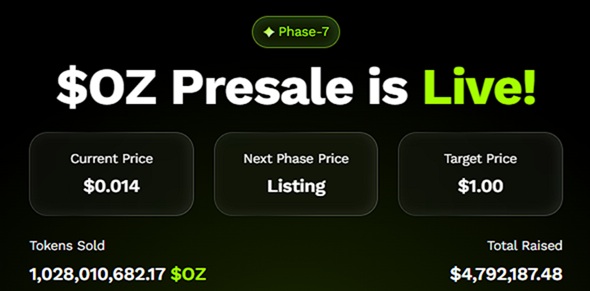
Ozak AI’s rapidly growing presale remains one of the strongest signals behind its multiplier potential. With over $4.7 million raised and more than 1 million tokens sold, Ozak AI is experiencing early-stage demand that mirrors the beginnings of previous cycle giants that later achieved 50x–100x gains. This level of global interest, forming before major exchange listings, indicates strong market conviction in Ozak AI’s long-term value.

Because Ozak AI enters the market with a small valuation but offers high-impact, real-world AI functionality, analysts believe its multiplier potential far surpasses that of SHIB—despite SHIB’s strong short-term narrative.

Shiba Inu appears positioned for a significant rebound, supported by healthy support zones, improving sentiment, and rising ecosystem engagement. A large multi-x rally is well within reach if market conditions continue strengthening.

However, Ozak AI’s price projection indicates much larger multipliers, driven by early-stage affordability, advanced AI-native technology, and powerful presale momentum. While SHIB may deliver strong gains, Ozak AI stands out as the project with the most explosive long-term ROI potential—quickly becoming one of the most compelling high-growth opportunities in the entire crypto market.

About Ozak AI

Ozak AI is a blockchain-based crypto assignment that provides a generation platform that specializes in predictive AI and superior information analytics for financial markets. Through machine gaining knowledge of algorithms and decentralized network technology, Ozak AI permits real-time, correct, and actionable insights to assist crypto fanatics and businesses in making the proper selections.


For more, visit:

Website: https://ozak.ai/

Telegram: https://t.me/OzakAGI

Twitter: https://x.com/ozakagi 

Apple Fights $38 Billion Fine Threat, Challenges India’s Global Turnover Penalty Law

0

Apple has filed a constitutional challenge against an amendment to India’s competition law, seeking to block antitrust proceedings that could expose the company to a colossal penalty of up to $38 billion.

The legal challenge, submitted to the Delhi High Court, targets a provision in the Competition Act 2024 that allows the regulator to calculate fines based on a multinational corporation’s global turnover—a major point of tension between New Delhi and global tech giants.

Apple’s 545-page petition argues that the amended law is “manifestly arbitrary, unconstitutional, grossly disproportionate, and unjust,” especially when applied to violations that occur only within the Indian market. The company is asking judges to declare the 2024 amendment illegal and prevent the regulator from taking any coercive steps that could force it to pay a potentially record-breaking fine.

The Anatomy of the $38 Billion Threat

The staggering $38 billion figure is not a final fine but Apple’s own calculated “maximum penalty exposure.” This is derived from the new law, which empowers the Competition Commission of India (CCI) to levy a penalty of up to 10% of a company’s average turnover from all its products and services globally for the preceding three financial years.

Based on Apple’s average global turnover from all services (including the App Store) over the three fiscal years leading up to 2024, the tech giant estimates the 10% maximum penalty could reach approximately $38 billion.

Before the 2024 amendment, the penalty was calculated using the “relevant turnover”—revenue generated specifically from the infringing goods or service within the Indian market. The CCI’s current counsel argued in court that fines based only on local revenue (which might be in the hundreds of millions) “don’t matter” to major tech companies, suggesting that the massive global turnover fines are necessary to act as an effective deterrent. Opponents like Match Group have echoed this, stating a fine based on worldwide revenue would act as a “significant deterrent against recidivism.”

The legal dispute is tied to an ongoing antitrust investigation initiated in 2021 by the CCI following complaints from Match Group (Tinder) and several Indian startups. CCI investigators have concluded that Apple engaged in “abusive conduct” on the market for apps distributable on its iOS operating system.

The key allegation is that Apple creates a monopoly position by requiring developers to use only its proprietary in-app purchase (IAP) system for digital goods. This system forces developers to pay commissions of up to 30% on every transaction. The CCI found the App Store to be an “unavoidable trading partner” for iOS developers, leaving them “no choice but to adhere to Apple’s unfair terms.”

The CCI also took issue with Apple’s rules that prohibit app developers from informing users within the app about alternative purchasing methods or providing external links to non-Apple payment systems, which the regulator argues results in higher prices for Indian consumers and stifles competition.

However, the 2024 amendment brings India’s antitrust penalty framework closer to the model used by the European Union, which also allows fines of up to 10% of a company’s global turnover for antitrust violations.

A major point of contention for Apple is the retrospective application of the law. Apple cited an unrelated case on November 10 where the CCI used the new rules to penalize a company for a violation that occurred nearly a decade earlier. Apple argued it has “no choice but to bring this constitutional challenge now” to avoid the same treatment in its ongoing case.

The Dominance Debate

Apple defends itself by saying it is a smaller player in India compared to Google’s dominant Android platform. However, Counterpoint Research noted that Apple’s smartphone user base has quadrupled in the country over the last five years, suggesting its market power is rapidly growing, especially among high-value consumers.

India’s CCI previously fined Google approximately $162 million in 2022 for abusing its dominant position with its Android platform, restricting it from certain revenue-sharing agreements. That fine was calculated under the old “relevant turnover” regime. The new challenge by Apple is a direct test of the regulatory seriousness behind the new, dramatically tougher global turnover law.

The Delhi High Court has requested a detailed response from the CCI on Apple’s arguments, setting the stage for a critical legal showdown that will define the regulatory environment for all multinational corporations operating in India.

Zazu Raises $1 Million Pre-Seed to Expand Pan-African Digital Banking For SME

0

Zazu, a neobank for African SMEs, offering seamless banking tools, cash flow automation, and real-time insights, has raised $1 million in pre-seed funding.

The funding round saw participation from Plug and Play Ventures and a notable lineup of angel investors and fintech leaders, including Zachariah George of Launch Africa Ventures, Axel Peyriere (Co-founder of AUTO24.africa), Akshay Patel (Founder of Paymentology), Ismael Belkhayat (Founder of Chari), and Sophie Guibaud (Founder of Fiat Republic).

The investment will support Zazu’s expansion in South Africa and Morocco, with broader plans to scale across the continent in 2026.

Founded in 2024 by Rinse Jacobs and Germain Bahri, Zazu was launched with the idea of making banking better for African founders and SMEs by providing them with a powerful bank account at the core, combined with invoicing, bookkeeping, and cash flow management tools. The fintech aims to provide African businesses with a seamless, Mercury-style banking experience tailored to their unique needs.

Zazu combines European fintech expertise with a deep understanding of African business realities, targeting the continent’s 50 million underserved SMEs. It offers services such as digital accounts, payments, financial management tools, and business connectivity features.

Five months ago, the neobank launched a feature “Zazu Connect”, designed to enhance connectivity and financial collaboration among African businesses. The launch aims to provide entrepreneurs and SMEs with seamless tools for payments, business networking, and financial management, strengthening Zazu’s mission to serve the continent’s 50 million underserved SMEs.

With over 50 SMEs already in beta and more than 1,000 businesses on its waitlist, the platform continues to expand its services across South Africa and Morocco, with plans to scale across the continent in 2026.

Zazu Connect integrates with major ecosystem players such as Paystack, Shopstar, and Ozow, while also offering SMEs opportunities to connect with partners, investors, and service providers. The company’s innovation has already earned it recognition, including selection for the Visa Accelerator Program, a finalist spot for KPMG’s Enterprise Innovator of the Year 2025, and inclusion in PwC’s “Fintechs to Watch.

Notably, Zazu offers a comprehensive suite of digital banking and business management tools designed specifically for African entrepreneurs and SMEs. Its features aim to simplify financial operations, improve efficiency, and provide businesses with the insights they need to grow.

These include;

Business Account: Zazu provides fully digital business accounts that allow SMEs to manage their finances seamlessly. Businesses can send and receive payments, track transactions in real-time, and operate with the flexibility of a modern banking platform.

Digital Incorporation: Zazu streamlines the process of registering and incorporating a business digitally, removing the traditional paperwork hurdles and enabling entrepreneurs to start and scale their ventures faster.

Invoice Management: The platform allows businesses to create, send, and track invoices easily, helping improve cash flow management and ensuring timely payments from clients.

Expense Management: Zazu offers tools to track and categorize business expenses, giving entrepreneurs better visibility and control over their spending.

Bookkeeping & Cash Flow: The platform integrates bookkeeping and cash flow tracking features, allowing businesses to monitor financial health, generate reports, and make informed decisions.

By combining these features, Zazu acts as an all-in-one financial ecosystem for SMEs, helping African entrepreneurs operate efficiently, reduce administrative burdens, and focus on growth

The company’s goal is to dust off the old banking experience and create the finance solution that empowers up entrepreneurs, ensuring they can focus on their core as they create the next great companies.

Zazu is on a mission to build a finance solution that entrepreneurs love, which makes banking feel less like an obstacle and more like a catalyst for growth.