DD
MM
YYYY

PAGES

DD
MM
YYYY

spot_img

PAGES

Home Blog Page 7742

Recent Investment Values Facebook at $69 billion

0

Investment fund GSV Capital has just paid $6.6 million for 225,000 shares of Facebook, the social networking site. The deal values Facebook at roughly $69b. So, the site we all share our photos have appreciated in value this year by $19b since Goldman Sachs investment this January valued it at $50b.

Facebook is simply the only giant standing. Its business will be difficult to break due to network effects where the more people on the site, the better. It is expected to go public next week with the success of LinkedIn, Pandora (the online music sharing site), and now Zynga hoping to raise $1b in an IPO.

News Corp Bought Myspace for $580m, Now Selling it for $35m and 5% Stake in Specific Media

0

Finally, News Corp has finally seen a buyer for Myspace. The company agreed to sell Myspace which has been losing money  to an online advertising network called Specific Media. The company which paid $580m in 2005 for the social network company will get $35m and 5% stake in the buyer.

Specific Media is an innovative global interactive media company that enables advertisers to connect with consumers in meaningful, impactful and relevant ways.

In July 1999, Tim Vanderhook founded the company with his brothers, Chris and Russell. Through its superior technology and expansive reach, Specific Media soon began to play a major role in shaping the direction of the online advertising industry by enabling marketers to address advertising to specific consumer segments across the online world.

Today, the company is leading the next phase of the advertising evolution by being the first to integrate display, video, mobile and IPTV into a single unified platform. Specific Media makes addressable advertising a reality, working across formats and screens and delivering a comprehensive set of targeting technologies and measurement capabilities.

Specific Media is the partner of choice for brand advertisers, with a notable Fortune 500 advertiser base and a roster of name brand publisher partners. Headquartered in Irvine, CA, Specific Media currently has offices across the U.S. and Europe.

Mobile-Based Integrated Transport Management System (MITMS) in Nigeria

2


Mobile-Based Integrated Transport Management System

-Luxury Buses, Coaches, Cross-Country Travel Operators in Nigeria-

by

First Atlantic Semiconductors & Microelectronics Ltd (Fasmicro)

Website: www.fasmicro.com Email: info@fasmicro.com

This Document: MITSM Nigeria in PDF


Introduction: This document is prepared to help present what Fasmicro can provide to any cross-country travel operator in Nigeria. The category includes luxury buses, coaches, inter-state taxi operators, etc. Typical examples include ABC Transport Plc, Edo Transport Service, and Imo Transport Corporation. We present this document to share the idea and will send detailed proposal to any operator that wants to engage us.


Our Idea: We propose a Mobile-Based Integrated Transport Management System (MITMS). It will comprise of Website Design, Apps Development or/and Software. Each is briefly explained:


1.                  Transport App. Based on Ovim Tablet – our Nigerian market notebook, we will implement an MITMS that will manage inventory, capture fixed assets, help in ticket management and synchronized with all the  company offices nation-wide.


A tablet personal computer (tablet PC) is a portable personal computer equipped with a touch screen as a primary input device and designed to be operated and owned by an individual. Unlike laptops, tablet personal computers may not be equipped with a keyboard, in which case they use a virtual onscreen substitute. All tablet personal computers have a wireless adapter for Internet and local network connection. Software applications for tablet PCs include office suites, web browsers, games and a variety of applications (source: Wikipedia).


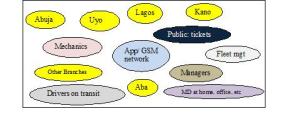
This means with the software installed in our Ovim tablet, any approved staff of the company can check information about any station or branch at any  time. Ovim works with GSM network and wireless-enabled making it easy to manage fleet and complex transport networks across the nation with simplicity. We will supply the tablets and implement the application software (Apps). The implication is that management will take logistics and transport coordination mobile and eliminate the problems of distance. For instance, the company may have a policy that drivers travelling from Lagos to Uyo must notify stations when they reach some stations like Benin, Onitsha, etc. Doing this will make it easy for managers to know where the buses are and when they will arrive. Upon completion of travel, the drivers will log into their tablets all the pertinent travel details which can help in developing future services. This information is made available to all approved staff/branches. From scheduling maintenance to coordinating fleet, our Apps will handle all via a simple device which is similar to Apple Ipad. A photo of our device (Fig.1) is shown below. We will supply many units to the company to cover managers, drivers, etc and implement an unprecedented logistics management system in Africa (Fig.2).

Fig.1: Ovim Tablet

Fasmicro MITMS ComponentsDecision Engine: Set Driver Standards, Reports – Driver manifests, directions, resource utilization, customer delivery, route summaries, etc – all done wirelessly.Support Engine: invoicing and booking documents, sending of transport alerts (delay, accident, non-forecast stops…), maintenance requests,  etcMeasurement Engine: Service quality control, vehicle load,  route problems,  real time problems

Fig.2: Mobile-Based Integrated Transport Management System

With Ovim Tablet and wirelessly connected, you can monitor drivers, fleet, branches, schedules, tickets, synchronized operations, track stock, etc- all done with a hand held device running on our App software. You can also connect with your mechanic and schedule each vehicle service through the App. The public will buy tickets, view schedules, time, etc through the Apps.


2.                  Website Design. The following will be implemented

a.                   Tickets: Travelers will make reservations online and can pay at your offices with their online reservations codes or pay at designated banks or even pay with ATM cards online.  We will have credit card interface, in case they become mainstream in coming months, in Nigeria. Ticket prices and schedule changes will be constantly updated by staff. There could also be information for advanced payment and discounts for group travels.

b.                  Travel information: Information for Baggage, bus routes, schedules, children travelling, and general safety issues will be put online. All rewards for repeat travels will also be made available here.

c.                   Discovery Travel: AKTC could be interested to offer special travel programs for people that want to discover the state. This will be like tours. Information on this will be presented on this site.

d.                  Station Locator: Addresses of all the branches will be put online as well as the major bus stops.

e.                   General: There will be about us section with Executive Bios and information about the state. Contact information will also be included.


3.                  Software. We can implement the #1 above for Personal computers. In that case, the software will run on computers, the same way Microsoft Word runs. Professionally, we think this is not the future. The world is becoming very mobile and having that capacity to synchronize all the branches through Ovim tablet in a GSM network will be good for any organization. But if our client wants PC localized software, we will gladly implement it. In that case, you will be deprived of real time data from the drivers, station managers, public mobile interface, etc.

Mobile-Based Electronic Medical Records System (mEMR) in Nigeria

0


Electronic Medical & Mobile Records System (EM2R)

-Hospitals, clinics, medical schools and health centers in Nigeria-

by

First Atlantic Semiconductors & Microelectronics Ltd (Fasmicro)


Website: www.fasmicro.com Email: info@fasmicro.com

Introduction: This document is prepared to help present what Fasmicro can provide to any hospital, medical school, clinic, and health center in Nigeria. We present this document to share the idea and will send detailed proposal to any health institution that wants to engage us.


Our Idea: We propose an Electronic Medical and Mobile Records System (EM2R). It will comprise of Electronic Patient Database, EM2R App, and Ovim Tablet.


Electronic medical records (EMR) are key components of modern healthcare delivery. And when you make the records mobile, you transition health delivery to the 21st century. Fasmicro using its Android based Ovim Tablet is well positioned to help health institutions to move their electronics records to the mobile space where doctors and health professionals can make use of them without limitations of distance.


We will help hospitals transform from paper-based recording keeping to Electronic Medical Records (EMR) to allow healthcare providers to share information across their care ecosystem. This access to digital lifeline is vital to saving and nurturing lives, preventing medical errors and improving efficiency of healthcare delivery. We think this is where Nigeria must be.


If you already have an electronic medical records system, Fasmicro will use that data and using our Apps, we will put it in the mobile domain. That means health professionals can access patient data anywhere where there is medical data. For instance, a doctor can attend to a patient who got sick in Sokoto but with the medical records in Aba. Using our technology, the doctor, if approved and in the system, can access that data on the Ovim tablet. He can also update those records. We have different layers of privileges the hospital can set.


An electronic medical record (EMR) is a computerized medical record created in an organization that delivers care, such as a hospital and doctor’s surgery. Electronic medical records tend to be a part of a local stand-alone health information system that allows storage, retrieval and modification of records (source: Wikipedia).


A tablet personal computer (tablet PC) is a portable personal computer equipped with a touch screen as a primary input device and designed to be operated and owned by an individual. Unlike laptops, tablet personal computers may not be equipped with a keyboard, in which case they use a virtual onscreen substitute. All tablet personal computers have a wireless adapter for Internet and local network connection. Software applications for tablet PCs include office suites, web browsers, games and a variety of applications (source: Wikipedia).


Fasmicro offers EM2R software, hardware systems, and a complete service portfolio to our clients. We own the Ovim Tablet environment and we will work with you to deliver the right service with absolute commitment to quality. Our system offers an unparalleled reliability, ease-of-use, efficiency, and customizability. We help clients manage their financial, administrative, clinical, and regulatory needs, and the records mobile ecosystem with guaranteed security.


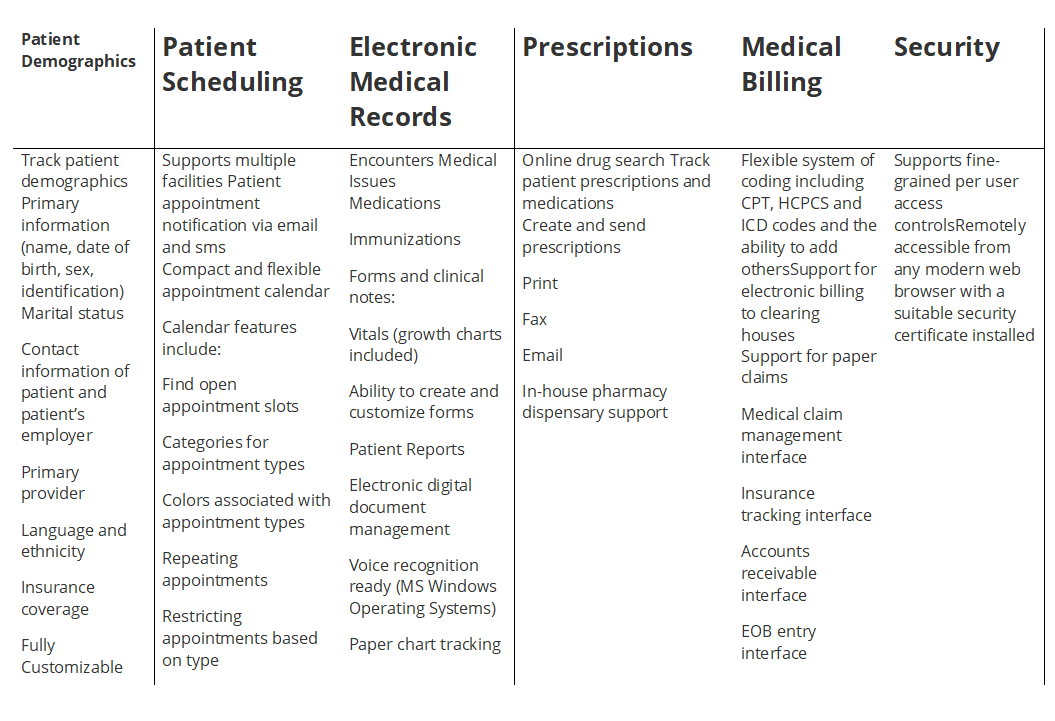
When clients engage us, we will help them develop an electronic database and transform their paper format into an electronic equivalent. Our software that runs on our Ovim Tablet will help doctors manage patients care in a mobile domain. We have tested our Tablet and found it ready for any EM2R function in Nigeria (see figures below). Table 1 shows the features of our system.

Figure 1: Ovim Tablet in action on EMR


Figure 2: Ovim in action on EMR

Table 1: Features of our EM2R System

Africa Not Present in Web Traffic Analysis from Google Analytics – Pageviews Dropped

0

We just received an email from Google Analytics on web traffic. Google looked at data in an anonymous data gathering from Nov 1, 2010 to Feb 1 2011. For comparison, they used data from Nov 1 2009 to Feb 1 2010. They excluded some data in the  non opted-in websites – “websites which have opted into anonymous data sharing with Google Analytics”.

Site Metrics

Compared to a year ago, websites have seen reduced pages / visit, average time on site, as well as bounce rate.

11/1/09 – 2/1/10 11/1/10 – 2/1/11 Difference
Pages/Visit 4.9 4.5 -0.4
Bounce Rate 48.2% 47.0% -1.2%
Avg Time on Site 5:49 5:23 -0:26

Breakdown by Geography

U.S. users spend more time on the web than any other nation but the Chinese  have more pounce rate.

Country Pages / Visit Bounce Rate Avg Time on Site
United States 4.7 (-0.1) 42.5% (-6.1%) 6:06 (-0:10)
United Kingdom 4.9 (-0.3) 41.5% (+0.2%) 5:38 (-0.27)
France 4.4 (-0.4) 49.7% (+1.4%) 4:40 (-0:08)
Brazil 4.1 (-0.1) 47.8% (-2.9%) 5:20 (+0:03)
China 4.1 (-0.1) 58.2% (+1.0%) 3:46 (+0:37)
Japan 3.9 (-0.1) 48.6% (-9.0%) 3:47 (-2:59)

For bounce rate, the distribution by country is plotted below: The distribution above is annotated with some countries — which seem to indicate a story of leisure and stage of economic development. For a related metric: average time on site, the distribution by country is plotted below:


The type of countries annotated in the average time on site graph above seem to be in reverse order as those in the bounce rate distribution.

Breakdown by Traffic Sources

Interesting, people spend more time when referred by a site.

Traffic Sources Pages / Visit Bounce Rate Avg Time on Site
Direct 4.0 (-0.5) 47.2% (-4.0%) 5:21 (-0:07)
Referral 5.0 (+0.1) 43.1% (-1.1%) 6:36 (-1:48)
Organic Search 4.9 (-0.1) 47.9% (-1.1%) 4:43 (+0:06)
CPC Search 5.6 (+0.0) 41.4 (-1.7%) 3:57(+0:07)

Conversion Rate Distribution

Many marketers’ favorite metric is conversion rate. Here is the worldwide distribution of Google Analytics “goal conversion rate” by country.

Simply, Africa is not yet in the web geography. We are a non-factor and Google just excluded us because our data might have been useless with out numbers.