DD
MM
YYYY

PAGES

DD
MM
YYYY

spot_img

PAGES

Home Blog Page 7744

Fasmicro Android Training Course Outline – Extensive and Focused

0

This is outline of Fasmicro Android training in Nigeria


Mobility Computing & Android App Development

Java Review

  • Introduction to Java
  • Types, variables, operators
  • More types, methods, conditionals
  • Loops and arrays
  • Objects and classes
  • Access control, class scope, packages, Java API
  • Design, debugging, interfaces
  • Inheritance, exceptions, file I/O
  • Development in Java

Android Overview and History

  • How it all got started
  • Why Android is different (and important)

Android Stack

  • Overview of the stack
  • Linux kernel
  • Native libraries
  • Dalvik
  • App framework
  • Apps

SDK Overview

  • Platforms
  • Tools
  • Versions

Hello World App

  • Creating your first project
  • The manifest file
  • Layout resource
  • Running your app on Emulator

Main Building Blocks

  • Activities
  • Activity lifecycle
  • Intents
  • Services
  • Content Providers
  • Broadcast Receivers

Basic Android User Interface

  • XML versus Java UI
  • Dips and sps
  • Views and layouts
  • Common UI components
  • Handling user events

Android System Overview

  • File System
  • Preferences
  • Notifications
  • Security model

Advanced UI

  • Selection components
  • Adapters
  • Complex UI components
  • Building UI for performance
  • Menus and Dialogs
  • Graphics & animations

Multimedia in Android

  • Multimedia Supported audio formats
  • Simple media playback
  • Supported video formats
  • Simple video playback

Sensors

  • Sensor overview: accelerometer, compass, orientation, etc
  • Camera
  • Touch Events
  • Trackball Events

Network

  • TelephonyManager
  • ConnectivityManager
  • HttpClient/Simple JSON GET
  • Java Sockets/Simple JSON POST
  • Java XML

Location Services

  • Location Manager
  • GPS
  • MapView

SQL Database

  • Introducing SQLite
  • SQLiteOpenHelper and creating a database
  • Opening and closing a database
  • Working with cursors Inserts, updates, and deletes

Basic Content Providers

  • Content provider MIME types
  • Searching for content
  • Adding, changing, and removing content
  • Working with content files

Labs #1-7

Mobility Computing and Microelectronics Courses in Nigeria

(contact us for customized off-site and on-site trainings)


Course 1:  Mobility Computing and Android Apps Development

Course 2:  Embedded Systems – FPGA and Microcontroller

Course 3:  Mixed Signal VLSI Design with CAD- Schematic, Layout, Extraction and Verification


Course I: Mobility Computing & Android App Development

Java Review

  • Introduction to Java
  • Types, variables, operators
  • More types, methods, conditionals
  • Loops and arrays
  • Objects and classes
  • Access control, class scope, packages, Java API
  • Design, debugging, interfaces
  • Inheritance, exceptions, file I/O
  • Development in Java

Android Overview and History

  • How it all got started
  • Why Android is different (and important)

Android Stack

  • Overview of the stack
  • Linux kernel
  • Native libraries
  • Dalvik
  • App framework
  • Apps

SDK Overview

  • Platforms
  • Tools
  • Versions

Hello World App

  • Creating your first project
  • The manifest file
  • Layout resource
  • Running your app on Emulator

Main Building Blocks

  • Activities
  • Activity lifecycle
  • Intents
  • Services
  • Content Providers
  • Broadcast Receivers

Basic Android User Interface

  • XML versus Java UI
  • Dips and sps
  • Views and layouts
  • Common UI components
  • Handling user events

Android System Overview

  • File System
  • Preferences
  • Notifications
  • Security model

Advanced UI

  • Selection components
  • Adapters
  • Complex UI components
  • Building UI for performance
  • Menus and Dialogs
  • Graphics & animations

Multimedia in Android

  • Multimedia Supported audio formats
  • Simple media playback
  • Supported video formats
  • Simple video playback

Sensors

  • Sensor overview: accelerometer, compass, orientation, etc
  • Camera
  • Touch Events
  • Trackball Events

Network

  • TelephonyManager
  • ConnectivityManager
  • HttpClient/Simple JSON GET
  • Java Sockets/Simple JSON POST
  • Java XML

Location Services

  • Location Manager
  • GPS
  • MapView

SQL Database

  • Introducing SQLite
  • SQLiteOpenHelper and creating a database
  • Opening and closing a database
  • Working with cursors Inserts, updates, and deletes

Basic Content Providers

  • Content provider MIME types
  • Searching for content
  • Adding, changing, and removing content
  • Working with content files

Labs #1-7

Distributors Wanted for Ovim Plus Tablet in Nigeria

0

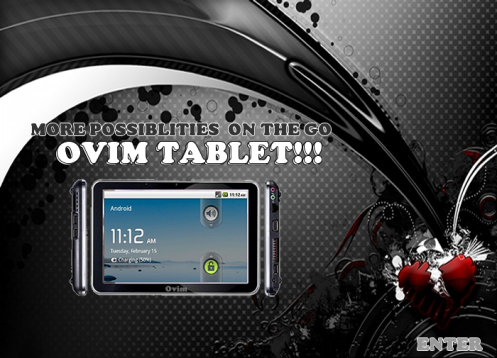
We are looking for distributors for Ovim Plus tablet which is right now on sale.

Welcome People, this is the tablet you have been waiting for. Ovim Plus is here. Like its predecessor, it is engineered with you in mind. Ovim Plus is elegant, sleek and simple. We call it the Nigeria’s tablet because there is nothing to benchmark it when you loop the affordable cost, features and the brand. It comes with 10.1 inch display and opens the door to Freedom. Oh yes Good People, Ovim Plus is ready for Android Market so you can download all those apps. Besides, if you need the local ones, you can download from our apps store. Get Ovim Plus today!

To apply, please send the following details:

  1. Contact Name
  2. Business/Company Name/Website (if any)
  3. Company physical address
  4. Include how long in business
  5. Email address and Phone Number
  6. Your Location (Town and State)
  7. Experience in selling phones/electronics in Nigeria and Yearly/Monthly revenue

Fasmicro Products and Services – Microelectronics and Embedded Systems CAD, Labware, and Tools

0

These are some products and services from Fasmicro


Support & Supplies
(CAD, lab tools, equipment, etc)

We supply and/or support all common microelectronics or semiconductor labware. These include microelectronics CAD tools, oscilloscope, function generators, meters, power supplies, silicon wafers, etc. Upon supply, our engineers will train your staff on how to use them. Depending on volume bought from us, we will provide free two-day offsite training on these equipment and tools. .

In this segment, we provide the following services, among others:

  • Acquisition of CAD tools and management of licensing
  • Purchase of labware, hardware, and related software
  • We support and maintain the systems, based on agreement

Here are some of the tools and equipment we supply and support:


Major CAD software

Cadence, Mento Graphics, Synopsis & Tanner


Hardware, Labware, etc

FPGA, DSP controllers, GPIB interface card, switches, development boards,UBICOM SX, NIDAQ, MPLAB IDE

• Scanning tunneling microscope STM/NT-MDT
• Atomic force microscope AFM/Veeco CPII
• SEM attachment for e-beam writing (Elphy/Raith)
• Automatic Dicing Saw, model DAD 321
• Equipment for optical measurements
– Laser (at 325nm)
– Detector (600-1600nm)
– UV/VIS lamp with monochromator
• Vector Network Analyser (VNA-Anritsu system)
• 12 ton heated press by Carver for microfluidics bonding and simple hot embossing experiments
• Fume Hood and Vacuum Oven (Lindberg Blue VO914A)
• Hewlett Packard 4278A 1 kHz/1 MHz Capacitance Meter
• Hewlett Packard 3488A – Switch Matrix


Supporting CAD software

PCB, FPGA, SUGAR, NODAS, Hamster, Matlab, C++ compilers

Process and device modeling software
– SILVACO Software (Athina, Atlas)
– Suprem and Pisces
– Floops and floods
– Software for MEMs modeling &  simulation
– Coventorware
– FEM-LAB”


Test equipment

Function/logic generator, spectrum analyzer, microscope, air station, signal generators, network analyzer, sampling scopes, power meters, probe stations, microwabe probe stations, test boards, NIDAQ, soldering stations, heat chambers, power supplies, multimeter, frequency counter, noise generator


Probe Station, Characterization and Testing

• Electrical characterization equipment
– Karl Suss PA150 semi-automatic probe station
– Karl Suss manual probe station
– Micromanipulator probe station
– RF probe station
– HP measuring systems (4142B, 4084B, 8110A, 700i series, 4140B, 4284, 4192A, 34401, 16500A)
– Keithley measuring equipment (230, 220, 617, 195A, 6517A)
– Tektronix 224J Oscilloscope
– Oxford optistat Cryostat for temperatures in the range 4.2-320 K.
– Oxford DN cryostat for temperatures in the range 77-500 K
• Optical characterization equipment
– Multiwavelength Spectroscopic Ellipsometer
– FTIR system, model Tensor 27 of Bruker
– Jobin Yvon spectrometer, wavelengths 300-1600 nm
– Argon Laser
– Oxford optistat Cryostat, 4.2-320 K
– Emission spectroscopy set-up for electroluminescence measurements: USB-2000 spectrometer (Ocean Optics)
• Morphology, structural characterization
– Leo 440 SEM
– AFM (Veeco CP-II), STM (NT-MDT)
– Stylus profilometer model XP-2 of Ambios Technology
• Testing equipment
– Systems for testing of gas flow, gas, pressure, acceleration and humidity sensors

 
Cleanroom

Equipped with (I) Silicon processing laboratory equipped with the following
– 4 laminar flow chemical benches
– 7 horizontal hot-wall furnace tubes
– 2 horizontal LPCVD tubes for nitride, oxide (TEOS), polysilicon
– 1 horizontal LPCVD tube for LTO
– Ion Implanter (EATON medium current, 200 KeV)
– Optical lithography systems (resolution down to 0,6 ?m)
– Electron beam lithography system (resolution 50 nm)
– Reactive Ion Etcher
– Metallization equipment (thermal, e-gun evaporation, sputtering)
– Process inspection equipment – High Density Plasma Etcher
– Different thin film deposition systems
• Sputtering
• MOCVD


Components/Modules:

Towards a Folklore Industry – Put Copyright Power on African folklores

0

Few months ago, I argued that the major difference between Africa and the United States is not necessarily democracy, infrastructure and weather, rather, the presence and absence of intellectual property rights (IPRs). And in my new book, I began the preface by discussing how technological progress along with IPRs has changed the course of humanity.


Without IPRs, it would be difficult for Africa to progress because invention may not easily transition to innovation without ownership and commercial rights to ideas. I argued that Africa may still be where most developed world is about five hundred years ago when despite legions of inventors, the world was not expanding its gross world product because commercialization of ideas was low. Magazines profiled inventors who in most cases died very poor.


We made the case that IPR was fundamental in accelerating the penetration of technology as investors were incentivized to put their resources into them understanding the commercial opportunities. Before then, why put your resources where the law would not protect you from reaping the benefits of risk-taking? With stronger IPR, technology diffused and productivity improved. That affected the quality of life with the result of higher living standards in most developed world.


The US has a patent system that works and quest for innovation is protected by law. What could become a hubby in Africa could turn out to be a Fortune 500 company in US.


This was well captioned by Reneta Milcheva who gave a very good example using William, the boy that harvested the wind in Africa. His was a hobby, but Steve Jobs’s Ipad was a business creation. If William have had a similar experience in America, he will be running a Fortune 1000 company today. He created value and instead of pursuing commercialization, they encouraged him to become a hobbyist, teaching other kids. Though around him people needed his product, it was not possible to meet that demand because that was in Africa. He has since gone for more education, which is good. And he might turn out to become a banker or lawyer in few years though he has a genius of Edison.


Simply, in Africa, there is no future for his idea since he cannot guarantee that people will not steal it if he begins to profit from it. So, for him, the investors see it as a hobby, no business opportunity. Why not? If William makes the first wind system, his friends will copy him and no law will be there to protect him.


I say it today: The greatest obstacle to Africa’s development is a weak legal system that discourages innovation.


When invention comes from Africa, it is unique. We have men that understand herbs and their wonders on poison. We have ‘orthopedic’ surgeons that treat bone fractures across African villages. We have people that can sing and craft the best story lines. In all these cases, there is no business.  Simply, most are just hobbies and investors see no opportunity because there are no IPRs covering them. Where you could have had a Pfizer incarnate, the person dies and the idea goes. In a continent that could not develop an indigenous way of writing despite centuries of existence, all these ideas that were refined, processed and improved by generations are just wasted because a succession gap exists today. Who cares? Not the governments!


But interestingly, Jan Goossenaerts sent a link on the possibility of WIPO (World Intellectual Property Organization) developing a system to patent folklores. If that happens, I can see smiles out of the villages in Africa. It sounds exciting but I do not know how it will work. Now is the time to begin that process of putting IPR across most inventions in Africa so that they will have investible values. We could have a folklore industry where one copyrights his story and sells the right? After all, what is the difference between music and folklore? One is free, the other you pay for it!


Credits: I must acknowledge all the insights I got from many people that commented and emailed after I wrote the piece of IPR.  Thanks.

Fasmicro Research and Advisory Services

0

Education is constantly evolving as a result of emerging technologies which are shaping global commerce and industry. Fasmicro understands this change and the enormous challenges faced by businesses and school administrators to not only meet the needs, but to exceed the expectations of customers, students and parents (and indeed society). In this era with constant technological disruptions, meeting the needs and expectations are not just enough, understanding the perceptions of customers and students is very vital.


This is a new century and new technologies will constantly evolve new industries, markets and economies. Innovation matters and training must be central to any strategy. Fasmicro assists schools, companies and institutions to develop a holistic technical training model. We understand that innovative technological applications, new policies, optimized processes are catalysts that enable educators to improve technical educational achievement. And for firms, to achieve superior customer retainment and profits.


Besides training and education, Fasmicro is positioned in all major areas of microelectronics and semiconductor research. We help clients look at data as well develop strategies in technical research. In our networks are PhD graduates from top engineering schools and will help you stay ahead of competition by helping to shape your next generation products.


We provide custom training on all areas of VLSI in both analog and digital systems. We have licensed CAD tools for VLSI designs and printed circuit board (PCB) education. We sell and support all major brands of FPGA boards such as Xilinx, Altera, etc. Our unique service provides free two-day offsite training if a client buys CAD, FPGA/VHDL, Demo boards and labware from us. We also train on embedded systems and microprocessor programming and extend that knowledge to robotics. We are master coders on Microchip and Parallax microprocessor families. We cover from design physics to testing.


These are some of the areas we train/educate clients:

  • VLSI (analog and digital)
  • VHDL and FPGA
  • Printed Circuit Board (PCB)
  • MEMS/BioMEMS
  • Embedded systems and microprocessor programming
  • Robotics
  • CAD Training for schematics, layout, etc
  • Other areas (please email)

Click for the list of courses available in Nigeria/Africa.


Join the Nigeria Microelectronics Academic Network to accelerate the diffusion of the world’s most dominant industry in Nigeria. Through this network, we will assist schools to acquire computer aided design tools at bargain prices, coordinate design process, designkits, and student test chips at international foundries. It costs N150,000 to join the network.


Unique Capabilities
Fasmicro provides innovative skills in strategy, project management, and technical capabilities. Our areas of technical education and training specialty include computing, electronics, robotics and electrical with particular focus on microelectronics and semiconductors.


For more on this, visit: Fasmicro Research