DD
MM
YYYY

PAGES

DD
MM
YYYY

spot_img

PAGES

Home Blog Page 7746

Craft Silicon Is Simply Crafting Software Solutions for Banking, Microfinance, mPayments and ePayments

0

Craft Silicon is a global software company, based in Kenya, providing software solutions for core banking, microfinance, switching and electronic and mobile payments across 4 continents.

When the wheels of time turn, the dynamics of most industries change. The Finance sector is no difference because over the years since over the years, it has evolved through the cycles of boom and downturn, which has challenged the functioning of all allied fields. Furthermore, the phenomenon of globalization has added new dimensions to this already volatile sector.

At Craft Silicon we have, since our inception in 1998, stayed ahead of the ever-changing times, with our core expertise in the domain of providing customised software solutions for the financial sector. How did we succeed in this? Simple. We never believed in waiting for the future to evolve, we rather shaped it with our lateral thinking and radical view of things.

Each passing day, we have reignited our passion of delivering world-class solutions with one question, ‘Is there a better and different way of doing things?’

Opportunities at the base of the pyramid are driving the buzz today. One of the most significant areas in this category around the world is Microfinance. Craft Silicon, in recognition of the bright prospects and the opportunities, has developed BRmfs (Bankers Realm Core Microfinance Solution) that helps manage small to large customer records, volumes of transactions, portfolios, profits and also analyze the risk factors. BR MFS Solution is now running on our high end web platform – BR .Net.

Craft Silicon’s MFI offering also provides its partners with alternate channels such as POS and mobile banking that allows businesses to provide online, real time and secure services to customers even in remote areas. The limitless scope and convenience offered could be testified by over 200 satisfied Micro Finance Institutions (MFIs), in over 32 countries around the world

Some Upcoming Conferences or Events In Nigeria – LinuxFest, DrupalCamp, etc

1

The following are some events or conferences which are planned in Lagos  or Abuja in the near future. If you know more, please let us know. Thank you.

  1. LinuxFest, Lagos

    Nigeria / Lagos

    28th30th October 2011

  2. Drupal Camp, Lagos

    Nigeria / Lagos

    7th9th October 2011

  3. Mobile Web West Africa 2012

    Nigeria / Lagos

    13th15th March 2012

  4. The African Conference on FOSS and the Digital Commons – IDLELO

    Nigeria / Abuja

    Online conference

    19th23rd March 2012

  5. Startup Weekend Lagos

    Nigeria / Lagos

    9th11th September 2011


LinuxFest is a free event, focused on grassroots evangelism of Linux and other Open source software projects. During the event, conference attendees listen to a number of presentations and make contact with a number of companies and non-profit organizations who share an interest in open source software. The event raises money through a raffle and by charging commercial vendors a donation fee for their booths. This allows the festival to stay free for all who wish to come, while raising enough money to fly in popular speakers.

[Prepare] Startup Weekend Lagos Announced: Sept 9 – 11

0


Startup Weekends are 54-hour events where developers, designers, marketers, product managers, and startup enthusiasts come together to share ideas, form teams, build products, and launch startups!


Startup Weekends are weekend-long, hands-on experiences where entrepreneurs and aspiring entrepreneurs can find out if startup ideas are viable.  On average, half of Startup Weekend’s attendees have technical backgrounds, the other half have business backgrounds.


Beginning with open mic pitches on Friday, attendees bring their best ideas and inspire others to join their team. Over Saturday and Sunday teams focus on customer development, validating their ideas, practicing LEAN Startup Methodologies and building a minimal viable product. On Sunday evening teams demo their prototypes and receive valuable feedback from a panel of experts.


It is coming to Lagos as follows and anyone can participate:


September 9th – 11th

Canton Concourse

Lagos


Startup Weekends are all about learning through the act of creating.  Don’t just listen to theory, build your own strategy and test it as you go


Startup Weekend is a 54 hour startup event that provides the networking, resources, and incentives for individuals and teams to go from idea to launch. Startup Weekend’s motto: Build Community. Start Companies. No Talk. All Action. In conjunction with local facilitators around the world, Startup Weekend is run by two guys out of Seattle, WA. Together, we are our own community of passionate entrepreneurs on a mission to help other entrepreneurs and facilitate innovation.


The event is open to anyone interested in the local entrepreneurial community, and it puts them in a setting where anything is possible. In the past 3 years, 550+ startups have started, 22,000+ entrepreneurs have been inspired. Teams have even started to generate revenue during the 54hr event, and others have even gone on to direct angel and VC investment. None of these stats take into account the amazing networking, ongoing professional relationships, and amazing experience that happen at every event.


[Book Presentation] IGI Global 2010 “Book of the Year” Award Book Will Be Presented in University of Nairobi

0
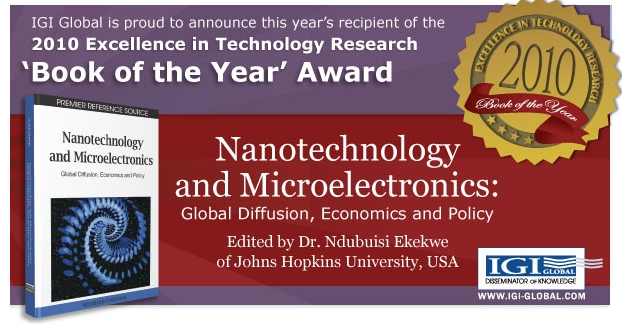
Prof Ndubuisi Ekekwe’s book received the prestigious IGI Global “Book of the Year” Award in 2010

Tekedia is happy to announce that our Founder will be traveling to South Africa for the Tech4Africa where he will be giving a speech. On his way, we will give a talk in University of Nairobi on his book that won book of the year award from IGI Global, a leading global publisher. We will give you updates as they become available.


2010 Excellence in Technology Research ‘Book of the Year’ Award

As a publisher of breakthrough technology research for over two-decades, IGI Global is pleased to announce the 2010 Excellence in Technology Research ‘Book of the Year’ Award that honors the most innovative studies published within the 2010 copyright year.

Celebrating the research accomplishments of Information Science scholars, the 2010 Excellence in Technology Research ‘Book of the Year’ Award acknowledges this year’s outstanding research contribution to the scientific community. The winning publication has furthered the study of technology and has demonstrated how innovative research positively impacts the advancement of society.

Meeting the award’s requirements of excellent peer-reviewed research results, a diverse body of international scholars, and exemplary discussion of an emerging field in technology, IGI Global has graciously selected the following winner of the 2010 Excellence in Technology Research ‘Book of the Year’ Award:


Prof Ndubuisi Ekekwe’s book received the prestigious IGI Global “Book of the Year” Award in 2010

Celebrating the research accomplishments of Information Science scholars, the 2010 Excellence in Technology Research ‘Book of the Year’ Award acknowledges this year’s outstanding research contribution to the scientific community. This winning publication has furthered the study of technology and has demonstrated how innovative research positively impacts the advancement of society.


Congratulations to Dr.Ndubuisi Ekekwe & all of the contributing authors of  

Nanotechnology and Microelectronics:
Global Diffusion, Economics and Policy


cbufton@igi-global.com www.igi-global.com


IGI Global 2010 ‘Book of The Year’ Award


ing the research accomplishments of Information Science scholars, the 2010 Excellence in Technology Research ‘Book of the Year’ Award acknowledges this year’s outstanding research contribution to the scientific community. This winning publication has furthered the study of technology and has demonstrated how innovative research positively impacts the advancement of society.


Congratulations to Dr.Ndubuisi Ekekwe & all of the contributing authors of

Nanotechnology and Microelectronics:
Global Diffusion, Economics and Policy


Asynchronous Sequenced Integrated Circuits – Design and Implementation Process

0

An asynchronous circuit is a circuit which is not governed by a global clock, but uses hand shaking communication protocol to communicate. It is largely an autonomous circuit and is delay insensitive.


Under a digital design paradigm, the design of asynchronous systems can be concisely described using high level languages. A programming notation, Communicating Hardware Processes (CHP), is used to provide a basic set of constructs that provides the specification of the circuit to be synthesized. The core of this language is a sequential programming notation based on E.W. Dijkstra’s language of guarded commands and C.A.R Hoare’s Communicating Sequential Process (CSP).


The language is distinguishable from many programmable languages in that it includes a notion of non-determinism as parts of its features. Non-determinism means that a program can have more than one output for the same sets of inputs. The CHP consists of a process or more, which operates in parallel and communicate with each other through channels. A channel connects two processes and the two ends of a channel are referred to as ports.


The next stage is called the process decomposition, which breaks up the CHP program into multiple parts and extracts, if possible, common program parts. Compiling smaller processes facilitates the rest of the synthesis procedure and sharing common program parts reduces the area of the final circuit. In addition, this process involves the separation of control and datapath, and enables temporary removal of the datapath and compilation of the control section.


The next stage is called handshaking expansion (HSE), which represents each communication action with operations on Boolean variables. For data transfer accuracy, the two ends of the channel have to obey some given protocol. The most prevalent ones are two-phase handshaking and four-phase handshaking protocols described later.


Usually, the HSE is optimized for concurrency while minimizing circuit areas of the implementation in another process called reshuffling. Besides, if there are states in a reshuffled HSE that cannot be distinguished, state variables are introduced to differentiate them. This process is known as state variable insertion.


The next stage involves a very simplified description of the CMOS transistor behavior called the production rule expansion. The result of this process produces what is called the production rule set, which could be considered to be a canonical representation of the digital circuit. This representation can be decomposed into several equivalent networks of digital operators based on the sets of building blocks used or the technology (Si or GaAs).


It is during this stage that issues, which include stability and non-interference, are examined carefully in the design. While stability ensures that circuit does not have hazards, non-interference will guarantee that the resulting CMOS circuit has no stable states whenever there is a short in the circuit. One way of achieving this is by guard strengthening; a process that reduces the number of states the production rules can fire thereby preventing incorrect effective firing. Guards are Boolean valued expressions, which could either be true or false.


A firing is said to be an effective firing when it changes the state of computation in a system; otherwise, it is called a vacuous firing. Moreover, to put the circuit in the proper state upon power up, a reset signal is added to the PRS. The production rule expansion is the final target of synthesis whose results are used for CMOS implementation (the hardware realization). A simplified design flow of an asynchronous QDI circuit involves the following stages:


* CHP specification

* Process Decomposition

* Handshaking Expansion

* Production Rule Exp.

* CMOS Implementation


Asynchronous circuits are promising. And the challenges in the deep-submicron technologies in form of electron thermal energy, tunneling leakage current that degrade performance and expend power consumption are potential issues that call for attention to asynchronous systems design. Though the development of the new generation QDI asynchronous systems has not made enormous commercial impacts, enormous ongoing projects project a bright future.


Even if the asynchronous architecture cannot be independent on its own, interfacing it with synchronous systems could help develop a new generation computing architecture that would possibly sustain the quest for performance, speed and reliability. Development of robust CAD and simulations tools for the asynchronous design as in the synchronous design would be a strategic milestone for all stakeholders in the semiconductors industry.