DD
MM
YYYY

PAGES

DD
MM
YYYY

spot_img

PAGES

Home Blog Page 798

RWUSD Launch Enhances Binance’s Appeal By Offering A Stable and High-Yield Product

0

Binance launched RWUSD, a principal-protected yield product on July 28, 2025, offering up to 4.2% APR. It’s benchmarked against tokenized real-world assets (RWAs) like U.S. Treasury bills but isn’t a stablecoin, security, or tradable token. Users can subscribe using USDT or USDC (USDC required in the EEA) at a 1:1 ratio with no subscription fees. RWUSD is credited to spot accounts, with daily rewards distributed in-kind.

Redemption is 1:1 in USDC, with options for Fast Redemption (instant, 0.1% fee) or Standard Redemption (T+3, 0.05% fee; free fast redemption quotas available). It’s non-transferable, non-withdrawable on-chain, and can be used as collateral for Binance VIP Loans while earning yield. Personal quotas reach up to $5M with flat APR. The product reflects Binance’s push into RWA tokenization, aligning crypto with traditional finance, though yields may vary with market conditions and regional restrictions apply (unavailable to U.S. persons).

RWUSD, a principal-protected yield product offering up to 4.2% APR by tracking tokenized U.S. Treasury Bills and other real-world assets (RWAs), signals Binance’s strategic push to integrate traditional financial instruments into the crypto ecosystem. This aligns with growing interest in RWA tokenization, which could attract institutional and retail investors seeking stable, low-risk returns in a volatile crypto market.

By offering a product that mimics the stability of traditional finance while leveraging crypto infrastructure, Binance positions itself as a leader in bridging DeFi and TradFi. This could enhance Binance’s reputation as an innovative exchange, potentially increasing user adoption and trading volumes, which indirectly supports BNB’s value. RWUSD is not a stablecoin, security, or on-chain asset, and it cannot be traded or withdrawn. However, it can be used as collateral for Binance VIP Loans while earning yield, adding a new use case within the Binance ecosystem. This increases the platform’s stickiness, encouraging users to hold and use BNB for transactions, fees, or subscriptions, which boosts demand for BNB.

RWUSD’s subscription via USDT or USDC (USDC mandatory in the EEA) could drive stablecoin inflows to Binance, further increasing platform activity and reinforcing BNB’s role as the ecosystem’s native token. RWUSD’s design as a principal-protected product, explicitly not classified as a security or tokenized RWA, suggests Binance’s careful approach to regulatory compliance amid ongoing scrutiny (e.g., SEC lawsuits and EU investigations).

By offering a low-risk, high-yield product, Binance differentiates itself from competitors, potentially capturing market share from other exchanges or DeFi platforms. This strengthens the Binance ecosystem, which is closely tied to BNB’s value proposition. BNB’s surge to $827-$859.56, with a market cap exceeding $105-$118 billion, reflects a combination of fundamental, technical, and market-driven factors.

Significant institutional investments, such as $610 million from entities like Windtree Capital ($520 million) and Nano Labs ($90 million), alongside whale activity (e.g., $118 million in short position liquidations on July 16), have fueled BNB’s rally. The token’s market cap growth and high trading volumes ($2.4-$3.4 billion daily) underscore strong institutional confidence. Institutional adoption signals BNB’s growing legitimacy as a diversified asset class, potentially attracting more corporate investors and boosting long-term demand.

Heavy reliance on institutional and whale activity can lead to sharp corrections if sentiment shifts or liquidations occur, as seen in February 2025’s decline due to whale selling. Investors should monitor on-chain metrics like whale wallet activity and daily active addresses for signs of reversals. The BNB Chain’s robust on-chain activity, with over 387 million transactions in a week and a total value locked (TVL) in DeFi rising 22% to $10.2 billion, highlights the network’s growing adoption. Upgrades like Pascal, Lorentz, and Maxwell, along with $19.2 billion in bridged TVL and $11.17 billion in stablecoin volume, reinforce BNB’s utility beyond trading fees.

BNB’s role in powering transactions, governance, and dApps on the BNB Chain enhances its intrinsic value, supporting price sustainability. The chain’s second-place ranking in user activity (33.7 million transactions) behind Solana further cements its competitive edge. Continued growth in dApps, DeFi, and NFT projects on BNB Chain could drive further demand for BNB, especially if Binance continues to list new tokens and support IEOs via Binance Launchpad.

BNB’s price broke a multi-year diagonal trendline, forming a cup-and-handle pattern with a projected target of $1,090-$1,200. Technical indicators like RSI (86.47, overbought) and ADX (47) confirm strong bullish momentum, supported by a broader altcoin season and Bitcoin’s surge to $123,300. Analysts predict BNB could reach $1,000-$1,200 in the short term if it sustains above $750-$780 support levels, with long-term forecasts as high as $2,292 by 2025 and $17,085 by 2030.

BNB’s rally often precedes broader altcoin market gains, potentially amplifying bullish sentiment across the crypto sector. This could benefit other altcoins but also increase systemic risk if a correction occurs. Despite regulatory challenges (e.g., SEC lawsuits, EU scrutiny, and IRS investigations tied to Tornado Cash), positive developments like potential BNB ETF approvals (e.g., VanEck’s filing with staking features) and Binance’s Hong Kong license application bolster investor optimism.

Approval of a BNB-based ETF could integrate BNB into traditional finance, unlocking new capital inflows and reinforcing its long-term growth potential. However, rejection or delays could dampen sentiment. The RWUSD announcement coincided with BNB’s surge to $855, with a 7% daily and 10% weekly gain, suggesting the product launch amplified bullish sentiment. RWUSD’s appeal to risk-averse investors could drive platform inflows, indirectly boosting BNB demand.

The RWUSD launch enhances Binance’s appeal by offering a stable, high-yield product, reinforcing its ecosystem and indirectly supporting BNB’s value through increased platform activity. BNB’s price surge to $827-$859.56 is driven by institutional demand, technical breakouts, BNB Chain growth, and market optimism, with potential to reach $1,000-$1,200 if momentum holds. However, regulatory risks, overbought conditions, and whale activity pose challenges. Investors should balance BNB’s strong fundamentals with market volatility.
AI Is Advancing—But You Can’t Outsource Your Thinking, Bluesky CEO Warns

1
The Bluesky social media app logo is seen on a mobile device in this photo illustration in Warsaw, Poland on 21 April, 2023. Founder Jack Dorsey of twitter has released the Bluesky application on Android. (Photo by Jaap Arriens / Sipa USA)(Sipa via AP Images)

As artificial intelligence reshapes the modern workplace and transforms how people write, code, and create, Bluesky CEO Jay Graber is warning that one thing must remain intact: critical thinking.

According to her, the temptation to hand over reasoning tasks to machines could weaken our most essential human skill—judgment.

“AI is able to automate a lot of critical-reasoning tasks, and if we fully outsource our own reasoning, it’s actually not good enough to run in an automated fashion,” Graber told Business Insider in a recent interview. “You can’t just fully outsource your thinking, or an essay, to AI.”

Graber’s comments come at a time when AI tools like ChatGPT and Claude are increasingly used for essay writing, customer support, moderation, and even software development. Bluesky, the decentralized social media platform she leads, uses AI to assist with moderation and content curation. But Graber stressed that Bluesky never allows AI systems to operate autonomously. Every AI-generated suggestion is reviewed by a human because context, she said, is everything.

“When you let it run autonomously, it doesn’t have actual context or intelligence, or the many things that we need as humans to make good decisions,” she explained. “And so it’s producing stuff that sounds or looks right without actually being right.”

AI Can Do the Work—But Do You Know How to Judge It?

Graber emphasized that as AI becomes more capable, the human role is evolving—from direct output to judgment and refinement. Whether it’s writing or coding, she believes users must still understand the fundamentals.

“If you don’t know what good code looks like, if you don’t know how to actually build a system, you’re not going to be able to evaluate its output,” she said.

AI can generate text or even solve bugs, but without the ability to assess and correct what it produces, the risk of flawed reasoning or misleading content grows.

Build the Thinking Muscle—Don’t Let It Atrophy

Graber advised students to push back against convenience and actually write essays by hand. The goal, she explained, is to build up the “muscle for critical thinking”—not weaken it by overusing AI shortcuts. The long-term risk, she warned, is a world filled with content that “sounds or looks right without actually being right.”

She also championed a generalist mindset, encouraging individuals to develop a wide range of skills rather than relying on AI as a crutch. In her view, AI is like packaged expertise, but human discernment is what gives that knowledge value.

“You need to have the good judgment of how you’re going to use it, and then you have to have the flexibility to take that knowledge and do something useful with it,” Graber said.

The Takeaway: Use AI, But Don’t Let It Use You

As artificial intelligence becomes a core part of everything from business to education, experts like Graber and Chowdhury are urging caution, not because AI is inherently harmful, but because human judgment is irreplaceable.

Bluesky’s refusal to let AI run unchecked is a case in point. “We’re never going to let it make decisions on its own,” Graber said. “Because it doesn’t understand what’s at stake.”

In sum, Graber is saying: in a world increasingly shaped by algorithms, the ability to think critically, ask the right questions, and apply sound judgment may be the most valuable skill of all.

Orange Money and JUMO Partner to Expand AI-Powered Microcredit Solutions Across Africa

0

Orange Money, a mobile phone-based money transfer service, has partnered with banking-as-a-service fintech provider JUMO to enhance digital financial services and expand access to microcredit across Africa.

This collaboration harnesses cutting-edge data analytics and Artificial Intelligence to serve unbanked populations by combining Orange Money’s extensive reach of over 100 million customers in 16 countries, and JUMO’s AI-driven lending technology, which has disbursed over $8 billion to 31 million Africans.

Through this partnership, Orange Money will strengthen its financial inclusion strategy by offering new microcredit products via mobile wallets. JUMO’s advanced data analytics and AI models will help optimize credit allocation, reduce lending risks to under 4%, and build sustainable credit portfolios.

Also, customers will be able to request loans directly through their Orange Money wallets, with eligibility determined by JUMO’s AI based on transactional data. Once approved, funds are instantly credited, and repayments are automated.

Speaking on the partnership, Aminata Kane, CEO of Orange Money Group said,

“Building on our extensive transfer and payment services, we now aim to support customers beyond transactions, helping them realise personal goals and manage daily emergencies. Our collaboration with JUMO accelerates this ambition by combining our reach with their innovative technology for faster, transparent, and more tailored credit solutions.”

Also commenting, Andrew Watkins-Ball, JUMO’s CEO said,

“We are proud to partner with Orange Money to extend affordable credit to millions. This collaboration leverages Orange’s scale and JUMO’s AI-driven platform, providing customers with greater financial choices and supporting our banking partners’ growth in new markets.”

The initial rollout begins in Burkina Faso, followed by Mali and Botswana. The alliance will create a multi-country, multi-product microfinance marketplace, leveraging partnerships with pan-African banks and development finance institutions.

This collaboration represents a new model for telco-fintech partnerships in Francophone Africa combining Orange Money’s distribution power with JUMO’s smart credit infrastructure to deliver frictionless, collateral-free, and data-driven lending tailored to African realities.

Mobile money has no doubt significantly boosted financial inclusion in Africa, with Sub-Saharan Africa leading globally in mobile money adoption, 33% of adults have a mobile money account compared to 10% worldwide, and account ownership in the region has risen from 23% in 2011 to 55% by 2021. Services like M-Pesa in Kenya have transformed access to financial services, enabling transactions, savings, and credit for millions, particularly in rural areas where traditional banking is scarce.

However, significant financial inclusion gaps persist. Nearly half of Sub-Saharan Africa’s adult population (45%) remains unbanked, compared to 29% in other developing economies. While mobile money has reduced Africa’s financial inclusion gap, challenges like low digital literacy and limited internet access persist.

Orange Money and Jumo’s partnership will play a significant role in mitigating these by offering USSD-based access (usable on basic phones) and focusing on user-friendly, transparent processes, though broader issues like gender disparities and regulatory inconsistencies still require attention.

In summary, the Orange Money-JUMO partnership is a transformative step toward closing Africa’s financial inclusion gap, leveraging AI to deliver accessible, low-risk microcredit at scale. It empowers underserved populations, supports economic growth, and sets a model for telco-fintech collaborations, though its success depends on addressing remaining infrastructure and literacy barriers.

Notably, Orange Money and Jumo partnership exemplifies the next wave of fintech innovation focused on frictionless, collateral-free, and data-driven credit delivery tailored to African realities.

Nigeria’s Next Phase of Startup Opportunities [podcast]

0

In this video podcast, “The Next Phase of Startup Opportunities in Nigeria,” I provide an analysis of Nigeria’s economic evolution through technological innovation and the critical areas for future growth in the nation’s entrepreneurial ecosystem.

The lecture begins by establishing a historical context, tracing Nigeria’s journey through distinct decades of transformation. The 1990s saw the emergence of “new generation banks” like Guaranty Trust Bank and Zenith Bank. These institutions, leveraging technology, gained significant competitive advantages, unlocked substantial market value, and cultivated customer loyalty, effectively laying the groundwork for modern financial innovation in the country. This period is retrospectively termed “FinTech 1.0.”

The 2000s marked the telecommunication revolution with the advent of mobile operators such as MTN and Econet. This brought widespread voice telephony, enabling mobile communication across Nigeria and creating a new wave of market opportunities. Building on this, the 2010s witnessed the transformative power of the mobile internet. Mobile devices evolved into versatile tools, serving as virtual bank branches, stores, and more, fundamentally reshaping nearly every aspect of Nigerian life by making services and commerce widely accessible via smartphones.

Currently, Nigeria is in a fledgling age of application utility. This era is characterized by the development of “combinatorial systems” that capitalize on the mobile internet’s pervasive nature. Entrepreneurs are actively creating solutions across diverse verticals, aiming to resolve deep-seated market frictions. A significant disruptor in this landscape is Artificial Intelligence (AI), which is poised to revolutionize and transform numerous industries.

Podcaster Ndubuisi Ekekwe, issues a stark warning: over 80% of existing Software-as-a-Service (SaaS) companies, particularly in emerging nations, risk “disintermediation” (being replaced or bypassed) if they fail to integrate AI capabilities into their operations.

The core of the presentation lies in its categorization of opportunities into three “stacks”:

  1. Downstream Stack: FinTech (The “Rainmaker”): FinTech has been the primary driver of the Nigerian startup scene due to its foundational role in all business transactions – the ability to pay and get paid. It served as a crucial “catalyst,” a necessary “friction that had to be fixed,” before other sectors could truly flourish. Podcaster Ndubuisi Ekekwe asserts that this stack is now “largely fixed,” meaning the fundamental infrastructure for easy payments is in place, clearing the path for subsequent phases of development.
  2. Midstream Stack: Software Systems: This stack encompasses the myriad software solutions being developed by young entrepreneurs across various industries, including e-commerce, education, and more. While innovative, the growth and full potential of this “midstream stack” are inherently constrained by the limitations of the “upstream stack.”
  3. Upstream Stack: The Next Frontier of Value Creation: This is identified as the most critical area for future growth. The upstream stack refers to foundational, core infrastructure and systemic issues that, once addressed, will unlock immense value across the midstream stack and the broader economy. Key areas within this stack include:
    • Logistics: Crucial for e-commerce to expand beyond current geographical limitations. Without robust logistics, e-commerce businesses remain locally confined, unable to achieve true “electronic” reach.
    • Storage Facilities (Agriculture/Commodity Trading): A significant challenge, particularly highlighted by the lack of a comprehensive “warehouse receipt system” in Nigeria. Such a system would enable the efficient pricing, storage, and trading of physical commodities (like palm oil, cocoa, sorghum) without requiring physical presence, akin to global gold or crude oil markets.
    • Broadband Internet Penetration: Insufficient broadband infrastructure continues to impede the effective delivery and impact of online educational content and other internet-dependent technologies.
    • Electricity/Power: A fundamental requirement for the development of modern manufacturing and the “factories of the future.”
    • Rule of Law/Intellectual Property Protection: Essential for fostering and protecting businesses operating in “intense intellectual property” sectors.

The presentation strongly emphasizes that addressing these upstream opportunities often necessitates Public-Private Partnerships (PPPs). Individual startups typically lack the capacity and resources to tackle such large-scale infrastructural and systemic challenges alone. The speaker warns that if the upstream stack remains unaddressed, the midstream stack will stay “largely frozen,” unable to realize its full potential.

In conclusion, the lecture posits that the FinTech “deal is done” in its role as a primary enabler. The strategic focus for capturing significant value in Nigeria’s entrepreneurial capitalism must now shift squarely to solving the foundational problems within the upstream stack. This requires a collaborative approach involving governments and large multinational corporations, primarily through Public-Private Partnerships. By tackling these core infrastructural and systemic challenges, Nigeria can truly unlock unprecedented growth and opportunities across all sectors, transitioning from geographically bounded businesses to a genuinely national and electronic economy.


Podcast VideoSign-up at Blucera and check Tekedia Daily podcast category under Training module.

WLD At $1.18, RNDR Stalls But BlockDAG’s GLOBAL LAUNCH Release & 100% Coin Unlock Offer Shakes The Market

0

Worldcoin (WLD) is moving closer to breaking a tough resistance that has held strong since March 2024. It’s grabbing attention as it approaches this key level. In contrast, Render (RNDR) is showing less energy, staying stuck in the same range for weeks. While WLD and RNDR work through their market paths, BlockDAG (BDAG)  is making headlines for something different altogether. Due to high demand from the community, the team behind BlockDAG has extended its NO VESTING PASS.

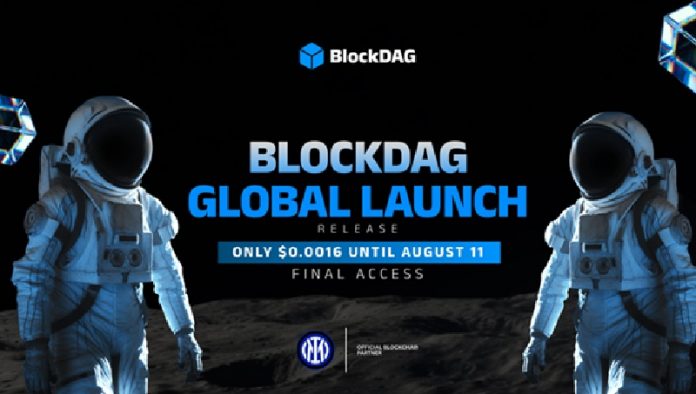
This gives users 100% access to their coins right at launch. On top of that, BlockDAG has introduced a special GLOBAL LAUNCH release price of $0.0016 until August 11. This move has pushed BlockDAG’s presale total beyond $354 million, making it one of the standout names in crypto right now.

Worldcoin Price Trend Approaches Breakout Zone

Worldcoin (WLD) is slowly gaining ground. It’s trading at about $1.18, just below a falling resistance line that’s been in place since March 2024. Over time, WLD has held key levels around $1.00 and $1.10, showing signs of building strength. Higher lows and steady volume are helping its case. The current Worldcoin (WLD) price trend also shows tight volatility and strong activity near major Fibonacci levels.

Buyers are staying active in these zones, creating the base for a potential breakout. If WLD can push above its resistance and hold that ground, the chart points toward a possible upward move. With momentum holding steady, all eyes are on whether WLD can finally break past the wall that’s been holding it back.

Render Price Movement Remains Sideways Below $5.50

The Render (RNDR) price outlook remains calm with little change in recent weeks. RNDR is stuck between $2.70 and $5.50. At the time of writing, it’s priced around $4.23. In the past 24 hours, RNDR has shown barely any shift, and the weekly trend shows a dip of about 2.77%. Trading volume is also down by nearly 33%, showing that fewer people are actively engaging with RNDR for now.

Open interest has dropped too, which means the excitement around RNDR has slowed. This puts the focus on the $4.00 support level. If RNDR can hold that, or better yet, push above its ceiling at $5.50, it could gain momentum again. Until that happens, the Render (RNDR) price outlook is in a holding pattern, with users waiting for a strong signal.

BlockDAG’s NO VESTING PASS & GLOBAL LAUNCH Offer Drive Surge In Demand

BlockDAG is making big waves. Thanks to community support, the team extended its NO VESTING PASS offer until August 4. This deal gives buyers full access to their BDAG coins the moment the platform launches, no waiting.

That’s not all. BlockDAG has also introduced a special GLOBAL LAUNCH release price of $0.0016, available until August 11. This price point is a massive chance for users looking to join early. Considering the final launch price is set at $0.05, buyers could see a 3,025% return if they grab the deal before the deadline.

So far, BlockDAG has raised over $354 million, making it one of the most successful presales in recent history. The coin has moved from $0.001 in Batch 1 to $0.0276 in Batch 29, showing a 2,660% increase. In total, over 24.4 billion BDAG coins have been sold. This growth has caught the eye of over 200,000 holders, and experts are already predicting a future price of up to $5 per coin.

With the clock ticking toward the GLOBAL LAUNCH release, this $0.0016 deal and the full unlock feature have helped place BlockDAG among the top-performing names in the market today. For anyone looking to join early, the timing couldn’t be better.

Final Thoughts

Worldcoin (WLD) is slowly building toward a breakout, and if it pushes past its resistance, it could change its trend completely. Render (RNDR), on the other hand, continues to move sideways, waiting for a sign to move. But BlockDAG is on a whole different track.

Its NO VESTING PASS and limited-time $0.0016 GLOBAL LAUNCH offer are giving the project major traction. With 200K holders and over 24.4 billion coins sold, BlockDAG is already making its mark. Right now, the combo of full coin unlock and low entry price gives it the edge as one of the top crypto coins to watch.

Presale: https://purchase.blockdag.network

Website: https://blockdag.network

Telegram: https://t.me/blockDAGnetworkOfficial

Discord: https://discord.gg/Q7BxghMVyu