DD
MM
YYYY

PAGES

DD
MM
YYYY

spot_img

PAGES

Home Blog Page 807

Trump’s Emergency Tariff Power Faces Federal Court Skepticism as Global Economic Stakes Hang in the Balance

0

A U.S. federal appeals court appeared unconvinced Thursday by arguments from the Justice Department defending President Donald Trump’s sweeping use of emergency powers to unilaterally impose global tariffs—an approach that has sent shockwaves across international markets and strained diplomatic ties.

At the heart of the dispute is Trump’s invocation of the International Emergency Economic Powers Act (IEEPA), a 1977 law historically used to restrict financial transactions during national emergencies, not to levy tariffs. Trump is now the first president to use the statute as a legal foundation for his far-reaching trade restrictions since reclaiming the White House in January 2025.

The hearing at the U.S. Court of Appeals for the Federal Circuit comes after the U.S. Court of International Trade ruled in May that Trump’s tariffs—both the general 10% “reciprocal tariff” and additional “trafficking-related” duties—overstepped presidential authority. The ruling was quickly paused by the appellate court, leaving the tariffs in effect while legal arguments continue.

During Thursday’s session, the appellate judges grilled Justice Department attorney Brett Shumate on whether IEEPA actually gives the president the power to set import duties. One judge challenged Shumate by pointing out that the law mentions “foreign exchange,” “currency,” and “payments,” but not tariffs, asking why tariffs should be lumped into that framework at all.

“There’s an old expression in the law: noscitur a sociis—‘a word is known by the company it keeps,’” the judge said. “Tariffs seem to have no friends in that statute. So, why?”

Shumate maintained that IEEPA gives the president broad discretion in emergencies. But plaintiffs’ attorney Neal Katyal—former Acting Solicitor General—countered forcefully, warning the court that accepting the administration’s view would strip Congress of its constitutional power over trade and tariffs.

“The president is saying he, on his own, with his say-so, can impose these tariffs.”

“And that is something no president in 200 years has ever thought. The tariff power goes all the way back to the Revolutionary War and, you know, the protests in the Boston Tea Party and the like,” Katyal said on MSNBC’s “Morning Joe.”

Katyal emphasized that the power to impose tariffs lies solely with Congress, citing the Boston Tea Party and America’s founding-era trade conflicts as historic evidence that the U.S. Constitution never intended for unilateral tariff authority to rest with the president.

A Trade Policy Flashpoint with Global Ramifications

Trump’s tariffs, first announced in April under the revived “reciprocal tariff” plan, slapped a blanket 10% baseline duty on nearly all imported goods, while targeting select nations—such as China, Mexico, and Canada—with even higher rates. He cited national security threats and economic retaliation by foreign governments to justify the measures.

The strategy sent global markets into brief turmoil. Although Trump later delayed implementation of some tariff hikes to calm financial nerves, a new wave of duties is set to snap into effect Friday. The administration insists the tariffs are necessary to level the playing field and protect U.S. industries from unfair foreign practices.

But the fallout has been severe. U.S. allies say the duties are damaging global supply chains and undermining trade talks. Emerging markets, already strained by inflation and debt, have warned that prolonged tariff wars could push them closer to recession.

A ruling against the tariff policy would deliver a huge relief to dozens of countries still scrambling to negotiate exemptions or bilateral trade agreements with Washington before the new round of duties begins.

On his social media platform Truth Social, Trump underscored what he sees as the stakes of the legal showdown.

“If our Country was not able to protect itself by using TARIFFS AGAINST TARIFFS, WE WOULD BE ‘DEAD,’ WITH NO CHANCE OF SURVIVAL OR SUCCESS,” he posted on Thursday morning.

The White House has long argued that without aggressive trade tools, the U.S. would continue losing out to foreign competitors. Attorney General Pam Bondi echoed the administration’s stance ahead of the hearing, saying: “We will continue to defend President Trump’s executive authority in courtrooms across the country.”

However, legal scholars warn that allowing the president to wield such sweeping trade powers without congressional approval could set a dangerous precedent—one that could outlast Trump and fundamentally alter the separation of powers in American governance.

The Federal Circuit Appeals Court is not expected to issue a ruling immediately. But legal experts say the outcome of this case—V.O.S. Selections v. Trump—will likely shape the future of U.S. trade policy and executive authority.

With several other lawsuits challenging Trump’s tariff regime waiting in the wings, a definitive judgment from the appeals court could either validate Trump’s aggressive economic nationalism or strip him of one of the most controversial tools in his trade arsenal.


U.S. Economy Grew At An Annualized Rate of 3% Amid FOMC Maintaining 4.25-4.5% Rate In July

0

The U.S. economy grew at an annualized rate of 3% in Q2 2025 (April-June), surpassing the Dow Jones consensus estimate of 2.3%, according to the Bureau of Economic Analysis. This marks a rebound from a 0.5% contraction in Q1 2025.

Key drivers included a sharp decline in imports (down 30.3%, boosting GDP by reducing the trade deficit) and a rise in consumer spending (up 1.4% from 0.5% in Q1). However, private sector investment fell 15.6%, and final sales to private domestic purchasers grew at a sluggish 1.2%, the slowest in over two years, signaling underlying weakness.

Some analysts, like those at Reuters, argue the growth overstates economic health due to the import-driven boost, with tariffs and trade policy uncertainty potentially slowing momentum into Q3 and Q4. The U.S. Q2 2025 GDP growth of 3% annualized, exceeding expectations of 2.3%, signals a robust economic rebound from Q1’s 0.5% contraction, driven largely by a 30.3% drop in imports and a 1.4% rise in consumer spending.

However, the Federal Open Market Committee’s (FOMC) decision to maintain the federal funds rate at 4.25–4.5% in July 2025, marking the fifth consecutive meeting without a change, reflects caution amid inflationary pressures and trade policy uncertainties. The sharp decline in imports, which mechanically lifts GDP by reducing the trade deficit, was a major contributor to the 3% growth.

This was partly due to businesses stockpiling goods in Q1 to preempt tariff hikes, followed by an import unwind in Q2. However, this effect may be temporary, as exports also fell 1.8%, signaling weaker global demand. Consumer spending, contributing 1.4% to GDP, remains a pillar of growth, supported by solid income gains. Yet, signs of demand erosion in sectors like electronics and furniture suggest tariff-related cost pressures are starting to bite, particularly for lower- and middle-income households.

Private sector investment dropped 15.6%, and business investment growth slowed to 1.9% from 10.3% in Q1. High interest rates, tariff uncertainty, and immigration restrictions are dampening business confidence, potentially capping long-term growth. Residential investment fell 4.6% in Q2, following a 1.3% decline in Q1, due to elevated mortgage rates, high home prices, and economic uncertainty.

Implications of FOMC’s No Rate Change

The FOMC’s decision to hold rates steady reflects worries about inflation, which remains elevated at 2.4% (CPI) and 2.3% (PCE) as of May 2025, above the Fed’s 2% target. Tariffs are expected to push core PCE inflation to 3% by year-end, limiting room for rate cuts. The FOMC noted solid labor market conditions, with unemployment at 4.1% and 671,000 jobs added in the first five months of 2025.

However, slower hiring rates and projected job growth of only 25,000 per month by Q4 2025 suggest cooling momentum, which could prompt rate cuts if it worsens. The FOMC’s cautious stance stems from uncertainty over trade policies and fiscal measures, such as the One Big Beautiful Act and potential Tax Cuts and Jobs Act (TCJA) expiration by December 2025. These could drive inflation or fiscal deficits, complicating monetary policy.

Two FOMC members, Michelle Bowman and Christopher Waller, dissented in favor of a 25-basis-point cut, the first such split since 1993. The Fed’s June 2025 dot plot projects two 25-basis-point cuts in 2025 (likely September and December), but seven members see no cuts, signaling a hawkish tilt unless labor market data weakens significantly. The Fed’s pause has kept Treasury yields elevated, with the 10-year yield at 4.21% as of April 2025.

If tariffs push inflation higher, yields could rise further, crowding out private investment and increasing borrowing costs. Markets expect 90 basis points of cuts in 2025, more than the FOMC’s median projection, indicating potential for deeper easing if economic conditions deteriorate. Lowered GDP forecasts (1.4% for 2025) and higher inflation projections (3% PCE) point to stagflation concerns, where growth slows but prices rise.

This challenges the Fed, as rate hikes could worsen unemployment, while cuts risk fueling inflation. The TCJA’s expiration could reduce household spending, while the $3.4 trillion fiscal cost of new legislation may increase deficits, pushing up interest rates and dampening growth. Conversely, provisions like R&D expensing could spur investment if extended. Tariffs and retaliatory measures could further reduce exports and imports, slowing global trade. This, combined with a stronger U.S. dollar.

With rates likely to stay high and inflation risks lingering, investors may favor diversified portfolios with exposure to inflation-resistant assets like commodities or high-quality corporate bonds, which could benefit if rates eventually fall. The GDP growth figure, while strong, masks vulnerabilities like declining investment and housing weakness, suggesting the economy’s health may be overstated. The Fed’s reluctance to cut rates, despite dissent, reflects a prioritization of inflation control over growth support.

Political pressure on Fed Chair Powell, including calls for his resignation, may further complicate decision-making, risking policy missteps. The Fed is likely to maintain its cautious stance at least through September 2025, with cuts possible if labor market weakness becomes clearer. However, persistent inflation and trade disruptions could delay easing, keeping economic growth fragile and reliant on a narrow base of high-income consumers and large firms

Aradel Grows H1 Profit to N191bn Despite Rising Costs and Falling Margins

0

Aradel Holdings Plc has reported a pretax profit of N124.1 billion for the second quarter of 2025, according to its latest financial results filed with the Nigerian Exchange (NGX).

This represents a modest 1.10% rise from the N122.7 billion recorded in the same quarter of 2024, helping to push its half-year pretax profit to N191.3 billion — a notable 17.89% increase year-on-year.

Revenue for the second quarter edged up slightly by 0.63% to N168.2 billion. However, Aradel’s performance across the first six months of the year was more impressive, with revenue surging to N368 billion — a 37.18% increase over the same period last year. A breakdown shows that crude oil remained Aradel’s main revenue driver, contributing N232.7 billion or 63.2% of the total. Refined products generated N116.4 billion, while gas sales accounted for N18.8 billion.

The company, however, encountered considerable cost pressures in Q2. Its cost of sales spiked by 32.23% to N90.3 billion, cutting gross profit by 21.23% to N77.8 billion. General and administrative expenses more than doubled, jumping 149.74% to N30.7 billion, dragging down operating profit to N55 billion — a steep decline from N114.7 billion reported in Q2 2024.

Nonetheless, strong financial income provided a cushion. Aradel’s finance income rose more than threefold to N8.3 billion, enough to offset finance costs of N5.6 billion. A sharp 70.4% drop in tax expense further strengthened the bottom line, allowing net income to grow by 36.14% to N112.1 billion from N82.4 billion in the same quarter last year.

Aradel’s balance sheet remains resilient. Total assets climbed to N1.8 trillion as of June 30, 2025 — a 3.48% increase. The company also posted healthy retained earnings of N444.1 billion, up from N395.2 billion in December 2024. Shares of Aradel closed at N514.10 on July 30, 2025.

While Aradel’s earnings highlight a stable and steady performance, another key player in Nigeria’s energy space, Seplat Energy Plc, delivered a record-breaking result that underscores the broader resurgence of the country’s energy industry.

Seplat, Nigeria’s leading indigenous energy firm listed on both the Nigerian Exchange and the London Stock Exchange, posted a stunning unaudited financial result for the six months ended June 30, 2025. The company’s revenue jumped to N2.167 trillion — a staggering 277% increase from the N575.1 billion posted in the same period last year. The historic leap was driven by ramped-up production, successful offshore expansion, and tight cost discipline.

Gross profit at Seplat more than tripled to N751.2 billion, up from N247.5 billion. Operating profit also soared to N601.2 billion, more than double the N285.2 billion recorded in the first half of 2024. Meanwhile, the company’s cash flow from operations nearly quadrupled, hitting N1.188 trillion compared to N308.2 billion in the prior year period.

According to Seplat CEO Roger Brown, “The company delivered first half production over 10% higher than the pro forma output in the same period last year, delivering on both our ambitions and supporting Nigeria’s goals of oil and gas production growth.”

Taken together, the strong performances of Aradel and Seplat indicate renewed momentum in Nigeria’s upstream oil and gas industry, despite global volatility and ongoing domestic challenges. The numbers show that strategic investments, efficiency gains, and market recovery are positioning indigenous companies to dominate the sector and deliver long-term value.

BUA Foods H1 2025: Profits Double as Rice Business Explodes 2,923%

0

BUA Foods Plc has posted one of its strongest performances yet, announcing a 101% year-on-year growth in profit before tax to N276.1 billion for the half-year ended June 30, 2025.

The company’s unaudited financials, released to the Nigerian Exchange on Wednesday, reflect the strength of its growing market share, expansion strategy, and aggressive move into Nigeria’s domestic rice value chain.

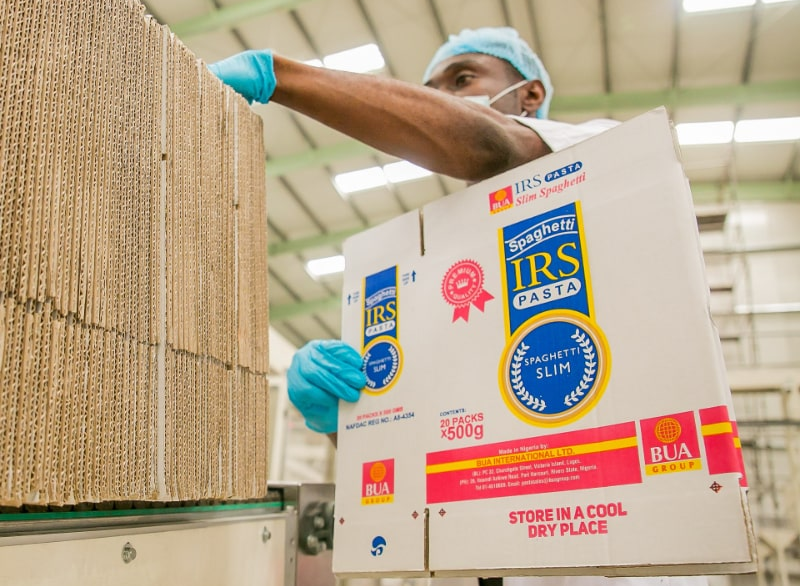
During the six months, BUA Foods’ revenue rose by 36% to N912.5 billion, driven by all four of its major product segments—Sugar, Flour, Pasta, and Rice. Notably, revenue from the rice division exploded by 2,923%, soaring to N39.3 billion from just N1.3 billion in H1 2024. The surge highlights the company’s rapid progress in ramping up local rice production, a move it had previously announced under its broader backward integration drive.

Gross profit stood at N339.3 billion, up by 55% year-on-year, while gross margin improved to 37.2% from 32.4%. Operating profit rose by 41% to N284.8 billion. Meanwhile, earnings per share nearly doubled, jumping from N7.27 to N14.45. These results underline the company’s successful cost discipline and operational efficiency in a high-inflation environment.

Total assets climbed to N1.33 trillion, representing a 21.7% increase from last year. Retained earnings rose sharply by 62% to N681.1 billion, and equity improved by 60.6% to N689.1 billion. Notably, BUA Foods also reduced its liabilities by 3.4% to N644.1 billion—evidence of a healthier balance sheet.

In his statement, Managing Director Engr. (Dr.) Ayodele Abioye said the company’s performance reflects “strong fundamentals, operational efficiency, and the resilience of our diversified business model. Amidst evolving macroeconomic dynamics, we remain focused on scale, affordability, and consistent value delivery to our customers and stakeholders.”

Segment-by-Segment Breakdown – H1 2025:

  • Flour Division: Revenue jumped by 66% to N378.2 billion.
  • Sugar Division: Revenue rose to N398.1 billion, marking an 8% year-on-year increase.
  • Pasta Division: Saw a 31% uptick in revenue to N96.9 billion.
  • Rice Division: Surged to N39.3 billion from N1.3 billion, marking a 2,923% increase.

A Groupwide Boom

The strong showing from BUA Foods follows closely behind the stunning performance of its sister company, BUA Cement Plc, which reported a 510.65% increase in pre-tax profit to N115.06 billion for Q2 2025. For the half-year, BUA Cement posted a PBT of N214.8 billion, more than five times the N40.1 billion recorded in H1 2024. Revenue for the cement firm grew to N580.3 billion, up 59.45% year-on-year.

The sharp turnaround was largely driven by improved revenue flows, cost controls, and the elimination of exchange rate losses, which had plagued Nigerian firms after last year’s FX liberalization. Cement was the sole revenue driver for BUA Cement, with the company reinforcing its dominance in Nigeria’s fast-expanding construction sector.

BUA’s Integrated Strategy Paying Off

The record-breaking results from both BUA Foods and BUA Cement highlight the success of BUA Group’s integrated industrial strategy, which combines backward integration with heavy investments in manufacturing infrastructure. Under the leadership of Abdul Samad Rabiu, BUA Group has built a vertically integrated empire focused on food security, construction materials, and industrial independence.

In recent years, the Group has scaled up investments in food processing, milling, sugar refining, and cement production, relying less on imports and shielding operations from foreign exchange shocks. These gains are now materializing in the form of explosive profits and stronger margins across the board.

BUA Foods is positioning itself as a key food supplier across West Africa as it pushes deeper into agriculture and rice production. Analysts say its rising equity and expanding asset base offer room for further growth in an economy where local content and industrial capacity are increasingly paramount.

Microsoft Surges Past $4tn in Market Cap, Intensifying Race Among U.S. Tech Giants

0

Microsoft on Thursday joined the exclusive $4 trillion club, pushing past the milestone after its shares jumped more than 5% on the back of strong quarterly results.

The surge intensifies the ongoing high-stakes race among America’s biggest tech titans—Microsoft, Apple, and more recently, Nvidia—to dominate the trillion-dollar valuation tier that now serves as a litmus test of global tech supremacy.

The software giant reported 18% revenue growth—its fastest in more than three years—driven almost entirely by the continued strength of its Azure cloud computing division. For the first time, Microsoft disclosed actual dollar figures for Azure and related cloud services, revealing they pulled in more than $75 billion in fiscal 2025. That’s a 34% jump from the prior year and underscores how critical Microsoft’s cloud infrastructure has become in powering the ongoing artificial intelligence boom.

With Thursday’s rally, Microsoft became the second U.S. company to hit the $4 trillion mark this year, following Nvidia, which briefly crossed the threshold earlier in June. Nvidia, whose graphics processing units (GPUs) are the essential hardware behind most AI models—including those from OpenAI, Microsoft, Google, and Meta—has seen explosive investor demand amid an industry-wide rush to build data centers and scale AI capacity. Its stock is up 33% in 2025 alone.

Apple, once the undisputed leader of the trillion-dollar club and the first company to ever cross the $1 trillion threshold back in 2018, now trails both Microsoft and Nvidia. Apple’s market cap sits around $3.2 trillion, following a 17% drop in its stock price this year. Investor concerns have mounted over Apple’s sluggish push into generative AI, with critics suggesting the company is falling behind while rivals like Microsoft and Nvidia reap first-mover advantage.

Analysts say Apple has failed to match the pace of its peers in building or acquiring advanced AI capabilities. While rivals like Microsoft and Google have poured tens of billions into AI research, cloud infrastructure, and landmark acquisitions, Apple has remained tight-lipped, offering only incremental updates to Siri and vague promises through its “Apple Intelligence” initiative.

“The incomplete AI strategy is still the biggest overhang, but we think Apple still has approximately 1.5 years to effect a compelling solution,” TD Cowen analyst Krish Sankar wrote in a note on Monday. He recommends buying the shares.

The fierce competition among these U.S. tech behemoths has become one of the defining narratives of the global financial markets. For over a year, Microsoft and Apple traded places as the world’s most valuable public company. Then came Nvidia, whose rise has rewritten the traditional order by turning chipmaking into a central pillar of the AI economy.

All three companies are not only battling for investor confidence but are deeply intertwined in the AI race—Microsoft has invested billions into OpenAI and continues to integrate AI across its suite of products; Nvidia supplies the hardware that makes AI possible; and Apple, while quieter, is expected to roll out AI features across its devices and operating systems.

Apple is set to release its quarterly earnings later Thursday, and markets are watching closely for signals about its AI roadmap. A strong showing could help Apple regain ground, but as it stands, Microsoft and Nvidia are setting the pace in a market increasingly dominated by cloud, chips, and artificial intelligence.

As these companies vie for position in the $4 trillion stratosphere, the battle is no longer just about size—it’s now about relevance in the next era of technology. And for now, the companies building the tools and infrastructure for AI appear to have the upper hand.