DD
MM
YYYY

PAGES

DD
MM
YYYY

spot_img

PAGES

Home Blog Page 826

Trump Strikes Landmark Trade Deal with Japan, Slashes Auto Tariffs and Unlocks $550bn Investment

0

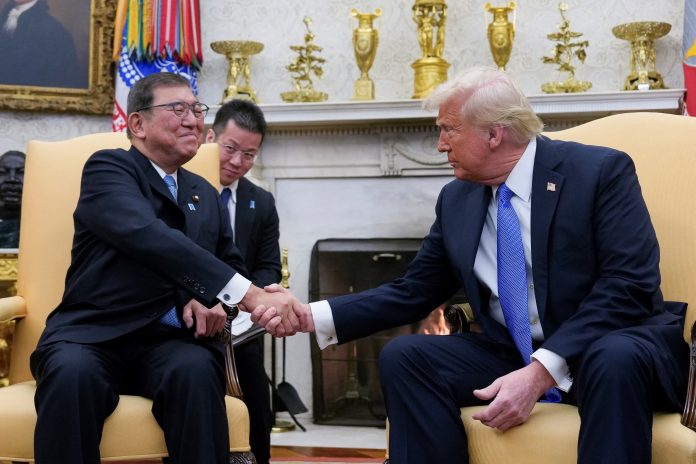
President Donald Trump on Tuesday night announced what he called “the largest trade deal in history” between the United States and Japan — a sweeping agreement that slashes auto tariffs, boosts U.S. exports, and unlocks a massive $550 billion Japanese investment in the American economy.

Speaking at a reception with Republican lawmakers at the White House, Trump declared, “I just signed the largest trade deal in history; I think maybe the largest deal in history with Japan… It’s a great deal for everybody.” He later added on Truth Social that the agreement would “create hundreds of thousands of jobs” and open Japan’s market to American cars, trucks, and agricultural products, including rice.

Under the agreement, the United States will impose a “reciprocal” 15% tariff on Japanese goods — a rate that notably applies to automobiles and auto parts. That marks a significant drop from the 25% levy Japan had faced since April. In return, Japan will inject $550 billion into the U.S. economy through a mix of equity and loans to Japanese businesses expanding into strategic sectors such as pharmaceuticals and semiconductors.

“This is a very exciting time for the United States of America, and especially for the fact that we will continue to always have a great relationship with the Country of Japan,” Trump said.

Key Terms of the Deal

  • Automobiles: Japan becomes the first country to receive reduced tariffs (15%) on auto and parts exports to the U.S. without volume restrictions, giving it a sharp edge over rivals like Germany and South Korea.
  • Agriculture: Japan will open its market further to U.S. rice and other farm products, a sticking point that had long stalled talks.
  • Investment: Japan will channel $550 billion into U.S. industries, including energy and tech. Trump claimed the U.S. would retain 90% of the profits from these investments.
  • Future talks: Both countries will continue negotiations on sectors left out of this agreement, including steel and aluminum, which remain subject to a steep 50% tariff.

Japanese Prime Minister Shigeru Ishiba called the deal “the lowest figure to date for a country that has a trade surplus with the United States.” In Tokyo, Ishiba said the government would “carefully” study the deal but hailed it as beneficial to Japanese jobs and innovation.

Ryosei Akazawa, Japan’s chief negotiator, posted a photo of himself pointing at an image of Trump and Ishiba in earlier talks, captioned “Mission accomplished.” He emphasized that the deal protects Japanese agriculture while providing new access for U.S. rice. “This agreement does not sacrifice Japanese farmers,” Akazawa told reporters.

Markets React

The announcement sent Japanese markets surging to a one-year high. Automaker shares led the rally, with Toyota rising nearly 12%, Honda and Nissan each gaining over 8%, and Mazda soaring 17%. Mitsubishi Motors climbed more than 13%. South Korean carmakers Hyundai and Kia also gained on expectations of similar tariff relief.

Auto exports make up over 28% of Japan’s shipments to the U.S. But Japanese carmakers had suffered steep declines in recent months: a 26.7% plunge in June and 24.7% in May, according to Japan’s trade ministry. Ed Rogers, CEO of Rogers Investment Advisors, said the new deal delivers “very needed short-term assurance” to Japan’s auto industry, though he warned that competition from China and South Korea remains intense.

The deal comes after months of strained negotiations, with Trump earlier threatening a 25% tariff on Japanese imports if a deal wasn’t reached by August 1. In a July letter to Prime Minister Ishiba, Trump had accused Japan of unfair trade practices, especially in rice and automotive imports.

“They won’t take our rice, and yet they have a massive rice shortage,” Trump posted recently. The U.S. sold $298 million worth of rice to Japan in 2024 and another $114 million between January and April this year, but critics had long pointed to Japan’s opaque rice import system.

Similarly, Trump repeatedly criticized Japan’s reluctance to import American cars. “We didn’t give them one car in 10 years,” he claimed earlier this month — though Japan imported over 16,000 U.S.-made vehicles in 2024, according to the Japan Automobile Importers Association.

Treasury Secretary Scott Bessent helped pave the way for the agreement with a high-level meeting in Tokyo last week.

“A good deal is more important than a rushed deal,” Bessent said, expressing optimism after talks with Ishiba.

Other Deals Unfolding

Beyond trade, Trump hinted that the U.S. and Japan are nearing a joint venture to develop a gas pipeline in Alaska — part of his broader push to shift Asian investment from China to U.S.-friendly projects.

“They’re all set to make that deal now,” Trump told lawmakers Tuesday.

Japan holds over $1.1 trillion in U.S. Treasury bonds — the largest foreign holder — giving it significant leverage in trade talks. The deal also comes at a delicate geopolitical moment, with the Trump administration pressuring allies to curb trade with China in exchange for deeper U.S. economic ties.

While Japan remains China’s largest trading partner, Tuesday’s agreement positions Tokyo more closely with Washington on trade alignment, especially in sectors where Beijing’s dominance has grown — like semiconductors and EVs.

The agreement builds on the 2019 bilateral trade pact between Japan and the U.S., which allowed greater duty-free access to some agricultural and industrial goods. However, the scale of this latest deal — particularly the $550 billion investment commitment and the slashing of auto tariffs — makes it the most consequential agreement between the two countries in recent memory.

With Trump’s August 1 deadline for sweeping tariffs still looming over other trading partners — including the EU, Mexico, and Brazil — Japan’s early compromise may serve as a model or a warning.
Safaricom Integrates PayPal Withdrawals into M-PESA App to Target Kenya’s Freelance Economy

0

Safaricom has taken a major step to strengthen its position in Kenya’s booming digital economy by integrating PayPal withdrawals directly into the M-PESA super app.

This new feature is designed to support the growing number of Kenyan freelancers and remote workers who rely on PayPal to receive payments from international clients.

By eliminating the need for third-party platforms or external web portals, Safaricom is making cross-border transactions faster, more seamless, and accessible marking a strategic move to capture a larger share of the country’s expanding freelance and gig economy.

Previously, users had to rely on a separate web portal to transfer funds from PayPal to M-PESA, a process often criticized for being slow and cumbersome.

The newly added mini app eliminates those steps, offering a seamless, in-app experience without the need for browser redirects or multiple logins. This marks the first time Kenyan users can withdraw directly from PayPal via the M-PESA app.

This update comes amid strong growth in Safaricom’s mobile money segment. M-PESA’s revenue for the year ending March 2025 was KES 161.1 billion (approximately USD 1.25 billion). This represents a 15.2% year-on-year growth for Safaricom’s mobile money service.

The growth was driven by a 20.3% increase in chargeable transactions per user and a 10.5% rise in monthly active customers, now totaling 35.82 million. M-PESA now contributes 43.4% of Safaricom’s total service revenue. 

Average revenue per user rose by 9.4% to KES 395.22 ($3.06), while Safaricom’s agent network grew 14.1% to nearly 299,000, ensuring widespread access to cash services. The M-PESA app itself has seen strong traction, with 13.7 million downloads and 4.7 million active users. In 2024 alone, it processed transactions worth KES 2.3 trillion ($17.83 billion).

Notably, M-PESA wallets now support balances up to KES 500,000 ($3,875), with individual transaction and daily limits also capped at KES 250,000 ($1,938) and KES 500,000, respectively.

Launched in 2007 by Safaricom and Vodafone in Kenya, M-Pesa has transformed financial access across Africa, becoming the continent’s leading mobile money service. The name, derived from “M” for mobile and “Pesa” (Swahili for money), reflects its core mission: enabling fast, secure, and accessible financial transactions via mobile phones, particularly for the unbanked.

By empowering affordable access to useful financial services for more than 60 million customers and 5 million businesses, M-PESA has been credited with largely contributing to an up to 60% growth in formal financial inclusion in different countries, with up to 84% of the population achieving formal financial inclusion.

In March 2024, M-Pesa boasted over 66.2 million customers and processed 33 billion transactions annually across seven African countries: Kenya, Tanzania, Mozambique, Democratic Republic of Congo, Lesotho, Ghana, and Ethiopia.

With the latest integration of PayPal withdrawals directly into the M-PESA app, Safaricom is positioning itself to capture greater transaction volumes, strengthen user retention, and reinforce its dominance in Kenya’s mobile money market.

Also, the PayPal-M-Pesa integration has been poised to be a game-changer for Kenya’s digital economy, with M-Pesa’s 30 million users in Kenya (out of 66.2 million globally) processing $4 billion in transactions annually. The service has empowered freelancers, small businesses, and online shoppers by bridging local mobile money with global payment systems.

This pivotal update aligns with M-Pesa’s evolution into a super app, which has seen it incorporate services like Pochi la Biashara, bill payments, and government services, positioning it as a rival to platforms like Flutterwave’s Send App for cross-border transactions.

Also, the integration supports financial inclusion, particularly for Kenya’s unbanked and underbanked populations, by enabling access to global markets without traditional banking infrastructure.

Lafarge Africa Triples Pre-Tax Profit to N126.6bn in Q2 2025, Driven by Construction Sector Booms

0

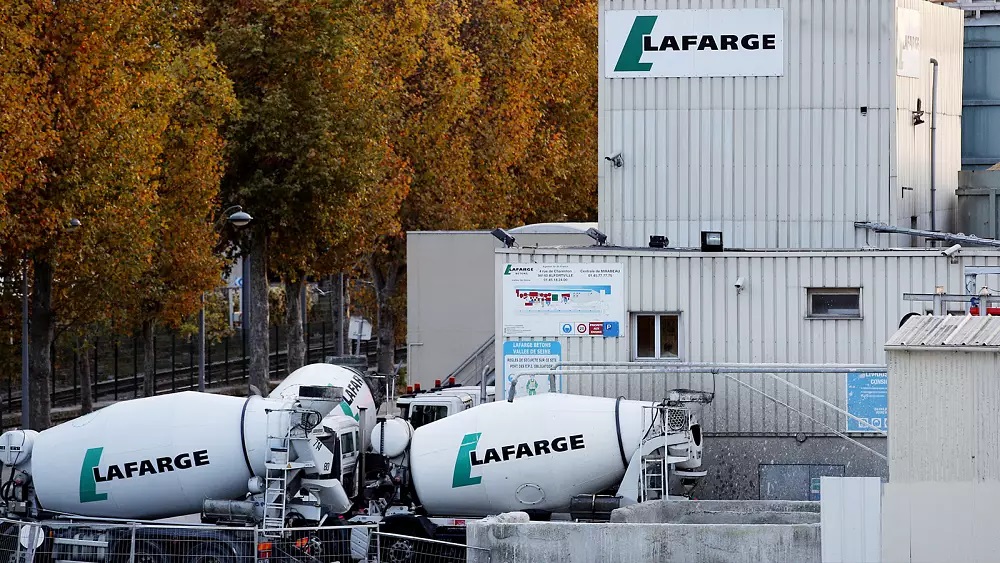
Lafarge Africa Plc has posted a pre-tax profit of N126.6 billion in the second quarter of 2025, marking an astonishing 233.9% jump from the N37.9 billion recorded during the same period in 2024.

The result signals a sustained earnings recovery and strong demand in the cement and construction market, as the company continues to benefit from robust sector-wide growth.

The impressive performance lifted Lafarge’s half-year profit to N199.7 billion—more than four times the N46.6 billion reported in the first half of 2024. This came as the company’s Q2 revenue surged 70.2% year-on-year to N268.6 billion, pushing total revenue for the first half of 2025 to N516.9 billion, up 74.9% compared to the same period last year.

Cement sales remained the engine of growth, accounting for N261.6 billion in Q2 revenue. Lafarge also made N6.6 billion from aggregates and concrete, and N296.8 million from other products, highlighting the company’s diverse building solutions portfolio.

The booming results coincide with a broader rebound in Nigeria’s construction sector. According to the National Bureau of Statistics (NBS), the construction industry recorded a 6.21% growth rate in Q1 2025, buoyed by increased infrastructure investments and heightened activity in both private and public building projects. The construction sector was among the top contributors to Nigeria’s GDP growth, which the International Monetary Fund projects will hit 3.3% for 2025.

Despite higher production costs—up 26.4% to N95.8 billion—Lafarge managed to more than double its gross profit, which rose to N172.7 billion from N81.9 billion in Q2 2024. This was achieved even as the company faced significant operational expenses. Selling and distribution costs rose 45.8% to N20.9 billion, while administrative expenses more than doubled, climbing 109.8% to N31.1 billion. Yet, operating profit soared to N120.6 billion, up from N47.7 billion a year ago.

Finance income also saw a notable boost, rising by 212.4% to N7.3 billion. Most of it came from interest earned on short-term deposits and current accounts, totaling N5.3 billion, with foreign exchange gains contributing another N1.9 billion—reflecting prudent treasury management amid currency volatility.

On the balance sheet, Lafarge’s total assets climbed to N1.02 trillion, compared to N990.5 billion in the corresponding period last year. Retained earnings also grew 15.5% to N364.4 billion, underscoring the company’s strong earnings retention and financial stability.

As of market close on July 21, 2025, Lafarge Africa’s shares were trading at N116 per unit, reflecting a year-to-date gain of 66.3%—a strong return driven by investor confidence in its growth trajectory.

The company’s stellar showing comes as Nigeria pushes infrastructure development to counteract macroeconomic shocks. With cement as a central input in roads, bridges, housing, and industrial projects, Lafarge’s performance continues to track closely with the pace of construction spending.

Analysts say the firm is well-positioned to benefit from continued infrastructure outlays, especially as both federal and state governments ramp up capital projects amid efforts to stimulate job creation and economic growth. The federal government’s shift to cement use in road construction is expected to sustain the growth in the long term.

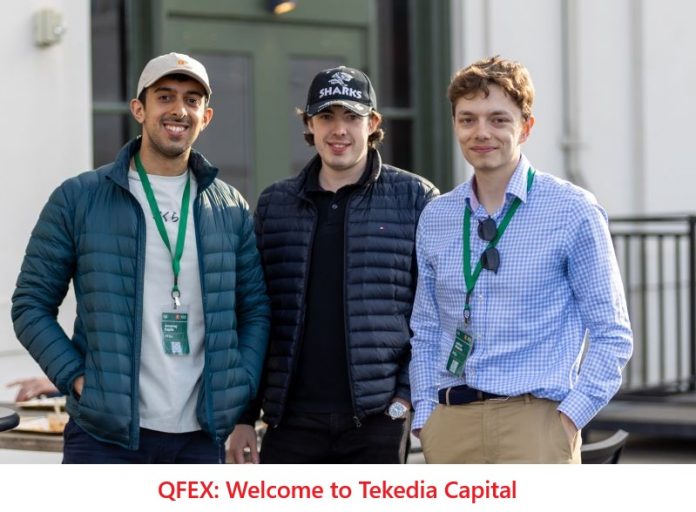
QFEX, 24/7 Exchange for Traditional Financial Markets, for Welcome to Tekedia Capital

0

QFEX is building a 24/7 exchange for traditional financial markets: no brokers, no delays. Today, trillions of US dollars move through the global financial markets, but legacy systems still rule. Orders route through brokers, fees vary without transparency, and trading shuts down on nights and weekends.

Inspired by the innovation in crypto markets, studied why real-time, global, always-on trading is possible in crypto – but not in traditional finance. QFEX acted. So, with QFEX, it would be possible for the stock exchange to be open 24/7 to buy US equities – and later others.

Largely, QFEX is bringing a direct-to-market, seamless experience to trading US equities, commodities, and FX pairs with purely volume-based fees, using cutting-edge tools like Perpetual Futures to power a new kind of exchange.

QFEX raised a significant amount of capital in one of the most successful seed rounds in this game; the team will make that public later.

Tekedia Capital is proud to be an investor in this US company. To learn more about QFEX, go here qfex.com, for Tekedia Capital and how to join, go here capital.tekedia.com

Africa’s Venture Capital Firm 54 Collective Faces Liquidation Amid Mastercard Grant Mismanagement Scandal

0

54 Collective, a venture capital firm that aimed to revolutionize investment and scale ideas to early-stage ventures throughout Africa, is currently on the edge of collapse following allegations of mismanaging over $42 million from Mastercard.

What began as a nonprofit initiative to fund African startups has spiraled into a full-blown financial scandal involving unauthorized transfers, unapproved rebranding, and thousands of questionable accounting entries.

Initially established to catalyze startup growth in Africa, the firm is accused of rerouting $4.59 million to its for-profit affiliate, Founders Factory Africa, and spending nearly $700,000 on a rebrand all without Mastercard’s approval.

Recall that in August 2024, the firm announced its rebrand into 54 Collective from Founders Factory Africa, promising a bolder mission to support tech ventures across Africa through catalytic capital and tailored operational support via its Venture Success Platform. This new model offered startups between $100,000 and $250,000 in equity investments and $100,000 to $150,000 in non-dilutive funding.

However, trouble began when Mastercard Foundation started asking questions about the rebrand and fund usage. The company’s accounting books were suddenly flooded with over 2,000 “adjusting journal entries”, none of which were supported by audited financial statements. According to Condia, the incomplete documentation prompted the foundation to commission accounting audit firm Deloitte, in December 2024 for a forensic audit. What they found was alarming, gross widespread financial irregularities.

In a letter, Daniel Hailu, Executive Director for Impact, Research, and Learning at Mastercard Foundation, raised red flags about “potential for-profit activity being associated with the brand linked to charitable programs” and the apparent transfer of goodwill to non-charitable entities. The foundation also launched an internal investigation into AFV’s dealings.

By February 2025, over 40 employees at 54 Collective were hit with news of a company shutdown. This comes after Mastercard Foundation ended its partnership with the VC, as well as pulling its funding, causing a financial collapse that rippled through the venture studio, Gen F accelerator, and Entrepreneur Academy, all programs once powered by the now-defunct grant.

Court documents reviewed by TechCabal confirm that Mastercard’s decision was directly tied to 54 Collective’s rebranding in August 2024. Despite CEO Bongani Sithole’s denials of wrongdoing and claims that the agreement wasn’t terminated due to a breach, the damage was already done.

In a desperate move, the firm tried to undergo “business rescue,” asking the court for $1.2 million to cover staff salaries and $500,000 for office closures. But a South African High Court was unconvinced, calling the rescue plan “legally invalid” and pointing to a “blatant disregard for the law.”

The Court has since issued a provisional liquidation order and frozen over a dozen bank accounts held by 54 Collective at Nedbank, Standard Bank, and Investec — citing concerns of improper fund transfers. The final liquidation hearing is scheduled for August 11, but all signs point to a permanent shutdown.

Launched in 2018, 54 Collective had invested in more than 55 tech startups across the continent, including well-known names like Renda, WellaHealth, and Lipa Later. Its Venture Success Platform was once hailed as a game-changer, offering personalized venture support through a team of seasoned experts.

Now, with its reputation in shambles, and a $106.5 million grant under scrutiny, 54 Collective is becoming a cautionary tale in Africa’s venture capital landscape, a stark reminder that ambition without accountability can unravel even the most promising missions.