DD
MM
YYYY

PAGES

DD
MM
YYYY

spot_img

PAGES

Home Blog Page 827

Google Signs EU’s AI Code of Practice as Meta Backs Out, Deepening Rift Over Regulation

0
The US is after Google also

Google has confirmed it will sign the European Union’s general-purpose AI code of practice, a voluntary framework meant to help developers of powerful AI models align with the bloc’s upcoming AI Act.

The move sets Google apart from Meta, which earlier this month refused to endorse the code, calling it overreaching and harmful to Europe’s AI prospects.

The decision by Google comes just days before August 2, when new EU rules for providers of “general-purpose AI models with systemic risk” are scheduled to take effect. These rules apply to major players like Google, Meta, OpenAI, Anthropic, and others building or deploying large-scale generative models. While the AI Act gives these companies two years to fully comply, the EU code of practice acts as a transitional mechanism to encourage best practices ahead of enforcement.

In a blog post published Wednesday, Kent Walker, Google’s President of Global Affairs, acknowledged that the final version of the code was an improvement from the original draft, but said the company still holds “serious reservations.” He warned that the AI Act and its accompanying code could hinder innovation, citing concerns over deviations from EU copyright law, slowed approval timelines, and exposure of proprietary trade secrets.

“We remain concerned that the AI Act and Code risk slowing Europe’s development and deployment of AI,” Walker wrote.

Despite those reservations, Google is going forward with its commitment to sign the code, making it one of the first among the world’s top AI firms to publicly declare support for the EU framework. Signing the code binds AI developers to a list of expectations, including keeping updated documentation on their AI models, avoiding the use of pirated content in training datasets, and responding to content owners who do not wish to have their work used to train AI.

Meta’s refusal to sign has drawn a sharp line within the AI industry. The company described the code as legally questionable and accused the EU of creating obligations that go beyond the AI Act’s legal framework. Meta also criticized what it called Europe’s “wrong path on AI,” arguing that such regulations may discourage companies from building foundational AI systems in the region. This sentiment reflects broader tensions between U.S. tech giants and European regulators, especially as the EU takes the lead globally in attempting to place guardrails on AI.

The EU’s AI Act itself is a sweeping risk-based regulation. It bans certain “unacceptable risk” uses of AI, including manipulative behavioral systems and social scoring, while placing strict controls on “high-risk” applications like facial recognition, biometrics, education, and employment. Developers of such systems will be required to register their models, conduct risk assessments, and meet transparency and quality management obligations. Violators face stiff penalties, including fines of up to 7% of global turnover.

While the code of practice is not legally binding, it offers a glimpse of how the EU plans to interpret and enforce the broader rules of the AI Act. Companies that sign the code are expected to benefit from greater legal clarity and reduced regulatory friction, particularly during the transition period before the full force of the law kicks in.

Google’s decision to align with the EU—despite ongoing misgivings—signals a cautious but strategic embrace of regulatory cooperation. Meta’s defiance, on the other hand, highlights deep industry fractures over how best to balance innovation with accountability in the fast-evolving AI space.

It is not clear for now whether other U.S. firms like Microsoft, OpenAI, or Anthropic will follow Google’s lead or side with Meta. What’s clear is that the EU’s push to rein in AI through comprehensive rules is no longer theoretical. The regulatory future is arriving, and companies must now choose their path.


Unlock Your Potential with Tekedia Mini-MBA: Where Knowledge Meets Business Execution

0

Imagine the thrill of a perfectly aimed penalty kick. Yes, that moment of precision, power, and ultimate goal, to win a trophy. That’s the same feeling you’ll get when you equip yourself with the knowledge and skills from Tekedia Mini-MBA, propelling your career and business towards undeniable success.

The Tekedia Mini-MBA Edition 18 is a dynamic 12-week online innovation management program, meticulously designed to elevate your understanding of business execution and growth, all within a crucial digital framework. Running from September 15 to December 6, 2025, this program is themed “Innovation, Growth & Digital Execution – Techniques for Building Category-King Companies.”

You will get a manual titled “The Dangote System: Techniques for Building Conglomerates” which will open your eyes on the physics of building enduring wealth.

Why Tekedia Mini-MBA?

  • Flexible Learning: All course content is self-paced, recorded, and archived, offering you the flexibility to learn at your convenience, no matter your schedule.
  • Comprehensive Curriculum: Dive deep into a wide array of critical business topics including Innovation, Design Thinking, Business Systems & Processes, Exponential Technologies, Marketing, Sales Management, Law, Leadership, and much more. Each week builds on the last, ensuring a holistic understanding of modern business landscapes.
  • Global Faculty & Engagement: Learn from a global faculty coordinated by the esteemed Prof. Ndubuisi Ekekwe. Engage directly with faculty and guests through “Tekedia Live” – optional Zoom sessions held thrice weekly (Tues, Thurs, Sat at 7 pm WAT), with all sessions archived for your convenience.
  • Practical & Applied Knowledge: The program is packed with videos, flash cases, challenge assignments, labs, and written materials, ensuring a practical and hands-on learning experience that goes beyond theoretical concepts.
  • Industry-Agnostic: Whether you’re in tech, finance, healthcare, or any other sector, the principles taught are universally applicable, designed to foster innovation and growth in any industry or firm.
  • Certificate of Achievement: Upon successful completion, you will be awarded a certificate of achievement by Tekedia Institute, Boston USA, a testament to your newly acquired expertise.

Invest in Your Future – Flexible Pricing Options!

Take advantage of early bird pricing until Aug 2, 2025.

  • “MINI” Package: Includes the Tekedia Mini-MBA and WhatsApp School for just US$170 or N120,000.
  • “MINF” Annual Package: For those committed to continuous growth, this package offers 3 consecutive MINI programs, 2 optional capstones, and annual access to Blucera.com and the Tekedia Daily podcast for $340 or N180,000.

Optional add-ons like homework review and a Tekedia capstone research paper are also available to enhance your learning journey.

Don’t miss out on this opportunity to transform your business acumen and kickstart your path to becoming a category-king!

Enroll today and take that decisive penalty kick towards unparalleled success with the Tekedia Mini-MBA. Visit https://school.tekedia.com/course/mmba18/ for more details and to register.

Afriex Expands Into Asia’s Largest Remittance Markets to Power Cross-Border Payments For African Traders And Diaspora

0

Afriex, a money-transfer platform that allows users to make instant and affordable money transfers locally and abroad, has expanded into Asia’s three biggest remittance markets, China, India, and Pakistan to meet rising demand for seamless cross-border payments.

The move strengthens Afriex’s position to serve African merchants and diaspora communities engaged in foreign trade or sending money home.

Speaking on the expansion, Afriex’s co-founder and CEO Tope Alabi said,

Our money transfers to India and Pakistan are instant, just like sending money to a friend or paying your Uber driver, and 90% of our transactions are completed in under two seconds. Although on China’s side, we are not yet at the same level of instant, but we’re getting close.”

Asia’s remittance market is a critical component of the global financial landscape, driven by high migration rates and the economic contributions of diaspora communities.

The global remittance market was valued at approximately USD 796.74 billion in 2023 and is projected to reach USD 1,334.69 billion by 2032, with a CAGR of 5.9%. Asia-Pacific holds the largest share, accounting for a significant portion of global inflows due to its high migrant population.

In 2022, Asia received USD 302.1 billion in remittances, the largest share of the global total of USD 682.6 billion. The Asia-Pacific digital remittance market was valued at USD 49.85 billion in 2018 and is expected to reach USD 269.78 billion by 2026, with a CAGR of 23.5%, driven by mobile money ecosystems and digital platforms.

India alone received $120 billion in remittances in 2023, followed by China with $50 billion and Pakistan with $27 billion three of the world’s top five recipient countries.

Afriex’s expansion to Asia’s biggest remittance markets comes amid a global surge in cross-border payments, fueled by migration, trade, and remote work. This move reflects the startup’s ambition to bridge financial connectivity between Africa and Asia, driven by increasing trade, migration, and global payment trends.

Afriex’s entry will facilitate smoother money transfers between Africa and Asia, benefiting African traders importing from Asia and diaspora communities supporting families.

Afriex was founded in 2019 by Alabi and John Obirine to fix a broken system where cross-border transfers were slow, expensive, and unfair. The company began as a simple MVP for friends and family.

Currently, the startup enables users to send and receive money in local currencies between Africa and other regions without relying on traditional payment rails like SWIFT. Its multi-currency payment infrastructure settles transactions in real time through a mobile app integrated with local banks.

Afriex enables real-time, low-cost money transfers through its mobile app, bypassing traditional systems like SWIFT. It waives fees on transfers above USD 10, earning revenue via foreign exchange spreads, and integrates with local banking systems for seamless settlements.

Afriex’s services target African traders and global diaspora populations that import goods or support families across these markets. To encourage adoption, Afriex waives transaction fees on transfers above $10, generating revenue from foreign exchange spreads.

The company currently has over 600k active users, serves over 50+ countries, and is backed by leading investors which include Y Combinator, Dragonfly, Sequoia Capital, and GoldenTree Asset Management.

Afriex aims to achieve instant payments to China by the end of 2025, matching its capabilities in India and Pakistan. The company partners with local firms in each country to navigate regulatory requirements efficiently.

The startup joins other African fintechs expanding globally, which include Flutterwave, which entered India through a local banking partnership in 2023, and LemFi, which secured $53 million in 2025 to scale operations across Asia and Europe. However, its focus on African-Asian corridors differentiates it, offering tailored solutions for underserved trade and remittance routes.

Notably, while its approach has evolved over the years, the company’s long-term goal is to build a global bank that enables people to send money to anyone instantly.

Business Financing and Unlocking Corporate Credit in Africa | Tekedia Mini-MBA

0

Access to business financing remains a critical challenge for many enterprises in Africa. Despite the continent’s entrepreneurial spirit and a growing pool of SMEs, traditional financing systems often exclude these businesses due to high collateral demands, limited credit histories, and fragmented financial markets. This exclusion stifles innovation and scalability, leaving many promising ventures underfunded and unable to expand. Informal financing still dominates, but it lacks the structure and sustainability necessary to drive long-term growth.

To unlock corporate credit across Africa, stakeholders must build robust credit infrastructure, deepen financial inclusion, and embrace innovative models such as fintech lending, invoice factoring, supply chain finance, and credit guarantees. Credit bureaus and digital identity systems can improve creditworthiness assessments. Public-private partnerships and regulatory reforms must also support more transparent and accessible lending ecosystems. By rethinking credit mechanisms and reducing structural barriers, Africa can catalyze entrepreneurship and industrial growth across its markets.

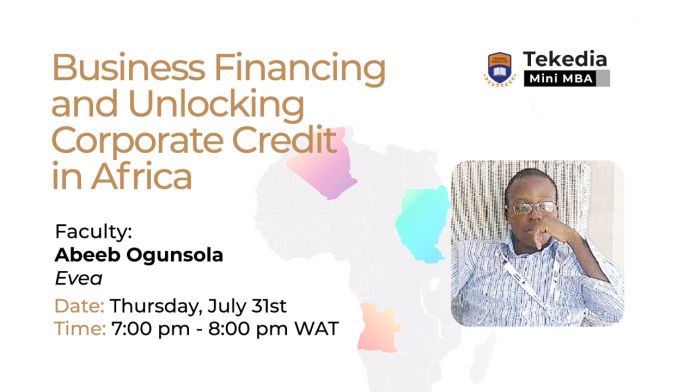
Tomorrow, at Tekedia Mini-MBA, Abeeb Ogunsola, CEO of Evea, a pioneering corporate credit company in Nigeria will educate on this, explaining the core difference between using a corporate credit card and a business loan – and how the firm has been funding companies via credit.

Thur, July 31 | 7pm-8pm WAT | Business Financing and Unlocking Corporate Credit in Africa – Abeeb Ogunsola, Evea | Zoom link https://school.tekedia.com/course/mmba18/

Generative AI Apps Soar in Usage and Revenue, With ChatGPT Leading the Surge

0

Generative AI apps are enjoying an unprecedented surge in popularity, as both user downloads and in-app spending reached record highs in the first half of 2025, according to a report released by market intelligence firm Sensor Tower.

Between January and June 2025, users downloaded generative AI apps 1.7 billion times—up from 1 billion in the latter half of 2024—signaling a staggering 70% growth. The category also recorded a dramatic spike in in-app purchases, with revenue nearly doubling to $1.87 billion from $932 million in H2 2024.

Users are not just downloading these apps; they’re spending more time than ever inside them. Sensor Tower reported that Gen AI apps saw over 15.6 billion hours of usage in H1 2025, a sharp rise from 8.5 billion hours in the second half of 2024. These figures spanned 426 billion sessions, a sign of increasing user engagement.

Asia Emerges as the AI Frontier

Asia outpaced all other regions in download growth, accounting for 42.6% of global Gen AI app installs in the first half of the year. Much of this momentum was driven by rising adoption in markets like India and Mainland China, with the region’s overall download growth reaching 80%, far ahead of 51% in Europe and 39% in North America.

When it comes to in-app purchases, Latin America registered the highest growth, though North America still holds the largest market share, pulling in 40% of total Gen AI in-app revenues.

ChatGPT Dominates Global Market—Except China

The growth of ChatGPT stood out in nearly every category. The app led in-app revenue rankings globally, except in China, where DeepSeek, a local competitor, topped the charts shortly after launch. While DeepSeek took the lead in downloads in China, ChatGPT maintained its dominance elsewhere, becoming the most-used generative AI assistant.

According to Sensor Tower, ChatGPT was used for an average of 12.1 days per month in H1 2025. That frequency places it alongside top social platforms like X and Reddit, with only Google having a better usage rate. Notably, weekend usage of ChatGPT also rose, suggesting that users now rely on the app not only for work-related tasks but also for lifestyle needs and personal support.

Beyond traditional uses like writing and coding, users are increasingly turning to ChatGPT for help with health and wellness, shopping recommendations, personal finance, and meal preparation. In Q2 2025 alone, over one-third of prompts were related to lifestyle and entertainment, demonstrating the app’s expanding role as a versatile assistant.

The report also found that 15% of ChatGPT users in the U.S. access it across both mobile and web, a multi-platform engagement that outpaces popular platforms like Temu and Threads, but still lags behind tech giants such as Google, Facebook, YouTube, and Amazon, where 25% or more of users interact across devices.

Generative AI Turns into a Branding Trend

The AI boom has also sparked a naming frenzy. The term “AI” now appears in over 100,000 app descriptions across the App Store and Play Store. In H1 2025, apps with “AI” in their names or descriptions were downloaded 7.5 billion times, accounting for about 10% of all app downloads globally.

Sensor Tower noted that developers across multiple categories—from photo editing and nutrition to test prep, translation, and hobby apps—are adding AI references to gain traction. This strategy has delivered measurable, though often short-lived, spikes in downloads.

“Apps that added terms like ‘AI’ or ‘LLM’ to their names or descriptions experienced a notable boost in downloads over the subsequent months,” the report stated, adding that while the term offers short-term visibility, it doesn’t guarantee long-term engagement unless backed by robust AI capabilities.

What It Means

The Sensor Tower report reinforces what many in the tech industry have anticipated—generative AI is not just a trend but a transformation. With increasing engagement times, cross-platform adoption, and diversified use cases, apps like ChatGPT are shifting how users interact with digital tools.

This means that as regional players like DeepSeek gain traction and new apps flood the market, the global generative AI space is setting the stage for even fiercer competition and innovation in the second half of the year.