DD
MM
YYYY

PAGES

DD
MM
YYYY

spot_img

PAGES

Home Blog Page 829

Trump Clinches Landmark Trade Deal with EU, Avoids Tariff War with 15% Levy and $1.35tn Investment Pledge

0

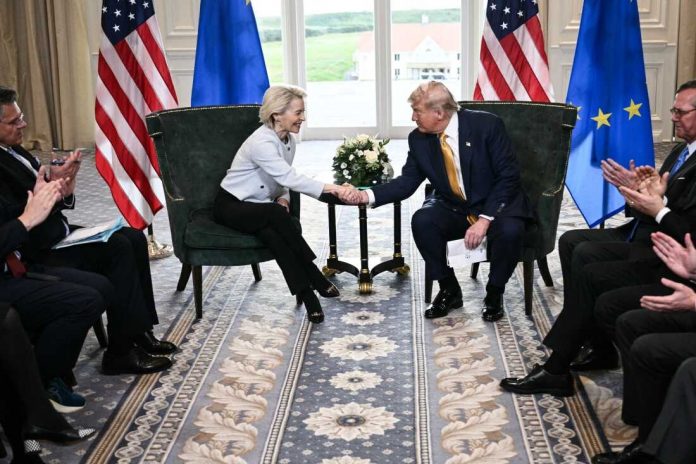
President Donald Trump announced a landmark trade agreement between the United States and the European Union on Sunday, narrowly averting a potentially bruising tariff war just days before the August 1 deadline.

The deal, reached after intense negotiations with European Commission President Ursula von der Leyen, imposes a 15% tariff on most European goods entering the U.S., including automobiles, while also delivering massive EU commitments to U.S. energy, military, and investment markets.

The agreement represents a middle ground between Trump’s earlier 30% tariff threat and the EU’s demand to retain 10% baseline rates. It also comes with significant concessions from Brussels, including a $750 billion purchase of U.S. energy and $600 billion in additional EU investment into the American economy, on top of existing levels. Trump said the EU would also purchase “hundreds of billions of dollars worth of military equipment,” although he didn’t disclose an exact amount.

“This is a very powerful deal. It’s a very big deal. It’s the biggest of all the deals,” Trump declared Sunday.

Von der Leyen, echoing Trump’s tone, called the agreement “a good deal, a huge deal, with tough negotiations.”

Tariff Terms and Exemptions

The 15% tariff will apply to a wide range of European exports, with major implications for industries like automobiles and consumer goods. However, certain sectors such as aircraft and aerospace components, specific chemicals, and pharmaceuticals are exempt, von der Leyen said. Notably, the newly imposed 15% tariff will not be added on top of any existing tariffs, providing a modicum of relief to European exporters.

The move comes as both sides scrambled to avoid a collapse in talks, which had been teetering until just days ago. Trump, in a press briefing before his meeting with von der Leyen, had pegged the chances of a deal at “50-50.” European officials had been preparing for a breakdown, authorizing counter-tariffs and even considering deployment of the EU’s “Anti-Coercion Instrument,” which some in Brussels described as the bloc’s “trade bazooka.”

$1.35 Trillion in Economic Commitments

Beyond tariffs, the deal is notable for its sheer economic scale. The $750 billion EU commitment to U.S. energy — including liquefied natural gas, oil, and renewables — represents one of the largest single pledges ever made by the bloc. It underscores Europe’s intent to diversify energy sources amid growing geopolitical uncertainty.

The EU also committed to $600 billion in new investments across U.S. infrastructure, tech, and manufacturing, a move Trump said would drive American jobs and supply chain independence.

While Trump touted the military procurement component, von der Leyen offered little detail, sparking speculation about future defense contracts involving NATO-aligned purchases of American aircraft, defense systems, and cybersecurity technologies.

European Leaders Weigh In

European capitals responded with a mix of relief and caution. Irish Prime Minister Micheál Martin praised the agreement as a stabilizing force, saying it “brings clarity and predictability” to the trading relationship, but acknowledged that higher tariffs would “make trade between the EU and the US more expensive and more challenging.”

Germany’s Chancellor Friedrich Merz — whose country’s powerful auto sector stood to lose the most — welcomed the outcome, emphasizing that reducing auto tariffs from 27.5% to 15% was a lifeline.

“With the agreement in the EU-US negotiations on tariffs, a trade conflict, which would have hit the export-oriented German economy hard, has been avoided,” Merz said in a statement.

Dutch Prime Minister Dick Schoof offered a more tempered reaction, writing on X: “No tariffs would have been better, but this deal brings clarity for our businesses and provides more market stability.”

Averting a Crisis

The deal averts what economists and trade experts had warned would be a mutually damaging showdown between the world’s two largest economic blocs. In 2024, U.S.-EU trade in goods and services totaled €1.68 trillion ($1.97 trillion), with the EU running a €50 billion overall surplus, according to the European Council.

Brussels had been under pressure to hold the line, especially after Washington’s hardline stance in previous trade spats with Canada, Mexico, and China. The threat of steep tariffs had rattled global markets, and the EU’s decision to meet Trump halfway — while extracting carve-outs and investment guarantees — is being hailed in diplomatic circles as a pragmatic compromise.

But critics say the burden of higher tariffs will be felt by consumers and businesses on both sides of the Atlantic. The agreement also leaves unresolved questions about how the new investment figures will be tracked, or whether the bloc’s military purchases will materialize at the scale Trump suggested.

Trump’s Trade Doctrine Holds

Sunday’s announcement adds to Trump’s growing list of bilateral trade deals, part of a broader shift away from multilateralism. It also marks a significant political victory for the president ahead of the fall legislative session, reinforcing his argument that the “America First” doctrine can deliver massive economic concessions from traditional allies.

For the European Union, the deal buys time and certainty — but at a cost. For the U.S., it underscores Trump’s willingness to threaten economic pain to secure strategic and financial wins. The world’s two largest trade powers may have averted a war, but the balance of power, many believe, has tilted unmistakably.

After months of tense negotiations, the U.S. and European Union have reached a trade agreement that includes a 15% tariff on most EU exports, plus automobiles, Bloomberg reports. The deal arrives days before the two major trading partners had threatened to impose rival 30% levies that would have “delivered a hammer blow” to global trade. The EU will also purchase $750 billion in U.S. energy and invest $600 billion in the U.S. Meanwhile, China and the U.S. are reportedly in talks to extend their tariff truce.


‘Happy Statistics, Unhappy People’: Rewane Breaks Down Nigeria’s 3.13% GDP Growth, Interest Rate Retention, and What It Means for Nigerians

0

Last week, Nigeria was awash with official data, led by the report from the Nigerian Bureau of Statistics (NBS) that the country’s Gross Domestic Product (GDP) recorded 3.3% growth in the second quarter of 2025. With the buzz the numbers are generating, renowned economist Bismarck Rewane is urging caution: numbers may be improving, but if people don’t feel the impact, then the celebration is misplaced.

In a sweeping review of the country’s macroeconomic outlook, Rewane weighed in on the Central Bank of Nigeria’s (CBN) decision to retain the benchmark interest rate at 27.5%, the recently released 3.13% GDP growth figures, and the strengthening of the naira—warning that while these indicators reflect progress, the lived reality for many Nigerians is still grim.

Speaking in an interview with ChannelsTV, following the Monetary Policy Committee’s (MPC) latest decision, Rewane described the CBN’s rate retention as a conservative but wise move.

“The market was divided. Some felt it was time to bring down rates by 25 basis points. Others wanted it retained. I think the committee did the right thing,” he said.

Over the past two years, interest rates have been raised six times, held steady three times, and only cut once, resulting in a cumulative increase of 8.75%. Inflation, though still troubling, has shown a gradual decline during that period.

Rewane underscored that the MPC was being cautious due to persistent vulnerabilities at home and global uncertainties abroad.

“Inflation is still a hydra-headed beast,” he warned. “You don’t go precipitously to reduce rates and then backtrack.”

He pointed to modest improvements: the naira has appreciated about 6.6% over two months, trading around N1,528 to the dollar, stronger in the parallel market than in the official window, a rare occurrence in more than a decade. Logistics costs have eased, and petrol prices fell by 4.4% to N865 per liter in the last month. Yet, these are far from signs of a fully recovered economy.

While Nigeria’s GDP figures for the first half of 2025 offered cause for optimism, showing a growth rate of 3.13%, Rewane was quick to temper expectations.

“It’s not yet Uhuru,” he said, reiterating that the GDP growth must translate into better living conditions. The country, now the fourth largest economy in Africa behind South Africa, Egypt, and Algeria, has a rebased GDP of around $250 billion.

In the world, it is number 40. The goal before was for Nigeria to be within the top 20 countries in the world. We are now number 40. The income per head in Nigeria is $1,000 compared to South Africa, where it’s $5,000. Our share of global GDP is 0.23% and our share of the global population is 2.9%. This economic growth shows an upward trend.

“Well, we still have work to do. And let me make it clear, the goal, as pointed out by the president, is that we should be at $1 trillion by 2030. Today, we are growing at 3.1%. For us to go from $250 billion to $1 trillion, we need to grow at 15%. That’s not going to happen quickly except certain things change,” he said.

Despite the little gain the naira recorded, Rewane warned that the currency’s future remains shaky. The naira has appreciated 8% year-to-date, but largely against a weakened dollar. Compared to the pound and euro, its performance is less impressive. He cautioned that if crude oil prices fall below $65 per barrel, the gains in the naira’s value could be wiped out quickly.

“Nigeria is playing it safe to avoid market flip-flops. What we’ve earned is a reputation of being cautious, stable, and consistent,” he said, emphasizing that price stability remains a central mandate for the CBN.

On inflation’s toll on households, Rewane painted a bleak picture. “Last year, in July, a bag of rice cost N84,000. It’s now N87,000. That’s up 3.57%, though it had previously dropped before rebounding,” he explained.

Wheat flour has jumped from N59,500 to N65,000, while chicken drumsticks are now N5,500, up 22%. Eggs rose 5.7% to N5,500, pepper soared 50% to N90,000, and tomatoes spiked 83%. Only garri saw a decline, from N46,000 to N33,000.

In the non-food category, costs continue to climb. Transport fares from Lagos to Benin rose from N25,000 to N28,250. Airfares from Lagos to Abuja have surged 31% from N152,000 to N200,000. Lonart syrup, a common malaria medication, rose from N3,800 to N4,600. Only cooking gas became more affordable, dropping from N15,060 to N11,875.

“That’s good, but you have to have the food to cook. Right now, you have the gas, but there’s hardly any food to cook in it,” he said.

Rewane emphasized that Nigeria must shift from simply celebrating statistical growth to ensuring an inclusive economic impact.

“What we want to avoid are happy statistics and unhappy people. How are we going to do that? You can grow as much as you want. You can do all, it must be about the welfare of the people. The people must feel it, must be happy about it. If not, you will have happy statistics and unhappy people,” he said.

He stressed the need for redistribution and economic planning that prioritizes poverty reduction and job creation. According to Rewane, the path forward requires deliberate efforts to close the gap between macroeconomic success and household realities.

SUI ETF Push Sparks Rally, ENA Eyes $0.63, BlockDAG Powers 10x Mining Surge Ahead of Launch

0

Opportunity doesn’t often knock twice, but right now, three cryptocurrencies are flashing strong upside signals. SUI has turned heads as Canary Capital’s ETF application enters SEC review. That move alone has stirred bullish chatter and reignited interest in the project. Ethena (ENA) is also gaining traction as it tests a major support level that previously acted as resistance. Holding that zone could push the price to $0.63 and beyond.

Meanwhile, BlockDAG (BDAG) might be the most accessible earning tool in the space. A recent live demo of its X1 and X10 mining combo showed how users can increase their daily earnings tenfold, just by pairing a compact rig with their smartphone. With BlockDAG’s presale climbing past $354 million, the project is gaining serious attention. All three coins bring something unique, but which one delivers the best opportunity right now? Here’s a closer look.

SUI Gains Strength as ETF Review Sparks Optimism

The outlook for SUI has turned bullish with the SEC now reviewing Canary Capital’s SUI ETF proposal. That development alone has fueled optimism around institutional demand, with analysts expecting a breakout if the ETF gains traction.

Currently priced near $3.95, SUI trades well above its 200-day average of $2.73. Technical signals are strong, including a 66 RSI, which leaves room for further gains. If SUI breaks through $4.00, it could quickly climb to $4.20 or even $5.00. Some predictions even stretch to $6 if ETF approval is granted.

Market watchers are now keeping a close eye on the $4.00 resistance level. If that’s broken with volume, the August outlook for SUI becomes far more exciting. With ETF developments unfolding and strong support in place, SUI remains one of the more technically sound assets to track right now.

Ethena Holds Support with $0.63 Price Target Ahead

Ethena (ENA) is retesting a key support zone between $0.37 and $0.45, a region that once acted as resistance. Now flipped to support, this range could launch ENA’s next major move. A sustained hold above $0.46 might trigger a run toward $0.63, with further upside to $0.80 and potentially $1.00.

The current price is steady, but a close watch is on the 200-day moving average at $0.4279. A dip below could change sentiment, yet for now, the structure remains bullish. Clearing the $0.50 mark would signal strength, potentially attracting more volume.

The broader trend shows ENA building upward pressure. Technical analysts are optimistic, noting that this support zone gives ENA the setup it needs to approach the next price target. For those tracking breakout plays, this support-flip behavior is usually a solid indicator.

BlockDAG Unleashes X10 Miner to Supercharge X1 Rewards

BlockDAG continues to make waves with its X1 miner app, now used by over 2 million users across Android and iOS. It offers a simple entry into passive earning, users just activate the app and start collecting up to 20 BDAG per day, directly from their smartphones. The process is user-friendly, requires no setup hassle, and is completely free to start.

What’s driving the latest surge in attention is the new X10 miner, revealed during a live demo. This compact hardware device links seamlessly with the X1 app via Bluetooth. Once connected, it amplifies daily rewards tenfold, taking earnings from 20 BDAG to 200 BDAG a day. It runs quietly, fits easily in any home setup, and needs no technical skills to operate, just plug it in and let it work.

BlockDAG’s presale has already crossed $354 million, and over 24.3 billion coins have been sold. The current price is locked at $0.0016, while the launch is set at $0.05. That creates a projected ROI of 3,025% from now to launch. With powerful mining tools, scalable tech, and growing demand, BlockDAG isn’t just building hype, it’s building real earning potential for everyday users in a way few projects can match.

Which Project Offers the Most Upside?

SUI’s outlook has strengthened with its ETF status under review, potentially pushing the price above $4 if momentum continues. ENA is showing solid technical structure with $0.63 as the next possible stop if support holds.

However, BlockDAG’s appeal lies in both its tech and returns. Its dual miner setup, live product showcase, and massive daily BDAG rewards offer a clear advantage. At just $0.0016 per coin with a 3,025% ROI window, the project combines ease of use with strong earning potential.

For anyone scanning the market for the best crypto to buy now, BlockDAG isn’t just an option, it’s a frontrunner.

Presale: https://purchase.blockdag.network

Website: https://blockdag.network

Telegram: https://t.me/blockDAGnetworkOfficial

Discord: https://discord.gg/Q7BxghMVyu

European Exporters Face A Heavy Blow as Trump Tariffs Loom, Trade Talks Falter

0

European firms are bracing for a heavy blow as President Donald Trump pushes ahead with sweeping tariffs on EU goods, intensifying trade tensions and threatening to derail key industries across the continent.

With just days to go before the U.S. imposes a 30% tariff on all European imports starting August 1, European officials are scrambling to reach a last-minute agreement to stave off the economic fallout.

Trump’s move follows a series of aggressive trade actions, including a 25% duty on foreign vehicles and parts imposed in April, bringing the effective U.S. tariff on European autos to 27.5%. The president has since threatened to raise this to 30%, sending shockwaves through Europe’s manufacturing and export sectors, particularly the already struggling auto industry.

Auto Industry Hit Hard

German auto giant Volkswagen reported a €1.3 billion ($1.53 billion) hit from U.S. tariffs in just the first half of 2025. Its Q2 earnings showed a sharp drop in operating profit, prompting the company to slash its full-year guidance.

Similarly, Stellantis, the multinational automaker behind brands like Jeep, Dodge, and Peugeot, pre-emptively warned investors of a €2.3 billion loss, citing tariffs and production delays. The group confirmed a €300 million loss in H1 from direct tariff costs and output disruptions triggered by trade uncertainty.

Swedish automaker Volvo Cars also posted a steep fall in Q2 operating profit, attributing the downturn directly to the White House’s tariff regime.

Consumer and Tech Firms Also Struggling

The economic toll isn’t limited to automakers. German sportswear brand Puma issued a profit warning Friday, saying U.S. trade policy had depressed sales and would likely lead to a full-year operating loss. Before the warning, Puma had projected a profit between €445 million and €525 million.

In France, spirits maker Rémy Cointreau raised its full-year guidance but admitted U.S. tariffs would weigh more heavily than anticipated, now projecting a €35 million tariff hit, up from its previous estimate of €25 million.

Nokia, the Finnish telecom equipment giant, cited tariffs as a key reason for slashing its full-year operating profit forecast to between €1.6 billion and €2.1 billion, down from €1.9 billion to €2.4 billion. Tariffs are expected to reduce Nokia’s 2025 earnings by as much as €80 million ($94 million).

Truck manufacturer Traton, a Volkswagen subsidiary, cut its 2025 revenue outlook, citing a dramatic slowdown in the North American market caused by rising tariffs. The company now expects sales to drop by up to 10%, down from a previous forecast that ranged from a 5% fall to a 5% increase. Traton warned that it hasn’t even priced in the possibility of additional 50% tariffs on Brazilian goods or a full 30% EU-wide levy.

Trade Talks: A 50/50 Gamble

Speaking to reporters Friday before departing for Scotland, President Trump said there was a “50/50 chance, maybe less” of a deal being reached with the European Union. EU Commission President Ursula von der Leyen is expected to meet Trump this Sunday in Scotland to discuss the escalating trade rift.

Despite a flurry of meetings and behind-the-scenes diplomacy, negotiators have failed to secure a pact. EU officials are reportedly considering a baseline 15% tariff compromise that might exempt some critical industries. But with the deadline looming, the European bloc is preparing countermeasures worth €93 billion ($109 billion) targeting a wide range of U.S. goods, effective August 7 if no deal is struck.

Global Trade Fractures

Trump’s tariff push isn’t limited to Europe. He has already enacted trade pacts with Britain, Japan, and the Philippines, but his administration’s “90 deals in 90 days” promise has so far yielded just five partial agreements.

Talks with Canada have stalled. Trump threatened to slap 35% tariffs on Canadian imports if Ottawa doesn’t agree to U.S. terms.

“We haven’t had a lot of luck with Canada,” Trump said.

He claimed many of the “deals” he referenced were actually notification letters to foreign governments about pending tariffs, not negotiated agreements.

Companies across Europe are now revisiting their forecasts, many of which were based on assumptions that the 30% tariffs would not materialize or that the EU would refrain from retaliating. Thales, the French aerospace and defense group, currently anticipates a limited direct impact from U.S. tariffs. However, its outlook assumes just 10% tariffs, well below what Trump is threatening.

In a Friday note to clients, Citi economists said early data shows European exporters are absorbing the tariff costs to maintain competitiveness, rather than passing them to consumers. Still, the impact is expected to feed through the system in the coming quarters. Citi now projects 0% core goods inflation in the eurozone in 2026 due to “disinflationary effects” — driven by lower Chinese import prices and a strengthening euro.

Currently, the only certainty is volatility. With the August 1 deadline approaching, investors, companies, and policymakers are watching closely to see whether Trump’s hardline strategy will result in a last-minute truce or trigger a full-blown transatlantic trade war.

Von der Leyen’s meeting with Trump this weekend may be Europe’s last chance to prevent a crisis.

BlockDAG’s $354M Presale & Viral X1+X10 Mining Demo Leads The Spotlight While TAO Eyes $740 & ENA Rebounds Near $1.27

0

BlockDAG recently unveiled a live demo syncing its X1 mobile app with the X10 mining rig in real time. This real?world demo generated immediate buzz across crypto channels. As clips of the demonstration spread, attention sharply shifted to BlockDAG (BDAG) and its practical, tech?driven strategy.

Simultaneousl, Bittensor (TAO) shows signs of a breakout backed by growing interest in its decentralized AI network, while Ethena (ENA) remains steady at key support levels with technical patterns suggesting a rebound could be near.

With BlockDAG’s live demo gaining widespread recognition and its presale reaching $354?M, the contrast between hype, real innovation, and long?term potential among these three projects is becoming clearer.

ENA Holds Fib Zone Suggesting Potential Bounce 

Ethena (ENA) is consolidating around $0.43–$0.44, aligning with the 0.618 Fibonacci level. Analysts see this zone as critical support that could trigger a rebound if it holds. ENA provides a yield?bearing synthetic dollar structure that blends decentralized finance exposure with earning capabilities. 

Despite continued regulatory scrutiny around synthetic assets, the project’s design still keeps it in focus. Analyst forecasts point toward a possible recovery toward $1.27, similar to levels seen in March. With clear technical signals and growing utility, ENA emerges as a standout among DeFi stablecoin platforms.

Bittensor (TAO) Poised for Breakout Above $421

Bittensor (TAO) trades near $419 while $421 serves as a short?term pivot point. Analysts expect a break above this level could propel the price toward $520 resistance, and possibly as high as $740. Its price trajectory follows over 18 months of horizontal consolidation, forming what appears to be a macro double?bottom. Rising on?chain trading volume supports renewed interest.

TAO’s decentralized AI infrastructure, where models compete and train on an open network, taps into growing demand for decentralized AI. While volatility remains, the setup shows mounting technical strength and market relevance—putting the $TAO push into clearer view.

BlockDAG’s X1+X10 Demo Reveals 10x Mining Capability From App And Rig

BlockDAG took a major step by launching the live demo that connects the X1 App running on a smartphone with the powerful X10 mining rig. This active demo confirmed true usability. The X1 App serves as a user?friendly control layer managing miner activity and syncing smoothly with the X10 hardware. The X10 rig itself processes blocks and can handle up to 200 BDAG per day using a compact plug?and?play design.

This removes complexity from traditional setups and broadens accessibility. Viewers responded enthusiastically as the X1?X10 combination demonstrated real mining output in real time. This level of functionality distinguishes BlockDAG from projects still at the concept stage. The demo reinforced its shift into operational infrastructure. Supporting data further advances the narrative: BlockDAG has raised $354?M, sold 24.3?billion coins, and is currently in Batch?29 priced at $0.0276.

The confirmed launch price is $0.05. Buyers from Batch?1 now enjoy 2,660% gain compared to the Batch?29 price. Right now, during the GLOBAL LAUNCH release, purchasers can access the special rate of $0.0016 until August 11. That offers a projected return of 3,025?% based on the $0.05 launch price. As a result, BlockDAG is gaining traction with real utility and strong presale momentum. The demo is live and generates huge excitement across the ecosystem.

Bottom Line

Ethena’s technical setup signals strength with Fibonacci support potentially paving a bullish path. Bittensor’s price targets appear increasingly achievable as decentralized AI gains traction. Still, BlockDAG’s functional live demo is setting it apart. The X1?X10 pairing showed actual mining at scale, eliminating doubts over real?world capability.

With GLOBAL LAUNCH release underway and $354M presale, BlockDAG is emerging not only as a contender but as a benchmark for functional crypto infrastructure. The momentum is unmistakable and its gap over peers is now too notable to dismiss.


Presale: https://purchase.blockdag.network

Website: https://blockdag.network

Telegram: https://t.me/blockDAGnetworkOfficial

Discord: https://discord.gg/Q7BxghMVyu