DD
MM
YYYY

PAGES

DD
MM
YYYY

spot_img

PAGES

Home Blog Page 831

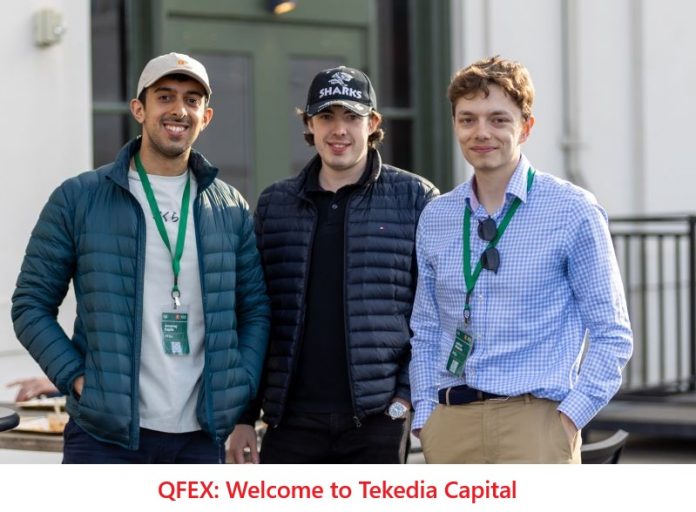
QFEX, 24/7 Exchange for Traditional Financial Markets, for Welcome to Tekedia Capital

0

QFEX is building a 24/7 exchange for traditional financial markets: no brokers, no delays. Today, trillions of US dollars move through the global financial markets, but legacy systems still rule. Orders route through brokers, fees vary without transparency, and trading shuts down on nights and weekends.

Inspired by the innovation in crypto markets, studied why real-time, global, always-on trading is possible in crypto – but not in traditional finance. QFEX acted. So, with QFEX, it would be possible for the stock exchange to be open 24/7 to buy US equities – and later others.

Largely, QFEX is bringing a direct-to-market, seamless experience to trading US equities, commodities, and FX pairs with purely volume-based fees, using cutting-edge tools like Perpetual Futures to power a new kind of exchange.

QFEX raised a significant amount of capital in one of the most successful seed rounds in this game; the team will make that public later.

Tekedia Capital is proud to be an investor in this US company. To learn more about QFEX, go here qfex.com, for Tekedia Capital and how to join, go here capital.tekedia.com

Africa’s Venture Capital Firm 54 Collective Faces Liquidation Amid Mastercard Grant Mismanagement Scandal

0

54 Collective, a venture capital firm that aimed to revolutionize investment and scale ideas to early-stage ventures throughout Africa, is currently on the edge of collapse following allegations of mismanaging over $42 million from Mastercard.

What began as a nonprofit initiative to fund African startups has spiraled into a full-blown financial scandal involving unauthorized transfers, unapproved rebranding, and thousands of questionable accounting entries.

Initially established to catalyze startup growth in Africa, the firm is accused of rerouting $4.59 million to its for-profit affiliate, Founders Factory Africa, and spending nearly $700,000 on a rebrand all without Mastercard’s approval.

Recall that in August 2024, the firm announced its rebrand into 54 Collective from Founders Factory Africa, promising a bolder mission to support tech ventures across Africa through catalytic capital and tailored operational support via its Venture Success Platform. This new model offered startups between $100,000 and $250,000 in equity investments and $100,000 to $150,000 in non-dilutive funding.

However, trouble began when Mastercard Foundation started asking questions about the rebrand and fund usage. The company’s accounting books were suddenly flooded with over 2,000 “adjusting journal entries”, none of which were supported by audited financial statements. According to Condia, the incomplete documentation prompted the foundation to commission accounting audit firm Deloitte, in December 2024 for a forensic audit. What they found was alarming, gross widespread financial irregularities.

In a letter, Daniel Hailu, Executive Director for Impact, Research, and Learning at Mastercard Foundation, raised red flags about “potential for-profit activity being associated with the brand linked to charitable programs” and the apparent transfer of goodwill to non-charitable entities. The foundation also launched an internal investigation into AFV’s dealings.

By February 2025, over 40 employees at 54 Collective were hit with news of a company shutdown. This comes after Mastercard Foundation ended its partnership with the VC, as well as pulling its funding, causing a financial collapse that rippled through the venture studio, Gen F accelerator, and Entrepreneur Academy, all programs once powered by the now-defunct grant.

Court documents reviewed by TechCabal confirm that Mastercard’s decision was directly tied to 54 Collective’s rebranding in August 2024. Despite CEO Bongani Sithole’s denials of wrongdoing and claims that the agreement wasn’t terminated due to a breach, the damage was already done.

In a desperate move, the firm tried to undergo “business rescue,” asking the court for $1.2 million to cover staff salaries and $500,000 for office closures. But a South African High Court was unconvinced, calling the rescue plan “legally invalid” and pointing to a “blatant disregard for the law.”

The Court has since issued a provisional liquidation order and frozen over a dozen bank accounts held by 54 Collective at Nedbank, Standard Bank, and Investec — citing concerns of improper fund transfers. The final liquidation hearing is scheduled for August 11, but all signs point to a permanent shutdown.

Launched in 2018, 54 Collective had invested in more than 55 tech startups across the continent, including well-known names like Renda, WellaHealth, and Lipa Later. Its Venture Success Platform was once hailed as a game-changer, offering personalized venture support through a team of seasoned experts.

Now, with its reputation in shambles, and a $106.5 million grant under scrutiny, 54 Collective is becoming a cautionary tale in Africa’s venture capital landscape, a stark reminder that ambition without accountability can unravel even the most promising missions.

American Bankers Association Has Urged U.S. OCC To Delay Approving National Trust Bank Charters For Crypto Firms

0

US banking groups, led by the American Bankers Association and other trade associations, have urged the Office of the Comptroller of the Currency (OCC) to delay approving national trust bank charters for cryptocurrency firms like Circle, Ripple Labs, and Fidelity Digital Assets. They argue that these firms’ applications lack transparency and sufficient detail for public scrutiny, raising “significant policy and process concerns.”

The banks claim that granting such licenses would be a “fundamental departure” from traditional fiduciary activities of trust banks, potentially allowing crypto firms to offer services like payments with less regulation and lower capital requirements, which could destabilize the financial system. They also express concerns about volatility, inadequate investor protections, and compliance with anti-money laundering (AML) and know-your-customer (KYC) standards.

Crypto advocates, including firms like Circle and Paxos, counter that blockchain-based systems offer technological advantages like real-time auditing and secure recordkeeping, and seeking licenses reflects a commitment to regulation, not evasion. They argue that national charters would enable broader operations without state-by-state licensing, as incentivized by the GENIUS Act, which limits stablecoin issuers’ activities. Industry voices, like Caitlin Long of Custodia Bank, suggest this debate may lead to litigation, as traditional banks fear competition from crypto firms operating under lighter trust charter rules.

Meanwhile, recent regulatory shifts, such as the OCC’s March 2025 guidance allowing banks to engage in crypto activities without prior approval, indicate a more permissive environment, though banks remain cautious due to lingering regulatory and risk concerns. The lobbying by US banks against crypto firms acquiring bank licenses has significant implications for the financial industry, regulation, and innovation.

Blocking crypto firms from obtaining national trust bank charters could limit their ability to compete with traditional banks, slowing the adoption of blockchain-based technologies like real-time auditing and secure digital asset custody. This may delay innovation in financial services, such as faster, cheaper payment systems or decentralized finance (DeFi) solutions.

If crypto firms are denied national charters, they may need to navigate state-by-state licensing, increasing compliance costs and complexity. This could discourage smaller crypto firms from scaling, favoring larger players and potentially concentrating market power. Banks argue that crypto firms under lighter trust charter regulations could pose risks due to volatility and weaker AML/KYC compliance.

If licenses are granted without stringent oversight, it might lead to systemic vulnerabilities. Conversely, overregulation could push crypto activities to less-regulated offshore jurisdictions, increasing global financial risks. Restricting crypto firms’ access to charters may limit consumer access to regulated crypto services, pushing users toward unregulated platforms with fewer protections. However, if charters are granted, robust oversight will be crucial to ensure investor safeguards amid crypto’s volatility.

The debate could spark litigation, as seen with cases like Custodia Bank’s, potentially clarifying the legal framework for crypto banking but also prolonging uncertainty. It may also pressure lawmakers to refine legislation like the GENIUS Act, balancing innovation with regulatory rigor. Traditional banks fear losing market share to crypto firms offering competitive services with lower capital requirements.

If crypto firms gain charters, banks may accelerate their own crypto offerings, as permitted by recent OCC guidance, intensifying competition but also integration of crypto into mainstream finance. Denying charters could push crypto innovation to jurisdictions with more favorable regulations, weakening the US’s position as a financial technology leader. Conversely, a balanced approach could position the US as a hub for regulated crypto innovation.

Grupo Murano’s $1B Bitcoin Treasury Plan Is A High-Stakes Bet That Could Redefine Corporate Finance In Latin America

0

Grupo Murano, a leading Mexican real estate firm valued at $1 billion, has announced a strategic plan to integrate Bitcoin into its treasury, starting with a $1 billion investment. The Nasdaq-listed company (MRNO) aims to build a $10 billion Bitcoin treasury within five years, leveraging refinancing and sale-leaseback transactions to fund the initiative while maintaining its core real estate and hospitality operations, including luxury hotels like Hyatt and Mondrian in Cancun and Mexico City.

CEO Elías Sacal emphasized Bitcoin’s potential for higher returns, predicting a 300% price increase over five years, and sees it as a hedge against inflation and systemic risk. The firm has already acquired 21 Bitcoins and secured a $500 million Standby Equity Purchase Agreement (SEPA) with Yorkville Advisors to further its Bitcoin purchases.

Additionally, Murano plans to introduce Bitcoin ATMs, enable BTC payments at its properties, and explore hosting Bitcoin conferences. The company has partnered with Gemini to facilitate its digital asset strategy and joined the “Bitcoin for Corporations” alliance as a Chairman’s Circle Member to promote corporate Bitcoin adoption. This move aligns with a growing trend of companies like MicroStrategy and Metaplanet adopting Bitcoin as a treasury asset, reflecting increased institutional confidence in cryptocurrencies.

Grupo Murano’s move strengthens the trend of corporations adopting Bitcoin as a treasury asset, following companies like MicroStrategy ($14B+ in BTC) and Metaplanet. This could inspire other Latin American and global firms to diversify into cryptocurrencies, especially in regions with volatile fiat currencies like Mexico. A Nasdaq-listed real estate firm allocating significant capital to Bitcoin signals growing institutional confidence, potentially reducing stigma around crypto and encouraging mainstream financial integration.

A $1B initial investment, with plans to scale to $10B, could drive Bitcoin demand, potentially pushing prices higher, especially if other firms follow suit. However, it may also increase volatility if large sales occur during market downturns. Murano’s strategy positions Bitcoin as a hedge against inflation and currency devaluation, critical in Mexico where the peso has faced historical volatility (e.g., 1994 Tequila Crisis, recent peso fluctuations). This could protect the company’s purchasing power but exposes it to Bitcoin’s price volatility.

Allocating 70-80% of assets to Bitcoin diversifies Murano’s portfolio away from traditional real estate, but it introduces high risk due to crypto’s speculative nature compared to stable real estate cash flows. Using SEPA, refinancing, and sale-leaseback deals to fund Bitcoin purchases could strain liquidity if real estate operations underperform or if Bitcoin’s price crashes, potentially impacting Murano’s creditworthiness.

Accepting BTC payments, installing Bitcoin ATMs, and launching crypto-based loyalty programs could attract crypto-savvy customers, positioning Murano as a forward-thinking brand. However, operational costs and regulatory compliance (e.g., KYC/AML) may pose challenges. As a major Mexican firm, Murano’s adoption could spur crypto infrastructure development in Latin America, where crypto use is already high (e.g., 14% of Mexicans own crypto, per Statista 2024).

Bitcoin’s price swings (e.g., 2021 peak of $69K, 2022 low of $16K) could lead to significant treasury losses, impacting Murano’s financial stability and shareholder confidence. Mexico’s crypto regulations remain unclear. While Banxico allows crypto trading, future restrictions (e.g., on corporate holdings or transactions) could complicate Murano’s strategy. Diverting $1B+ from real estate to Bitcoin may limit Murano’s ability to capitalize on Mexico’s booming property market (e.g., 7% annual growth in Cancun tourism real estate, per CBRE 2024).

Crypto enthusiasts and Bitcoin maximalists view this as a bold, visionary move. They argue it protects against fiat devaluation, aligns with global trends (e.g., El Salvador’s BTC adoption), and positions Murano as a leader in financial innovation. Proponents believe Murano’s early adoption could attract crypto-rich investors and tourists, boosting its hotel and real estate brands.

Traditional investors and financial analysts question the move, citing Bitcoin’s volatility and lack of intrinsic cash flow compared to real estate. They argue that a 70-80% allocation to BTC is reckless for a real estate firm, risking insolvency if crypto markets crash. Skeptics highlight Mexico’s ambiguous crypto laws and potential for government crackdowns, which could force Murano to unwind its position at a loss.

Some analysts see the strategy as a high-risk, high-reward play. If Bitcoin appreciates significantly (e.g., to $200K+ as some predict), Murano could outperform peers. However, they note the need for robust risk management, such as hedging or phased BTC purchases. Neutral voices on X suggest Murano’s success depends on execution—integrating crypto payments and ATMs effectively while maintaining real estate profitability.

Mexico’s high crypto adoption (ranked 16th globally, per Chainalysis 2024) and economic challenges (e.g., 4% inflation in 2024) make Bitcoin appealing. However, wealth inequality and limited crypto literacy could widen the divide between crypto adopters and traditional investors. The move amplifies the global split between crypto advocates (e.g., Michael Saylor, Cathie Wood) and skeptics (e.g., Warren Buffett, Jamie Dimon), with Murano’s success or failure likely to influence corporate sentiment worldwide.

Grupo Murano’s Bitcoin treasury plan is a high-stakes bet that could redefine corporate finance in Latin America, boosting Bitcoin’s legitimacy but risking financial stability. The divide between supporters and skeptics reflects broader debates about crypto’s role in traditional industries, with Murano’s outcome potentially shaping future corporate strategies. For now, its success hinges on Bitcoin’s price trajectory, regulatory developments, and Murano’s ability to balance crypto and real estate operations.

OpenAI Confirms $30bn-Per-Year Oracle Deal, Unveils Details of Massive Stargate AI Data Center Project

0

OpenAI CEO Sam Altman has confirmed that his company is behind the staggering $30 billion-a-year data center deal Oracle disclosed in June, ending weeks of speculation over the mysterious client that sent Oracle’s stock to record highs.

The confirmation came via Altman’s post on X and was followed up with a blog post detailing OpenAI’s growing infrastructure ambitions under its Stargate initiative.

In an SEC filing on June 30, Oracle reported a cloud deal expected to generate $30 billion in annual revenue but did not name the client. The scale of the agreement puzzled observers, as it alone exceeds the $24.5 billion Oracle generated from all of its cloud customers in fiscal 2025. The Wall Street Journal revealed on Monday that the client in question is OpenAI, a claim that Altman has now validated.

The deal will see Oracle provide 4.5 gigawatts of capacity—equivalent to two Hoover Dams’ worth of power—dedicated to supporting OpenAI’s artificial intelligence workloads. The capacity will be used to build one of the world’s largest data centers under a $500 billion project known as Stargate, originally announced in January 2025. The facility, dubbed Stargate I, is under construction in Abilene, Texas, and is being jointly developed by OpenAI, Oracle, and SoftBank. However, the $30 billion contract itself does not involve SoftBank.

In its own announcement, Oracle said the facility will span multiple hyperscale data centers across the U.S., supporting OpenAI’s highly compute-intensive model training and deployment workloads.

“Oracle’s unique ability to deliver mission-critical AI infrastructure at a global scale makes them an essential partner,” said Altman.

The Stargate project marks a major milestone in OpenAI’s ambition to lead the artificial general intelligence (AGI) race. The facility’s scale is unprecedented—it will use more power than any single data center complex ever built and is estimated to serve roughly four million homes in equivalent energy terms.

Yet this is not a straightforward win for Oracle. The construction and operation of such a massive facility come with enormous financial and logistical challenges. Oracle CEO Safra Catz disclosed in June that the company spent $21.2 billion on capital expenditures in the previous fiscal year and plans to spend another $25 billion this year—primarily on data centers. These investments are not solely for OpenAI; they also serve Oracle’s broader customer base, which includes large enterprise clients and government agencies.

Even more striking is the scale of OpenAI’s financial commitment relative to its own revenue. Altman recently disclosed that OpenAI had reached $10 billion in annual recurring revenue, nearly doubling from $5.5 billion a year earlier. That means the Oracle deal alone is triple OpenAI’s current revenue, not counting its existing cloud service costs, ongoing model training expenses, and other operational overheads.

The aggressive infrastructure build-out suggests OpenAI is betting heavily on a future where demand for its AI systems will scale exponentially—and soon.

The broader implications of this deal ripple far beyond Oracle and OpenAI. With cloud computing and AI workloads putting increasing pressure on data center infrastructure, utilities and local governments are now grappling with energy demands previously unimaginable in the tech sector. The 4.5 GW capacity required for Stargate is not just a technical feat; it’s a geopolitical and environmental flashpoint in the making.

Altman, who has long championed OpenAI’s vision of safe and beneficial AGI, hinted that the partnership will form the computational backbone of its next-generation AI systems.

“The infrastructure we are building with Oracle will power the models of tomorrow,” he said. “It’s the scale we need to safely push forward.”

Meanwhile, Oracle co-founder Larry Ellison—now the world’s second richest man according to Bloomberg—has framed the deal as a validation of Oracle’s strategy to dominate enterprise cloud AI.

“We are building a generational platform for the AI era,” Ellison said. “And OpenAI will be at its center.”

In the short term, the deal is expected to reshape not just Oracle’s cloud portfolio, but also the entire data center industry. As hyperscalers scramble to keep up with AI’s rising computational demands, OpenAI’s megadeal with Oracle may be just the first in a series of similarly audacious infrastructure plays.