DD
MM
YYYY

PAGES

DD
MM
YYYY

spot_img

PAGES

Home Blog Page 843

U.S., EU Trade Deal Still Possible Ahead of August 1 Tariff Deadline, Commerce Secretary Says

0

With just days to go before sweeping tariffs are set to take effect, U.S. Commerce Secretary Howard Lutnick says there is still a strong possibility of securing a trade agreement with the European Union, signaling cautious optimism despite growing global trade tensions.

In an interview on CBS’ Face the Nation on Sunday, Lutnick said he had just spoken with EU trade negotiators and believes there is “plenty of room” to strike a deal before the August 1 deadline set by President Donald Trump.

“These are the two biggest trading partners in the world, talking to each other. We’ll get a deal done. I am confident we’ll get a deal done,” he said.

However, he emphasized that the August 1 date remains a “hard deadline,” after which new tariffs will automatically kick in if no agreement is reached.

“Nothing stops countries from talking to us after August 1, but they’re going to start paying the tariffs on August 1,” Lutnick warned.

Trump’s Tariff Ultimatum

On July 12, President Trump announced a sweeping plan to impose tariffs on several major U.S. trading partners, including the European Union and Mexico. The proposed levies include a 30% tariff on most EU and Mexican imports, as well as blanket tariffs ranging from 20% to 50% on other nations like Japan, Brazil, and Canada. The president also threatened a steep 50% tariff on imported copper.

In a formal letter addressed to European Commission President Ursula von der Leyen and similar communications to other leaders, Trump outlined his administration’s intent to rebalance what he described as “deeply unfair” trading relationships. He accused some partners of exploiting U.S. markets and failing to match America’s openness with reciprocal treatment.

Trump’s move comes amid mounting frustration over the slow pace of trade negotiations and growing concerns about the U.S. manufacturing sector, which has struggled to regain momentum despite the administration’s earlier tariff rollbacks.

Pressure on the EU

While the European Commission has not publicly disclosed the details of ongoing talks, sources in Brussels told Politico Europe that officials are working around the clock to broker a temporary understanding before the deadline. European leaders are particularly concerned about the potential fallout of tariffs on the automotive, agricultural, and aerospace sectors — all of which would be significantly affected if the U.S. measures go into effect.

Some EU members are also pressing for the bloc to prepare retaliatory tariffs should Trump follow through. Germany, in particular, which relies heavily on car exports to the U.S., is reportedly urging a more conciliatory approach to avoid an escalation that could harm its already weakened economy.

USMCA May Also Be Reopened

In a notable shift, Lutnick also indicated that Trump plans to reopen the United States-Mexico-Canada Agreement (USMCA), the signature trade deal from his first term. Although the agreement currently exempts most North American goods from tariffs, Lutnick suggested a renegotiation could begin “a year from today.”

Lutnick said the president is absolutely going to renegotiate USMCA without providing further details on what changes the administration may seek. While goods currently compliant with USMCA rules of origin are exempt from the looming tariffs, that protection could be short-lived if Washington reopens the pact.

Bracing for the Potential Impacts

Wall Street and industry leaders have warned that a new wave of tariffs could deliver a major blow to global markets. Analysts at Goldman Sachs noted in a research note that increased duties could stoke inflation and disrupt supply chains already strained by post-pandemic dislocations and geopolitical conflicts.

The U.S. Chamber of Commerce has urged the administration to delay the implementation of tariffs, arguing that “negotiations should not be conducted under threat.” Meanwhile, European business associations say the uncertainty is already affecting investment decisions.

Despite the warnings, Lutnick insisted that Trump’s tough stance is already bearing fruit. He had emphasized the president’s belief in using leverage, noting that it’s working and countries are back at the table.

With time running out, the coming days could determine whether the U.S. and EU can salvage a deal or whether the global economy will be plunged into another trade war. If no agreement is reached by August 1, many European goods entering U.S. ports will be subject to steep duties, potentially setting off a retaliatory cycle with wide-ranging economic consequences.

However, Lutnick’s optimism, though reassuring to some, does little to calm the nerves of exporters and manufacturers who now face the prospect of higher costs, delayed shipments, and possible job cuts if the tariffs go into effect.


Nigeria Recorded 3.13% GDP Growth in Q1 2025, Bolstered by Services and Industrial Sector Gains

0

Nigeria’s Gross Domestic Product (GDP) rose by 3.13% year-on-year in real terms during the first quarter of 2025, marking a notable rebound from the 2.27% growth recorded in Q1 2024.

This is according to the latest report released by the National Bureau of Statistics (NBS), which attributes the improved performance to the strength of the services and industry sectors, as well as a broader recalibration of national accounts.

In nominal terms, the economy expanded to N94.05 trillion in Q1 2025, up from N79.51 trillion in the same quarter of 2024, representing a year-on-year increase of 18.30%.

The Q1 2025 data is the first GDP report issued following the successful rebasing of Nigeria’s national accounts from a 2010 base year to 2019. The rebasing exercise, which economists say was long overdue, aligns Nigeria’s GDP calculations with more current economic realities and ensures better measurement of emerging industries such as digital services and creative sectors.

Services Sector Anchors Growth

The services sector maintained its dominance, growing by 4.33% in real terms and accounting for 57.50% of total GDP. Telecommunications and Information Services stood out, growing by 7.40% and contributing 10.59% to real GDP—an increase from 10.17% in Q1 2024. The sector’s performance reflects the ongoing digital shift across various parts of the economy, from financial services to education and media.

Finance and Insurance also delivered a robust performance, expanding by 15.03% year-on-year. This was largely driven by fintech innovations, rising digital adoption, and deeper financial inclusion efforts that have widened access to formal banking. The sector’s efficiency has improved with technology-backed customer onboarding and transaction processing, which analysts say is also reshaping the labor structure in banking.

Trade, Transportation, and Real Estate were also solid contributors. The trade sector grew by 1.78%, accounting for 18.21% of GDP. Transportation, one of the fastest-growing segments in the quarter, jumped by 14.08%, lifted by improvements across road, rail, air, water, and pipeline transport. Real estate posted 4.61% growth, reflecting a mix of ongoing commercial property projects and residential demand.

Industrial Output Rises, Oil Sector Slows

The industry sector grew by 3.42% year-on-year, improving on the 2.35% posted in Q1 2024. Within this, oil production averaged 1.62 million barrels per day (mbpd), slightly higher than the 1.57 mbpd produced in Q1 2024. However, real GDP growth in the oil sector dropped to 1.87%, down sharply from 4.71% in the corresponding quarter last year. Its share of the economy declined marginally to 3.97% from 4.02%.

Manufacturing, meanwhile, showed signs of stability and gradual rebound. It grew by 1.69% in real terms, supported by sub-sectors such as Food, Beverage, and Tobacco (3.48%), Cement (4.94%), and Pharmaceuticals (5.33%). The manufacturing sector contributed 9.62% to GDP, a reflection of ongoing industrial recovery despite cost pressures tied to energy and foreign exchange.

The construction industry recorded 6.21% growth, driven by infrastructure investments and increased activity in both private and public sector building projects.

Agriculture Still Trails Behind

Agriculture, which employs the largest share of Nigeria’s working population, remained the weakest of the three major sectors. It grew by just 0.07% in real terms, an improvement from the -1.79% contraction in Q1 2024, but still far below expectations. Crop production rose 3.71%, but livestock, forestry, and fishing delivered weaker or mixed results. Security challenges in key agricultural zones, poor mechanization, and post-harvest losses continue to limit the sector’s growth.

In nominal terms, agriculture contributed 19.40% to GDP, down from 20.86% a year earlier, underscoring its declining weight in the country’s overall economic mix.

Emerging Sectors Register Strong Gains

Several niche sectors recorded significant real growth, signaling ongoing structural transformation in the economy. The Electricity, Gas, Steam, and Air Conditioning Supply sector grew by a staggering 18.65%, up from just 2.49% in Q1 2024. This jump may be partly attributed to improved power generation and gas supply activities under the government’s energy reforms.

Water Supply, Sewerage, and Waste Management grew 9.43%, while the Arts, Entertainment and Recreation sector expanded by 9.63%, reflecting the global rise of Nigerian music, film, and gaming industries.

Accommodation and Food Services also advanced by 2.65%, while Public Administration recorded a modest 1.83% growth.

On the downside, Other Services contracted sharply by 6.13%, and Professional, Scientific and Technical Services slowed to 2.53%, from 5.71% in Q1 2024. The latter’s decline may reflect broader global debates around the impact of Artificial Intelligence on white-collar productivity.

Broader Economic Outlook

The Q1 2025 GDP performance underscores a cautiously optimistic economic trajectory, despite concerns about inflation, interest rates, and public sector borrowing. Analysts believe the rebasing offers a more accurate window into Nigeria’s evolving economy, and that the strong performance in services and industry gives policymakers a clearer path to foster growth.

However, with agriculture lagging and oil underperforming, long-term structural reforms remain vital to achieving inclusive growth. There are also broader calls for fiscal and monetary coordination to tackle rising unemployment and ensure that the gains in GDP translate to tangible improvements in household income and welfare.

Asia And Africa Lead The Charge as GenAI Education Explodes Globally – Coursera Report

0

The global appetite for Generative AI (GenAI) education is reaching unprecedented heights, with Asia and Africa emerging as the fastest-growing regions in this digital learning revolution.

According to a recent report by Coursera on its “Global Skills Report 2025”, enrollments in GenAI courses have surged impressively driven by increased accessibility, rising interest in AI-driven skills, and the urgency to remain competitive in a rapidly evolving tech landscape.

In 2023, early adopters showed strong interest in the technology, with enrollment in GenAI courses on Coursera reaching a rate of one person per minute. By 2024, this figure had surged to eight enrollments per minute, reflecting growing awareness of GenAI’s potential.

The momentum has only accelerated in 2025. GenAI course enrollments on Coursera have seen a remarkable 195% year-over-year growth. To date, the platform has recorded over 8 million enrollments in GenAI content, with an average of 12 new learners signing up every minute across nearly 700 available GenAI courses.

This rapid adoption is driven in large part by shifting employer expectations. A striking 94% of employers now report being likely to hire candidates with GenAI credentials, and 75% even prefer candidates with GenAI skills over more experienced applicants lacking such expertise.

In line with this demand, roles such as AI and Machine Learning Specialists are projected to grow by as much as 40% over the next four years. As such, proficiency in GenAI fundamentals, including prompt engineering and large language model (LLM) application, has become essential for those looking to remain competitive in the evolving job market.

Regionally, Asia Pacific (APAC) leads in GenAI adoption, powered by countries like India, which holds the highest number of GenAI course enrollments globally. The region’s employers place strong emphasis on job readiness, with 95% believing that industry-recognized micro-credentials provide graduates with immediately applicable skills more than any other region in the world.

Sub-Saharan Africa (SSA) is also advancing rapidly in digital education. The region now boasts more than 8 million Coursera learners, a 20% year-over-year increase, making it the fastest-growing learner base globally. A significant factor in this growth is the high rate of mobile learning adoption (65%), which has helped extend digital education to broader and more diverse populations. This trend supports the region’s ongoing efforts toward inclusive digital transformation.

Botswana, for example, recorded a 16% year-over-year increase in its Coursera learner base, growing from 85,000 in 2024 to 99,000 in 2025. Women now make up 50% of Coursera learners in the country, demonstrating progress toward gender parity in digital upskilling. Despite its relatively low ranking on the AI Maturity Index (#85), Botswana has seen a 178% year-over-year increase in GenAI course enrollments, indicating growing interest in future-focused skillsets.

In South Africa, where 93% of organizations are running active AI programs, the country is leveraging widespread mobile connectivity and robust infrastructure to expand digital capabilities across its economy.

Meanwhile, Nigeria stands out with a young, tech-savvy population 70% of its citizens are under the age of 35, and bold initiatives like the 3 Million Technical Talent (3MTT) program. These efforts underscore the country’s strategic investment in workforce development. Notably, GenAI course enrollments in Nigeria rose 98% year-over-year on Coursera, signaling strong national interest in AI, while demand for cybersecurity and network-related skills is expected to grow by 87% by 2030.

Together, these trends illustrate how GenAI is reshaping digital education and workforce readiness across the globe, with regions like APAC and SSA making significant strides in closing the skills gap and preparing their populations for the future of work.

First HoldCo Slams Arise TV, ThisDay Over Share Trade Report — Clarifies Otedola, Government Had No Involvement

0

First HoldCo Plc has lashed out at recent reports by Arise TV and ThisDay Newspaper over their coverage of a N323.4 billion block trade involving the company’s shares, accusing both platforms of “deliberate misrepresentation” and “grossly unprofessional conduct” aimed at inciting panic.

The response comes after a flurry of media speculation surrounding the off-market transaction executed on July 16, 2025. The deal, one of the largest in the history of the Nigerian Exchange (NGX), involved 10.43 billion shares of First HoldCo sold at N31 per share across 17 negotiated trades.

While the transaction itself was legitimate and regulator-supervised, reports from Arise and ThisDay reportedly framed it as a veiled takeover involving billionaire businessman and First HoldCo chairman, Femi Otedola, and possibly the Nigerian government — an angle the company has firmly denied.

In a statement issued Monday, First HoldCo made it clear that Mr. Otedola was neither the buyer nor a beneficiary of the shares in question. It also stated unequivocally that the Federal Government of Nigeria and the Office of the Attorney General were not parties to the transaction.

“The shares were acquired by an independent bridge holder, and the process was transparent, supervised by regulators, and devoid of any undue influence,” the company said. “Mr. Femi Otedola did not buy or take over the traded shares. The Federal Government of Nigeria, its agencies, and the Attorney General were not involved.”

The company noted that the misinformation appeared calculated to destabilize its operations and undermine shareholder confidence, especially given the strategic importance of the transaction in shaping its future governance and ownership structure.

Attorney General’s Office Also Debunks Report

Backing the company’s position, the Office of the Attorney General of the Federation issued its own rebuttal through Kamarudeen Ogundele, Special Adviser on Communication and Publicity. Ogundele described the reports suggesting government involvement as “false, misleading, resentful, and potentially harmful.”

According to him, Attorney General Lateef Fagbemi was not involved in any share dealings related to First HoldCo. While the Federal Government was aware of the transaction framework — including a trustee structure approved by the Central Bank of Nigeria (CBN) and overseen by RENCAP — it played no active role in the deal.

“This falsehood must be corrected to prevent confusion or misconceptions about First HoldCo’s ownership and governance,” Ogundele said, reiterating the independence of the buyer and the non-participation of the government.

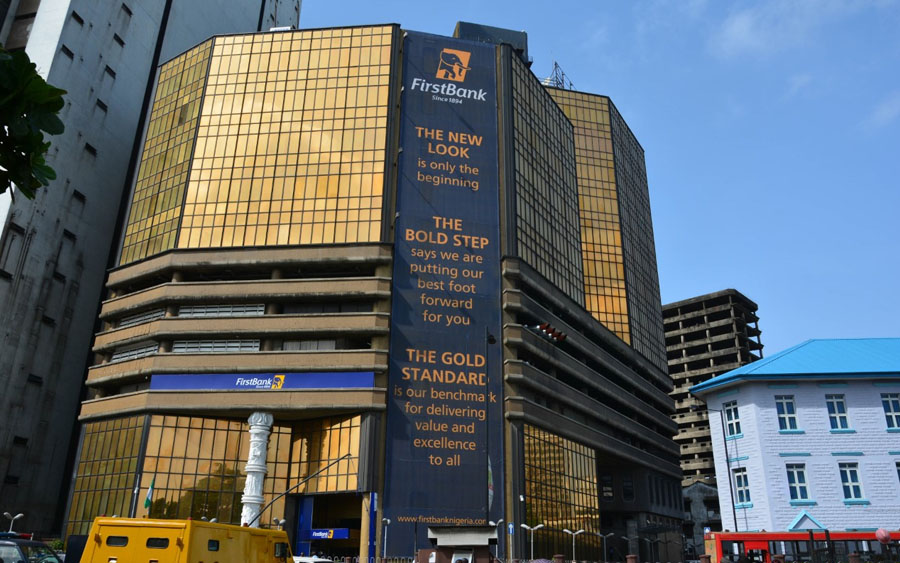
The statement by First HoldCo also included a direct jab at the owner of both ThisDay and Arise TV, suggesting ulterior motives behind the coverage. The company hinted at unresolved debt issues involving General Hydrocarbons Ltd — a company linked to the media group’s founder — and FirstBank, which is part of the HoldCo group.

“We urge the owner of these media platforms to focus on settling General Hydrocarbons Ltd’s debt to FirstBank, rather than channeling negative energy toward vilifying the First HoldCo Group,” the statement said.

The company also used the opportunity to call for stronger adherence to journalistic ethics, urging media platforms to prioritize fairness, objectivity, and fact-checking.

Strategic Reshuffle in the Shadows

While First HoldCo insists the trade does not signal a hostile takeover, the sheer volume and value of the shares — totaling N323.4 billion — have reignited talk of a potential leadership transition or capital restructuring. Notably, the transaction represents the formal exit of Oba Otudeko, a founding figure in the group’s evolution and a former heavyweight shareholder.

Otudeko’s exit, combined with the influx of new shareholding under a trustee structure, suggests significant behind-the-scenes reconfiguration of the HoldCo’s influence map, with implications for future board appointments, strategy realignment, and shareholder activism.

As one of the largest off-market block trades ever recorded on the NGX, the deal underscores First HoldCo’s continued position as a high-stakes player in Nigeria’s corporate ecosystem — and a lightning rod for speculation. Time will tell whether the current furor settles or triggers further disclosures in the weeks ahead.

Political Instability Drives Dollar Down 10% Since January

0

Amid heightened political tensions in Washington, the Bank for International Settlements (BIS) sounded the alarm this weekend. The aim was to highlight the crucial importance of central bank independence at a time when the US Federal Reserve is under unprecedented political pressure.

The BIS’s annual report warns of a growing trend toward political interference, particularly in the United States, where Donald Trump has stepped up his public attacks on Jerome Powell, the Fed Chairman. The US president criticizes Jerome Powell for “slowing US growth with overly restrictive monetary policy.”

Trump has even publicly stated his intention to replace Powell. This stance is worrying: markets fear a weakened Fed that could be manipulated and therefore less credible.

The BIS emphasizes that central banks (such as the Fed) must remain independent, as they have a delicate task to perform. The fact is that the Fed must balance between supporting economic growth through low interest rates as President Trump desires or preserving monetary value, so as not to cause the growing public debt to explode.

As a direct consequence of this political and monetary instability, the US dollar (DXY) fell to its lowest level in more than three years to around 97.2 points. This represents a decline of more than 10% since January — its worst performance since 2022. This weakness in the greenback can be explained by:

  • The prospect of a policy shift by the Fed driven by political pressure.
  • Anticipation of disorderly rate cuts.
  • Investors’ loss of confidence in US institutional stability.

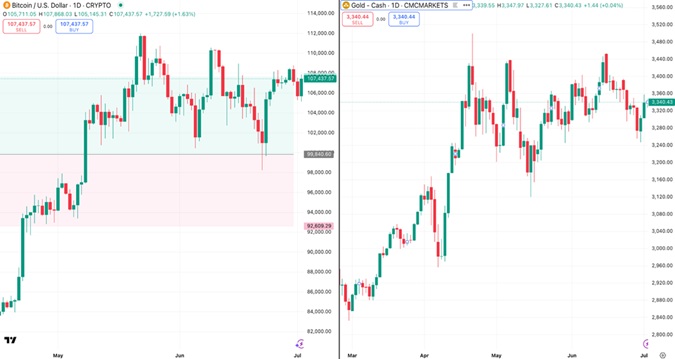
An HSBC analyst thinks that “There is a Trump risk premium built into the dollar today.” Such an unstable climate pushes investors to alternative assets, like gold and Bitcoin. The price of Bitcoin has rebounded to over $120,000, buoyed by an influx into crypto ETFs ($1.7 billion in June) and the price of gold reaches almost $3,400, boosted by currency volatility.

The credibility of the Federal Reserve — one of the historic global pillars of stability — is being weakened by the institutional clash between Trump and Powell. This situation threatens the confidence that has long surrounded the dollar’s dominance.

Beyond cryptocurrencies and gold, there are other “neutral” currencies like the Swiss franc, Japanese yen, and the digital Chinese yuan. These are now acting as safe havens from a dollar that is looking less and less stable. A development that was unthinkable just a few years ago.