DD
MM
YYYY

PAGES

DD
MM
YYYY

spot_img

PAGES

Home Blog Page 86

Mono Protocol Sees Rising December Momentum as Stage 19 Nears Completion

0

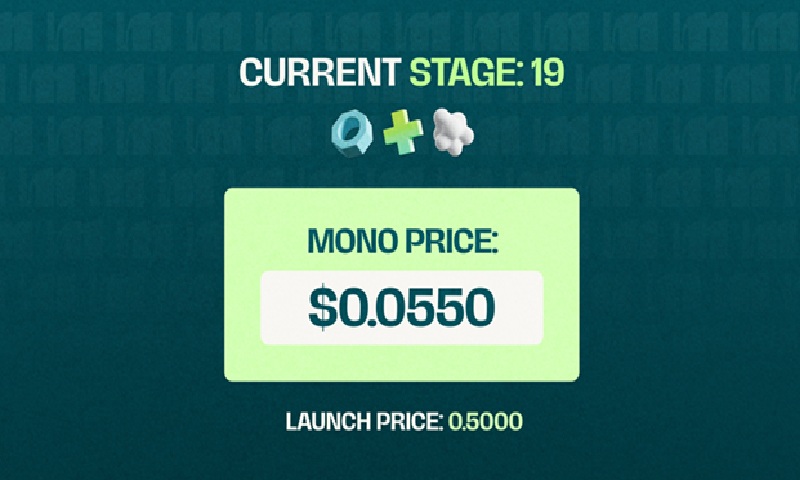
December is showing renewed strength across the crypto presale landscape, and Mono Protocol continues to gain momentum as one of the most followed projects in this segment. The team reports that Stage 19 has now reached $3.71 million of the $3.80 million target, with the token price holding at $0.0550. This steady progress comes as early-stage market activity increases and users shift toward infrastructure platforms offering clear utility.

Mono Protocol’s consistent updates, unified balance system, and recent development improvements are supporting this uptick in visibility. As participants monitor the progress of ongoing crypto presales, Mono’s focus on cross-chain functionality continues to position the project at the center of December’s attention.

Rising Participation Driven by Infrastructure Demand

The broader Web3 sector is entering a period of heightened interest in utility-focused projects. Mono Protocol benefits directly from this trend. Its cross-chain execution framework addresses long-standing friction points, including fragmented balances, unreliable routing, and multi-step transaction processes.

As users evaluate entries in the best crypto presale category, they are prioritizing platforms that provide practical systems rather than speculative promises. Mono’s architecture offers a developed foundation that supports this shift, helping attract steady participation as Stage 19 moves toward completion.

The presale’s structured model—combined with transparent funding milestones—continues to resonate across the presale crypto environment. December’s growing activity is reinforcing this momentum and helping drive Mono’s visibility across multiple channels.

Development Updates Build Confidence as December Activity Climbs

Mono Protocol has continued publishing routine development reports covering website fixes, dashboard updates, routing refinements, and interface adjustments. These improvements have contributed to smoother participation flows and stronger user retention during the presale round.

This level of communication remains critical for users tracking cryptocurrency presales that prioritize active development. With December bringing increased market research and presale monitoring, consistent transparency has strengthened Mono’s position among early-stage Web3 infrastructure projects.

The team’s timely updates also support confidence in the long-term roadmap. As users explore options across crypto pre sales, Mono’s continuous refinements offer a clear signal of ongoing progress.

Unified Balance System Lifts Visibility During the December Cycle

The unified balance system remains a major factor in Mono Protocol’s growing December momentum. By consolidating user balances across all supported chains, the system removes the need for bridges, repeated approvals, and network switching. This feature is receiving increased attention as users look for simplified multi-chain experiences.

With more investors examining multi-network infrastructure in December, Mono’s unified balance design is emerging as a key differentiator. It places the project alongside presales that center on real-world utility, positioning it strongly within web3 crypto presale discussions.

This model is especially appealing to users who want familiar workflows, predictable execution, and reduced complexity during high activity periods.

Automated Routing Engine Supports Reliability During Market Surges

December’s increase in multi-chain activity often leads to congestion and unstable routing conditions across networks. Mono Protocol’s automated routing engine has become a core advantage during this period. It evaluates chain conditions in real time and selects the best execution path to reduce failed transactions.

This capability reinforces Mono’s standing in pre sale cryptocurrency research lists as participants pay closer attention to reliability during periods of elevated traffic. The routing system remains a central part of Mono’s infrastructure proposition as December interest expands.

Conclusion

Mono Protocol continues to build strong momentum as December drives renewed interest across the crypto presale market. With $3.71M raised in Stage 19 and a price of $0.0550, the unified balance system, routing engine, and consistent updates support its growing visibility. As this round approaches completion, Mono remains one of the most active and utility-based entries of the month.


Learn More about Mono Protocol

Website: https://www.monoprotocol.com/

X: https://x.com/mono_protocol

Telegram: https://t.me/monoprotocol_official
LinkedIn: https://www.linkedin.com/company/monoprotocol/

Investors Shift Toward Infrastructure Projects as Mono Protocol’s Stage 19 Nears Its Funding Target

0

As market volatility continues, early-stage participants are shifting attention toward infrastructure projects that provide clear functionality. Mono Protocol is gaining momentum in the crypto presale landscape with a unified balance model and consistent development updates. Stage 19 continues to advance as the raise approaches its next milestone.

Stage 19 Shows Stable Participation With $3.71M Raised at $0.0550

Mono Protocol reports steady progress as Stage 19 moves closer to completion.

The presale coin price remains at $0.0550, and the round has raised $3.71 million out of the $3.80 million target. This performance keeps Mono among the most active cryptocurrency presales as December activity increases.

The team continues sharing weekly updates, noting improvements in website stability, dashboard responsiveness, and platform performance. These steps support onboarding and reflect the consistent development pace that users expect from presale crypto projects focused on long-term execution.

This steady communication pattern remains important across crypto pre sales, especially in market conditions where reliability plays a central role in user decisions.

Why Infrastructure Projects Are Gaining More Attention

Recent market trends show increased interest in infrastructure-driven platforms. These projects aim to solve longstanding issues in multi-chain environments such as fragmentation, manual network switching, and transaction failure risk.

Users following web3 crypto presale opportunities are paying closer attention to ecosystems that offer practical solutions rather than speculative appeal. Mono Protocol fits this category with a design focused on unified cross-chain balances and automated routing.

As more networks emerge, infrastructure becomes difficult to manage for average users. Mono’s approach reduces these layers by offering a single environment for interacting across chains, which continues drawing interest in coin presale evaluations centered on functional utility.

Unified Balance System Simplifies Multi-Chain User Experience

Mono Protocol’s unified balance model converts complex multi-chain activity into one accessible workflow. Instead of tracking multiple wallets or bridging assets repeatedly, users maintain one balance per token across supported networks.

This removes several manual steps and reduces user error. It also gives developers a simpler design framework because applications no longer require separate deployments for each chain.

This design direction supports Mono’s visibility across pre sale cryptocurrency research lists, where simplicity and execution reliability are primary evaluation points.

Routing Engine Ensures Smooth Execution Across Networks

The platform’s routing engine automatically selects the best available path for each transaction.

During periods of congestion, traditional cross-chain systems often fail or revert. Mono aims to reduce these issues by scanning network conditions and choosing a stable route.

This supports consistent execution and reduces failures that often cost users time and capital.

Such features have become key discussion points across crypto presales where performance and reliability matter.

The routing engine, combined with unified balances, positions Mono as a system capable of supporting both everyday users and application developers.

Rewards Hub Keeps User Activity Consistent as Updates Roll Out

Mono Protocol’s Rewards Hub remains active with participation tasks, social missions, and referral incentives. These tools support community involvement during the raise and provide structured engagement as the project advances toward future stages.

The combination of routine updates and community tools continues increasing visibility inside cryptocurrency presales where user involvement often reflects long-term growth potential.

Mono’s transparency and consistent progress remain central factors in why many early participants continue monitoring Stage 19 closely.

Conclusion

Infrastructure is becoming a stronger focus for early-stage users, and Mono Protocol stands out with its unified balance system, routing automation, and active communication. With $3.71 million raised at the current presale coin price of $0.0550, Stage 19 remains on track as interest grows across the presale crypto environment.


Learn More about Mono Protocol

Website: https://www.monoprotocol.com/

X: https://x.com/mono_protocol

Telegram: https://t.me/monoprotocol_official

LinkedIn: https://www.linkedin.com/company/monoprotocol/

Why USE.com Is Positioned To Become the Best Upcoming Global Crypto Exchange

0

The crypto market is entering a new chapter where innovation, infrastructure strength and global accessibility determine whether an exchange can truly compete at scale. As traders across multiple regions evaluate alternatives to long-established platforms, one name has consistently surfaced in discussions about the most promising upcoming exchange. USE.com is emerging as a powerful new contender, designed to challenge industry leaders with a modern architecture built for speed, security and global usability.

The excitement around new centralised exchanges has grown steadily as users demand better performance, fairer fees and platforms aligned with modern regulatory expectations. In this environment, USE.com differentiates itself through a robust engineering approach and a clear commitment to providing a complete trading ecosystem from day one. With its public Beta approaching, the platform is generating interest at a level usually reserved for long-established brands.

A High Performance Engine Designed for Professional Trading Standards

Trading infrastructure is the backbone of any exchange, and USE.com places this at the center of its identity. The platform introduces an ultra-fast matching engine engineered for high-throughput order execution and minimal latency. Professional traders, high-frequency participants and users executing complex strategies require systems capable of maintaining stability even during market surges. USE.com is designed precisely for these scenarios.

The engineering team behind the platform has focused on optimizing execution flow, liquidity distribution and system responsiveness. This allows both spot and perpetual futures markets to operate under conditions typically associated with institutional trading environments. As global traders increasingly prioritize performance when choosing where to execute large volumes, USE.com’s infrastructure gives it a strong competitive advantage.

A Security and Compliance Framework Built for Global Adoption

The exchange landscape has changed significantly over the past few years. Traders no longer accept weak security assumptions or unclear compliance practices. USE.com acknowledges this shift by building its security systems on institutional-grade standards.

The exchange integrates advanced custody protections, multi-layered internal controls and a strong compliance foundation aligned with global expectations. These elements signal to traders that USE.com is entering the market with long-term durability in mind, not as an experimental or short-lived platform.

In a world where user confidence must be earned through transparency and robust protection measures, USE.com stands out as a new exchange that treats security as a core requirement rather than a feature.

A Complete Ecosystem That Supports Every Level of Crypto Trader

USE.com delivers more than a trading interface. It aims to offer a complete ecosystem that includes spot markets, perpetual derivatives, earning tools and launch features. This makes it suitable for both experienced traders seeking a multi-product platform and new entrants looking for a clear, unified environment.

Low fees and simple onboarding ensure that global users can join easily, regardless of their trading background. The interface is built to be clean and intuitive while still offering the advanced tools professionals expect.

This versatility is a major reason why the platform is being discussed as a potential competitor to major exchanges such as Binance, Bybit, OKX, Bitget and KuCoin. New exchanges rarely enter the market with this level of readiness, and USE.com is already being viewed as one of the most complete launch-phase platforms of the year.

Why Traders Are Actively Searching for New Alternatives

The interest surrounding USE.com is not occurring in isolation. The broader crypto market is experiencing a shift where traders increasingly seek platforms that combine modern performance with institutional reliability. Many users have expressed concerns about rising fees, liquidity inconsistencies, user experience limitations and evolving compliance challenges on existing exchanges.

As a result, global search interest for terms like best new crypto exchanges, upcoming centralized exchanges and new CEX platforms has continued to rise. USE.com has naturally entered these conversations as traders explore better options with next-generation infrastructure.

The timing of USE.com’s Beta is strategically aligned with this growing demand, giving it a unique opportunity to attract both early adopters and long-term users seeking a modern trading environment.

The Possibility of a Future Token and Why It Is Fueling Market Curiosity

Exchange tokens have historically been among the most successful utility tokens in the industry due to their direct link to trading activity and user incentives. Although USE.com has not confirmed any details regarding a token or presale, speculation continues to build within early communities.

If the exchange introduces a token in the future, analysts believe it could easily become one of the most important presale events of the year due to the strong underlying platform. The possibility alone adds momentum to the exchange’s visibility ahead of the Beta phase.

Analyst Perspective

From an analytical standpoint, USE.com appears to be entering the market at an ideal moment. Trader expectations for centralized exchanges have increased significantly, particularly in areas such as execution speed, custody security, regulatory robustness and global onboarding efficiency. Platforms that fail to innovate risk losing relevance, while new exchanges built on modern standards have the potential to grow rapidly.

USE.com fits squarely into this second category. Its infrastructure, product mix and user experience combine to create a strong foundation for long-term expansion. If the platform delivers the level of performance it promises during the Beta launch, it could quickly position itself as a top global exchange and one of the leading new platforms.

Telegram: https://t.me/useglobal

X: https://x.com/useexchange

Central Bank of Nigeria Tightens Grip on Banks With Strict 48-Hour App Fraud Refund Policy

0

The Central Bank of Nigeria (CBN) has raised the stakes in the fight against electronic fraud, issuing a bold directive that mandates banks to reimburse victims of Authorised Push Payment (APP) fraud within 48 hours.

This decisive move signals a new era of customer protection in Nigeria’s financial ecosystem, placing greater responsibility on financial institutions and offering renewed confidence to millions of digital banking users.

In a circular signed by Dr. Rita Sike, Director, Financial Policy & Regulation Department, the CBN wrote,

“The Central Bank of Nigeria, in furtherance of its mandate of promoting a sound financial system in Nigeria, hereby exposes this draft guidelines aimed at addressing the rising incidence of Push Payment fraud in the financial system for comments.

“When finalised, the guidelines would mandate all financial institutions to institute preventive measures as well as modalities and managing APP fraud”.

The new directive come as fraud in Nigeria’s financial sector continues to surge. Data from the Financial Institutions Training Centre (FITC) shows fraud losses jumped 603% to N3.29 billion ($2.27 million) in Q1 2025, with 12,347 cases reported, a 7.63% increase from the previous year.

Over the years, Nigeria’s financial system has recorded significant transformative impact of digital payment channels, Unstructured Supplementary Service Data (USSD), internet banking and instant transfers on Nigeria’s financial ecosystem.

However, the rapid adoption of these digital channels, have been infiltrated by bad players, leading to a rise in electronic fraud cases. These has led to the eroding of trust in the country’s financial system as institutions and individuals play safe.

Among these fraudulent activities, Authorised Push Payment (APP) fraud has been a growing concern in the industry. This form of fraud is often executed through social engineering methods, that exploits the customer’s trust and the finality of digital transactions, making it increasingly challenging to detect and prevent.

As APP fraud continues to rise often driven by sophisticated social engineering tactics the CBN’s policy aims to restore trust, strengthen accountability, and curb the growing menace threatening the nation’s digital economy.

The CBN issued certain guidelines to ensure a safe and sound financial system. The guidelines applies to all financial institutions under the regulatory purview of the CBN and covers all electronic paymentsyment channels through which customers initiate push transactions.

To promote proactive fraud risk management, financial institutions shall at a minimum, implement Early Warning System (EWS) for the prevention and timely detection and mitigation of APP fraud. Such measures may include red-flagging accounts on suspicion of fraudulent activities, behavioral monitoring, and documentation of EWS indicators such as accounts identified through typologies, repeated complaints, unusual inflows/outflows, or previous involvement in fraud cases.

Banks And OFIs are mandated to;

I. Implement EWS for the timely detection and mitigation of APP fraud, incorporating red flagging of accounts suspected of fraudulent activities.

ii. Ensure that EWS indicators shall be thoroughly documented, including but not limited to accounts identified through fraud typologies, repeated complaints, unusual inflows/outflows, or prior involvement in fraud cases.

iii. Accounts flagged under the EWS shall be subject to enhanced monitoring and or/ restriction pending a full investigation.

iV. Establish a board-approved framework for EWS and Red flagging of accounts (RFA) specifically for APP fraud.

Reimbursement

Banks and OFIs shall implement a fair, timely and transparent reimbursement process for victims of APP fraud, subject to the following principles

I. Customers who are victims of APP fraud shall be eligible for reimbursement, subject to investigative outcomes.

ii. Reimbursement, where applicable, shall be made within forty-eight (48) hours from the conclusion of a documented APP fraud investigation.

iii. Where APP fraud incident involves more than one financial institution, the originating financial institution shall commence investigation immediately and notify the other institution(s) involved within 30 minutes of receiving the customer’s complaint.

iV. In the course of the investigation and data sharing, all exchange of customer information shall comply with the Nigeria Data Protection Act, 2023.

V. The institutions involved shall conduct a joint investigation to determine the lapses, amount lost or unrecoverable, modalities for joint reimbursement and measures for mitigating future occurrence and losses.

Vi. The affected institutions shall make the reimbursement within sixteen (16) working days from the date the incident was first reported.

However, not every victim of APP fraud will get their funds back. A customer is only eligible for reimbursement where a report is made within seventy-two hours (72) and cooperates with investigation. Also when there is no evidence of negligence, collusion or criminal intent on the part of the customer.

Notably, a customer will be reimbursed if the financial institution failed to implement appropriate fraud detection, warning or verification protocols that could have prevented the transaction. In a move to enhance consumer education and awareness, financial institutions shall ensure that customers are aware of available fraud reporting channels. Also they shall provide clear, accessible, and continuous education on APP fraud risks and reporting procedures.

Outlook

The CBN’s latest directive marks a significant turning point in Nigeria’s financial landscape, placing customer protection at the heart of digital banking operations. By enforcing stricter timelines, clearer investigative procedures, and accountability measures for banks and other financial institutions, the apex bank is signalling that fraud, particularly APP fraud will no longer be treated with leniency.

While the guidelines set a high bar for compliance, they equally empower customers with greater confidence to engage in digital transactions without fear of permanent loss. However, the shared responsibility remains: financial institutions must strengthen their defences, and customers must remain vigilant and report incidents promptly.

Ultimately, the success of this policy will depend on how effectively banks implement these measures and how well the public embraces safer digital habits. If executed as intended, the CBN’s framework could restore trust, minimise losses, and reinforce Nigeria’s ambition to build a secure, inclusive, and resilient digital financial ecosystem.

Peter Schiff Labels MicroStrategy’s Business Model A “Fraud” Amid Stock Sale

0

Prominent American economist, stockbroker, and financial commentator Peter Schiff has criticized MicroStrategy’s recent $1.44 billion stock sale, describing the company’s business model as fraud, and labeling CEO Michael Saylor “the biggest con man on Wall Street.”

In a post on X, Schiff claimed that MicroStrategy sold stock not to acquire more Bitcoin, as the market might expect, but to generate U.S. dollars to fund interest and dividend obligations.

He wrote,

“Today is the beginning of the end of $MSTR. Saylor was forced to sell stock not to buy Bitcoin, but to buy U.S. dollars merely to fund MSTR’s interest and dividend obligations. The stock is broken. The business model is a fraud, and Saylor is the biggest con man on Wall Street.”

“Don’t expect the mainstream financial media to tell you the truth about what MicroStrategy was just forced to do to delay its ultimate demise”, he added in a subsequent post.

Schiff predicts that Strategy could suffer a massive crash following its establishment of a USD reserve for dividend payments, a move that has allayed fears that the company would have to sell its BTC holdings to pay them.

He further explained that the company’s new approach involves selling stock to raise cash, investing that cash in Treasuries yielding approximately 4%, while using it to cover debt and preferred stock costs of 8%–10%. He questioned how long investors would continue to support this model “just to gamble on Bitcoin.”

Recently, MicroStrategy announced the creation of a $1.44 billion U.S. dollar reserve and an increase in its Bitcoin holdings to 650,000 BTC. Michael Saylor, Founder and Executive Chairman, stated, “Establishing a USD Reserve to complement our BTC Reserve marks the next step in our evolution, and we believe it will better position us to navigate short-term market volatility while delivering on our vision of being the world’s leading issuer of Digital Credit.”

MicroStrategy President and CEO Phong Le added that the USD reserve is intended to cover 21 months of dividends, reflecting the company’s commitment to credit investors and shareholders while reinforcing its role in the broader Bitcoin ecosystem.

Schiff’s criticism comes as MicroStrategy’s leveraged ETFs have been severely impacted by the ongoing cryptocurrency downturn. According to a Reuters report, the T-Rex 2X Long MSTR Daily Target ETF and Defiance Daily Target 2x Long MSTR ETF, both designed to deliver twice the return of MicroStrategy shares, have lost nearly 85% of their value so far in 2025. The T-Rex 2X Inverse MSTR Daily Target ETF has declined by 48% over the same period.

MicroStrategy shares have fallen more than 40% this year, with declines driven by Bitcoin’s drop below $90,000. Since joining the Nasdaq 100 index, the company’s shares have more than halved, sliding roughly 70% from their November 2024 peak.

Despite the steep declines, analysts’ ratings have remained relatively optimistic. Of the 16 brokerages covering the stock, 10 rate it a “buy” equivalent, four “strong buy,” and two “hold,” with a median price target of $485, implying a potential 183% gain over the next 12 months, according to LSEG data.

Saylor is scheduled to deliver a keynote titled “The Undeniable Case for Bitcoin” at a Binance conference in Dubai this Wednesday.