DD
MM
YYYY

PAGES

DD
MM
YYYY

spot_img

PAGES

Home Blog Page 9

Best 7 Ways to Share a Power BI Dashboard

0

Sharing dashboards is one of the most important parts of modern analytics because insights only create value when people can access them easily. Businesses today want faster ways to collaborate, present performance, and deliver data experiences without technical friction or heavy development work. Whether you are building internal reports, client portals, or portfolio projects, understanding the right sharing method helps you scale faster while keeping data secure.

Quick Comparison — Power BI Sharing Methods

Sharing Method Best For Licensing Impact External Sharing Branding Options Scalability
Reporting Hub White-label portals & SaaS analytics Azure capacity model Yes Full white-label High
Power BI Service Internal team collaboration Per-user licensing Limited Minimal Medium
Secure Link Sharing Quick controlled access License required Limited None Medium
Publish to Web Public demos & portfolios Free public link Yes (Public) None High
Website Embedding Marketing or product pages Embedded capacity Yes Custom UI High
Export to PDF/PPT Offline sharing None after export Yes Static only Low
Microsoft Teams Daily collaboration Per-user licensing Internal only Minimal Medium

1. Share Power BI Dashboards With Reporting Hub
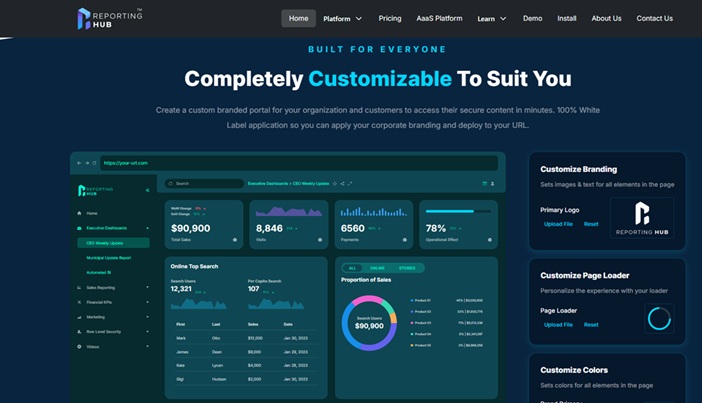
Reporting Hub helps teams launch white-label Power BI dashboards faster without complex development work. Organizations can deliver analytics to unlimited external users while controlling costs using Azure capacity pricing. Businesses transform dashboards into branded SaaS products without building custom infrastructure or managing complicated embedding pipelines.

The platform reduces time to market by providing plug-and-play deployment aligned with Microsoft architecture. Teams create fully branded portals with custom domains, logos, fonts, and colors without writing additional frontend code. Multi-tenant architecture allows agencies and enterprises to manage multiple clients securely from a single centralized environment.

Reporting Hub positions Power BI as a revenue product instead of an internal reporting expense for organizations. Companies can monetize industry-specific insights through subscription analytics while maintaining governance, security, and scalable deployment models. Azure native infrastructure ensures monitoring, capacity management, and enterprise-grade access control without heavy engineering overhead.

Pros:

  • Unlimited external sharing without per-user licensing
  • Fully white-label branded portals
  • Faster deployment with plug-and-play setup
  • Supports productization and monetization

Cons:

  • Requires Azure capacity planning
  • Better suited for external delivery than small internal teams

2. Share Directly from Power BI Service

Power BI Service sharing allows internal users to access dashboards securely and easily within the Microsoft ecosystem. Team members collaborate using familiar permissions, workspace roles, and version updates without moving files across different platforms. This method works best when everyone already uses Microsoft accounts and Power BI licenses within the same organization.

Sharing directly from Power BI keeps governance centralized and ensures updates appear instantly for authorized viewers across projects. Organizations benefit from built in compliance features, but external sharing can become expensive due to licensing requirements. It remains one of the simplest methods for internal analytics collaboration when scalability is not the primary concern.

Pros:

  • Easy internal collaboration
  • Centralized governance

Cons:

  • Requires per-user licensing
  • Limited white-label customization

3. Share Using a Secure Link

Secure link sharing allows dashboard owners to provide controlled access without sending files or managing manual exports. Users receive a direct URL with permissions applied, making it convenient for quick collaboration or temporary stakeholder reviews. This option balances accessibility and security when teams need fast sharing without public exposure.

Permissions remain managed through Power BI, ensuring only authorized users can open the dashboard through the shared link. However, licensing requirements still apply, which can increase costs when sharing with large external audiences frequently. Secure links work best for short term collaboration rather than large scale analytics delivery.

Pros:

  • Fast and simple sharing
  • Maintains controlled access

Cons:

  • Licensing still required
  • Not ideal for large external audiences

4. Publish to Web (Public Sharing)

Publish to Web creates a public version of a dashboard that anyone can access without signing into Power BI. This method is commonly used for portfolios, educational content, or non sensitive datasets intended for open audiences online. It provides an easy way to demonstrate analytics capabilities without managing authentication barriers.

Because the dashboard becomes publicly accessible, organizations must avoid sharing confidential or sensitive business information using this method. While it removes licensing limitations, it also removes security layers, making it unsuitable for enterprise data environments. Publish to Web works best for marketing demos rather than operational analytics delivery.

Pros:

  • No login required
  • Great for public portfolios

Cons:

  • No security controls
  • Not suitable for private data

5. Embed the Dashboard in a Website or Blog

Embedding Power BI dashboards into websites allows businesses to integrate analytics directly into customer facing platforms. This approach is often used by SaaS products or marketing teams that want dashboards to appear as part of a branded digital experience. Developers can customize layout and interface to match existing web applications or portals.

While embedding creates a seamless user experience, it often requires technical setup and embedded capacity planning for scalability. Organizations must manage authentication, performance, and infrastructure carefully when delivering analytics at scale through web environments. This method works best for product teams with development resources available.

Pros:

  • Custom user experience
  • Ideal for SaaS or marketing portals

Cons:

  • Requires technical setup
  • Capacity planning needed

6. Export to PDF or PowerPoint

Exporting dashboards to PDF or PowerPoint provides a static way to share insights with audiences who do not use Power BI. This approach works well for executive presentations, client reports, or offline environments where interactive dashboards are not required. Users can distribute files through email or presentations without managing viewer permissions.

However, exported versions lose interactivity, filtering, and real time data updates, which limits deeper analysis capabilities. Teams may also need to regenerate exports frequently to keep information current, adding manual work to reporting workflows. This method remains useful when simplicity and accessibility are the primary goals.

Pros:

  • Easy offline sharing
  • No viewer licenses required

Cons:

  • Static content only
  • Manual updates required

7. Share Through Microsoft Teams or Apps

Sharing dashboards through Microsoft Teams integrates analytics directly into daily collaboration workflows used by many organizations. Teams channels allow members to view reports alongside conversations, making it easier to discuss insights without switching tools frequently. This method supports real time collaboration and keeps analytics visible within existing communication environments.

Although Teams integration improves accessibility, it primarily supports internal sharing rather than external delivery or white label experiences. Licensing requirements still apply, and customization options remain limited compared to embedded or branded portal solutions. It works best for organizations already relying heavily on Microsoft collaboration tools.

Pros:

  • Seamless collaboration inside Teams
  • Real time visibility for internal users

Cons:

  • Limited external sharing
  • Requires licensing

Security & Permission Best Practices For Sharing Power BI Dashboards

When you share Power BI report access across teams or clients, maintaining strong governance and permission control becomes essential. Security planning ensures that dashboards remain accessible only to the right audiences while protecting sensitive organizational data.

Use Role-Based Access Control

Role-based permissions help organizations assign access levels based on responsibilities rather than individual user management. This approach reduces administrative overhead while maintaining consistent security policies across multiple dashboards. Clear role definitions also prevent accidental data exposure during collaboration.

Apply Row-Level Security

Row-level security ensures users see only the data relevant to their role or organization within shared dashboards. It becomes especially important when delivering multi-tenant analytics experiences or external client reporting portals. Proper configuration helps maintain trust while scaling analytics delivery safely.

Monitor Usage and Access

Regular monitoring allows teams to track who accesses dashboards and how data is being used across environments. Analytics logs and governance tools provide insights into performance, adoption, and potential security risks over time. Continuous monitoring supports compliance and helps organizations scale sharing responsibly.

Final Thoughts – Choosing the Right Sharing Method

Choosing the right sharing method depends on your goals, audience size, and whether dashboards are internal tools or external products. Simple internal collaboration may only require Power BI Service or Teams integration, while external delivery often benefits from embedded or white-label solutions.

Beginners typically start with direct sharing or exports because they require minimal setup and technical knowledge. Advanced teams looking to scale analytics or monetize insights often move toward embedded platforms and white-label portals that support unlimited users and stronger branding.


Lil Baby’s Top Pick: Spartans’ 33% Back Beats Stake.us and 7bet for the Best Online Bitcoin Casino Title

0

Finding the ideal online bitcoin casino in 2026 feels much harder than it was before. Many sites exist now and each one has its own gifts, games, and prize plans. Stake.us lets people play for free with no risk to their own cash. 7bet keeps play easy for UK fans with simple sports and casino deals.

Both sites work fine for their users but they do not really change the game. Spartans comes into the mix with a deal that others do not have which is 33% back on money through its CashRake plan. It also features a special team up with the music star Lil Baby for us. Look at them.

Stake.us: A Sweepstakes Site for Free Games

Stake.us is a sweepstakes site based in the US. It avoids using real cash directly. Instead users have two coins which are Gold Coins for fun and Stake Cash for real gifts. New fans get 250,000 Gold Coins and $25 in Stake Cash for free when they join. There is a daily prize for 30 days too. Put next to an online bitcoin casino, Stake.us acts uniquely since it uses a sweepstakes plan instead of cash play.

No sports betting exists here and the game list is smaller than big sites. Stake Cash needs a 3x play rule before cash out and the site is blocked in 14 US states. Back pay is 5% which is quite low. It is good for light players who want test things out without paying money but past that it has a few limits for all fans.

7bet: A Simple UK Site with Standard Deals

7bet is a site with a UK permit and is watched by the UK Gambling Commission. It has sports betting plus casino games and joining is very easy. The sports gift for new fans is a simple bet £10 to get £10 in free bets deal and the casino part gives 100 free turns on one slot when you pay £20. Put next to a large online bitcoin casino, the 7bet list is more small and only looks at the UK group.

Gift totals are less than what other names like Betfred or Bet365 give out. Free turns are stuck on one game and gift wins are cut at £100 plus you cannot use e-wallets for deals. There are some good tools like Early Payout for ball fans but no cash back plan or prize club exists. It is a safe and basic pick with nothing more added.

Spartans: The Site That Is Now Rewriting The Rules

Spartans is not just another play site. It is the online bitcoin casino that is truly shifting how fans get prizes. With over 5,900 games from 43+ makers, a full world sports list for ball, hoops, tennis, UFC, and esports, plus proven quick cash outs in the field, Spartans gives all a top player would want in one spot.

But this is where it gets very fun. The CashRake plan at Spartans is not like any other out there. It puts back up to 33% of money put in to the fans. Each play that fails gets 3% fast cash back and on top of that up to 33% of the house gain comes back as real time back pay. There are no high ranks to work through or secret levels. Every single user gets it from day one and gains can be seen live. Compared to others the gap is huge.

Then there is the link with Lil Baby. This is not just a random star deal. Music winner Lil Baby adds real worth to the table, lifts basketball odds, and gives special live studio times shown only for Spartans fans, plus unique games that you will not see on any other online bitcoin casino. It is fun and play joined in a new way now.

For fans who want more games, quick cash, big prizes, and a time that really gives back, Spartans is in a class of its own.

Final Ideas

All three platforms have something to offer. Stake.us works for casual players who want a free, risk-free experience. 7bet is a decent choice for UK bettors who prefer simple sports betting with no complications.

But when it comes to finding a full online bitcoin casino that actually gives back, Spartans is on a different level. The 33% CashRake system, 5,900+ games, verified fastest payouts, and the Lil Baby partnership create a package that Stake.us and 7bet simply cannot match. Spartans is the one platform where every player gets treated like family.


Find Out More About Spartans:

Website: https://spartans.com/

Instagram: https://www.instagram.com/spartans/

Twitter/X: https://x.com/SpartansBet

YouTube: https://www.youtube.com/@SpartansBet

Trump’s Trade And Manufacturing Adviser Said White House May Force Datacenters To Absorb Full Costs Of Operations

0

President Donald Trump’s trade and manufacturing adviser, Peter Navarro, said the White House may move to force data center developers to absorb the full costs associated with their operations, as electricity prices continue to rise and voter dissatisfaction over affordability deepens.

“All of these data center builders, Meta on down, need to pay for all, all of the costs,” Navarro said on Fox News’ “Sunday Morning Futures.” “They need to pay, not only pay for the electricity that they’re using on the grid, but they have to pay for the resiliency that they’re affecting as well. They need to pay for the water. So there’s activity, action here going forward, where we force them to internalize the cost.”

Navarro did not outline how such a policy would be structured, whether through regulatory mandates, grid pricing reforms, federal compacts, or state-level agreements.

A spokesperson for Meta Platforms said the company already covers the full cost of energy consumed by its data centers and funds grid upgrades.

“Meta pays the full costs for energy used by our data centers so they aren’t passed onto consumers — and we go beyond that by paying for new and upgraded local infrastructure as well as adding new power to the grid,” the spokesperson said.

The debate unfolds against a backdrop of surging electricity demand driven by artificial intelligence infrastructure and cloud computing expansion. Electricity prices rose 6.9% year over year in 2025, with little indication of short-term relief.

Data centers, particularly in Northern Virginia and New Jersey, have significantly increased load on regional grids. The nation’s largest grid operator, PJM Interconnection, oversees several of the most data center-intensive markets.

In January, several states and the White House signed a pact urging PJM to require large technology companies to finance new power generation capacity. The agreement called for $15 billion in new generation within PJM’s footprint, funded by tech firms, and requested an emergency auction to secure additional supply.

Energy Secretary Chris Wright said after the announcement, “Perhaps no region in America is more at risk than in PJM. That’s why President Trump asked governors across the Mid-Atlantic to come together and call upon PJM to allow America to build big reliable power plants again.”

The administration is also reportedly drafting a compact for major technology firms to ensure that data centers do not push higher utility costs onto residential consumers.

Trump said on Truth Social last month that he had struck a deal with Microsoft “to ensure that Americans don’t ‘pick up the tab’ for their POWER consumption, in the form of paying higher Utility bills.” He added that negotiations were ongoing with other technology companies.

Microsoft pledged not to raise utility costs near its data centers and committed to replenishing water used in operations.

Affordability, Midterms, and Economic Messaging

Navarro linked rising electricity prices to broader affordability concerns. “We understand the ravages that inflation took on you because of Joe Biden’s irresponsibility,” he said, adding that administration policy aims to make wages rise faster than inflation.

However, polling trends suggest the economy is emerging as a vulnerability ahead of the November 2026 midterm elections. Aggregated polling data from RealClearPolitics shows Democrats holding a 5.2-point lead in the generic congressional ballot. Surveys consistently place Trump underwater on economic approval ratings.

In a Super Bowl interview on “NBC Nightly News,” Trump was asked, “At what point are we in the Trump economy?” He replied, “I’d say we’re there now,” adding that he was “very proud” of the state of the economy.

Democrats have centered their messaging on affordability, arguing that everyday goods and services remain too expensive. Democratic governors Abigail Spanberger and Mikie Sherrill both won statewide elections in 2025 after campaigning on lowering electricity costs.

Structural Tensions in the AI Boom

The administration’s posture reflects a broader tension between promoting AI-driven economic expansion and managing its infrastructure consequences. Data centers are critical to generative AI, cloud services, and national competitiveness. Yet they require substantial electricity, water, and grid upgrades.

For utilities, the rapid concentration of load in specific regions creates reliability challenges. If capacity expansion lags demand growth, wholesale power prices can spike, translating into higher consumer bills. Policymakers are now weighing how to allocate those costs.

Navarro’s call to “internalize the cost” suggests a push toward cost-causation principles in grid economics, where large industrial users bear not only their energy consumption but also the capital costs of new generation, transmission upgrades, and grid resiliency investments.

At the same time, the administration is opposing some offshore wind projects in the Northeast, even as it pushes for “big reliable power plants,” signaling a preference for conventional generation sources to stabilize supply.

The emerging policy debate places technology companies at the intersection of industrial growth and consumer affordability. If formalized, new cost-sharing requirements could reshape the economics of AI infrastructure deployment, influence site selection decisions, and accelerate private investment in dedicated generation assets.

Warner Bros. Discovery Weighs Reopening Talks as Paramount Sweetens Offer, Adding Fresh Uncertainty to Deal

0

Warner Bros. Discovery’s board is reassessing its Netflix agreement after Paramount Skydance enhanced its all-cash bid, deepening uncertainty around a transaction already facing legal, financial, and regulatory complexities.


Warner Bros. Discovery is considering reopening discussions with Paramount Skydance after receiving an amended proposal that improves the economics of its hostile bid, according to a Bloomberg News report citing people familiar with the matter.

The renewed deliberations come months after Warner Bros. agreed in December to sell its film studio and HBO Max streaming service to Netflix for $27.75 per share. Paramount, which owns CBS and MTV, subsequently launched an unsolicited all-cash offer of $30 per share.

Last week, Paramount further sweetened its proposal, introducing a “ticking fee” of 25 cents per share for every quarter the deal remains unclosed after Dec. 31, 2026, due to regulatory delays. According to prior reporting by CNBC.com, that mechanism could amount to roughly $650 million in additional cash value per quarter.

Paramount also pledged to absorb the $2.8 billion termination fee owed to Netflix if Warner Bros. were to abandon the existing agreement, and said it would eliminate $1.5 billion in potential debt refinancing costs.

Together, those concessions materially alter the financial calculus for Warner Bros.’ board and shareholders.

Escalating Deal Complexity

The board’s willingness to evaluate Paramount’s enhanced proposal adds another layer of complexity to a transaction that was already multifaceted.

At the core is a three-sided dynamic:

• A signed agreement with Netflix at $27.75 per share
• A hostile, higher all-cash bid from Paramount at $30 per share
• Competing signals that both bidders are prepared to improve their terms

The situation effectively introduces an auction environment after a definitive agreement has already been executed. That dynamic increases legal, fiduciary, and execution considerations for Warner Bros.’ board.

Under typical merger agreements, boards retain fiduciary-out clauses allowing them to consider superior proposals. However, exercising such clauses can trigger termination fees, litigation risk, and shareholder scrutiny. Paramount’s willingness to cover the $2.8 billion break fee is designed to neutralize one of the largest barriers to switching suitors.

Even so, reopening negotiations could expose the company to claims from Netflix if procedural obligations are not strictly observed.

Beyond price, the outcome has significant strategic implications for the media landscape.

Acquiring Warner Bros.’ studio and HBO Max would dramatically expand Netflix’s content production capacity and intellectual property library, reinforcing its position in global streaming. It would also accelerate vertical integration by pairing one of Hollywood’s major studios with the largest subscription streaming platform.

For Paramount, the acquisition would represent a transformative scale move. The company has faced competitive pressure in streaming and traditional broadcasting. Securing Warner Bros.’ assets could reposition it more aggressively in a market dominated by a few global players.

The emergence of competing bids underlines broader industry stress. Streaming profitability remains uneven, advertising markets have been volatile, and legacy media companies continue to grapple with cord-cutting and declining linear TV revenues.

In that context, Warner Bros.’ assets are viewed as strategically valuable, making the deal particularly sensitive.

Regulatory and Financing Risks

Regulatory review remains a central variable.

A Netflix–Warner Bros. combination could attract scrutiny over content concentration and market power in streaming distribution. A Paramount-led transaction could face examination over media consolidation and ownership structures.

The ticking fee signals Paramount’s expectation that regulatory review may extend beyond standard timelines. By compensating shareholders for delay, the mechanism attempts to mitigate uncertainty, but it also highlights the possibility of protracted approval processes.

Financing strength is another factor. An all-cash bid may offer greater certainty than a stock-heavy transaction, but it also depends on access to capital markets and balance sheet capacity. Paramount’s promise to eliminate $1.5 billion in refinancing costs addresses one dimension of execution risk, yet broader financing conditions remain relevant.

Growing Questions Surrounding the Deal

The latest development adds to mounting issues surrounding the transaction:

• A signed agreement is now subject to competitive pressure
• A hostile bidder escalating terms
• Potential regulatory headwinds
• Significant termination fees and refinancing implications
• The prospect of litigation or shareholder activism

What began as a straightforward asset sale has evolved into a high-stakes bidding contest with legal and strategic ramifications.

Bloomberg reported that both Paramount and Netflix have indicated a willingness to raise their offers further. The mere possibility of a higher bid increases leverage for Warner Bros.’ board but also prolongs uncertainty for employees, investors, and counterparties.

India Approves $1.1 Billion State-Backed VC Program to Boost Deep Tech and AI

0

The approval of a R100 billion ($1.1 billion) state-backed fund-of-funds to channel capital into AI, advanced manufacturing, and other deep-tech startups signals a strategic shift toward long-horizon innovation.


India’s cabinet has approved a R100 billion ($1.1 billion) venture capital program aimed at strengthening financing for artificial intelligence, advanced manufacturing, and other high-risk sectors grouped under “deep tech.”

First outlined in the January 2025 budget speech, the initiative now moves from policy intent to execution. Structured as a fund of funds, the government will allocate capital to private venture firms, which will in turn deploy it into startups, according to TechCrunch.

The model allows New Delhi to influence sectoral priorities while relying on market-based fund managers to evaluate risk and select companies.

The move comes at a pivotal moment for India’s innovation economy: startup formation is accelerating, yet private capital has become more selective, particularly for capital-intensive ventures with longer development cycles.

From Consumer Internet to Frontier Technologies

The new program builds on a 2016 fund-of-funds initiative that committed R100 billion to 145 private funds, which have collectively invested more than R255 billion in over 1,370 startups, according to official data.

This iteration, however, has a sharper mandate. Rather than broadly supporting early-stage digital startups, it prioritizes sectors that require sustained research and heavy upfront capital — including semiconductor design, robotics, aerospace, climate technologies, and AI-enabled industrial systems.

Such sectors often face a structural funding gap in emerging markets. Private investors tend to favor asset-light, fast-scaling consumer internet models, where returns can materialize quickly. Deep-tech ventures, by contrast, may take years before reaching commercial viability, making them more dependent on patient capital.

By extending the startup classification window to 20 years and raising the revenue threshold for eligibility for tax and regulatory benefits to R3 billion, the government is aligning policy with the realities of hardware and research-driven innovation. These changes recognize that revenue generation does not necessarily signal maturity in deep-tech industries.

The broader objective appears to be reducing India’s reliance on imported advanced technologies while fostering domestic intellectual property in areas that intersect with national competitiveness.

A Buffer Against Slowing Private Capital

The approval also reflects shifting venture capital dynamics. India’s startup ecosystem raised $10.5 billion in 2025, down just over 17% from the previous year, while the number of funding rounds fell nearly 39% to 1,518 transactions, according to Tracxn data.

The decline signals not a contraction in entrepreneurial activity but a recalibration in investor appetite. Global interest rates, tighter liquidity, and risk re-pricing have made venture capital more disciplined. Late-stage mega-rounds have slowed, and early-stage funding has become more selective.

Against this backdrop, the state-backed program serves two purposes. It cushions early-stage and deep-tech startups from cyclical funding shocks and provides anchor capital that can crowd in private investors. Government participation in a fund-of-funds structure often improves fundraising prospects for emerging venture firms, particularly smaller domestic managers outside major metropolitan hubs.

IT Minister Ashwini Vaishnaw highlighted the rapid expansion of India’s startup base, which has grown from fewer than 500 recognized startups in 2016 to more than 200,000 today. More than 49,000 startups were registered in 2025 alone, the highest annual total on record.

The geographic diversification component is also significant. By extending investment beyond Bengaluru, Delhi-NCR, and Mumbai, policymakers aim to broaden participation in the innovation economy and reduce the regional concentration of capital.

Strategic Positioning in the Global AI Race

The timing of the approval, just ahead of the government-backed India AI Impact Summit, underscores the geopolitical dimension of the initiative. Global AI leaders, including OpenAI, Anthropic, Google, Meta, Microsoft, and Nvidia, are expected to participate, alongside Indian conglomerates such as Reliance Industries and Tata Group.

India’s scale — more than a billion internet users and a rapidly digitizing economy — makes it a critical market for global technology companies. Yet policymakers have increasingly emphasized domestic capability in strategic sectors, particularly AI infrastructure and advanced manufacturing.

The fund-of-funds model enables India to develop a stronger indigenous venture ecosystem, reducing dependence on foreign capital and encouraging local expertise in frontier technologies. It also aligns with broader industrial policy goals aimed at building resilient supply chains and fostering homegrown innovation.

Vaishnaw said the program would remain flexible and noted that “extensive consultations have taken place with all stakeholders.”

Ultimately, the initiative represents more than a financing mechanism. It signals an evolution in India’s startup strategy — from supporting digital entrepreneurship broadly to deliberately shaping the next generation of high-technology firms.