DD
MM
YYYY

PAGES

DD
MM
YYYY

spot_img

PAGES

Home Blog Page 9

Why Investors Are Watching Trump’s Crypto-Related Stock Moves Closely

0

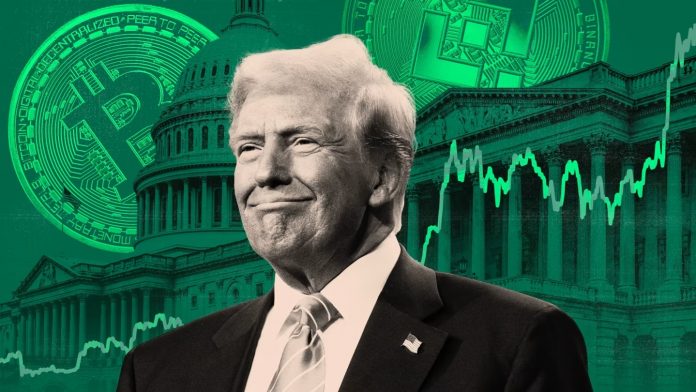
Donald Trump’s latest financial disclosure has put his trading activity in crypto-related equities under renewed scrutiny, revealing more than 1,000 transactions that included sales of Strategy and Coinbase shares before he later returned to Coinbase.

The filing offers a detailed glimpse into how the president managed positions tied closely to the cryptocurrency market during a period of heightened volatility and political attention surrounding digital assets.

According to the disclosure, Trump sold shares of Strategy, the company formerly known as MicroStrategy and one of the most prominent corporate holders of Bitcoin.

The filing records two Strategy sales, with each transaction falling within the disclosure’s reporting range of between $16,002 and $65,000.

Strategy’s stock has become closely associated with Bitcoin because of the company’s aggressive strategy of holding the cryptocurrency as a treasury asset. The filing also shows three separate Coinbase sales.

Those transactions were significantly larger, with reported values ranging from $116,003 to $315,000. Coinbase is one of the largest publicly traded cryptocurrency companies in the United States.

Making Trump’s trading activity particularly notable given his administration’s broader emphasis on creating a more favorable regulatory environment for digital assets. What makes the disclosure especially interesting is that Trump subsequently bought Coinbase shares again.

The filing indicates that he purchased between $50,001 and $100,000 worth of Coinbase stock after selling the company’s shares. He also made a smaller investment in Robinhood, another publicly traded platform with substantial exposure to cryptocurrency trading and digital-asset services.

The transactions do not necessarily indicate a deliberate attempt to time the cryptocurrency market. Financial disclosures generally provide transaction ranges rather than exact purchase or sale prices.

Making it difficult to determine the precise gains, losses or investment rationale behind individual trades. The sequence of sales followed by a Coinbase purchase is likely to attract attention because of the president’s prominent role in shaping U.S. crypto policy.

Trump has increasingly positioned himself as a supporter of the cryptocurrency industry, while companies such as Coinbase and Strategy have become important publicly traded proxies for different parts of the digital-asset economy.

Coinbase represents the infrastructure and trading side of crypto, while Strategy’s equity valuation has become heavily influenced by Bitcoin’s price and the company’s treasury strategy.

The disclosure therefore provides an unusual intersection between personal investment activity, public policy and the rapidly expanding cryptocurrency economy.

Investors may examine the transactions for clues about market sentiment, although the filing itself does not establish that Trump bought or sold based on expectations about Bitcoin or broader crypto prices.

The broader significance lies in how closely traditional financial markets and cryptocurrency markets have become intertwined. A portfolio containing Strategy, Coinbase and Robinhood shares reflects exposure to an ecosystem that has moved from the margins of finance toward mainstream capital markets.

As regulatory decisions continue to shape the industry, disclosures involving influential political figures are likely to receive increased attention. Trump’s latest filing does not explain his investment decisions.

But it demonstrates that crypto-linked equities have become significant enough to feature prominently in the financial portfolios of high-profile investors. For markets, the transactions are another reminder that cryptocurrency is no longer isolated from conventional stocks, politics and institutional finance.


What Phantom’s SUI Exit Means for Crypto Wallet Competition

0

Phantom Wallet’s decision to sunset support for SUI marks a significant development for users of the multichain crypto ecosystem and highlights the increasingly competitive environment among blockchain networks and wallet providers.

The move means that SUI users who have relied on Phantom for managing their assets will need to pay closer attention to the transition and consider alternative wallets or platforms for continued access to the Sui ecosystem.

Phantom has established itself as one of the most recognizable self-custody wallets in crypto, expanding beyond its original Solana-focused identity to support multiple blockchain networks.

Its growth reflected a broader industry trend in which users increasingly wanted a single wallet capable of managing assets across different ecosystems. The decision to remove SUI support therefore represents a notable reversal of that multichain expansion.

For SUI holders, the most important issue is understanding what sunsetting support means in practical terms. A wallet ending support does not necessarily mean that the underlying SUI assets have disappeared.

In a self-custodial environment, assets remain recorded on the blockchain rather than being stored directly inside the wallet application. Users may lose access to certain wallet functions, including transaction capabilities, asset visibility, network-specific features, or updates related to Sui.

This distinction is particularly important for less experienced users. Crypto wallets are interfaces through which people interact with blockchain networks; they are not conventional bank accounts holding coins in a centralized database.

Consequently, users should carefully follow Phantom’s official transition instructions and ensure they understand how their recovery phrase, private keys, and SUI assets are handled before making any changes.

The development also raises broader questions about the relationship between wallets and blockchain ecosystems. Wallet providers occupy an increasingly influential position because they determine which networks users can conveniently access.

When a major wallet changes its supported chains, developers, traders, and token holders can feel the effects even though the underlying blockchain continues operating independently.

For Sui, the development could create additional pressure to strengthen its native wallet ecosystem and make onboarding as seamless as possible.

The Sui network has built a growing presence around decentralized applications, gaming, decentralized finance, and digital assets. Maintaining easy access to these applications is therefore critical to preserving user activity and liquidity.

The decision illustrates the commercial realities facing wallet companies. Supporting a blockchain requires engineering resources, security monitoring, infrastructure maintenance, user support, and continued compatibility with network upgrades.

Wallet providers must continuously evaluate whether the benefits of supporting a particular ecosystem justify those costs. For investors and users, Phantom’s SUI sunset should therefore be viewed as more than a routine product change.

It is a reminder that the infrastructure surrounding crypto assets can evolve rapidly. Users should avoid panic selling simply because a wallet is ending support, but they should also avoid ignoring transition deadlines or assuming that existing wallet functionality will remain available indefinitely.

SUI’s future will depend more heavily on the strength of its underlying ecosystem than on any single wallet integration. Phantom’s decision may inconvenience users in the short term.

But it also provides a broader lesson about self-custody: controlling assets requires understanding the networks, wallets, recovery mechanisms, and infrastructure that make those assets accessible. As crypto becomes increasingly multichain, that knowledge will remain essential for navigating the industry safely.

World Liberty Financial Receives Conditional OCC Approval for National Trust Bank

0

World Liberty Financial has received conditional approval from the U.S. Office of the Comptroller of the Currency (OCC) for a national trust bank, marking another significant development in the growing intersection between digital assets and the traditional financial system.

The approval represents an important step for the company as it seeks to establish a regulated banking structure capable of operating within the broader U.S. financial framework.

The OCC is responsible for supervising and regulating national banks and federal savings associations in the United States.

A conditional approval therefore carries considerable significance, particularly for a company associated with the rapidly expanding digital-asset industry. However, conditional approval is not the same as a final authorization to begin full banking operations.

World Liberty Financial would still need to satisfy outstanding regulatory requirements before receiving final approval and commencing the activities permitted under its charter. The development reflects a broader shift in the relationship between cryptocurrency businesses and U.S. regulators.

For years, many digital-asset companies operated primarily through partnerships with conventional banks because obtaining direct access to regulated banking infrastructure was difficult.

The emergence of companies seeking their own banking charters suggests that the industry is increasingly attempting to integrate financial technology, blockchain infrastructure and traditional banking under regulated entities.

A national trust bank could potentially provide World Liberty Financial with a more direct framework for offering custody, fiduciary and other permitted financial services. The precise scope of activities will depend on the conditions attached to the OCC approval and subsequent regulatory decisions.

This distinction is particularly important because a trust bank does not automatically function like a conventional commercial bank. The announcement also arrives as U.S. policymakers continue debating how digital assets should fit into the country’s financial architecture.

Regulators and lawmakers have increasingly focused on stablecoins, tokenized assets, digital-asset custody and the role of regulated institutions in blockchain-based markets. As these sectors expand, regulatory clarity has become an increasingly important competitive factor.

For World Liberty Financial, obtaining conditional approval could strengthen its position in this evolving environment. A regulated banking structure could potentially improve institutional credibility and create new opportunities to connect blockchain-based products with established financial markets.

At the same time, the approval places the company under heightened regulatory expectations. Compliance, governance, risk management and consumer protection will become central considerations as it progresses toward final authorization.

The development could also have implications beyond World Liberty Financial. If more digital-asset companies successfully obtain national trust charters, the boundary separating traditional finance from blockchain-based financial services could become increasingly difficult to define.

Established financial institutions may face greater competition from technology-driven firms, while crypto companies could gain access to more regulated infrastructure.

The conditional nature of the approval means investors and market participants should avoid treating it as the completion of the process.

Regulatory conditions can require substantial work before an institution becomes fully operational. The next stage will therefore be closely watched for evidence that World Liberty Financial can satisfy the OCC’s requirements and translate the preliminary approval into a functioning regulated institution.

The OCC decision highlights how rapidly the financial landscape is changing. Digital-asset firms are no longer seeking only market adoption; they are increasingly pursuing formal integration with the institutions that underpin the global financial system.

World Liberty Financial’s conditional approval could become an important example of that transition, provided the company successfully completes the remaining regulatory steps.

Bitcoin Records Largest Weekly Gain Since March 2023, Surging Over 23%

0

Bitcoin has reportedly delivered its strongest weekly performance in more than three years, climbing more than 23% as the cryptocurrency broke out of a prolonged summer range.

The asset moved from levels near $62,000–$63,000 at the start of the week to a peak around $79,500 before settling in the high $77,000s to low $79,000s by Monday.

The advance marks the largest percentage gain for seven days since March 2023, when Bitcoin rose sharply amid the regional banking crisis. In dollar terms, the weekly increase of roughly $14,000 to $15,000 ranks among the largest on record.

Also. Trading volumes expanded significantly as the price cleared successive resistance levels, including moves past $70,000 and $75,000.

Institutional demand played a central role. U.S. spot Bitcoin exchange-traded funds recorded approximately $1.92 billion in net inflows over the week, the strongest total since October 2025.

BlackRock’s iShares Bitcoin Trust (IBIT) accounted for the majority of the capital, with one single day alone bringing in more than $600 million. The influx reversed prior weeks of weaker or negative flows and coincided with a sharp rise in ETF trading activity.

Macro factors also supported the move. Announcements related to expanded U.S. Treasury buybacks helped ease yields and improved liquidity conditions for risk assets. Derivatives markets amplified the rally through large short liquidations, with billions of dollars in positions closed as prices accelerated higher.

The combination of fresh institutional buying and forced covering created a powerful upward feedback loop.

The broader cryptocurrency market participated in the rebound. Ethereum and several major altcoins posted double-digit gains over the same period, lifting overall market capitalization. Ethereum’s price broke above $2,500 U.S. in early trading on Aug. 24, having gained 34% over the last seven days. In contrast, Bitcoin’s price has increased 24% over the same time period.

Bitcoin’s dominance remained elevated, reflecting its leadership in the move. Despite the strong week, Bitcoin remains well below its October 2025 all-time high near $126,000, leaving substantial ground still to recover on a longer-term basis.

This rally changes the unpleasant picture of the first two quarters of 2026, restoring optimism to the market after months of intense pressure on the price.

The first half of the year proved extremely difficult for investors, as the declines in January and February were followed by a 20.5% plunge in June, which brought bearish sentiment back to the market.

Zaye Capital market analyst Naeem Aslam says Bitcoin is increasingly trading as both a risk-sensitive asset and a hedge against fiscal and monetary policy uncertainty.

Market participants are now watching whether the renewed ETF demand and improved sentiment can sustain further gains or whether the rapid advance invites consolidation.

Outlook

The near-term outlook for Bitcoin remains constructive, although the pace of the latest advance raises the likelihood of increased volatility and a period of consolidation.

Sustained ETF inflows could provide a strong foundation for further upside, particularly if institutional demand remains elevated and macroeconomic conditions continue to support liquidity-sensitive assets.

While the sharp weekly rally has significantly improved sentiment, Bitcoin’s ability to maintain momentum after such a large move will be critical in determining whether the latest surge develops into a broader recovery toward its previous all-time high.

Fasset Raises $68 Million at $1 Billion Valuation as Stablecoin Banking Enters a New Phase

0

Fasset, a stablecoin-powered neobanking platform, has reached unicorn status after raising $68 million in a Series C funding round led by Japan’s SBI Group.

The financing values the company at $1 billion and highlights the growing investor appetite for financial platforms using stablecoins to modernize payments, banking and cross-border settlement.

The latest investment comes only three months after Fasset secured $51 million in Series B funding in May.

With the new capital included, the company has raised $119 million during 2026, demonstrating the speed at which its business has expanded. Fasset said the fresh funding will be directed toward strengthening its financial infrastructure, particularly Own Network.

While increasing investment in artificial intelligence systems designed for stablecoin settlement, corridor banking and tokenized assets. The fundraising is significant because it reflects a broader shift in how stablecoins are being positioned within financial markets.

Rather than being used solely as crypto trading instruments, stablecoins are increasingly being developed as settlement infrastructure for payments, remittances and international commerce. Fasset is attempting to build a banking model around that infrastructure, connecting traditional financial institutions with blockchain-based settlement rails.

According to Fasset, its Own Network connects banks, telecommunications companies, payment providers, liquidity providers and other financial infrastructure across more than 100 banking corridors.

The company says it now processes more than $40 billion in annualized transaction volume, serves more than three million wallets and supports more than 1,000 enterprises across 125 countries.

Artificial intelligence is another major component of Fasset’s expansion strategy. The company plans to deploy agentic AI systems to improve transaction routing across payment rails, currencies, liquidity providers and settlement methods.

Such technology could become increasingly important as financial networks become more fragmented, particularly in emerging markets where consumers and businesses may rely on several different payment systems.

The involvement of SBI Group also gives the fundraising broader strategic significance. Japan’s financial conglomerate is already active across banking, securities, asset management and digital assets.

Its investment in Fasset indicates that established financial institutions are increasingly viewing stablecoin infrastructure as a potential component of the next generation of international payments.

SBI has also partnered with Fasset through SBI Remit, creating opportunities to connect Fasset’s infrastructure with a wider remittance network. For Fasset, the $1 billion valuation represents more than a fundraising milestone.

It places the company among fintech unicorns while strengthening its ability to compete in a rapidly developing digital-finance market. The company is pursuing a model in which users can receive, hold, transfer, spend and invest across currencies and asset classes through a unified financial platform.

However, the road ahead will not be without challenges. Stablecoin businesses continue to operate within evolving regulatory frameworks, while competition is increasing among fintech companies, crypto firms, payment networks and traditional banks.

Fasset will therefore need to demonstrate that its infrastructure can scale securely while maintaining regulatory compliance across numerous jurisdictions. Fasset’s latest funding round reflects a larger transformation underway in global finance.

Investors are no longer viewing stablecoins simply as digital representations of fiat currencies. Increasingly, they are being treated as programmable settlement rails capable of connecting fragmented financial systems.

With $68 million in fresh capital and a $1 billion valuation, Fasset is betting that this infrastructure can become the foundation of a more interconnected global banking system.