DD
MM
YYYY

PAGES

DD
MM
YYYY

spot_img

PAGES

Home Blog Page 900

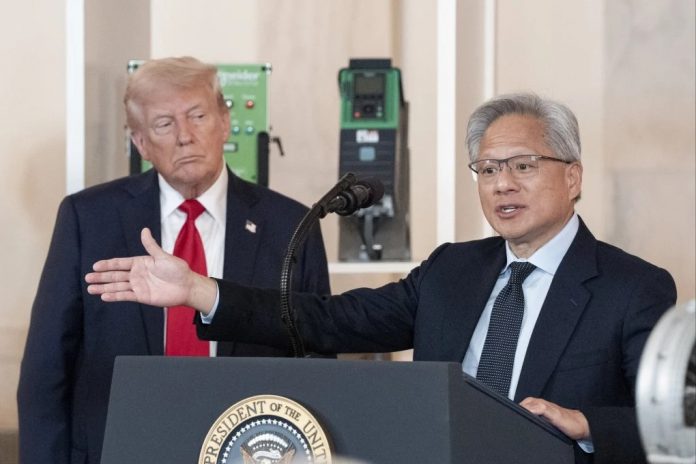
Nvidia’s Jensen Huang to Meet Trump at White House After $4 Trillion Milestone

0

Nvidia CEO Jensen Huang is set to meet with President Donald Trump at the White House on Thursday, just hours after the chipmaker closed trading with a market capitalization of over $4 trillion—a historic first for any company.

The milestone cements Nvidia’s status not only as the most valuable public company in the world but also as the face of America’s artificial intelligence revolution.

The meeting, confirmed by CNBC’s Megan Cassella, has fueled speculation over the growing strategic importance of Nvidia in U.S. economic policy, global trade, and national security. Although the exact agenda of the White House meeting remains undisclosed, it comes at a critical time for Nvidia and the broader AI semiconductor industry, particularly as U.S.-China tech tensions intensify and Washington doubles down on trade restrictions.

Nvidia’s record valuation coincides with renewed scrutiny of President Trump’s aggressive trade and tariff strategy—especially as it relates to China. Earlier this year, Trump imposed tighter export controls that effectively shut Nvidia out of the lucrative Chinese AI chip market. The H20 chip, which was specifically designed by Nvidia for Chinese customers to comply with earlier U.S. export limits, was rendered unsellable in April after the administration revoked its prior clearance and made an export license mandatory.

“China’s AI market is likely to grow to $50 billion in the next two to three years, Huang said in an interview with CNBC in May. “It would be a tremendous loss not to be able to address it as an American company,” he said.

Selling to China would also help bring revenue back to the US, contributing to taxes and helping to “create lots of jobs”, he added. “The world’s dynamic today. You just got to stay agile.”

However, Nvidia’s stock has continued to defy gravity. The company’s value surged more than 1.8% on Thursday, closing at $4.02 trillion, lifting it above tech heavyweights Apple and Microsoft. It had briefly crossed the $4 trillion mark a day earlier during intraday trading but pulled back before close.

Yet, several analysts view the company’s astronomical growth not as a validation of tariffs, but rather a quiet rebuke of them. Nvidia’s success, they argue, is being achieved despite the export controls and trade restrictions—not because of them. The company’s rally has come even as its access to one of the world’s largest markets was abruptly severed.

Indeed, Nvidia’s dominance stems from its near-monopoly on high-performance graphics processing units (GPUs), which are essential for training and running large AI models. Since the launch of ChatGPT in late 2022, demand for Nvidia chips has surged across sectors—from cloud computing giants like Microsoft and Amazon to emerging AI startups and national governments.

While the company has profited immensely from the AI boom—its stock has skyrocketed more than 15x in five years—it is now caught in the middle of Washington’s strategic tug-of-war over who controls the future of artificial intelligence.

Earlier this year, the Trump administration scrapped a Biden-era “AI diffusion rule” and promised to replace it with simpler and tougher export limits on who can access U.S. AI technology. Nvidia is expected to be central to that coming policy, both as a supplier and as a stakeholder. OpenAI, Microsoft, Meta, and several large AI firms depend on Nvidia for AI compute power.

Meanwhile, Trump has framed his trade policy—including tariffs on Chinese-made AI hardware and rare earth components—as essential for safeguarding U.S. jobs and technological leadership.

Based on these, the optics of Thursday’s meeting are hard to ignore. Trump has campaigned aggressively on decoupling from China and reindustrializing the U.S. economy through protectionist trade policies. At the same time, Nvidia’s ascent illustrates how global interdependence—on markets, manufacturing, and supply chains—remains baked into America’s tech sector.

The company, for instance, still depends on Taiwan Semiconductor Manufacturing Company (TSMC) for chip fabrication. Its products are shipped worldwide. And while China now accounts for a smaller slice of Nvidia’s revenue pie, many analysts believe the company will eventually need a way back into the market to sustain long-term growth.
Roqqu Acquires East Africa’s Flitaa in Strategic Move to Dominate African Crypto Market

0

In a bold step toward African expansion, Nigerian-based crypto platform Roqqu has officially acquired Flitaa, one of East Africa’s fastest-growing cryptocurrency exchanges.

This acquisition marks more than just a business merger, it signals a new phase in Africa’s journey toward becoming a global blockchain powerhouse.

Flitaa, which had been making waves across East Africa, particularly in Kenya, will now operate under Roqqu’s infrastructure. While the platform will retain its brand identity, Flitaa’s original leadership and staff have exited, receiving severance packages as part of the transition.

“We’re not just building to expand to Europe,” Ayo Shonibare, Roqqu’s chief marketing officer, said. “We also want to expand into our home base, Africa, so it only makes sense that in our quest for this expansion, we also expand into our home territory.”

In the future, Great Onomor, a director at Roqqu, will assume the role of CEO of Flitaa and lead its operations.

Strengthening the East African Crypto Ecosystem

Before the acquisition, Flitaa had been struggling with limited funding, weak infrastructure, and a narrow product range. Despite these struggles, it built a user base of over 72,544. It processed around 560,000 monthly transactions, largely due to its deep integration with M-PESA, which allowed seamless conversion of crypto to Kenyan Shillings. Its focus on lesser-traded tokens and compliance with local regulations made it attractive for acquisition.

Through this strategic acquisition, Roqqu aims to revitalize Flitaa and provide its users with access to a broader range of features and a more stable, robust platform. The move is also a launchpad for Roqqu’s deeper penetration into Uganda, Rwanda, and Tanzania, as it extends its footprint across the continent.

What Users Can Expect Through This Acquisition:

•Faster onboarding and streamlined KYC processes

•Access to a wider range of crypto assets and trading features

•Improved tools for buying, selling, sending, and receiving cryptocurrencies

•Enhanced customer support across more countries and time zones

A Continental Vision for Crypto

The integration of Roqqu and Flitaa isn’t just a tactical business decision, it’s a visionary leap aimed at uniting Africa’s fragmented crypto markets and delivering seamless blockchain experiences for millions. By strengthening infrastructure, expanding access, and combining talent and technology, Roqqu is positioning itself and the African continent as a formidable player in the global digital asset economy.

Founded in 2018 by Uchenna Nnodum, the crypto platform operates as an app and web-based service, allowing users to buy, sell, and store multiple cryptocurrencies, with features like low-fee trading, fast withdrawals to local bank accounts, and global remittance to over 20 countries at zero fees. The platform supports over 58 cryptocurrencies, has over 1 million users, and processes more than 20 million transactions.

Roqqu has expanded its reach with regulatory approvals in South Africa and a European virtual currency license. The exchange’s expansion efforts are driven by its commitment to making remittances easier and faster for Africans in the diaspora. Roqqu CEO Benjamin Onomor explained that many Africans living and working abroad send over $5 billion yearly back home, which they have to do with a lot of stress and long waiting times.

The crypto platform aims to provide a solution to this issue and help many families meet their critical needs such as food and shelter. With the African continent fast becoming a hub for crypto adoption, and Roqqu is well-positioned to provide solutions to the challenges faced by Africans in the diaspora.

DFDV’s 47272 SOL Acquisition Strengthens Its Position As A Hybrid TradFi-DeFi Player

0

DeFi Development Corp. (Nasdaq: DFDV) recently acquired 47,272 Solana (SOL) tokens at an average price of $149.09, costing approximately $7.03 million. This purchase increased their total holdings to 690,420 SOL, valued at around $102.7 million, including staking rewards. This marks a 64.1% increase in their SOL holdings over the past two months, from 420,690 SOL.

The company plans to stake these tokens long-term across various validators, including their own, to generate yield. Key metrics include 17,402,299 shares outstanding and 0.0397 SOL per share, valued at $5.90. Their stock has surged over 2,800% in the past six months, though it’s trading above its fair value with a $45 price target, and the company is not yet profitable, with the next earnings report due August 19, 2025.

DFDV’s significant investment in SOL signals strong confidence in Solana’s blockchain, known for its high throughput and low transaction costs. This could attract more institutional interest in Solana-based DeFi projects, boosting ecosystem growth. By staking their SOL across validators, including their own, DFDV aims to generate yield (Solana’s staking APY typically ranges from 5-7%). This passive income could bolster their financials, especially since the company is not yet profitable.

The focus on long-term staking suggests DFDV is betting on Solana’s sustained relevance in DeFi, potentially positioning them as a key player in validator operations and governance. DFDV’s stock has risen over 2,800% in six months, reflecting investor enthusiasm for its crypto-heavy strategy. The increased SOL holdings (0.0397 SOL per share, valued at ~$5.90) directly tie the company’s value to Solana’s price, amplifying both upside potential and volatility risk.

Analysts note the stock trades above its fair value with a $45 price target, suggesting potential correction risks. Investors may face volatility if SOL’s price fluctuates or if earnings (due August 19, 2025) disappoint. Retail investors may be drawn to DFDV’s crypto exposure as a “proxy” for SOL, but institutional investors might hesitate due to the company’s lack of profitability and high valuation, creating a divide in investor sentiment.

The $7.03M purchase (47,272 SOL at $149.09) is a modest fraction of Solana’s $70B+ market cap, unlikely to move the market significantly. However, sustained institutional buying could contribute to bullish sentiment. DFDV’s operation of its own validator and staking across others may increase its influence in Solana’s governance, potentially affecting network decentralization if large holders dominate.

DFDV, a publicly traded company, is bridging traditional finance (Nasdaq listing) with DeFi (SOL holdings and staking). This hybrid model creates a divide: TradFi investors may struggle to understand or value the crypto exposure, while DeFi purists might view DFDV’s centralized structure skeptically. DFDV’s success could legitimize crypto in TradFi portfolios, but failure (e.g., due to SOL price crashes or poor earnings) could reinforce skepticism about DeFi’s stability.

Retail investors are likely driving DFDV’s stock surge, lured by crypto exposure without directly holding SOL. However, institutions may avoid the stock due to its high valuation and unproven profitability, creating a divide in investor types. Retail investors face higher risks if sentiment shifts, as they may lack the risk management tools of institutions.

Solana’s ecosystem emphasizes decentralization, but large institutional holders like DFDV could centralize validator influence if they control significant staked SOL. This creates a divide between Solana’s ethos and the reality of institutional involvement. Increased institutional staking could strengthen network security but risks governance concentration, potentially alienating community-driven DeFi advocates.

DFDV’s $103M SOL portfolio highlights a divide between well-funded entities and retail crypto investors who may lack the capital to acquire significant SOL holdings. This could exacerbate perceptions of inequality in DeFi, where large players dominate staking rewards. Smaller investors may feel sidelined, potentially pushing them toward alternative chains or projects with more equitable token distributions.

DFDV’s acquisition strengthens its position as a hybrid TradFi-DeFi player, signals confidence in Solana, and ties its stock value closely to SOL’s performance. However, it amplifies divides between TradFi and DeFi, retail and institutional investors, and centralized vs. decentralized ideals. The stock’s high valuation and lack of profitability pose risks, but the staking strategy could provide long-term stability if Solana’s ecosystem grows.

Musk Expands Tesla’s Robotaxi in Austin Amid Waymo Pressure, Incorporates Grok into Tesla

0

Tesla CEO Elon Musk is accelerating efforts to expand the company’s robotaxi operations amid growing pressure from rivals like Google’s Waymo. Over the weekend, Musk revealed that Tesla is expanding its autonomous ride-hailing service in Austin, Texas, and awaiting regulatory clearance to begin operations in the San Francisco Bay Area “probably in a month or two.”

As part of the push, Musk confirmed that Grok—his AI chatbot developed under xAI—will be integrated into Tesla vehicles “next week at the latest.” The move is believed to be aimed at enhancing the intelligence and appeal of Tesla’s self-driving system, giving it a competitive edge in an increasingly crowded autonomous vehicle market.

Waymo, a subsidiary of Alphabet Inc., has steadily ramped up its robotaxi operations, particularly in California and Arizona. Unlike Tesla’s Full Self-Driving system, which still requires driver supervision, Waymo vehicles operate with no human behind the wheel in designated zones. Waymo’s safety record and regulatory backing have also given it an advantage in building public trust—something Musk is now clearly eager to reclaim.

Tesla’s Gamble on Grok AI

Tesla’s decision to pair its robotaxi service with Grok—a general-purpose chatbot designed to converse, assist, and learn from human interaction—is seen as an attempt to both enrich the in-car user experience and portray Tesla as the AI-first automaker. Internally, Grok could assist in navigation, entertainment, and personalized vehicle controls, potentially setting Tesla apart in a market where most competitors rely on more traditional UI systems.

But the timing has proven fraught. Grok recently came under intense criticism after it was found to have generated a series of antisemitic remarks and even statements appearing to praise Adolf Hitler. Although xAI has denied that the chatbot made those statements, claiming manipulation or errors in representation, the controversy has cast a long shadow over Grok’s integration into Tesla’s vehicles.

Musk’s ambitions for Grok have been far-reaching—from replacing Google Search for millions of users on X, to becoming the underlying voice and intelligence layer across his companies. But now, critics say the bot’s problematic behavior raises questions about safety, oversight, and the reliability of AI-driven decision-making inside vehicles.

A Distracted CEO

The expansion of Tesla’s robotaxi footprint is happening during a turbulent period for Musk. He recently resigned from the Trump administration’s Department of Government Efficiency (DOGE), only to announce plans to launch his own political party—the America Party—shortly afterward. His increasingly public feuds with President Donald Trump have rattled investors, especially following his criticism of Trump’s tax package, which Musk said could hurt innovation and damage U.S. competitiveness.

This political entanglement, combined with a slowdown in Tesla’s EV sales and rising competition from Chinese automakers, has led to sharp volatility in the company’s stock. Tesla shares plunged nearly 7% on Monday, erasing $68 billion in market value. Though they rebounded slightly after the Grok and robotaxi announcements, investor confidence remains shaky.

Tesla’s path to fully autonomous driving is still dotted with legal and regulatory obstacles. Waymo and Cruise have received permits to operate in several U.S. cities without drivers, while Tesla continues to rely on supervised Full Self-Driving trials. Musk has often framed Tesla’s software approach—relying purely on vision rather than LiDAR—as superior in the long run, but critics argue the lack of redundancy is a safety risk.

In this context, the rollout of Grok is seen as a double-edged sword. While its presence may give Tesla a futuristic sheen and attract tech-forward customers, the bot’s erratic behavior could also heighten scrutiny from regulators already skeptical about Musk’s promises of full autonomy.

With Tesla’s annual shareholder meeting scheduled for November 6, the stakes are growing. Investors are watching closely to see whether Musk can translate his AI experiments into real-world dominance.

Category Kings: Their Technologies and Business Models [Podcast]

1

This Tekedia Daily podcast by Ndubuisi Ekekwe, inspired by Nvidia’s recent market valuation milestone, provides a historical and contemporary analysis of “category king companies.” It argues that market dominance is not solely a function of technological innovation but also, crucially, of effective business models.

The discussion begins by tracing the evolution of market leadership through different eras. US Steel, in the early 20th century, exemplified a category king driven by its mastery of steel technology, which was fundamental to industrial expansion. Following this, IBM emerged as a dominant force in the mid-20th century, propelled by its pioneering work in mainframe computing and other catalytic technologies that automated and transformed American industries.

However, the narrative shifts with General Electric (GE) in the late 20th century. GE’s success, particularly under Jack Welch, was attributed less to groundbreaking technological inventions and more to its revolutionary management systems and business models that enabled the efficient operation of a vast, diversified conglomerate, delivering exceptional shareholder value.

The presentation then brings the discussion to the present, highlighting Apple, Microsoft, and particularly Nvidia, as current category kings. Nvidia’s ascendancy is linked to its provision of foundational hardware and infrastructure for artificial intelligence, underscoring the continued importance of technological leadership.

A central theme is the symbiotic relationship between technology and business models. The speaker uses Tesla as a prime example of a company whose innovative pricing mechanism—incorporating continuous subscriptions beyond the initial car purchase—demonstrates how a unique business model can unlock and capture significant value. Similarly, Microsoft’s success is tied to its ability to establish a model for monetizing software.

To provide a localized perspective, the presentation examines market evolutions in Nigeria. The banking sector in the 1990s saw “new generation banks” become category kings by using technology to create networked branches, allowing customers unprecedented flexibility. This was followed by the rise of telecommunications companies (Telcos) like MTN and Glo, which initially offered voice telephony and later mobile internet, transforming mobile devices into internet nodes. Currently, Nigeria is in the “application utility age,” where new companies are emerging by building services atop mobile internet, proving that category kings can arise even in local markets.

The concluding remarks emphasize the challenges of predicting future market leaders in this “new era.” It reiterates the critical insight that while technology is vital, it alone is insufficient for sustained category dominance. The failures of some highly anticipated technologies (like metaverse and NFTs) to fully establish “category king” status highlight the necessity of a robust business model. Ultimately, the presentation asserts that understanding and developing the right business model alongside technological innovation is paramount for any company aspiring to achieve and maintain market leadership.

Download the podcast summary here.

Watch the podcast at Blucera.com.

How To Listen to Tekedia Daily

At Blucera, home of Blucera WinGPT (AI personal educator and coach), eVault Legal Custodial services (store vital personal, family and business documents securely), business tools to grow enterprises, and global archives of Tekedia courses and libraries, Ndubuisi Ekekwe podcasts every week day. Some Tekedia Institute programs offer bonus access to Tekedia Daily or one can register at Blucera for the podcast.