DD
MM
YYYY

PAGES

DD
MM
YYYY

spot_img

PAGES

Home Blog Page 92

Canada’s GDP Records 2.6% Q3 Bounce, A Reprieve Amid a Growing U.S.-Tariff Storm

0

Canada avoided a technical recession this quarter after GDP rebounded by 2.6 percent annualized. But behind the numbers lies a deeper tension: a country straining to shield itself from a sweeping U.S. tariff campaign that has already shaken exporters, households, and investor confidence.

The shock came from broad government action and a surge in crude oil exports. Crude oil and bitumen shipments jumped 6.7 percent, while government capital investment rose 2.9 percent — reflecting spikes in spending on weapon systems and large non-residential projects such as hospital infrastructure. Residential resale activity and renovations also added to demand.

Thanks to that boost, Canada’s economy managed to escape the downturn that followed a revised 1.8 percent contraction in the previous quarter. Monthly GDP growth, based on industrial output, matched expectations in September with a 0.2 percent rise, largely on a 1.6 percent manufacturing expansion.

Still, signs of fragility remain as business capital investment flat-lined in the quarter. Household consumption — the usual backbone of growth — slipped 0.1 percent. New residential construction fell 0.8 percent. And early estimates for October point to a possible 0.3 percent GDP decline, hinting that the fourth quarter may begin on uncertain footing.

Statistics Canada cautioned that the third-quarter numbers may be revised when foreign merchandise trade data becomes available, delayed by the recent U.S. government shutdown.

Economists such as Doug Porter of BMO Capital Markets believe the rebound may be temporary.

“This should quash recession chatter for now,” he wrote.

But he added that the broader economic landscape remains fragile, especially under the weight of trade uncertainty.

The strength of the report has already strengthened expectations that the Bank of Canada will not cut interest rates when it meets on December 10, after having held its key rate at 2.25 percent.

The U.S.–Canada Tariff War: A Shockwave Still Rippling Through the Economy

To understand the fragility behind Canada’s rebound, one must see it against the backdrop of an escalating trade confrontation with the United States. Revived in early 2025 under new U.S. leadership, tariffs of 25 percent on most Canadian goods and 10 percent on energy imports have disrupted decades of tightly integrated commerce between the two neighbors.

Canada is among the most exposed nations in the world: in 2023, roughly 77 percent of its merchandise exports went to the U.S., and trade-sensitive industries accounted for a meaningful share of GDP.

Industries such as automotive, manufacturing, oil and gas, metals, and agriculture have taken the hardest hits. The tariff shock threatens supply chains that span multiple border crossings just to complete a single product. Analysts warn that a sharp disruption to exports could reduce national GDP by as much as 1.5 percent below baseline in 2026, along with substantial job losses in manufacturing and export-heavy provinces.

Metal producers, auto-parts manufacturers, plastics, chemical, and equipment suppliers — all tied to cross-border supply chains — are scrambling to absorb higher costs, rework sourcing, or risk shuttering operations.

Sectors such as agriculture, forestry, and energy are also vulnerable. In many cases, Canada relies heavily on U.S. markets for exports or imported inputs — meaning the tariff war risks raising domestic costs even while reducing export income.

Beyond the direct cost pressures, the tariff environment has injected pervasive uncertainty. Firms reluctant to commit to expansion or new hiring, households uncertain about job security and income, lenders growing cautious — the macroeconomic ripple remains under the surface even if headline GDP grew this quarter.

What the Q3 Surge Reveals — and What It Masks

The rebound shows two things clearly: first, Canada retains structural buffers — diversified income streams beyond manufacturing exports, a robust energy sector, and the capacity for government-led fiscal support. Second, it reveals how precarious the recovery remains when core drivers of long-term growth, business investment, consumer spending, and construction, are still under pressure.

The increase in oil export revenue and government capital spending helped boost headline growth this quarter. But such support is, by nature, temporary and tied to global commodity prices and political will.

Business investment remains flat, suggesting firms remain wary of long-term commitments until trade uncertainty clears. Household consumption shrinking hints at caution among consumers who face inflationary pressures from tariffs and rising costs of goods. Falling residential construction suggests the housing market is not immune either.

Economists note that the rebound may not be enough to change the underlying structural risks posed by an aggressive and geo-politically driven tariff war. A revised trade flow, weakened industrial base, and fragile consumer confidence could keep GDP growth volatile.

Where Canada Goes from Here — A Tightrope Between Resilience and Risk

At least for now, the Q3 data gives the government and the central bank breathing room. With the Bank of Canada unlikely to cut rates soon, there is some stability in financial conditions. The Canadian dollar responded positively, strengthening to 1.3982 against the U.S. dollar, while two-year government bond yields jumped as markets repositioned.

But structural fixes are not easy. To avoid slipping back into economic contraction, economists expect Canada to:

  • Find new export markets and reduce over-dependence on the U.S.
  • Incentivize domestic manufacturing and supply-chain diversification to shield vulnerable sectors.
  • Support households and businesses coping with inflation and tariff-related cost pressures.
  • Ensure that public spending — which helped this quarter — is sustainable and not a one-off fix.

Some in Ottawa believe the tariff war may accelerate long-discussed shifts: deeper trade ties with Europe and Asia, new investment in energy and resources, and rebuilding manufacturing around new global supply chains.

Still, many warn that the risks remain high. Tariffs on steel, aluminum, autos, and other sectors continue to bite. Private investment remains cautious, and consumer and business sentiment remain under pressure.

While the 2.6 percent rebound defuses recession talk for now, it leaves Canada on a tightrope. Some analysts believe that unless trade tensions ease or Canada succeeds in reorienting its economy quickly, future quarters could deliver more shocks than rebounds.


Palantir Struggles Amid AI Selloff as Valuation Fears and Michael Burry’s Bet Stir Investor Anxiety

0

November has been an unforgiving month for Palantir Technologies, the Denver-based analytics powerhouse that has become a poster child for the artificial intelligence boom.

Shares of the software company dropped 16%, marking their steepest decline since August 2023, as investors fled AI-linked equities amid soaring valuation concerns. Yet the selloff tells only part of the story. Behind the numbers lies a clash of market sentiment, contrarian investing, and the precarious balance between hype and fundamentals in the AI sector.

Palantir entered November on a high. The company reported third-quarter revenue of $1 billion for the second consecutive quarter, surpassing Wall Street expectations. It had a strong earnings beat, showcasing a growing roster of government and commercial clients, and continued momentum in its AI offerings. But the celebrations were short-lived. Despite the robust performance, the stock’s post-earnings selloff reflected investor anxiety over Palantir’s sky-high valuation—trading at roughly 233 times forward earnings, far above peers like Nvidia at 38 times or Alphabet at 30 times.

Wall Street analysts didn’t hold back talking about this backdrop. Jefferies described Palantir’s valuation as “extreme,” warning clients that other AI-linked names like Microsoft or Snowflake offered a better risk-reward profile. RBC Capital Markets highlighted the company’s “increasingly concentrated growth profile,” a nod to its reliance on a relatively narrow base of contracts. Deutsche Bank added that the stock’s multiple was “very difficult to wrap our heads around.” Collectively, these warnings amplified fears that Palantir’s meteoric rise could collide with market reality.

Then came the high-profile short. Michael Burry, famed for calling the 2008 housing crisis and later immortalized in The Big Short, revealed positions against Palantir and AI chipmaker Nvidia. Burry, known for contrarian bets and dramatic predictions, criticized AI hyperscalers for inflating earnings, sending ripples through an already jittery investor base.

But appearing twice in one week on CNBC, Palantir CEO Alex Karp called Burry’s actions “egregious” and accused him of market manipulation, famously declaring, “The idea that chips and ontology is what you want to short is bats— crazy.”

Amid the turbulence, Palantir continued to rack up wins. The company inked a multiyear deal with consulting giant PwC to accelerate AI adoption in the U.K., and secured an agreement with aircraft engine maintenance firm FTAI. These contracts underscore that, on the ground, Palantir is executing its strategy and expanding its footprint. Yet, in a market obsessed with multiples and momentum, even tangible achievements struggle to offset valuation anxieties.

The selloff at Palantir mirrors broader turbulence across AI stocks in November. Nvidia fell more than 12%, while Microsoft and Amazon dropped roughly 5% each. Even the quantum computing sector, long touted as the next frontier, saw significant declines: Rigetti Computing and D-Wave Quantum shed over a third of their market value. Only tech giants like Apple and Alphabet emerged unscathed among the so-called “Magnificent 7.”

The message from the market is understood to be that investors are recalibrating expectations, seeking evidence that hype is translating into sustainable profits.

Palantir’s predicament also highlights a generational tension in technology investing. On one hand, the company positions itself as a democratizer of advanced analytics, giving ordinary investors and companies access to tools that were once the exclusive domain of elite venture capitalists in Silicon Valley.

Karp framed this mission in a recent letter to shareholders: “Please turn on the conventional television and see how unhappy those that didn’t invest in us are. Enjoy, get some popcorn. They’re crying. We are every day making this company better, and we’re doing it for this nation, for allied countries.”

On the other hand, the market is demanding discipline and predictability, wary of valuations untethered from short-term profitability.

Palantir’s revenue growth and contract wins suggest a company executing on strategy, yet its extreme valuation and exposure to AI hype make it highly sensitive to investor sentiment, underlining a juxtaposition. The presence of a contrarian investor like Burry—one who has historically shaken markets with prescient bets—adds a layer of uncertainty few stocks experience. For Palantir, every earnings report, deal announcement, or executive commentary now carries amplified significance.

Looking ahead, Palantir’s challenge is not technological but psychological, prompting questions such as: Can it sustain growth and continue executing contracts while navigating a market that has grown increasingly skeptical of AI exuberance? Will valuation pressures force a period of consolidation, or can the company’s expanding product suite and government ties justify the lofty multiple?

For investors, the situation is a study in contrasts: a company at the cutting edge of AI and analytics, yet tethered to a stock price that has become a lightning rod for debate over the future of tech investing.

In many ways, November’s turbulence is emblematic of the AI market itself—a sector filled with promise and peril, innovation and speculation, growth and scrutiny. Palantir may have the technology, contracts, and ambition to shape the AI landscape, but it also faces the humbling reality that in today’s market, perception is just as powerful as performance.

Dogecoin Price News: Bulls Eye Breakout as Little Pepe (LILPEPE) Builds Toward 18361% Price Explosion

0

DOGE is back in focus as it tests a crucial support zone near $0.17. This is an area traders believe could determine whether the original meme coin reignites a fresh bullish phase. Bulls are eyeing a breakout that will send DOGE to new highs. But there is a new meme coin, Little Pepe (LILPEPE) that is gaining momentum. It’s building meme infrastructure that could transform the meme narrative. Analysts believe its momentum is building toward an 18,361% rally.

Dogecoin Price Update: Bulls Target Key Breakout Zone

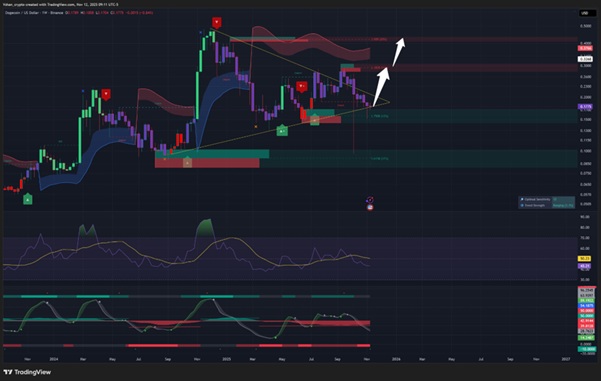
DOGE’s current technical posture is drawing heavy scrutiny. Support???????????????? at $0.17 has been a major turning point for trend reversals in the past. Thus, analysts suggest that a strong defence at this level might reignite bullish momentum.  Many believe that the main event that will trigger a larger run to $0.28 and then $0.40 will be a clear break beyond $0.20. Eventually, DOGE may hit the widely anticipated $1 ????????????????mark. Crypto analyst Shan Specter recently highlighted a descending triangle on the daily timeframe, which he believes mirrors previous DOGE setups that preceded explosive rallies.

Source: Shan Specter on X

Specter notes that once DOGE reclaims $0.20 with solid volume, “the path to $1 becomes structurally viable.” This cites past triangle breakouts that delivered 50%–100% short-term gains. Despite its near-term choppiness, DOGE’s long-term charts look increasingly familiar to seasoned traders. Multi-year consolidation channels from 2017 and 2021 are repeating almost beat for beat.  Several analysts have shared long-range projections showing DOGE’s fractal structure as it prepares for another vertical expansion. Some models suggest $2 targets if momentum aligns. However, more aggressive fractals indicate a focus on the $5 region, based on prior deviation-to-rally patterns.

Little Pepe (LILPEPE): The Next High-Velocity Meme Rocket

Little Pepe distinguishes itself from typical meme tokens by anchoring its brand around a purpose-built Layer 2 architecture. Instead of relying solely on hype, the project is constructing a high-throughput environment optimized for low-cost transactions, fair launches, and frictionless trading. Its zero-tax model removes the usual cost burden on traders. Meanwhile, its anti-sniper and anti-bot mechanics ensure that exploitative bots don’t hijack early liquidity.  The upcoming Pump Pad adds another layer of utility by serving as a launch platform for new microcaps within the LILPEPE ecosystem. This gives the token an expanding base of real usage and creates natural demand inflows each time a new project uses the platform.  In short, LILPEPE isn’t just a meme. It’s a meme ecosystem with infrastructure, an integrated launchpad, and built-in trader protections. This is precisely the blend that multiplies meme-cycle performance.

Presale Momentum & Market Validation

The presale has been one of the strongest in the market this cycle. It’s now moving through Stage 13 at a price of $0.0022. The team has raised more than $27.4 million so far and sold  16.6 billion tokens. This level of funding places LILPEPE in a tier few meme projects ever reach before launch, signaling real demand. Market visibility has also exploded. The project is already listed on CoinMarketCap and CoinGecko during its presale phase. With its strong CertiK security score and confirmed Tier-1 exchange listings lined up for launch, the picture becomes clear.

Community Growth & Viral Mechanics

LILPEPE’s community engine is firing at full speed, and it’s one of the biggest reasons analysts believe this token could deliver an explosive upside. The project launched a massive $777,000 community giveaway designed to pull in new holders and accelerate social traction across X, Telegram, and Discord.  For bigger buyers, stages 12–17 include an additional 15 ETH mega-prize pool. It encourages whales and mid-tier traders to accumulate aggressively before listings. As engagement compounds, the social footprint expands, giving the token continuous visibility. This type of organic, incentive-driven expansion is exactly how meme rockets achieve escape velocity.

Why Analysts Project an 18,361% Surge for LILPEPE

The 18,361% projection isn’t random hype. It’s based on straightforward valuation math, supply and demand mechanics, and historical patterns of meme cycle behavior.  With its current presale price of $0.0022, LILPEPE has the advantage of an asymmetric upside, where even modest liquidity inflows can trigger big price moves. An 18,361% increase will bring the price to $0.40. Its Layer-2 framework adds real utility. This gives it a stronger long-term growth curve than traditional meme coins that rely solely on sentiment. If?????????? the listing goes smoothly, the ecosystem grows, and the launchpad gains traction, Little Pepe might stun the crypto space with a huge rally.

Conclusion

Dogecoin is poised for a potential surge to a new price level. However, its uptrend is limited by its current size. Meanwhile, Little Pepe is still in its early stages and is backed by real infrastructure. With analysts eyeing an 18,361% runway, LILPEPE offers a growth potential that DOGE simply can’t match. For pure explosive potential, Little Pepe is the clear leader.


For more information about Little Pepe (LILPEPE) visit the links below:

Website: https://littlepepe.com

 Whitepaper: https://littlepepe.com/whitepaper.pdf

 Telegram: https://t.me/littlepepetoken

 Twitter/X: https://x.com/littlepepetoken

 $777k Giveaway: https://littlepepe.com/777k-giveaway/

Experts Compare Ozak AI’s Early Growth to BNB’s 2018 Run — Potential 800× Gains by 2030

0

Experts compare Ozak AI’s presale momentum to the 2018 BNB rally, which made early investors into billionaires. With $4.55 million in presale investment already raised, experts see Ozak AI’s presale momentum matching the BNB 2018 surge.

BNB began trading at less than $1, and by mid-2018, it had risen to a high of $24, representing a 75% increase and a big profit for BNB investors. Analysts expect similar possibilities in the Ozak AI presale phase, which currently provides a significant ROI for early investors prior to launch.

Presale Momentum: From $0.001 to $0.014 and Beyond

Ozak AI is in its current presale phase priced at $0.014. At The time of the launch The Ozak AI was priced at $0.001 anmd now it has increased 1300% from The launch phase. The previous 6th presale phase recently closed with $4.46 million worth of OZ tokens sold in the presale phase. Over 1.01 billion OZ tokens have been sold so far. Investors are entering into the current presale phase to secure more tokens before the current presale ends, as the next presale will launch with the price hike. Analysts predict that due to the massive adoption of the token, It will deliver 800x by the end of 2030.

The Math Behind Ozak AI’s 800× Growth Projection

At the current presale price of $0.014, $100 invested in Ozak AI will secure 7,100 OZ tokens. Analysts estimate that the token will achieve the anticipated price within the specified time period. If the token hits its listed target price of $1 by the end of 2026, the secured tokens will be valued at $7,100, representing 71x growth and a 7,042% rise. If the token hits $5 by the end of 2027, the secured tokens will be worth $35,700, representing a 350x increase. If the token hits $7 by 2028, the $100 investment will be worth $50,000, representing a 500x return. If the token achieves $10 by the end of 2029, the secured tokens will be valued $71,400 with 700x and If the token hits the $11.20 milestone, the secured tokens will be worth $80,000, representing an 800x increase. This converts the tiny investment into a substantial return.

The Technology Powering Ozak AI’s Growth

The Ozak AI’s strong technology merges AI and the Blockchain To produce the AI predictive Tools. This makes the Ozak AI to be Unique among the Other AI based Cryptos. The Ozak AI’s Advanced Technology consist of Smart Contract Execution Layer which plays a major role in the Ozak AI technology. It controls the work distribution, payments to node operators, and staking. It uses Rollup technology to make all actions cheaper and faster. The Ozak Data Vaults are the secure storage lockers of Ozak AI. It stores all financial data in the encrypted NoSQL databases. The access is controlled by a Smart contract, where the authorized users can access it.

Partnerships Driving Growth and Market Adoption

The Ozak AI’s strategic collaboration with Gremory AI and Watch AI helps to integrate the technology across multiple blockchain ecosystems and boost demand for its token utility. Before the Ozak AI makes its market prediction, liquidity is moved across DLMM pools like Metera with the assistance of Gremory AI, a Solana liquidity engine.  Ozark AI’s fast prediction agents are now teamed up with WatchAI to make sure trades and AI actions are safe and trustworthy.

Final Thought: Could Ozak AI Be the “BNB of the AI Era”

The BNB has emerged as one of the most strong cryptos following the 2018 surge, which provided many investors with a significant ROI. Ozak AI, with its powerful AI-driven blockchain technology, Presale momentum, and Strategic Partnership, is one of the most promising tokens of the year, matching the BNB surge. Investors aiming for long-term profits may find Ozak AI to be the token that may transform a tiny investment into a massive 800x if the market supports it and presale momentum increases.


For more information about Ozak AI, visit the links below:

Website: https://ozak.ai/

Twitter/X: https://x.com/OzakAGI

Telegram: https://t.me/OzakAGI

Warburg Pincus Acquires Majority Stake in Raptor Technologies in $1.8bn Deal as NatWest Moves to Offload Cushon Stake to Willis Towers Watson

0

Warburg Pincus has agreed to acquire a majority stake in Raptor Technologies, a leading provider of safety software solutions for K-12 schools, from fellow investment firm Thoma Bravo, in a transaction that values the company at approximately $1.8 billion, according to sources familiar with the confidential matter.

The deal, which could be announced imminently, represents a significant transaction in the growing mission-critical software sector, driven by escalating demand for school safety technology.

The acquisition sees Warburg Pincus take control of the Houston-based technology firm following a period of rapid expansion under Thoma Bravo’s ownership. This sale was anticipated, as Reuters had reported in September that Thoma Bravo was exploring a sale of Raptor Technologies, which was expected to potentially fetch more than $2 billion based on reported EBITDA of over $80 million.

As part of the new ownership structure, JMI Equity, another existing investor that has partnered with Raptor since 2021, will retain a significant minority stake in the company, reinvesting alongside Warburg Pincus. This continuity of investment from JMI suggests confidence in Raptor’s continued growth trajectory and market leadership.

The deal is expected to officially close in January 2026. Representatives for Warburg Pincus and Thoma Bravo declined to comment on the transaction, and Raptor Technologies and JMI Equity did not immediately respond to requests for comment.

Raptor Technologies specializes in providing a comprehensive suite of safety software solutions for the K-12 education market, covering the entire school safety lifecycle. Its globally integrated product portfolio supports key functions, including:

  • Crisis Prevention and Preparation: Tools for risk assessment and protocol development.
  • Emergency Response and Recovery: Technology to manage real-time communication, reunification, and recovery efforts during crises.
  • Safe Student Movement Management: Systems for visitor management, attendance automation, and controlled dismissal tracking.

The crucial nature of Raptor’s technology has made it increasingly sought-after, particularly in light of the continuous rise in school-based security incidents, including school shootings. Raptor’s website states that its platform is currently used by 60,000 schools across 55 countries, underscoring its broad market penetration and the critical demand for its Software-as-a-Service (SaaS) products.

The Thoma Bravo Legacy

Thoma Bravo’s four-year tenure as the majority owner was characterized by aggressive growth and strategic expansion. The firm, a leading software-focused private equity investor, partnered with Raptor and JMI Equity in 2021 and was instrumental in scaling the business, overseeing six strategic acquisitions. These acquisitions included UK-based CPOMS in 2021 (a leading provider of student safeguarding software) and SchoolPass in 2023 (a provider of cloud-based attendance and dismissal automation). These deals helped Raptor expand its platform beyond basic visitor management to encompass emergency management, student well-being, and campus movement solutions, transforming it into a comprehensive leader in school safety software globally.

The sale to Warburg Pincus, a global private equity firm with extensive experience in the technology and education technology sectors, signals the next phase of growth for Raptor, likely focusing on continued platform integration and international market expansion.

NatWest in Exclusive Talks to Offload Cushon Stake to Willis Towers Watson in Strategic U-Turn

Meanwhile, NatWest Group has entered exclusive talks to sell its 85% stake in the workplace pension provider Cushon to U.S. insurance broker Willis Towers Watson (WTW), a deal that signals a major strategic shift under the British bank’s current leadership.

The negotiations come barely two years after NatWest acquired control of the fintech firm.

According to people familiar with the confidential matter, the potential transaction could value Cushon at more than £150 million ($198.06 million). Both NatWest and WTW have remained publicly tight-lipped, with NatWest stating only that its “focus remains on delivering for our customers.”

The sources cautioned that discussions remain fluid and a transaction is not guaranteed.

The potential sale marks a sharp reversal of NatWest’s expansion into financial technology under former CEO Alison Rose.

NatWest paid £144 million for its 85% stake in Cushon, leaving management with the remaining 15%. This purchase was part of a broader rush by major UK lenders to acquire smaller, agile fintech firms to expand their product ranges and appeal to younger customers.

Cushon, known for its digital-first pension tools, has grown into a notable workplace pension and savings provider. As of early 2025, it manages roughly £3 billion in assets and serves more than 650,000 members across more than 21,000 employers. Its digital platform was originally intended to complement and modernize NatWest’s customer offerings.

Under current CEO Paul Thwaite, NatWest has pushed to simplify the bank’s structure and refocus on traditional core growth areas, such as mortgage lending and business banking. Industry analysts note that this shift makes divestment of non-core fintech investments, even those recently acquired, more likely. The discussions fit into a broader pattern of reassessment among big lenders after years of chasing high-growth fintech strategies.

A successful sale to Willis Towers Watson would be one of the most significant fintech exits involving a major UK bank this year. For WTW, the acquisition of Cushon’s digital platform and scale would serve to add significant scale to its existing workplace pensions and employee-benefits operations, strengthening its position in the competitive UK retirement market.

The negotiations continue behind closed doors, with both sides weighing the valuation, timing, and strategic fit. If the deal progresses, it would effectively unwind one of NatWest’s flagship fintech purchases, while potentially giving Cushon a new international owner at a moment when competition and consolidation in workplace pensions remain intense.