DD
MM
YYYY

PAGES

DD
MM
YYYY

spot_img

PAGES

Home Blog Page 926

Nigerian Influencers: On the Cosmopolitan Aspirations

0

While much of the country’s political conversation remains focused on ethnic allegiance and regional power dynamics, a rising number of influential voices are championing what can be described as cosmopolitan aspirations. This orientation emphasizes global citizenship, universal values, and engagement with international standards of leadership, culture, and development.

Cosmopolitanism in this context is not about abandoning cultural heritage or favoring foreign models over local realities. Instead, it is a conscious effort to imagine Nigeria as part of a wider human community. These influencers are not rejecting their roots; they are projecting their values and experiences onto a global stage, seeking to elevate conversations about governance, inclusion, and justice.

One of the most prominent examples of this worldview is former presidential candidate Peter Obi. His tributes to the late Pope Francis were not simply religious expressions. Rather, they reflected a broader philosophy rooted in humility, service to the vulnerable, and moral accountability in public life. Obi praised Pope Francis as a figure who lived for others, defended the dignity of the poor, and led with grace. In doing so, Obi connected Nigeria’s leadership crisis with the global need for ethical governance.

Governor Babajide Sanwo-Olu offers another version of cosmopolitanism, framed through urban development. During his presentation at Harvard Business School, he spoke about Lagos as a city poised to become a global economic and innovation hub. He emphasized infrastructure, climate action, and public-private partnerships as key drivers of growth. His message was not merely about Lagos; it was about how African cities can rise to meet global expectations through planning, resilience, and vision.

These examples show that Nigerian influencers are not waiting for the world to notice them. They are actively inserting themselves into global dialogues and shaping narratives around leadership, justice, and progress. Their aspiration is not just to be part of the global system, but to redefine it from within.

At the same time, this cosmopolitan posture often draws criticism. Skeptics accuse cosmopolitan thinkers of being disconnected from local realities or of aligning too closely with Western interests. There is fear that such global-mindedness erodes traditional values or invites foreign control. In a society where national pride and cultural loyalty are strong, cosmopolitanism is sometimes seen as elitist or unpatriotic.

However, these criticisms ignore an essential point. Cosmopolitanism is not a rejection of the local. It is a commitment to seeing the local through a broader lens. When Peter Obi donates to a Catholic orphanage in Anambra or supports a rural hospital in Ogbaru, he is not turning away from his roots. He is investing in his community with the same values that guide his global vision. When Sanwo-Olu presents Lagos as a model for African development, he is placing local ambition in a global context. When Ayo Sogunro defends human dignity, he is speaking on behalf of Nigerians who are too often excluded from national conversations.

Cosmopolitan aspiration, in this sense, is about creating a bridge between Nigeria and the world. It invites Nigerians to take pride in their identity while embracing ideas that can improve governance, protect rights, and expand opportunities. It also insists that Nigerian experiences and voices belong in international forums and debates.

To make this vision more inclusive, there is a need to expand access to civic education, digital tools, and leadership training. Cosmopolitan values should not remain the preserve of the elite. They must be translated into policies and programs that empower young people, strengthen institutions, and build trust in public life.

Ultimately, what Nigerian influencers are offering through their cosmopolitan vision is a reimagined future. They believe that a new Nigeria is not only possible, but achievable by aligning national development with global responsibility. Their messages challenge the country to look beyond the limits of its politics and to engage with the world as equal participants in shaping its future.

Editor’s Note: This article is a product of Infoprations’ Communicative Strategies of Nigerian Influencers Project, 2025. The team includes Abdulazeez Sikiru Zikirullah, Moshood Sodiq Opeyemi, Bello Opeyemi Zakariyha, and Oni Oluwaseun.

France’s Mistral Eyes $1bn Raise in Bold Push to Cement European AI Leadership

0

French artificial intelligence startup Mistral is in advanced talks to raise up to $1 billion in equity, led by Abu Dhabi’s MGX fund, Bloomberg reports, citing sources familiar with the matter.

The ambitious fundraising is part of a broader capital push that includes discussions with Bpifrance SACA and other French lenders to secure several hundred million euros in debt.

The move signals a strategic acceleration for Mistral, one of Europe’s most promising AI companies, as it seeks to establish itself as a global force capable of challenging the dominance of American players like OpenAI, Anthropic, and Google DeepMind. Founded in 2023 by former Meta and DeepMind researchers, the Paris-based firm has quickly grown into a cornerstone of France’s sovereign AI strategy.

Mistral has already raised over $1.19 billion, achieving a $6.5 billion valuation following its Series B in June 2024. The company focuses on open-weight large language models (LLMs) — AI models that are accessible and modifiable by developers, offering transparency and adaptability. Its flagship product, the Le Chat chatbot, is widely seen as Europe’s response to ChatGPT.

Unlike its U.S. counterparts that mostly operate as closed platforms, Mistral’s approach to openness has drawn support from European enterprises and governments seeking alternatives to U.S.-controlled AI. Clients include BNP Paribas, AXA, Stellantis, and Veolia, with some reportedly signing contracts worth more than $100 million.

Infrastructure Expansion: Europe’s Largest AI Campus

Beyond software, Mistral is part of a landmark venture with MGX, Bpifrance, and Nvidia to build Europe’s largest AI data center campus near Paris. The massive facility will house thousands of Nvidia’s Blackwell chips—considered the gold standard for AI training—and is expected to scale up to 1.4 gigawatts of power capacity by 2028.

The facility is designed to function as Europe’s core AI compute hub, a critical asset as the region races to build independent capacity in response to fears of over-reliance on U.S.-based infrastructure like Microsoft Azure or Google Cloud. The French government, led by President Emmanuel Macron, has thrown its full weight behind the initiative as part of the France 2030 plan, which earmarks over €100 billion for AI and digital sovereignty.

France’s close alignment with the UAE on AI development has also deepened. The Emirati government has committed to investing €50 billion in AI infrastructure and ventures across France, including direct support for Mistral. The investment reflects growing geopolitical cooperation in AI between Europe and the Gulf — a move meant to counterbalance China and the U.S. in the emerging tech race.

This collaboration has also helped Mistral emerge as a key beneficiary of the UAE’s $100 billion MGX fund, created to make the Emirates a global AI leader. The fund has made Europe a focus, particularly France, thanks to its pro-innovation regulation and deep scientific talent pool.

Mistral’s rise is not just a success story for European tech; it’s a pivotal moment in the global AI power struggle. The EU has repeatedly raised concerns about being left behind as U.S. firms dominate the AI race. Nvidia CEO Jensen Huang, speaking at Paris’ VivaTech conference, strongly endorsed the need for “sovereign AI” — AI infrastructure controlled and owned locally — calling it essential for cultural autonomy and industrial competitiveness.

Mistral embodies that vision. With robust public and private backing, technical credibility, and a clear strategic mission, the company is one of the few European firms with a real chance of shaping the global AI narrative.

If successful, the fresh capital injection will fuel:

  • Expansion of R&D to improve its open-weight models.
  • Hiring and infrastructure scale-up.
  • Acceleration of its European AI campus project.
  • Commercial rollout across new verticals, including government, healthcare, and automotive.

The company’s growth also sends a message to other AI hopefuls in Europe that sovereign innovation is not only possible but fundable — provided there’s scale, clarity of vision, and alignment with national strategic priorities.

For Mistral, this is more than a funding round. It’s a shot at building Europe’s first truly global AI company, and potentially the strongest non-U.S. counterweight in the generative AI space to date.

New Analysis Kills Dogecoin’s (DOGE) $10 Dream in 2025 While Little Pepe (LILPEPE) Keeps Gaining Traction

0

Dogecoin’s long-standing $10 price target has been ruled out by multiple on-chain indicators and market analyses in 2025. Despite retail enthusiasm, DOGE lacks scalable infrastructure and tangible utility to meet rising blockchain demands. As meme coin competition intensifies, newer entrants with functional ecosystems are taking center stage. Investors are now redirecting attention to alternatives offering value beyond viral branding. In this changing market, Little Pepe (LILPEPE) is emerging as a utility-driven meme coin contender backed by Layer 2 infrastructure.

Presale Metrics Show Growing Confidence in Little Pepe

Little Pepe ($LILPEPE) is a meme coin developed on an Ethereum-compatible Layer 2 blockchain designed for high throughput and low fees. The meme coin’s token supply is fixed at 100 billion LILPEPE. According to official figures, the fourth stage of its presale is underway, with 3,079,604,994 tokens sold out of the 3,750,000,000 token cap. That reflects $3,603,487 raised so far, out of the current funding goal of $4,475,000.

The LILPEPE presale Stage 4 is offering tokens at a rate of $0.0013 each. The next phase—Stage 5—will see the price rise to $0.0014, reflecting rising investor demand. The Little Pepe presale has shown impressive momentum across its structured pricing stages. Stage 1 launched at a modest $0.001 and quickly raised $500,000, while Stage 2 followed at $0.0011, collecting $1.325 million. The excitement continued in Stage 3, which sold out at $0.0012 and brought in over $2.5 million.

This strong performance is setting the stage for the next price jump to $0.0014 in Stage 5, as investor demand accelerates. Notably, there is 0% tax on trading, which reduces friction for both buying and selling, ensuring transparent and utility-focused distribution.

LILPEPE’s ecosystem has multiple built-in features, including sniper bot protection, staking rewards, DAO-based governance, and a meme launchpad. Additionally, developers have confirmed that NFTs and cross-chain compatibility will be added in future updates. The project offers a no-tax environment, creating better incentives for long-term participation. 

Layer 2 Blockchain Architecture Strengthens LILPEPE’s Technical Case

Little Pepe’s Ethereum-compatible Layer 2 design enables secure and fast transactions at lower costs. The chain reserves 30 billion tokens for operational scalability, and its architecture supports both staking and utility functions. As blockchain competition evolves, Layer 2 capabilities are increasingly viewed as critical for project longevity and growth.

The LILPEPE token utility extends beyond trading. It powers the Little Pepe ecosystem, where users can stake their holdings to earn rewards. The platform’s zero-tax structure, combined with sniper bot protection, builds a more stable trading environment. DAO voting adds a governance layer that allows community input in future upgrades and decisions. These attributes set LILPEPE apart from legacy meme coins like Dogecoin, which still lack these core blockchain features.

Marketing allocation stands at 10 billion tokens, with additional funds reserved for centralized exchange (CEX) listings. This ensures liquidity across both decentralized and centralized platforms. The liquidity pool is supported with 10 billion tokens, maintaining healthy trading dynamics. The $LILPEPE token functions as the primary asset across the entire ecosystem, unlike DOGE, which remains largely symbolic in utility.

$777,000 Giveaway Adds Momentum to Presale Activity

In addition to presale stages, Little Pepe has launched a $777,000 giveaway to incentivize early participation. The campaign will run throughout the presale. 10 winners will each receive $77,000 worth of LILPEPE tokens. To enter, participants need to contribute a minimum of $100 to the presale.

This initiative aligns with the project’s broader growth strategy by rewarding early backers. Participants must also complete specific giveaway tasks, such as following, sharing, and tagging friends. This structure increases engagement while expanding the user base further as the token advances to later sale stages.

Conclusion

Dogecoin has already failed to provide information about scalable infrastructure in 2025, which has made its $10 story questionable. Contrastingly, Little Pepe has an Ethereum Layer 2 framework, DAO structure, and low-fee model, which is an alternative to the utility model. LILPEPE will be enjoying long-term sustainability with the presence of sniper bot protection, staking rewards, and future cross-chain.

With presale drive gathering and additional wind behind the $777K giveaway, Little Pepe provides a far more solid value offering than meme coins fueled by social vibes. Those looking at combining meme appeal and blockchain action are now left with an attractive alternative to follow.


For More Details About Little PEPE, Visit The Below Link:

Website: https://littlepepe.com

GitHub CEO Says Smart Companies Will Hire More Developers in AI Age — Even as Layoffs Stir Fears of Job Displacement

0

GitHub CEO Thomas Dohmke has made a forceful case that artificial intelligence, rather than replacing software engineers, will become a massive accelerator for their productivity — and will drive a surge in demand for human developers at the most forward-thinking companies.

“The companies that are the smartest are going to hire more developers,” Dohmke said in a recent podcast interview. “Because if you 10x a single developer, then 10 developers can do 100x.”

His remarks come at a time of heightened anxiety in the global tech industry. Tech giants including Amazon, Google, Meta, and Salesforce have laid off tens of thousands of employees since 2023, with many citing restructuring for an “AI-first” future. That wave of job cuts has fueled fears that artificial intelligence is not just enhancing productivity — it’s replacing human workers.

But Dohmke, whose company GitHub is at the center of the AI-software development revolution through its AI assistant Copilot, offered a counter-narrative: AI doesn’t reduce the need for developers — it expands what they can do. He called AI a “force multiplier” that amplifies the capability of engineering teams and unlocks more complex and ambitious projects that were previously out of reach.

“AI Is Not a Shortcut to Billion-Dollar Startups”

Dohmke was especially dismissive of the idea that AI tools have made coding skills irrelevant. He acknowledged that while AI has democratized access to programming, allowing even novices to build apps or automate workflows, professional software development still requires deep technical expertise, especially in enterprise environments.

“I think the idea that AI without any coding skills lets you just build a billion-dollar business is mistaken,” he said. “Because if that were the case, everyone would do it.”

Far from eliminating the need for developers, AI has only sharpened the demand for skilled engineers who can integrate, manage, and scale the increasingly complex systems modern businesses rely on, he indicated.

Layoffs, Panic, and a Fork in the Road

Dohmke’s comments land in the midst of a growing divide in the tech world. On one side are leaders and analysts who warn that AI — especially generative tools like ChatGPT and Claude — could render millions of jobs obsolete. IBM, for instance, said last year it would pause hiring for roles it believed AI could eventually replace. Goldman Sachs projected that 300 million jobs could be affected by AI globally.

On the other side are AI optimists like Dohmke, who argue that the technology will create new opportunities even as it reshapes existing workflows. From his perspective, companies are at a fork in the road: those that embrace AI to empower developers and scale faster will pull ahead, while those that see it only as a cost-cutting tool may fall behind.

“The best companies are hiring more engineers, not fewer,” he said. “Because AI helps you move faster — not shrink your team.”

Dohmke also emphasized that while AI helps speed up software creation, it hasn’t reduced the overall workload for development teams. In fact, by enabling faster iteration and easier prototyping, AI has led teams to take on even more projects.

Instead of drying up development pipelines, AI has widened them. We haven’t seen a single company eliminate their developer workload, Dohmke said, adding that in fact, they’re just doing more with the same or slightly bigger teams.

He called this the “most exciting time to be a developer,” explaining that AI tools have brought the long-held dream of turning an idea over coffee into a working app by nightfall closer to reality than ever before.

GitHub and Microsoft Betting Big on Human-AI Collaboration

Dohmke’s stance aligns with Microsoft’s broader strategy around AI, which emphasizes human-AI collaboration, not replacement. GitHub Copilot, one of the first widely used generative AI coding tools, now serves over 1.5 million developers and is deeply embedded into workflows at major companies. Microsoft has described it as one of the most transformative productivity tools in recent memory.

By enabling developers to write code faster, fix bugs in real time, and prototype with ease, Copilot is a prime example of how AI can augment human potential, not sideline it.

As the tech industry tries to find its footing in the post-AI boom era, Dohmke’s remarks are a timely reminder that while job roles may evolve, the core value of human ingenuity remains. AI, far from being a job destroyer, may prove to be the ultimate catalyst for growth — for developers, and for the companies wise enough to invest in them.

The GitHub’s top executive is thus saying that the future doesn’t belong to companies cutting staff and betting solely on machines. It belongs to those building alongside them — with developers still firmly at the wheel.

New Meme Coin TOKEN6900 (T6900) Raises $250k In Viral ICO

0

A new trend is going viral in the meme coin space.

Unapologetically utility-less meme tokens are in high demand, as indicated by the recent success of Fartcoin, SPX6900 and particularly, the Useless Coin.

Now, a new meme coin, TOKEN6900 (T6900), is picking up the torch and showing strong early momentum in its presale. The next step in the evolution of SPX6900, T6900 has raised $250k in just a few days of its viral ICO.

Prominent analysts and whales are already beginning to take note, with many calling it the next 100x crypto. Turns out, being the most brain-rot crypto is actually the winning formula.

TOKEN6900 – A New Meme Coin With The Most Brain Rot

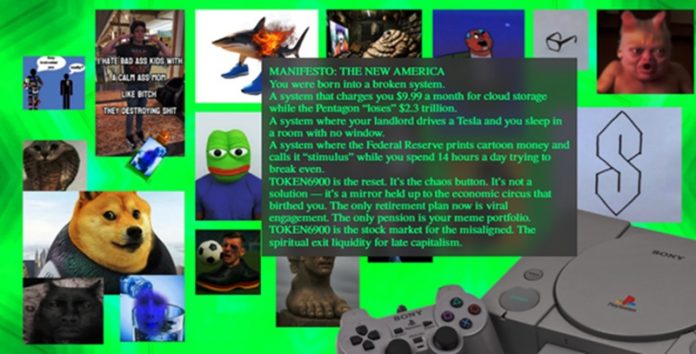
TOKEN6900 is a new-gen meme coin, one that isn’t interested in hiding behind the veneer of utility. No AI, no paying attention to the macroeconomic conditions. The project revolves around one thing alone: unwavering devotion to the number 6900.

The project’s whitepaper unapologetically admits, “It’s Above Everything. It Doesn’t Track GDP, Oil Reserves, Or Corporate Earnings. It Tracks Vibe Liquidity.”

Much like SPX6900, TOKEN6900 is fueled by the same anti-Wall Street spirit, meme-fueled delusion and the collective hallucination of terminally online traders.

Just like SPX is delusionally aiming to flip the overall market capitalization of the S&P 500, T6900 is vying to become the new global benchmark for brain rot finance.

Despite the obvious delusion, this ploy of being unapologetically utility-less has been extremely successful as of late.

Fartcoin’s success confirms what Dogecoin and Pepe proponents already knew – utility, AI, and fundamentals play little role when it comes to making it big in the meme coin sector.

Fartcoin hit a $2.7 billion all-time high, largely because it was funny and because its success irritated serious-minded Wall Street purists.

Similarly, take the recent viral Useless Coin. Its core principle is in its name – it is another meme coin that doesn’t try to sell investors on utility and admits to being useless. Unsurprisingly, it has seen remarkable success, rallying by nearly 6000% since its June lows and reaching a peak valuation of $300 million.

It is, therefore, no surprise that TOKEN6900 is creating a strong buzz among meme coin investors, especially among those who missed out on USELESS. Even those who got in early and secured attractive returns from it are likely to jump on another new meme coin with similar, yet unique, selling points.

Could T6900 Be The Next 10x Crypto?

The TOKEN6900 presale launch has received an enthusiastic response. The viral ICO has already raised $250k in just a few days, signalling strong community support and high upside potential.

Crucially, the T6900 developer team isn’t interested in a long, drawn-out ICO. It believes that a new meme coin should hit the open market at a low market capitalization. As a result, the TOKEN6900 presale has a $5 million hard cap.

This suggests that presale buyers could be in for substantial gains. If T6900 manages to replicate even half of Useless Coin’s performance, late-stage participants could still see up to 30x returns. Early buyers, naturally, stand to gain much more if the momentum holds.

Notably, USELESS itself could hit a billion-dollar valuation in the coming weeks.

Meanwhile, early T6900 buyers can also benefit from the project’s staking system, which is designed to reward first movers. Although staking will remain active for a full year after the token generation event (TGE), the highest APY is reserved for those who stake early. Currently, the annual yield stands at 189%.

Unsurprisingly, many smart money investors are among the early T6900 buyers, with many among them eyeing up to 100x returns from it.

Interested buyers can use the OTC widget on the presale website or through the Best Wallet app. They can check out the project’s X and Instagram accounts as well.

Visit TOKEN6900 Presale