DD
MM
YYYY

PAGES

DD
MM
YYYY

spot_img

PAGES

Home Blog Page 946

Projected Exodus of 16,500 High-Net-Worth Individuals (HNWIs) From The UK In 2025

0

United Kingdom faces the largest single-year exodus of wealth ever recorded comes from a Forbes article citing the Henley Private Wealth Migration Report 2025, which projects 16,500 high-net-worth individuals (HNWIs)—those with liquid investable assets of $1 million or more—will leave the UK in 2025. This figure is double China’s projected outflow of 7,800 HNWIs and ten times Russia’s, marking a significant shift.

The report attributes this to high tax rates, including capital gains and inheritance taxes, the abolition of the non-domicile (non-dom) tax regime, Brexit’s economic fallout, and the declining prominence of the London Stock Exchange. Destinations like the UAE, US, Italy, and Switzerland are attracting these individuals due to lower taxes and favorable investment climates.

However, the narrative is contested. The Tax Justice Network argues that the “exodus” is overstated, with only 0.63% of the UK’s millionaire population (16,500 out of over 3 million) expected to leave, a negligible fraction. They note that millionaire migration has consistently been near 0% since 2013, and academic studies suggest wealthy individuals are less mobile than claimed, often tied to immovable assets like property.

Critics also point out inconsistencies in Henley’s reporting, such as labeling smaller outflows as “insignificant” in prior years while calling similar numbers an “exodus” now. The economic impact is debated. The departing HNWIs are estimated to take £66 billion in investable assets, potentially reducing tax revenue and economic activity. Non-doms, for instance, contribute significantly to VAT and stamp duty.

Yet, the UK’s millionaire population has grown 20% since 2017, per UBS, suggesting resilience. The Labour government’s tax reforms, including the non-dom abolition, aim to raise £33.8 billion over five years, but some argue this could deter future investment, with cities like Dubai and Paris gaining as financial hubs.

Skepticism about the data’s source is warranted. Henley & Partners, a firm specializing in residency and citizenship by investment, may have incentives to exaggerate migration trends. Without clearer evidence, the “exodus” might reflect strategic relocations for tax planning rather than permanent departures. Time and more robust data will clarify the true scale and impact.

HNWIs, including non-domiciled residents, contribute significantly to taxes like VAT, stamp duty, and capital gains. The departure of £66 billion in investable assets could reduce government revenue, potentially straining public services or necessitating higher taxes elsewhere. Wealthy individuals often invest in businesses, real estate, and financial markets. Their exit could dampen UK economic growth, particularly in sectors like luxury goods, property, and the London Stock Exchange, which is already losing prominence.

The outflow to destinations like Dubai, Paris, and the UAE may accelerate the decline of London as a global financial center, especially post-Brexit, as competing hubs offer lower taxes and better incentives. The Labour government’s tax reforms, such as abolishing the non-dom regime, aim to raise £33.8 billion over five years. If successful, this could offset losses and fund public services, though it risks deterring future investment if perceived as overly punitive.

The departure of HNWIs might fuel public debates about wealth inequality. While some may view it as a step toward fairness, others could see it as evidence of the UK becoming less attractive to talent and capital. HNWIs often fund charities, cultural institutions, and community projects. Their exit could reduce such contributions, affecting the arts, education, and local communities, particularly in London.

The exodus could intensify criticism of Labour’s tax policies, with opponents arguing they drive wealth away. This may pressure the government to adjust policies or face political fallout in future elections. The migration underscores Brexit’s lingering economic effects, such as reduced EU market access and regulatory challenges, which may further polarize public opinion on the UK’s post-Brexit trajectory.

The UK’s loss highlights growing global competition for HNWIs, with countries like the UAE and Switzerland offering attractive tax regimes. This could push the UK to rethink its tax and immigration policies to remain competitive. The scale of the exodus (0.63% of UK millionaires) may be overstated by Henley & Partners, whose business interests could bias their projections. Actual economic impact may be smaller if most HNWIs retain UK ties or assets.

The UK’s millionaire population has grown 20% since 2017, suggesting resilience. The long-term impact depends on whether new wealth is attracted to offset departures. Global economic trends, such as interest rate changes or geopolitical shifts, could alter migration patterns, making 2025 projections uncuncertain.

While the exodus poses risks to the UK’s economy, particularly in tax revenue and financial hub status, its impact may be mitigated by policy adjustments and the UK’s broader economic strengths. However, it signals a need for strategic measures to retain and attract wealth in a competitive global landscape.

Bitget Wallet Partners Mastercard For “Zero Crypto Card”

0

Bitget Wallet has partnered with Mastercard and Immersve to launch a zero-fee crypto card, enabling users to spend cryptocurrencies like USDC at over 150 million Mastercard-accepting merchants worldwide. The card, available through the Bitget Wallet app, supports real-time crypto-to-fiat conversions with no top-up or annual fees.

It integrates with Apple Pay and Google Pay, offering tap-and-pay convenience. Initially launching in the UK and EU, it plans to expand to Latin America, Australia, and New Zealand. The card requires a 10 USDC issuance fee and basic KYC, with no credit checks. Early users (first 2,000) receive 5% cashback in BGB. Immersve ensures compliance with KYC and AML regulations. The U.S. is excluded pending regulatory approvals.

The partnership between Bitget Wallet, Mastercard, and Immersve to launch a crypto card has significant implications for the crypto and financial sectors, but it also highlights a growing divide in crypto adoption and accessibility. The card bridges crypto and fiat by enabling seamless spending at over 150 million Mastercard merchants. This integration could normalize crypto as a payment method, boosting its practical use beyond speculative trading.

Features like Apple Pay/Google Pay compatibility and real-time crypto-to-fiat conversion enhance user convenience, potentially attracting non-crypto natives. No credit checks and low fees (10 USDC issuance, zero annual/top-up fees) make the card accessible to underbanked populations, particularly in regions like Latin America, where expansion is planned. However, KYC/AML requirements may still exclude some unbanked users without formal identification.

The card strengthens Bitget Wallet’s ecosystem, potentially increasing user retention and BGB token utility (e.g., via 5% cashback incentives). This could elevate Bitget’s competitive edge in the crypto wallet market. Compliance with KYC/AML via Immersve signals a move toward regulated crypto solutions, which could build trust among traditional financial institutions but may alienate privacy-focused crypto users. Exclusion of the U.S. due to regulatory hurdles highlights ongoing challenges in scaling crypto products globally.

The card could drive crypto spending, stimulating merchant economies in supported regions (UK, EU, soon Latin America, Australia, New Zealand). It may also pressure competitors (e.g., Binance, Crypto.com) to innovate their crypto card offerings. The UK and EU benefit first, with planned expansion to Latin America, Australia, and New Zealand. These regions gain early access to crypto spending infrastructure.

The U.S. and other countries with strict regulations (e.g., parts of Asia) are left out, creating a gap in access to crypto payment solutions. This reinforces a divide between crypto-friendly and crypto-restrictive jurisdictions. Those familiar with crypto wallets and digital payments (via Apple Pay/Google Pay) will adopt the card easily, deepening their integration into the crypto economy.

Older or less tech-literate populations may struggle with wallet setup, KYC, or crypto volatility, limiting broader adoption. Those with disposable income to hold USDC or other supported cryptocurrencies can leverage the card’s benefits (e.g., cashback in BGB). While the card aims to serve the underbanked, the 10 USDC fee and KYC requirements may still exclude the poorest or those without formal IDs, perpetuating financial exclusion. Those comfortable with KYC/AML compliance will embrace the card as a step toward mainstream integration.

Crypto purists who value decentralization and anonymity may reject the card due to its centralized compliance and reliance on traditional finance (Mastercard). The first 2,000 users receiving 5% BGB cashback gain an economic advantage, creating a disparity with later adopters. Users of rival platforms (e.g., Crypto.com’s card) may face a choice between switching to Bitget or sticking with potentially less competitive offerings.

The Bitget-Mastercard crypto card is a step toward mainstreaming crypto payments, offering convenience and potential financial inclusion. However, it also highlights divides in geographic access, technological literacy, economic status, and ideological alignment within the crypto space. While it bridges crypto and fiat for some, regulatory, economic, and cultural barriers may widen disparities for others.

Sparkassen-Finanzgruppe To Offer Crypto Trading Services

0

Sparkassen-Finanzgruppe, Germany’s largest banking group, announced plans to offer cryptocurrency trading services to its 50 million retail customers by summer 2026. This marks a significant shift from its 2023 stance, which viewed crypto as too volatile and risky. The service, facilitated by DekaBank, a Sparkassen subsidiary with a BaFin-issued crypto custody license, will allow clients to trade Bitcoin and Ethereum directly through the Sparkasse mobile app.

The move aligns with the EU’s Markets in Crypto-Assets (MiCA) regulation, providing a clear legal framework, and responds to growing customer demand and competition from fintech firms. Sparkassen will not offer investment advice and will emphasize the speculative nature and risks of cryptocurrencies, ensuring regulatory compliance and security.

Germany’s largest banking group, with 50 million customers, entering the crypto market signals a significant step toward mainstreaming cryptocurrencies in Europe’s largest economy. This could normalize crypto trading among retail investors, increasing market participation and liquidity. It aligns with growing institutional acceptance, as seen with other European banks and global players like Fidelity or BlackRock offering crypto-related services.

The EU’s Markets in Crypto-Assets (MiCA) regulation, effective since 2024, provides a clear legal framework that has encouraged traditional financial institutions like Sparkassen to enter the crypto space. This could set a precedent for other European banks to follow, fostering a regulated crypto ecosystem. The emphasis on compliance (e.g., BaFin licensing, risk disclosures) may enhance consumer trust but also highlights the regulatory scrutiny crypto services will face.

By integrating crypto trading into its mobile app, Sparkassen challenges fintech platforms like Coinbase or Bitpanda, which have dominated retail crypto trading. Traditional banks’ entry could erode fintechs’ market share, given their established trust and customer base. However, fintechs may retain an edge with more diverse crypto offerings, as Sparkassen will initially limit trading to Bitcoin and Ethereum.

Increased retail access could drive crypto prices, particularly for Bitcoin and Ethereum, though volatility remains a concern. The bank’s risk warnings suggest a cautious approach to temper speculative bubbles. Germany’s move could influence other major economies to integrate crypto into traditional banking, potentially reshaping global financial markets.

Sparkassen’s decision not to offer investment advice underscores the need for customer education on crypto risks. This could lead to a divide between informed investors and those speculating without understanding, potentially exacerbating financial inequality. The service’s accessibility via the mobile app may democratize crypto access but also risks attracting inexperienced investors drawn by hype.

Customers of Sparkassen (and similar banks) gain easy access to crypto trading without needing third-party platforms, potentially lowering costs and barriers. This could particularly benefit older or less tech-savvy demographics who trust traditional banks over fintechs. Those outside Sparkassen’s customer base or in regions without similar banking initiatives may face unequal access. Smaller banks or regions lagging in crypto regulation could widen this gap.

Investors with financial literacy and crypto knowledge are better positioned to benefit from trading opportunities while managing risks. In contrast, uninformed retail investors, lured by the bank’s brand trust, may face significant losses due to crypto’s volatility, especially without advisory support. This could deepen wealth disparities, as sophisticated investors leverage market movements while novices suffer from speculative losses.

Institutional players (e.g., banks, hedge funds) entering crypto markets with robust infrastructure and compliance frameworks may outpace retail investors in terms of access to advanced tools, custody solutions, and market insights. Retail investors, even with Sparkassen’s platform, may lack the scale or resources to compete with institutional strategies, potentially leading to market imbalances.

Germany’s progressive stance, backed by MiCA, contrasts with jurisdictions with stricter or unclear crypto regulations (e.g., parts of the U.S. or Asia). This could create a divide where European investors benefit from regulated access while others face legal uncertainties or bans. Emerging markets with limited banking infrastructure may struggle to replicate such services, further isolating their populations from crypto’s potential.

Sparkassen’s move is a pivotal moment for crypto’s integration into traditional finance, promising greater adoption and legitimacy but also highlighting divides in access, knowledge, and market dynamics. While it empowers millions of retail customers, it underscores the need for education and regulatory clarity to mitigate risks and ensure equitable benefits. The competitive pressure on fintechs and the global ripple effect will likely shape the crypto landscape in the coming years.

Shiba Inu (SHIB) and Pepe Coin (PEPE) Walked So Little Pepe (LILPEPE) Could Run: Top New Memecoin in 2025

0

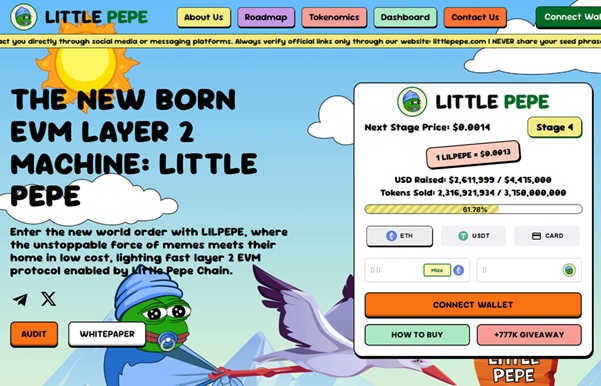
For years, Shiba Inu and Pepe Coin carried the meme-coin torch, capturing headlines and meme lore on crypto forums. But as 2025 rolls in, a new frog is sprinting past them: Little Pepe (LILPEPE)—a meme coin powered by actual Layer-2 infrastructure, driven by serious investment momentum, and currently fueling FOMO before its listing at $0.003.

The Veteran Meme Kings: SHIB & PEPE

In 2021, Shiba Inu revolutionized the way meme investments were conducted by leveraging social virality and layered burns to generate substantial profits. However, it’s now losing steam; the excitement over whale and burn is waning, which suggests that Shibarium support may not last much longer. Pepe Coin, once the dark horse with low-cost accessibility and viral appeal, now trades modestly, relying purely on nostalgia rather than innovation. Both have cultural clout, but neither is pushing meme culture forward with real technological or tokenomic breakthroughs.

Enter LILPEPE: Memes Meet Mechanics

That’s where LILPEPE changes the game. This isn’t just another token slapped onto a proven blockchain—it’s a purpose-built Layer-2 EVM blockchain optimized for meme tokens and NFTs, designed for speed, minimal gas, and anti-sniper bot protection. With developers who’ve helped shape top meme coins backing this project, LILPEPE isn’t just a meme; it’s thoughtfully structured for growth. The presale numbers are even more telling. In Stage 4, tokens are priced at $0.0013, with 2.316 billion already snapped up and $2.611 million raised toward a $4.475 million hard cap. In less than 24 hours, the round filled up 61.76%. When Stage 4 completes, the price will tick to $0.0014—but with the listing anchored at $0.003, presale buyers lock in a guaranteed 130.76% gain once LILPEPE launches. And that’s just the start: analysts are eyeing an all-time high around $0.635 by the end of 2025—implying a breathtaking 488× return (48,746%) from today’s price.

Whale Momentum & Community Hype

You can feel the shift in investor energy. Deep-pocketed buyers are piling in, igniting FOMO across Telegram, Twitter, and crypto circles. A blazing $770,000 giveaway, with ten winners receiving $77,000 each, is fueling a frenzy and social reach.  Unlike the old meme-coin aura that relied on personalities—DOGE with Elon’s tweets, SHIB’s orbits—the LILPEPE rocket is powered by infrastructure and strategic rollout, making it a more solid bet for investors seeking hype with substance.

Why LILPEPE Might Outpace Old Meme Favorites

Shiba Inu and Pepe may have pioneered meme mania, but their engines are sputtering: SHIB suffers from whale attrition and empty burn cycles, while PEPE’s chart action is meandering with no new catalyst in sight. LILPEPE, on the other hand, offers Layer-2 speed, fair launch technology, Launchpad tools, anti-bot features, and a phased presale ROI. It’s meme culture engineered for real-world utility—and built by insiders who know how to launch hits in this space. This isn’t speculation—it’s strategy.

The 2025 Meme Race Is On

Picture 2025 as a meme battleground. The old guard (SHIB and PEPE) marches forward but is hobbled by legacy structures and diminishing hype. LILPEPE, meanwhile, begins on the blocks with momentum, infrastructure, institutional-grade launch plans, and a pump-stage narrative propelled by both whales and community. This isn’t just a meme-coin gamble—it’s meme-coin evolution. It’s one thing for gods of doggos and frogs to trot the course. It’s quite another for a frog built on rails to sprint ahead. LILPEPE is that frog, and the race is heating up fast.

Final Take: Meme 2.0 Is Here

If your portfolio has lingered on SHIB or PEPE, that nostalgia may hold, but the vibe has shifted. LILPEPE offers presale gains, real utility, exchange momentum, bot-resistant fairness, and ultra-fast infrastructure. The FOMO is real, the roadmap is sharp, and the upside is structurally designed. Ready to join the sprint? Presale is live, and the frog is racing. Secure your LILPEPE before it hits $0.0014 Enter the $770K token giveaway.


For more information about Little Pepe (LILPEPE) visit the links below:

Website: https://littlepepe.com

Whitepaper: https://littlepepe.com/whitepaper.pdf

Telegram: https://t.me/littlepepetoken

Twitter/X: https://x.com/littlepepetoken

Digital Governance could be Nigeria’s Untapped Engine for Reforms

0

Recently, while casually browsing the internet, I stumbled upon Rwanda’s IremboGov platform, it is a centralized digital portal that offers access to over 100 government services. It was a quiet discovery, but a powerful one. IremboGov allows Rwandans to apply for national IDs, pay taxes, register births, request land certificates, and more, all online and from one place. The platform is simple, intuitive, and integrated. As I navigated, I couldn’t help but ask: why can’t Nigeria adopt this?

Though, Nigeria is no stranger to digital initiatives since over the years, we have developed several platforms such as the Corporate Affairs Commission’s (CAC) business registration portal, the Treasury Single Account (TSA), and the National Identity Number (NIN), Bank Verification Number (BVN) systems, etc. Each of these has contributed something valuable, but the common thread among them is fragmentation. They exist in isolation, often unreliable, and riddled with technical or bureaucratic challenges. The reality is that most Nigerians still engage with government services through inefficient, paper-based, and manual systems. It’s not unusual to visit a government office multiple times just to complete a simple process like renewing a license or retrieving a lost certificate.

These touchpoints breed not only frustration but also corruption, as they place disproportionate power in the hands of civil servants who often act as gatekeepers to essential services. In many government offices across Nigeria, basic administrative tasks such as processing documents, verifying identity, or approving applications are deliberately delayed, creating opportunities for possible extortion. What should be routine becomes transactional. The absence of transparent, automated systems allows discretionary power to continue unchecked. Citizens are frequently told to “come back tomorrow,” only to be subtly asked for favours to speed up the process. This behavior is partly driven by a deeply ingrained culture where the public office is seen as a personal money-making enterprise. Without digital systems that log, timestamp, and track every step of a service process, corruption remains while ordinary Nigerians continue to bear the cost in time and money.

This is where Rwanda’s IremboGov and similar platforms around the world can offer valuable lessons. What Rwanda has built is not just a website, but a vision of governance that is citizen centered, efficient, and transparent. And Rwanda is not alone. India through UMANG, an initiative of the India Ministry of Electronics and Information Technology, integrates more than 1,200 public services across both state and federal levels. Kenya’s eCitizen portal has also achieved major strides in making government services easily accessible and transparent.

What these platforms have in common is not just their functionality, but their philosophy which is for government services to be accessible, accountable, and devoid of unnecessary human intervention.

Nigeria, by contrast, continues to operate in silos. Our public sector platforms often fail to communicate with each other. A citizen’s NIN is not automatically useful across all agencies. Taxpayer data is not integrated. Procurement systems are rarely transparent. And in many cases, even where platforms exist, the user is still expected to visit a physical office to complete the process.

The result is an administrative culture that is slow and prone to abuse. But more than inefficiency, this fragmentation comes at a steep cost. Without unified data systems, we lose opportunities to make smarter policy decisions. Without real-time dashboards for project spending, budget allocations, or procurement contracts, we leave the door wide open for waste and fraud.

What Nigeria needs is a comprehensive national platform, a singular digital gateway where citizens can access all government services, submit documents, make payments, track applications, and file complaints. It should be built with interoperability in mind, integrating systems like BVN, NIN, CAC, and tax databases. Moreover, one of the most strategic entry points for Nigeria’s digital governance transformation could be the National Identity Number (NIN). If fully optimized, the NIN can serve as Nigeria’s equivalent of the U.S. Social Security Number (SSN); a single, trusted identity used across all public and private sector platforms.

The Federal Ministry of Communications, Innovation and Digital Economy is uniquely positioned to spearhead Nigeria’s transition to a fully digital governance framework. The ministry can lead the charge by developing a unified e-governance blueprint anchored on collusion, data security, citizen access, and service integration. However, true success depends on cross-ministerial collaboration. The ministry must move beyond siloed ICT initiatives and work closely with other ministries such as Finance, Interior, Health, Education, and Works to digitize their service delivery processes and ensure that all government platforms speak the same digital language.

Through inter-ministerial task forces, performance dashboards, and digital service standards, the ministry can foster collective ownership of digital governance. Moreover, by involving stakeholders from the state and local government levels and aligning with national strategies like the Nigeria e-Government Master Plan from The Nigeria Information Technology Development Agency (NITDA), the ministry can build an holistic approach that places citizens, not bureaucracy, at the center of public service delivery.

This is an opportunity to transform not just how government functions, but how citizens experience governance. Through digitization, we can reduce corruption, increase transparency, and restore credibility in public institutions. We can empower a young, tech-savvy population that already interacts with banks, retailers, and media online but still struggles to interact with government in the same way.