DD
MM
YYYY

PAGES

DD
MM
YYYY

spot_img

PAGES

Home Blog Page 954

Shiba Inu (SHIB) and Pepe Coin (PEPE) Walked So Little Pepe (LILPEPE) Could Run: Top New Memecoin in 2025

0

For years, Shiba Inu and Pepe Coin carried the meme-coin torch, capturing headlines and meme lore on crypto forums. But as 2025 rolls in, a new frog is sprinting past them: Little Pepe (LILPEPE)—a meme coin powered by actual Layer-2 infrastructure, driven by serious investment momentum, and currently fueling FOMO before its listing at $0.003.

The Veteran Meme Kings: SHIB & PEPE

In 2021, Shiba Inu revolutionized the way meme investments were conducted by leveraging social virality and layered burns to generate substantial profits. However, it’s now losing steam; the excitement over whale and burn is waning, which suggests that Shibarium support may not last much longer. Pepe Coin, once the dark horse with low-cost accessibility and viral appeal, now trades modestly, relying purely on nostalgia rather than innovation. Both have cultural clout, but neither is pushing meme culture forward with real technological or tokenomic breakthroughs.

Enter LILPEPE: Memes Meet Mechanics

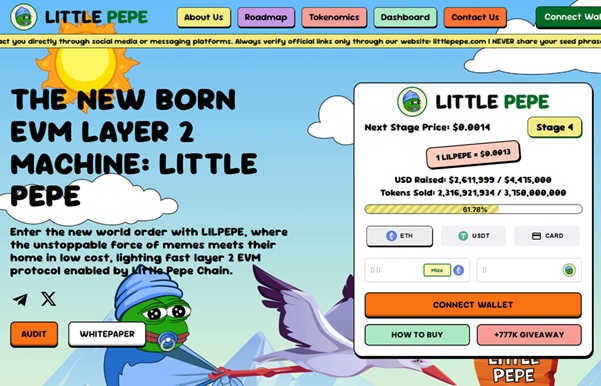
That’s where LILPEPE changes the game. This isn’t just another token slapped onto a proven blockchain—it’s a purpose-built Layer-2 EVM blockchain optimized for meme tokens and NFTs, designed for speed, minimal gas, and anti-sniper bot protection. With developers who’ve helped shape top meme coins backing this project, LILPEPE isn’t just a meme; it’s thoughtfully structured for growth. The presale numbers are even more telling. In Stage 4, tokens are priced at $0.0013, with 2.316 billion already snapped up and $2.611 million raised toward a $4.475 million hard cap. In less than 24 hours, the round filled up 61.76%. When Stage 4 completes, the price will tick to $0.0014—but with the listing anchored at $0.003, presale buyers lock in a guaranteed 130.76% gain once LILPEPE launches. And that’s just the start: analysts are eyeing an all-time high around $0.635 by the end of 2025—implying a breathtaking 488× return (48,746%) from today’s price.
Whale Momentum & Community Hype

You can feel the shift in investor energy. Deep-pocketed buyers are piling in, igniting FOMO across Telegram, Twitter, and crypto circles. A blazing $770,000 giveaway, with ten winners receiving $77,000 each, is fueling a frenzy and social reach.  Unlike the old meme-coin aura that relied on personalities—DOGE with Elon’s tweets, SHIB’s orbits—the LILPEPE rocket is powered by infrastructure and strategic rollout, making it a more solid bet for investors seeking hype with substance.

Why LILPEPE Might Outpace Old Meme Favorites

Shiba Inu and Pepe may have pioneered meme mania, but their engines are sputtering: SHIB suffers from whale attrition and empty burn cycles, while PEPE’s chart action is meandering with no new catalyst in sight. LILPEPE, on the other hand, offers Layer-2 speed, fair launch technology, Launchpad tools, anti-bot features, and a phased presale ROI. It’s meme culture engineered for real-world utility—and built by insiders who know how to launch hits in this space. This isn’t speculation—it’s strategy.

The 2025 Meme Race Is On

Picture 2025 as a meme battleground. The old guard (SHIB and PEPE) marches forward but is hobbled by legacy structures and diminishing hype. LILPEPE, meanwhile, begins on the blocks with momentum, infrastructure, institutional-grade launch plans, and a pump-stage narrative propelled by both whales and community. This isn’t just a meme-coin gamble—it’s meme-coin evolution. It’s one thing for gods of doggos and frogs to trot the course. It’s quite another for a frog built on rails to sprint ahead. LILPEPE is that frog, and the race is heating up fast.

Final Take: Meme 2.0 Is Here

If your portfolio has lingered on SHIB or PEPE, that nostalgia may hold, but the vibe has shifted. LILPEPE offers presale gains, real utility, exchange momentum, bot-resistant fairness, and ultra-fast infrastructure. The FOMO is real, the roadmap is sharp, and the upside is structurally designed. Ready to join the sprint? Presale is live, and the frog is racing. Secure your LILPEPE before it hits $0.0014 Enter the $770K token giveaway.


For more information about Little Pepe (LILPEPE) visit the links below:

Website: https://littlepepe.com

Whitepaper: https://littlepepe.com/whitepaper.pdf

Telegram: https://t.me/littlepepetoken

Twitter/X: https://x.com/littlepepetoken

Digital Governance could be Nigeria’s Untapped Engine for Reforms

0

Recently, while casually browsing the internet, I stumbled upon Rwanda’s IremboGov platform, it is a centralized digital portal that offers access to over 100 government services. It was a quiet discovery, but a powerful one. IremboGov allows Rwandans to apply for national IDs, pay taxes, register births, request land certificates, and more, all online and from one place. The platform is simple, intuitive, and integrated. As I navigated, I couldn’t help but ask: why can’t Nigeria adopt this?

Though, Nigeria is no stranger to digital initiatives since over the years, we have developed several platforms such as the Corporate Affairs Commission’s (CAC) business registration portal, the Treasury Single Account (TSA), and the National Identity Number (NIN), Bank Verification Number (BVN) systems, etc. Each of these has contributed something valuable, but the common thread among them is fragmentation. They exist in isolation, often unreliable, and riddled with technical or bureaucratic challenges. The reality is that most Nigerians still engage with government services through inefficient, paper-based, and manual systems. It’s not unusual to visit a government office multiple times just to complete a simple process like renewing a license or retrieving a lost certificate.

These touchpoints breed not only frustration but also corruption, as they place disproportionate power in the hands of civil servants who often act as gatekeepers to essential services. In many government offices across Nigeria, basic administrative tasks such as processing documents, verifying identity, or approving applications are deliberately delayed, creating opportunities for possible extortion. What should be routine becomes transactional. The absence of transparent, automated systems allows discretionary power to continue unchecked. Citizens are frequently told to “come back tomorrow,” only to be subtly asked for favours to speed up the process. This behavior is partly driven by a deeply ingrained culture where the public office is seen as a personal money-making enterprise. Without digital systems that log, timestamp, and track every step of a service process, corruption remains while ordinary Nigerians continue to bear the cost in time and money.

This is where Rwanda’s IremboGov and similar platforms around the world can offer valuable lessons. What Rwanda has built is not just a website, but a vision of governance that is citizen centered, efficient, and transparent. And Rwanda is not alone. India through UMANG, an initiative of the India Ministry of Electronics and Information Technology, integrates more than 1,200 public services across both state and federal levels. Kenya’s eCitizen portal has also achieved major strides in making government services easily accessible and transparent.

What these platforms have in common is not just their functionality, but their philosophy which is for government services to be accessible, accountable, and devoid of unnecessary human intervention.

Nigeria, by contrast, continues to operate in silos. Our public sector platforms often fail to communicate with each other. A citizen’s NIN is not automatically useful across all agencies. Taxpayer data is not integrated. Procurement systems are rarely transparent. And in many cases, even where platforms exist, the user is still expected to visit a physical office to complete the process.

The result is an administrative culture that is slow and prone to abuse. But more than inefficiency, this fragmentation comes at a steep cost. Without unified data systems, we lose opportunities to make smarter policy decisions. Without real-time dashboards for project spending, budget allocations, or procurement contracts, we leave the door wide open for waste and fraud.

What Nigeria needs is a comprehensive national platform, a singular digital gateway where citizens can access all government services, submit documents, make payments, track applications, and file complaints. It should be built with interoperability in mind, integrating systems like BVN, NIN, CAC, and tax databases. Moreover, one of the most strategic entry points for Nigeria’s digital governance transformation could be the National Identity Number (NIN). If fully optimized, the NIN can serve as Nigeria’s equivalent of the U.S. Social Security Number (SSN); a single, trusted identity used across all public and private sector platforms.

The Federal Ministry of Communications, Innovation and Digital Economy is uniquely positioned to spearhead Nigeria’s transition to a fully digital governance framework. The ministry can lead the charge by developing a unified e-governance blueprint anchored on collusion, data security, citizen access, and service integration. However, true success depends on cross-ministerial collaboration. The ministry must move beyond siloed ICT initiatives and work closely with other ministries such as Finance, Interior, Health, Education, and Works to digitize their service delivery processes and ensure that all government platforms speak the same digital language.

Through inter-ministerial task forces, performance dashboards, and digital service standards, the ministry can foster collective ownership of digital governance. Moreover, by involving stakeholders from the state and local government levels and aligning with national strategies like the Nigeria e-Government Master Plan from The Nigeria Information Technology Development Agency (NITDA), the ministry can build an holistic approach that places citizens, not bureaucracy, at the center of public service delivery.

This is an opportunity to transform not just how government functions, but how citizens experience governance. Through digitization, we can reduce corruption, increase transparency, and restore credibility in public institutions. We can empower a young, tech-savvy population that already interacts with banks, retailers, and media online but still struggles to interact with government in the same way.

The Future of Dating: How Artificial Intelligence is Shaping Modern Dating

0

Looking for romance today can feel like shouting into the void and hoping someone cute shouts back. We’ve all been there, swiping until our thumbs go numb. Now, a new, nerdy wingman has entered the chat: Artificial Intelligence. Forget robots falling in love; the real story is the code in your phone playing matchmaker, armed with data and a cheeky disregard for bad pickup lines. Let’s pull back the curtain on how this ghost in the machine is quietly rearranging the whole courtship game.

The New Matchmaker: AI-Powered Pairing

Ticking boxes for age and location is ancient history in this game. The AI cupid works in sneakier, smarter ways. It’s a digital people-watcher, analyzing every swipe, message, and profile you linger on a little too long. It learns your “type” even when you don’t know it yourself, noticing you have a thing for rock climbers or people who use too many emojis. This behavioral deep dive allows it to serve up suggestions that are scarily on-point. This analytical approach goes beyond just finding a life partner; platforms focused on casual meetups, like the TenderBang hookup site, also use this tech to get people together faster. The system simply learns from what works and doubles down, making the whole process far more accurate.

Beyond the Match: The AI Makeover

A match is one thing, but starting a chat that doesn’t immediately crash and burn is another. AI is stepping in as a profile polisher and conversation coach. Some apps use it to suggest which of your photos will get the most attention or help you rephrase a bio to sound less like a tax form. When it’s time to talk, the AI can pop up with conversation starters based on things you both like, so you can skip the agonizing “hey” and get straight to arguing about pineapple on pizza. More than that, tech has been crucial for creating a more tailored online dating environment, giving different communities their own spaces to find a spark without the background noise.

Building a Safer Space: AI for Security and Authenticity

The AI has a real talent for sniffing out scammers by seeing the kind of shady patterns a human moderator would probably miss after their third cup of coffee. Its cleverest trick is photo verification, which forces someone to match their picture with a live selfie—effectively killing a “catfish” before it can swim. But it gets deeper than just spotting obvious fakes. The new wave of artificial intelligence in dating is now starting to get a read on how truthful someone is, flagging inconsistencies that suggest their story might have a few holes.

The Future is Getting Weirder

And if you think things are strange now, just wait. The future of AI in the romance department is set to get even stranger and more personal. Imagine AI planning a first date in a virtual reality café, letting you get a feel for someone’s vibe without having to put on real pants. There’s even talk of systems that could predict a relationship’s potential for success by analyzing communication styles. It sounds a bit like science fiction, but the aim is always the same: to cut through the noise faster and point you toward something that actually has a shot.

So, the bottom line is this: AI is making the messy business of finding someone a lot smoother and safer. But it’s just the opening act. It can get you both to the door, but it can’t make you laugh at their jokes or create that electric first-touch moment. For better or worse, that magic part is still your job.

Tesla’s Fully Autonomous Vehicle Delivery from Factory to Customer And Future of Mobility [Podcast]

0

Tesla’s achievement of its first fully autonomous vehicle delivery from factory to customer marks a pivotal moment, signaling the imminent future of mobility. This breakthrough, though followed by initial safety scrutiny, underscores the rapid pace of innovation in the autonomous vehicle sector. It highlights that the vision of driverless cars, once futuristic, is now a tangible reality accelerating towards widespread adoption. For businesses and individuals globally, this shift necessitates a keen understanding of evolving transportation paradigms, emphasizing how technology is not just changing how we travel, but also disrupting traditional value chains and creating entirely new service models.

For regions like Nigeria and Africa, Tesla’s development presents a compelling “leapfrogging” opportunity. Instead of replicating existing complex infrastructure, these regions can directly adopt and adapt advanced autonomous solutions for logistics and public transport. This demands proactive engagement in developing local talent in AI and robotics, fostering context-specific innovations, and creating agile regulatory frameworks that encourage safe technological integration rather than stifling progress. The advent of autonomous delivery and robotaxi services means the future of mobility is here, offering Africa a chance to be a key participant in shaping, not just consuming, this transformative era.

In this podcast, I explain this evolving autonomous reality and what lies ahead for Africa. A summary of the podcast is available here.

From Monday, the videos will move to Blucera.com exclusively.

About Tekedia Daily

To read our short introduction of Tekedia Daily – podcasting revelations on business, click here.

How To Listen to Tekedia Daily

At Blucera, home of Blucera WinGPT (AI personal educator and coach), eVault Legal Custodial services (store vital personal, family and business documents securely), business tools to grow enterprises, and global archives of Tekedia courses and libraries, Ndubuisi Ekekwe podcasts every week day. Some Tekedia Institute programs offer bonus access to Tekedia Daily or one can register at Blucera for the podcast.

The Implications of Tom Lee Joining BitMine Immersion Technologies

0

Tom Lee, a prominent Wall Street strategist and co-founder of Fundstrat, has been appointed Chairman of the Board of Directors at BitMine Immersion Technologies (NYSE: BMNR), effective June 30, 2025. This move coincides with BitMine’s announcement of a $250 million private placement to acquire Ethereum (ETH) as its primary treasury reserve asset, aiming to position the company as the “MicroStrategy of Ethereum.” The strategy mirrors MicroStrategy’s approach with Bitcoin, where it amassed significant BTC holdings to boost its market value.

BitMine plans to increase its ETH holdings by over 16x through this initiative, using proceeds to buy and stake ETH, leveraging Ethereum’s capabilities like smart contracts, stablecoin payments, and decentralized finance (DeFi). The company will track ETH held per share as a key performance metric, similar to MicroStrategy’s BTC Yield. The private placement, involving the sale of 55,555,556 shares at $4.50 each, was led by MOZAYYX and included major investors like Founders Fund, Pantera Capital, FalconX, Kraken, and Galaxy Digital.

The deal, expected to close around July 3, 2025, has driven BMNR’s stock price to surge, with reports of increases ranging from 220% to 694.8%, inflating its market cap from $26 million to over $150 million. Lee emphasized Ethereum’s role in stablecoin transactions, noting their rapid adoption as a key driver for ETH’s potential growth, especially with regulatory advancements like the U.S. Senate’s “Genius Act” supporting stablecoin mainstream adoption.

BitMine continues its Bitcoin mining operations but is pivoting to capitalize on Ethereum’s ecosystem, joining other firms like SharpLink Gaming in adopting ETH as a treasury asset. By adopting ETH as its primary treasury reserve asset, BitMine is diversifying from its Bitcoin mining roots. This positions the company to capitalize on Ethereum’s unique features, such as smart contracts, DeFi, and stablecoin infrastructure, potentially enhancing its growth prospects.

The $250 million private placement and high-profile investors (e.g., Founders Fund, Pantera Capital) signal strong market confidence, as evidenced by the 220%–694.8% stock price surge. This could elevate BitMine’s profile, attracting more institutional interest. Holding and staking ETH exposes BitMine to Ethereum’s price volatility, which could drive significant returns if ETH appreciates, as Tom Lee predicts (noting stablecoin adoption as a catalyst).

However, it also risks losses if ETH underperforms. While prioritizing ETH, BitMine’s ongoing Bitcoin mining operations provide a diversified revenue stream, balancing its crypto exposure. The stock’s dramatic rally suggests speculative enthusiasm, offering potential gains for early investors but also risks of volatility, especially if ETH prices fluctuate or the strategy underdelivers.

The involvement of major crypto-focused funds like Pantera and Galaxy Digital may reassure investors, signaling rigorous due diligence and long-term confidence in BitMine’s vision. Tracking ETH held per share (akin to MicroStrategy’s BTC Yield) provides investors with a clear metric to evaluate BitMine’s performance relative to Ethereum’s market dynamics.

BitMine’s move could drive further institutional adoption of ETH, reinforcing its position as a leading blockchain for DeFi and stablecoin transactions. This aligns with Tom Lee’s view of stablecoins as a growth driver for Ethereum. BitMine’s strategy may inspire other public companies to adopt ETH or other cryptocurrencies as treasury assets, following MicroStrategy’s playbook. This could increase corporate demand for ETH, potentially impacting its price.

By emphasizing Ethereum’s role in stablecoin transactions, BitMine’s pivot could amplify focus on Ethereum-based stablecoins, especially with regulatory tailwinds like the U.S. Senate’s “Genius Act.” BitMine’s focus on Ethereum’s stablecoin infrastructure could accelerate the mainstream adoption of stablecoins for payments, bridging traditional finance and crypto ecosystems.

The strategy hinges on favorable regulatory developments, such as the “Genius Act.” Success could encourage further pro-crypto legislation, while regulatory setbacks could pose risks. Tom Lee’s involvement, given his Wall Street credibility, may bolster confidence in crypto as a legitimate asset class, potentially attracting more traditional investors to the space.

Ethereum’s price swings could impact BitMine’s balance sheet and stock performance, especially if market sentiment sours. Successfully managing ETH staking and treasury operations requires technical and financial expertise, and missteps could erode investor trust. Other firms, like SharpLink Gaming, are also adopting ETH as a treasury asset, potentially diluting BitMine’s first-mover advantage.

BitMine’s pivot, backed by Tom Lee and major investors, positions it as a potential leader in corporate Ethereum adoption, with significant upside if Ethereum’s ecosystem grows as anticipated. However, the strategy carries risks tied to crypto volatility, execution, and regulatory developments. The move could catalyze broader institutional interest in Ethereum, reshape corporate treasury strategies, and strengthen crypto’s role in global finance, but its success depends on market conditions and BitMine’s ability to execute its vision.