

Abstract
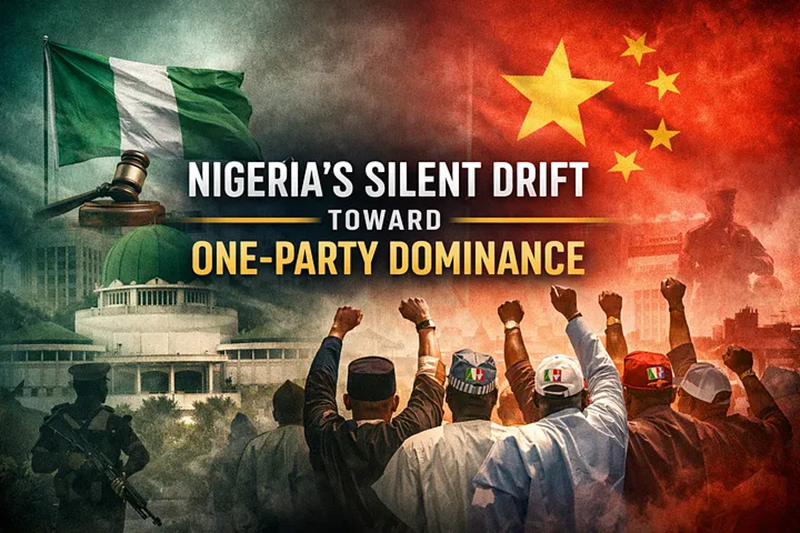
This article examines the evolution of Nigeria–China political and economic relations and situates them within Nigeria’s contemporary democratic trajectory. While Nigeria remains constitutionally a multiparty democracy, recent patterns, mass political defections, executive–legislative convergence, weakened opposition, and selective federal pressure on non-aligned states suggest a drift toward de facto one-party dominance. The paper argues that although there is no evidence of direct institutional exportation of China’s one-party system to Nigeria, there is a concerning convergence in governance behavior and elite incentives that mirrors dominant-party and authoritarian development models. This convergence raises critical questions about accountability, opposition viability, and democratic resilience in Nigeria.
Outline
- Introduction
- Conceptual Framework: Democracy, Party Competition, and Foreign Influence
- Nigeria’s Domestic Political Landscape: From Competitive Multipartyism to Party Convergence
- China’s Governance Model: Influence Without Formal Export
- Structural Abnormalities in Nigeria’s Political System
- Executive Power, Federal Pressure, and Punitive Federalism
- Correlation, Convergence, and Democratic Erosion
- Implications for Accountability and Democratic Choice
- Conclusion
- Recommendations for Further Research
1. Introduction
Nigeria, Africa’s most populous nation, formally transitioned to civilian democratic rule in 1999 with a constitutional commitment to multiparty competition, separation of powers, and federalism. Over the past two decades, Nigeria has also deepened its economic and diplomatic engagement with the People’s Republic of China, which is now one of its largest trading partners and a major financier of infrastructure and development projects.
Concurrently, Nigeria’s domestic political environment has undergone a significant transformation. Observers increasingly note the erosion of opposition strength, mass defections into the ruling All Progressives Congress (APC), and growing alignment across the executive, legislative, and judicial arms of government. This article interrogates whether these developments represent routine political realignment or a structural shift toward de facto one-party dominance, and whether international partnerships?-?particularly with China?-?interact with domestic incentives to reinforce this trajectory.
2. Conceptual Framework: Democracy, Party Competition, and Foreign Influence
2.1 Democratic Competition
A functional democracy is characterized not merely by elections, but by:
Competitive political parties
Credible opposition
Institutional checks and balances
Accountability through debate, oversight, and alternation of power
Register for Tekedia Mini-MBA edition 20 (June 8 – Sept 5, 2026).
Register for Tekedia AI in Business Masterclass.
Join Tekedia Capital Syndicate and co-invest in great global startups.
Register for Tekedia AI Lab.
Opposition is not a threat to democracy; it is its operational core.
2.2 One-Party System vs. One-Party Dominance
A critical distinction must be made:
One-party system: Only one party is legally permitted to govern (e.g., China).
One-party dominance: Multiple parties exist legally, but one party controls power so comprehensively that opposition becomes ineffective.
Nigeria constitutionally rejects the former, but emerging political patterns increasingly resemble the latter.

3. Nigeria’s Domestic Political Landscape: From Competition to Convergence
3.1 APC Dominance Across Institutions
Since 2015, the APC has consolidated power through:
Control of the presidency
Legislative majorities
Influence over key judicial appointments
What distinguishes the current phase is not electoral victory alone, but systemic convergence, where institutional resistance diminishes rather than intensifies.
3.2 Mass Political Defections as a Structural Red Flag
In a healthy democracy:
Opposition gains ground when the ruling party underperforms
Politicians lose elections; they do not abandon parties en masse

Nigeria is experiencing the reverse:
Governors defect mid-term without an electoral mandate
Senators and Representatives abandon opposition platforms after elections
Opposition parties are hollowed out, not defeated
This is not ideological realignment. It is political survival behavior, driven by incentives tied to federal power and access to state resources.
4. China’s Governance Model: Influence Without Formal Export
China operates under a constitutional one-party system led by the Chinese Communist Party (CCP). There is no evidence that China is formally exporting this system to Nigeria, nor rewriting Nigeria’s constitution.
However, influence does not require direct transplantation.
China’s governance philosophy emphasizes:
Stability over pluralism
Development over accountability
Centralized authority over institutional contestation
These ideas become influential when political elites begin to normalize them as “efficient governance,” especially in environments where opposition is framed as obstruction rather than oversight.
5. Structural Abnormalities in Nigeria’s Political System
The scale and direction of Nigeria’s political convergence are not normal within a multiparty democracy:
Political actors defect toward power, never away from it
Opposition does not recover through elections
Legislative debate weakens rather than sharpens
Party loyalty becomes a prerequisite for political relevance
This pattern signals coercive consolidation, not democratic persuasion.
6. Executive Power, Federal Pressure, and Punitive Federalism
A further indicator of democratic erosion is the selective treatment of opposition-controlled states:
Reduced federal cooperation
Administrative bottlenecks
Politicized anti-corruption pressure
Fiscal and institutional isolation
This creates a system of punitive federalism, where governance stability is conditioned on party alignment. The implicit message is clear:
Join the ruling party or face destabilization.
Such mechanisms are common in centralized or dominant-party systems, where conformity is enforced administratively rather than electorally.
7. Correlation, Convergence, and Democratic Erosion
It is analytically incorrect to claim simple causation between China–Nigeria relations and Nigeria’s political trajectory. However, it is equally misleading to ignore convergence.
Foreign partnerships can:
Empower ruling elites economically
Reduce dependence on domestic accountability
Normalize governance models that deprioritize opposition
Nigeria’s democratic erosion is primarily domestically driven, but external partnerships may reinforce elite incentives that weaken democratic contestation.
8. Accountability Without Opposition Is an Illusion
With:
The executive, legislature, and judiciary are aligned
Minimal parliamentary resistance
Politically cautious courts
Economically pressured media
Nigeria risks becoming a consensus state, where decisions are negotiated within elite circles, and elections merely ratify outcomes.
In such systems:
Corruption becomes systemic
Debate is replaced by loyalty signaling
Elections persist, but choice disappears
Democracy without choice is not democracy.
9. Conclusion: A Silent Transition
Nigeria is not officially a one-party state. But de facto one-party dominance?-?driven by elite convergence, federal pressure, and weakened opposition?-?represents a silent democratic transition. China’s influence is not constitutional imitation; it is behavioral normalization. It shapes what political elites consider acceptable, efficient, and legitimate.
If current trends continue:
Opposition will exist largely in name
Accountability will erode in practice
Democracy will survive primarily as branding
By the time the transition is openly acknowledged, institutional closure may already be complete.
10. Recommendations for Further Research
Further study should include:
Longitudinal data on party defections across electoral cycles
Interviews with defecting politicians on incentive structures
Comparative analysis with other dominant-party states
Examination of foreign financing, elite networks, and governance norms