

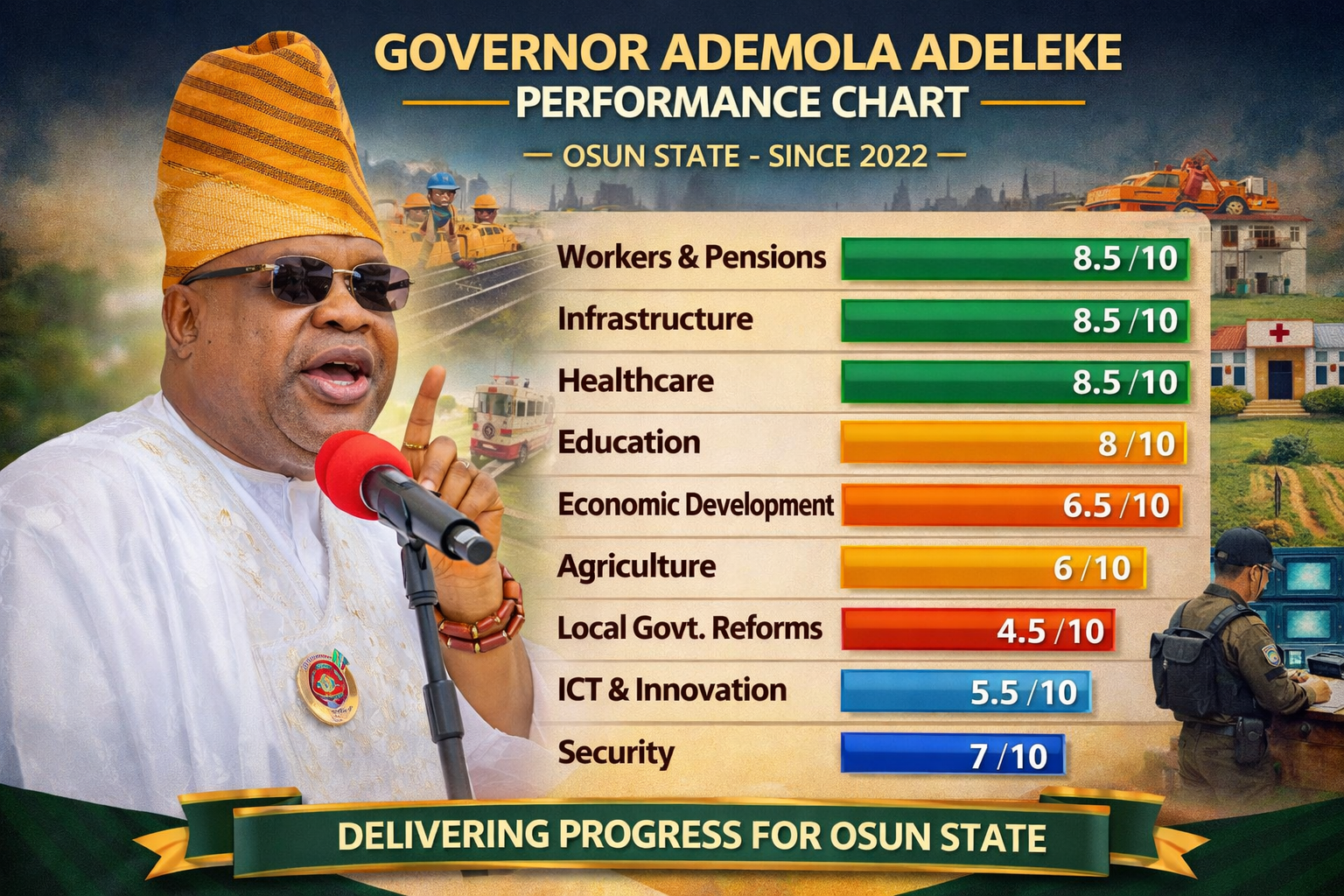
Has Governor Ademola Adeleke fulfilled the promises that earned him victory in 2022? Campaigns often generate ambitious pledges, but governance is ultimately judged by measurable outcomes rather than political rhetoric. In this piece, our analyst evaluate performance against campaign commitments, provides a more objective basis for assessing his administration using publicly available data from 2022 to 2026.
Governor Adeleke entered office with a governance agenda centred on improving workers’ welfare, rebuilding infrastructure, expanding access to healthcare and education, stimulating economic growth, strengthening agriculture, promoting digital innovation and restoring public confidence in government. Nearly four years into his administration, the record presents a picture of notable achievements alongside areas where expectations remain unmet.
Perhaps the administration’s strongest performance has been in public infrastructure. Road rehabilitation projects have been implemented across the state’s three senatorial districts, addressing roads that had deteriorated over many years. The government has also prioritised the completion of abandoned projects, signalling an intention to maximise previous public investments rather than initiating entirely new projects for political visibility. Rehabilitation of schools and primary healthcare facilities has similarly become one of the administration’s defining achievements, with numerous public facilities receiving upgrades that directly affect service delivery.
Register for the next Tekedia Mini-MBA.
Register for Tekedia AI in Business Masterclass.
Join Tekedia Capital Syndicate and co-invest in great global startups.
The administration has also earned recognition for improving the welfare of civil servants and pensioners. Prompt salary payments have become more consistent compared with previous years, while outstanding promotion issues and pension obligations have been addressed in phases. Recruitment exercises for teachers and healthcare workers have reduced staffing shortages in critical sectors. These interventions have helped rebuild confidence among public employees, who remain central to the effective delivery of government services.
Healthcare has emerged as another area of measurable progress. Investments in primary healthcare centres, medical equipment and health service accessibility reflect a deliberate effort to strengthen the foundation of healthcare delivery. Rather than focusing exclusively on urban hospitals, the administration has expanded attention to community based healthcare, which has the potential to improve health outcomes for rural populations where access to quality services has historically been limited.
Education reforms also demonstrate tangible progress. Beyond the recruitment of additional teachers, investments in school infrastructure have created a more conducive learning environment. Government officials have cited improvements in student performance indicators, although some of these claims would benefit from broader independent verification. Nevertheless, improvements in school facilities and teacher availability represent concrete outputs that are visible across many communities.

Economic development, however, presents a more mixed assessment. While the administration has pursued revenue reforms aimed at improving internally generated revenue and reducing financial leakages, the broader objective of transforming Osun into a more diversified and investment driven economy remains a work in progress. The state continues to rely significantly on federal allocations, making it vulnerable to fluctuations in national revenue. Large scale private sector investment and industrial expansion have not yet reached the level many expected during the campaign.
Agriculture illustrates a similar pattern. Government programmes have sought to support farmers and improve agricultural productivity, but the promised transformation towards agro industrialisation has progressed slowly. The establishment of processing industries capable of creating substantial employment opportunities remains limited. As a result, agriculture continues to contribute below its potential to economic growth and youth employment.
Digital transformation represents another area where implementation has lagged behind campaign expectations. Although the administration has expressed commitment to innovation and digital governance, progress in expanding technology infrastructure, promoting digital entrepreneurship and positioning Osun as a competitive digital economy has been modest. In an increasingly technology driven economy, this represents an opportunity that future policy priorities should address more aggressively.

The administration has also encountered significant challenges beyond its direct control. The prolonged political and legal disputes surrounding local government administration have complicated efforts to strengthen grassroots governance. These disputes have affected service delivery in some areas and illustrate how institutional conflicts can limit the implementation of campaign promises, regardless of executive intentions.
Security presents a relatively positive picture. Although Osun has avoided the widespread insecurity experienced in several neighbouring states, maintaining this stability requires continuous collaboration between state institutions, traditional rulers, community organisations and federal security agencies. The state’s comparatively peaceful environment remains an important advantage for economic and social development.