

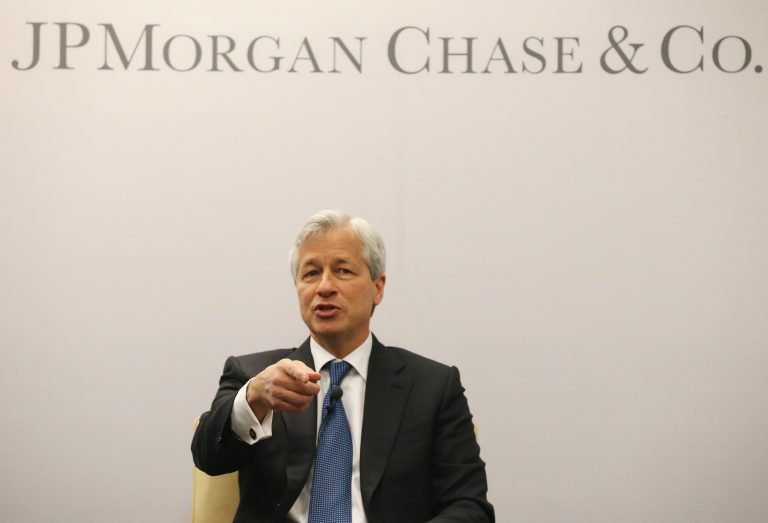
Peter Schiff, a long-time critic of Bitcoin and an outspoken supporter of gold, has dismissed claims that JPMorgan CEO Jamie Dimon is changing his stance on cryptocurrencies.
The misunderstanding followed Dimon’s December 11, 2025, interview on Fox Business, in which he discussed blockchain’s practical uses in traditional finance.
During the interview, Dimon reiterated that blockchain technology is “real” and increasingly effective for moving money. He emphasized that JPMorgan uses blockchain to settle trillions of dollars daily in faster and cheaper ways, particularly through stablecoins pegged to the U.S. dollar.
Register for Tekedia Mini-MBA edition 20 (June 8 – Sept 5, 2026).
Register for Tekedia AI in Business Masterclass.
Join Tekedia Capital Syndicate and co-invest in great global startups.
Register for Tekedia AI Lab.
He also highlighted the bank’s ongoing development of a stablecoin built on the Base network and the tokenization of real-world assets. Despite this, Dimon maintained his skepticism toward Bitcoin, describing it as speculative and separate from enterprise blockchain applications.
JPMorgan’s broader blockchain adoption is reflected in its Onyx platform, which processes more than $1 trillion annually through services like intraday repos and cross-border payments. These systems rely on permissioned blockchain networks—far removed from Bitcoin’s decentralized nature.
Some observers had interpreted Dimon’s praise of blockchain as a softening of his long-standing criticism of Bitcoin. However, Schiff refuted this interpretation, insisting that Dimon’s views on Bitcoin remain unchanged.

He wrote,
“He is talking about stablecoins not Bitcoin. His opinion on Bitcoin has not changed. He still knows it’s a Ponzi.”
According to Schiff, those celebrating Dimon’s remarks as bullish for Bitcoin are misunderstanding the distinction between blockchain as a technological tool and Bitcoin as a decentralized monetary system.

In his response, Schiff stressed that Dimon’s comments were strictly about blockchain infrastructure and stablecoins not Bitcoin. He bluntly stated that Dimon “still knows it’s a Ponzi,” reaffirming the JPMorgan chief’s historical position.
Schiff’s clarification underscores a broader reality in the financial sector: institutional adoption of blockchain technology does not necessarily translate into endorsement of Bitcoin.
Peter Schiff, a prominent economist, gold advocate, and long-time critic of unconventional assets, has remained one of Bitcoin’s most vocal skeptics. Even as cryptocurrencies gain wider acceptance among institutional investors and traditional financial players, Schiff’s opposition has stayed firm.
His criticism is rooted not just in market movements, but in deep-seated economic beliefs that shape how he views money, value, and financial stability. At the core of Schiff’s argument is his belief that Bitcoin lacks intrinsic value. He maintains that, unlike productive assets such as businesses or tangible commodities, Bitcoin does not generate income or serve a fundamental economic function.
According to Schiff, Bitcoin’s price is largely sustained by speculation and the expectation that someone else will be willing to buy it at a higher price in the future, a dynamic he believes is unsustainable over the long term.
Schiff’s long-standing support for gold also plays a central role in his critique. He views gold as “real money,” pointing to its thousands of years of history as a store of value, its physical properties, and its widespread acceptance across cultures and economies. In contrast, he argues that Bitcoin, as a purely digital asset, has not been tested across multiple economic cycles and lacks the historical credibility that gold enjoys.
Outlook
The exchange between Schiff and Bitcoin proponents highlights a broader divide shaping the future of finance. As banks and financial institutions increasingly adopt blockchain infrastructure, stablecoins, and tokenized assets, skepticism toward Bitcoin itself persists among many traditional economists and executives.
For critics like Schiff, institutional blockchain adoption reinforces not weakens the argument that the technology’s value lies in regulated, centralized applications rather than decentralized cryptocurrencies.
Meanwhile, Bitcoin supporters continue to argue that fixed supply, decentralization, and growing global awareness will ultimately validate its role as digital gold.