

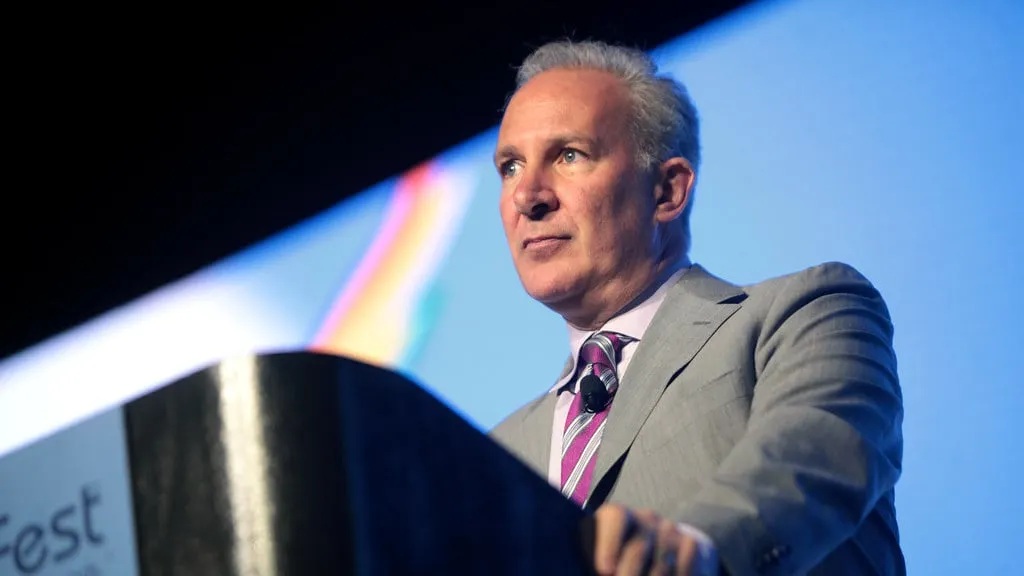
American stockbroker and financial commentator Peter Schiff, has challenged President Donald Trump’s explanation of his recent wealth gains.
Trump had attributed increases in his net worth to the performance of the broader stock market and the idea that he had prospered alongside other investors.
Schiff argued that a substantial portion of those gains instead came from the sale of meme coins linked to Trump, generating roughly $1.4 billion at the direct expense of the buyers of those tokens.
Register for the next Tekedia Mini-MBA.
Register for Tekedia AI in Business Masterclass.
Join Tekedia Capital Syndicate and co-invest in great global startups.
He wrote on X,
“Trump claimed that he made money along with everyone else due to the booming stock market. Yet the $1.4 billion he earned from selling meme coins came at the expense of investors who collectively lost a similar amount of money. Maybe some of those bagholders voted for Democrats.”
Financial disclosures released earlier in 2026 showed that Trump-related crypto ventures produced about $1.4 billion in reported income.

A large share of that figure stemmed from royalties and sales tied to the $TRUMP meme coin and related projects, including tokens associated with World Liberty Financial.
Independent analyses of blockchain data and public filings estimated that the family received hundreds of millions from meme-coin arrangements alone.
Meanwhile, the tokens themselves experienced steep declines after their initial surges. $TRUMP, for example, fell more than 95 percent from its early peak, leaving many retail holders with significant paper losses.

Reports based on on-chain data indicated that buyers as a group lost hundreds of millions of dollars, and in some tallies the collective shortfall reached into the billions.
Schiff framed the episode as a classic zero-sum transfer rather than the kind of wealth creation associated with rising equity markets.
In a rising stock market, share prices can advance because companies generate earnings or because capital is allocated more productively; both sellers and remaining holders can benefit over time.
Meme-coin trading, by contrast, often involves the rapid transfer of value from later buyers to earlier sellers or to those who control large allocations of the tokens.
Schiff has long been skeptical of speculative cryptocurrencies and has previously described Trump-linked meme coins as poor investments that primarily serve other purposes, including possible access to political figures.
The economist’s post added a pointed political observation. He noted that some of the investors left holding depreciated tokens might have supported Democrats, though the broader pattern of losses among Trump-aligned buyers has also drawn comment from other observers.
Schiff’s criticism fits a longer pattern of commentary in which he has contrasted traditional stores of value, such as gold, with highly volatile digital assets whose prices depend heavily on hype and celebrity association.
His comment on Trump’s stock wealth narrative, comes as American Senator Elizabeth Warren is preparing to make oversight of crypto ventures linked to President Donald Trump’s family an early focus once she assumes the chair of the Senate Banking Committee in January.
Warren has long been one of the most vocal congressional critics of the cryptocurrency industry and of the Trump family’s involvement in it.
Her office has previously pressed federal agencies for investigations into potential national security risks, conflicts of interest, and compliance shortcomings tied to these ventures.
At the center of the expected scrutiny is World Liberty Financial, the decentralized finance and stablecoin project launched in 2024 with involvement from Trump’s sons and other partners.
However, Trump and his representatives have maintained that the family’s crypto activities are managed at arm’s length and that the president does not personally direct day-to-day decisions.
Supporters of the ventures have argued that the tokens created new markets and that voluntary buyers assumed the risk. Critics, including Schiff, counter that the scale of the profits relative to the subsequent losses raises questions about fairness and about the blending of political celebrity with financial products.
The episode underscores a tension that has accompanied the growth of political meme coins. While the broader equity market can reflect genuine economic expansion, the gains realized by those who control the supply of a celebrity token frequently come from the capital of those who purchase it at elevated prices.