

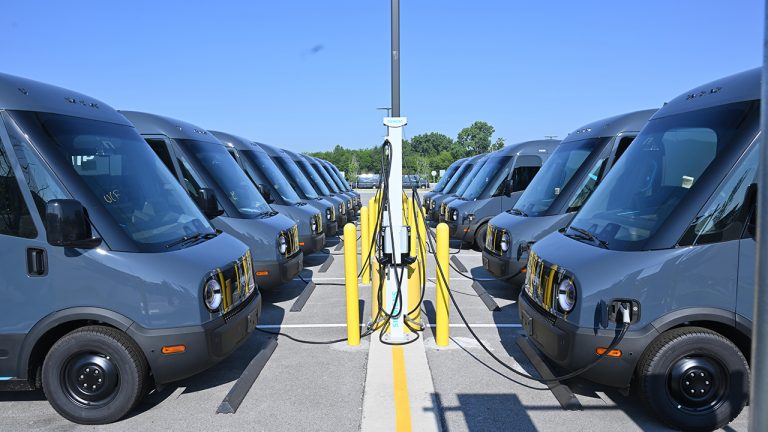
Rivian Automotive laid out an ambitious roadmap on Thursday at its first “Autonomy and AI Day,” revealing custom AI models, a proprietary car computer, and a new in-house chip that the company says will enable fully autonomous driving in its forthcoming vehicles.
The announcements mark a significant step in Rivian’s efforts to differentiate itself in the crowded electric vehicle (EV) market and signal the company’s strategic push toward a potential robotaxi business.
The presentation comes amid challenging market conditions for EV makers in the United States. Rivian shares were down roughly 3% during the hour-long event and fell further after OpenAI unveiled its own GPT-5.2 model on the same day, reflecting investor attention shifts toward the broader AI sector. Rivian’s stock dropped as much as 9% in afternoon trading, underscoring the pressure the company faces to demonstrate long-term growth potential.
Register for Tekedia Mini-MBA edition 20 (June 8 – Sept 5, 2026).
Register for Tekedia AI in Business Masterclass.
Join Tekedia Capital Syndicate and co-invest in great global startups.
Register for Tekedia AI Lab.
Central to Rivian’s autonomy strategy is the Autonomy+ subscription, launching in early 2026 for second-generation vehicles. The package, priced at $2,500 upfront or $49.99 per month, will deliver continuously expanding autonomous capabilities, powered by Rivian’s new processors and autonomy computers. By comparison, Tesla’s premium Full Self-Driving (FSD) package costs $8,000 upfront or $99 per month, highlighting Rivian’s more accessible pricing approach.
RJ Scaringe, Rivian’s founder and CEO, emphasized that AI is accelerating technology development at an unprecedented pace.
“AI is enabling us to create technology and customer experiences at a rate that is completely different from what we’ve seen in the past,” he said.

The company also plans a near-term software update introducing a “Universal Hands-Free” feature, allowing hands-free driving across more than 3.5 million miles of marked roads in North America, with continuous improvement through reinforced learning as vehicles accrue mileage.
Rivian’s approach differs significantly from Tesla’s primarily camera-based system. Its R2 vehicles will employ a combination of lidar, radar, and camera sensors to support level 4 autonomous driving under SAE standards, meaning vehicles can operate without human intervention in typical traffic and weather conditions. Passengers could sleep or engage in other activities while the car navigates. Alphabet’s Waymo also classifies its robotaxi fleet at level 4, offering a clear precedent for Rivian’s ambitions.
The company indicated that the rollout of level 4 autonomous vehicles opens the door to a robotaxi strategy. Scaringe said, “While our initial focus will be on personally owned vehicles, which today represent the vast majority of miles in the United States, this also enables us to pursue opportunities in the rideshare space.”

Analysts suggest that if Rivian can successfully launch autonomous robotaxis, it could unlock a high-margin, recurring revenue stream and expand its addressable market far beyond personal EV sales.
Competition in autonomous EVs is intensifying. Tesla and General Motors continue developing proprietary systems, while Honda, Lucid, and Nissan have partnered with startups such as Helm.AI, Nuro, and Wayve. These players vary in technical approach, with Rivian emphasizing a combination of sensor fusion and AI learning through real-world driving, while others rely on cameras, mapping, or cloud-assisted decision-making.
The hardware underpinning Rivian’s AI ambitions is a new custom chip, expected in 2026, designed with multi-chip module packaging and high memory bandwidth of 205 gigabytes per second. Vidya Rajagopalan, vice president of electrical hardware, said this architecture is crucial for supporting the intensive AI workloads required for real-time decision-making in autonomous driving. Chief Software Officer Wassym Bensaid framed the strategy as a move beyond software-defined vehicles, calling Rivian’s platform an “AI-defined vehicle” capable of integrating perception, planning, and user interaction seamlessly.
Rivian also introduced the Rivian Assistant, a next-generation AI-powered voice interface to launch in early 2026 across first- and second-generation vehicles, enabling natural-language interaction for navigation, in-car functions, and information requests.
The company faces a challenging backdrop. EV sales in the U.S. have slowed after the early termination of the $7,500 federal tax credit, and Chinese EV makers are intensifying global competition. Rivian shares are up roughly 25% this year but remain over 80% below the company’s 2021 IPO price, reflecting internal production challenges, market volatility, and investor skepticism.
If Rivian can execute on its vision for level 4 autonomy and the Autonomy+ subscription, the implications will be significant. Fully autonomous vehicles operating as robotaxis could dramatically expand Rivian’s total addressable market, provide high-margin, recurring revenue, and position the company as a key player in mobility-as-a-service, not just EV manufacturing.
Unlike traditional car sales, robotaxis offer continuous revenue generation and higher asset utilization, creating the potential for Rivian to capture market share in both personal and commercial transport sectors.
By combining proprietary AI hardware, a robust software stack, and a subscription-driven model, Rivian aims to move beyond the limitations of conventional EV adoption and stake a claim in the emerging autonomous vehicle ecosystem. The company’s progress over the next two years will be critical to demonstrating whether its ambitious strategy can reshape its financial trajectory and establish it as a leader in both autonomous mobility and electric vehicle innovation.