

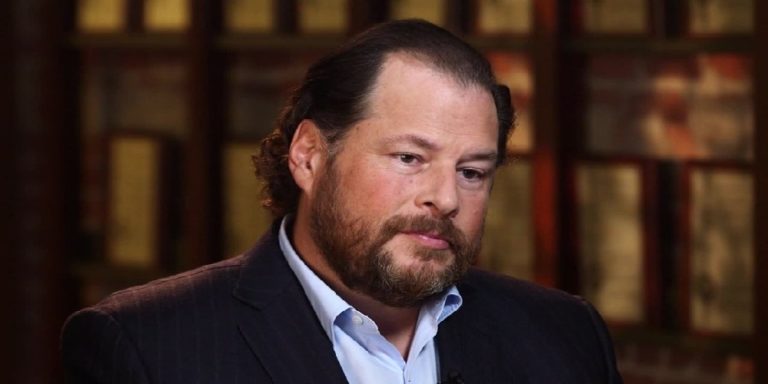
Salesforce CEO Marc Benioff has urged artificial intelligence companies to act responsibly as powerful models become embedded in businesses and everyday life, warning the industry not to repeat the mistakes made during the rise of social media.
Benioff’s comments came as the technology industry confronts a growing debate over AI safety, intensified by Anthropic CEO Dario Amodei’s call for frontier AI developers to slow the pace of model development so that safety measures can keep up with rapidly advancing capabilities.
Speaking to CNBC’s Jim Cramer during Salesforce’s annual Dreamforce conference in San Francisco, Benioff said the social media industry provided a cautionary example of what can happen when powerful technology expands faster than safeguards and accountability.
Register for the next Tekedia Mini-MBA.
Register for Tekedia AI in Business Masterclass.
Join Tekedia Capital Syndicate and co-invest in great global startups.
“A lot of companies got hurt, a lot of individuals got hurt through social media,” Benioff said. “We don’t want that to happen in AI.”
Benioff has spent years criticizing the social media industry’s impact on society. In 2018, he described Facebook as “the new cigarettes” and called for greater government regulation of social media companies.
His warning about AI is notable because Salesforce is closely connected to the companies developing the technology. The enterprise software giant has increasingly incorporated generative AI into its products and partnerships, putting it directly in the middle of the commercial expansion of the technology.

Last month, Salesforce unveiled Claudeforce, which includes a plugin allowing customers to use Anthropic’s Claude to access customer information stored in Salesforce and perform tasks including composing emails and updating records.
Amodei appeared alongside Benioff at Dreamforce on Tuesday, reinforcing his argument that AI developers should take greater responsibility for the pace and safety of their technology.
“I think that’s the way to lead the industry forward, to set an example, to say that everyone can always be better,” Amodei said.

Benioff Stops Short of Calling for a Slowdown
While Benioff emphasized responsibility and ethics, he stopped short of directly criticizing AI developers or endorsing Amodei’s call for a slowdown.
Instead, he framed the issue as one of corporate responsibility. AI companies, he argued, need to consider how their products affect customers, communities, and society as the technology becomes more capable.
“We want AI to take care of these things and be held responsible, and take care of these actions and be ethical,” Benioff said. “The heart of ethics is responsibility.”
He also appealed directly to technology companies developing frontier AI systems.
“We really look at a light on our brethren here in San Francisco and all over the world and say, ‘We want you to be ethical in your actions and how you take care of your communities and the world,’ because this technology is very powerful,” he said.
The comments add another perspective to an increasingly public disagreement among technology executives over how to manage AI’s rapid development.
Amodei has noted that the industry should deliberately reduce the pace of capability improvements. OpenAI CEO Sam Altman has backed the need for greater coordination and monitoring, while Meta CEO Mark Zuckerberg and Nvidia CEO Jensen Huang have emphasized the ability of companies to build safety and alignment into AI systems while continuing development.
Benioff’s position is closer to a responsibility-focused approach. His argument does not require companies to halt development, but it places greater emphasis on how they deploy the technology and the obligations that come with controlling increasingly powerful systems.
His idea matters for Salesforce, whose business depends on persuading enterprises to place AI inside core business processes. As AI agents move from generating content to accessing company databases, updating records and taking actions on behalf of employees, questions around reliability, security and accountability become commercial issues as well as questions of ethics.
The debate is also unfolding against a changing view of AI’s impact on enterprise software. Salesforce and other software companies were hit earlier this year by concerns that sophisticated AI models could disrupt traditional applications by allowing businesses to accomplish tasks without relying as heavily on conventional software.
Those concerns have eased in recent months as investors have increasingly considered the possibility that AI could become an additional layer of enterprise software rather than simply replace it.
Salesforce shares rose more than 4.5% in the previous session as enterprise software stocks rallied following Amodei’s call for a slower pace of AI development. The shares gave back some of those gains on Tuesday.
Salesforce remains more than 50% above its 52-week low of about $146 reached in late June.
For Benioff, however, the major issue is whether the companies building and deploying the technology can accept responsibility for what happens as its capabilities expand.
His warning draws a direct line from the social media era to the AI boom: technologies can create enormous commercial value while also producing consequences that become harder to manage once adoption reaches a massive scale.
“We don’t want that to happen in AI,” Benioff said.