

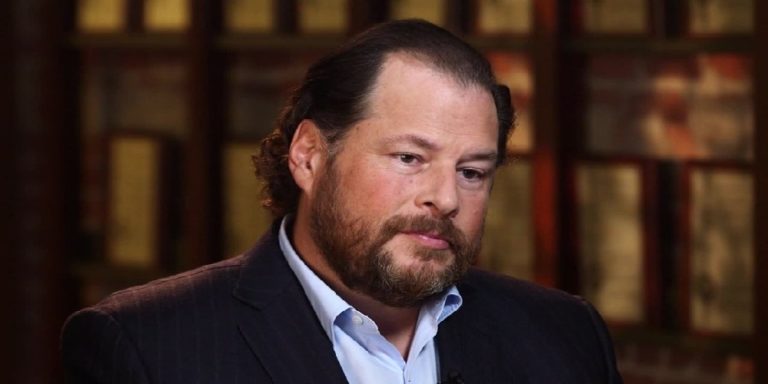
Marc Benioff, the outspoken CEO and co-founder of Salesforce, is doubling down on artificial intelligence, calling it a “digital labor revolution” that is already reshaping the company from the inside out — and, according to him, it’s working with near-flawless accuracy.
In a new interview with Bloomberg’s Emily Chang, Benioff said Salesforce is having “hundreds of thousands” of AI-powered conversations with customers and that its AI models are hitting a 93% accuracy rate in resolving queries.
“Even for a large brand or a large company that we work with, like Disney, it’s about 93%,” Benioff said, emphasizing that AI is no longer experimental — it’s embedded, and it’s delivering.
Register for Tekedia Mini-MBA edition 20 (June 8 – Sept 5, 2026).
Register for Tekedia AI in Business Masterclass.
Join Tekedia Capital Syndicate and co-invest in great global startups.
Register for Tekedia AI Lab.
Benioff pointed to Agentforce, Salesforce’s platform for building AI agents, which he previously touted as handling tens of thousands of customer service issues with minimal human intervention. According to him, the tool is helping Salesforce’s clients — including some of the world’s largest corporations — streamline support, reduce wait times, and free up human employees to focus on complex, high-value interactions.
AI Already Doing Half the Work
Benioff made a striking claim that AI now does between 30% and 50% of all work at Salesforce, playing a central role in engineering, software development, and customer support. While the company didn’t provide granular breakdowns of which departments are most affected, Benioff painted a picture of a future in which intelligent agents, not just human employees, make up a growing portion of the global workforce.
“We’re looking at the deployment of an estimated $3 trillion to $12 trillion of digital labor,” Benioff told Bloomberg, suggesting that AI agents and robots will eventually operate alongside — or in place of — human workers at a global scale.

That prediction aligns with broader forecasts from McKinsey and Goldman Sachs, both of which estimate that AI could automate a significant portion of white-collar jobs within the next decade.
Layoffs and Hiring Amid AI Expansion
AI’s rising role at Salesforce is believed to have fueled its growing job cuts. Bloomberg reported earlier this year that the company plans to eliminate over 1,000 roles in 2025, touting AI as a productivity driver. The company had about 76,500 employees as of January, according to its latest annual report.
These layoffs have sparked renewed debate over whether AI tools are augmenting or outright replacing workers. While Benioff frames AI as a way to enhance productivity and reduce repetitive labor, it raises concerns about how many employees may be impacted by this transition.

However, Salesforce isn’t freezing hiring entirely. On Thursday, its careers page listed 359 open roles in the U.S., suggesting a shift in skills demand, with more emphasis on AI-literate roles and internal mobility.
Internal AI Tools: From Hiring to the C-Suite
Salesforce is also turning AI inward. The company recently launched Career Connect, an internal AI tool designed to help employees discover other roles within the company that match their skills and job history — a move Benioff says is intended to foster internal mobility and reduce friction in job matching.
Benioff himself is reportedly using AI in his own daily workflow, including for planning Salesforce’s annual business strategy.
It’s less lonely at the top with an AI helper, he said.
A Values-Based Digital Future?
Despite the promise of AI, Benioff also issued a caution: the future of AI-driven productivity must be shaped with ethical foresight.
“It’s a digital labor revolution,” he said, “but it’s on CEOs to make sure their values are in the right place.”
In other words, as the AI economy expands and automation becomes a central part of business operations, Benioff believes corporate leaders have a responsibility to ensure that efficiency gains translate into shared prosperity — not just higher profits and thinner payrolls.
The comments come at a time when tech companies across the board are facing tough questions about AI’s impact on job security, and ethics, even as they pour billions into developing and deploying it.