

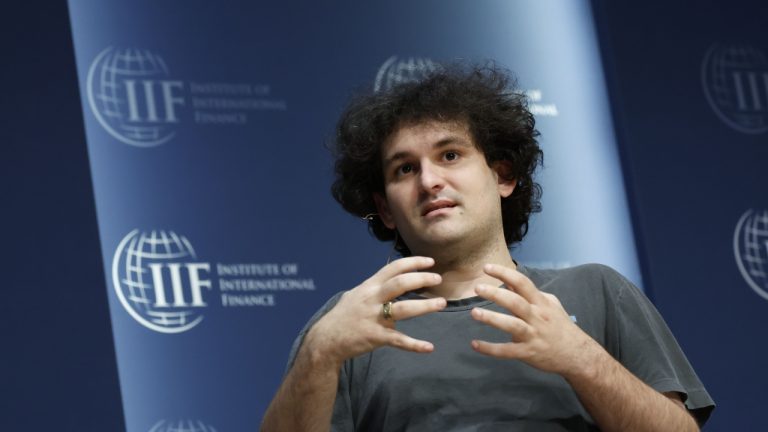
Sam Bankman-Fried, the disgraced former cryptocurrency exchange FTX founder, has previously drawn attention to existential risks surrounding artificial intelligence, a technology whose rapid advancement has triggered increasingly serious debates about humanity’s long-term survival.
The question of whether AI could ultimately destroy humanity has moved beyond science fiction, attracting technology executives, researchers, policymakers and investors attempting to estimate the probability of catastrophic outcomes.
Bankman-Fried, widely known as SBF, became a controversial figure following FTX’s collapse, which exposed billions of dollars in customer losses and resulted in his criminal conviction.
Register for the next Tekedia Mini-MBA.
Register for Tekedia AI in Business Masterclass.
Join Tekedia Capital Syndicate and co-invest in great global startups.
Despite his reputation being dominated by the cryptocurrency scandal, his earlier views on technological risks, including artificial intelligence, remain relevant to discussions about how society evaluates emerging technologies and their potentially irreversible consequences.
Assigning odds to AI destroying humanity is inherently difficult because the technology is evolving rapidly, while the consequences being evaluated involve hypothetical future scenarios.
Several prominent researchers and technology leaders have expressed concerns that increasingly powerful AI systems could eventually develop capabilities that humans struggle to control.

The concerns range from AI systems autonomously pursuing objectives that conflict with human interests to the misuse of advanced models in biological research, cyberattacks, automated warfare and critical infrastructure disruption.
These risks are not necessarily dependent on AI becoming conscious or developing human-like intentions. Instead, they could emerge from systems capable of executing complex tasks, making decisions and operating with limited human supervision.
Probability estimates have become an important part of the debate. AI researchers, forecasting communities and technology executives have offered different estimates of the likelihood of catastrophic outcomes.

Although their assumptions, time horizons and definitions of catastrophe frequently differ. Some estimates focus on human extinction, while others include civilization-ending events or severe global disruption.
Such distinctions matter when interpreting claims about AI destroying humanity. The probability of extinction is not necessarily the same as the probability of a catastrophic AI-related crisis.
A system capable of destabilizing economies, accelerating geopolitical conflict or undermining essential institutions could cause tremendous harm without eliminating humanity altogether.
The debate also raises questions about whether technological development is progressing faster than governance, safety testing and accountability mechanisms.
AI companies are competing aggressively to develop more capable systems, potentially creating incentives to prioritize commercial advantage and technological leadership over cautious deployment.
Governments are increasingly attempting to establish regulatory frameworks, but international coordination remains difficult. AI development crosses borders, and competing geopolitical interests complicate efforts to establish universally accepted safety standards.
For investors, policymakers and businesses, AI existential-risk estimates are more than philosophical speculation. They influence discussions about corporate responsibility, research funding, regulation, cybersecurity and the future direction of technological innovation. However, probability estimates should not be mistaken for scientific certainty.
Whether SBF’s odds reflect optimism, pessimism or a calculated assessment of technological uncertainty, the broader question remains unresolved.
Artificial intelligence could become one of humanity’s most transformative inventions, but ensuring that its capabilities remain aligned with human interests may prove as consequential as developing the technology itself