

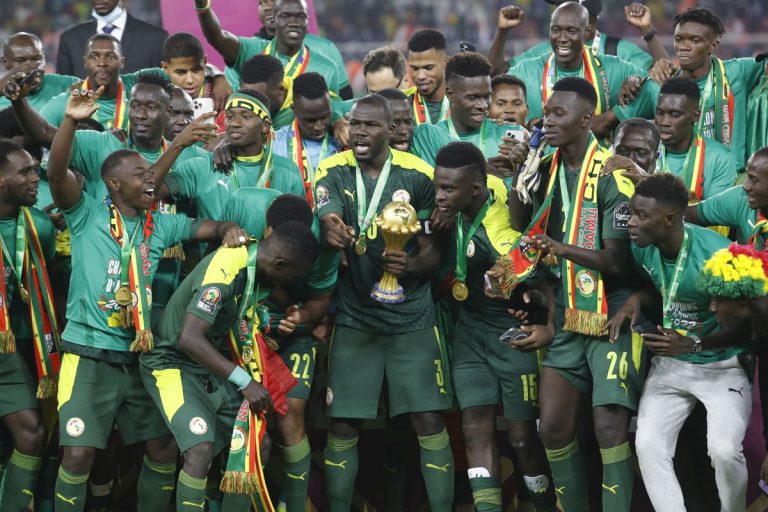
Senegal’s battle to reclaim its African Cup of Nations crown has shifted to the courtroom, with the country’s football authorities filing a formal appeal before the Court of Arbitration for Sport (CAS) in a case that is already stirring unease across the sport.
The dispute stems from the chaotic final in Rabat on January 18, where Senegal beat Morocco 1-0 after a brief abandonment. Players had walked off in protest against a penalty decision they deemed decisive. When they returned 14 minutes later and saw the match, few expected the result itself would later be erased.
But in a move that has since triggered widespread criticism, the appeals board of the Confederation of African Football (CAF) ruled that Senegal had effectively forfeited the match by leaving the field, awarding Morocco a 3-0 victory and, with it, the title.
Register for Tekedia Mini-MBA edition 20 (June 8 – Sept 5, 2026).
Register for Tekedia AI in Business Masterclass.
Join Tekedia Capital Syndicate and co-invest in great global startups.
Register for Tekedia AI Lab.
CAS confirmed that Senegal’s appeal seeks not only to annul that ruling but to have the country formally reinstated as champions of Africa. The federation is also pressing for procedural safeguards, including a suspension of filing deadlines until CAF provides a fully reasoned decision — something Senegal’s legal team insists has yet to materialize.
At the core of the case lies a fundamental question about the boundaries of authority in football. Senegal’s lawyers argue that once a referee allows a match to resume and reach its conclusion, the result becomes sacrosanct. Any subsequent administrative reversal, they warn, risks weakening one of the sport’s most enduring principles — that outcomes are settled on the field of play.
Juan de Dios Crespo Perez, a senior member of Senegal’s legal team, did not temper his language. He described CAF’s ruling as “crude” and “irrational,” arguing that it runs counter to the laws of the game.

“This decision cannot even be considered a true sporting justice ruling – it is so crude, so absurd, so irrational,” he said. “It openly violates the laws of the ?game and the principle that refereeing decisions are final.”
His position has found resonance beyond Senegal’s borders, where former players, administrators, and analysts have questioned whether CAF’s disciplinary reach has crossed into territory traditionally reserved for match officials.
That criticism has been sustained and unusually broad. Across African football circles, the decision has been described as disproportionate, with commentators noting that walk-offs, while punishable, rarely result in the retroactive nullification of completed matches. Others have pointed to inconsistencies in past CAF disciplinary cases, arguing that sanctions have historically stopped short of rewriting results once play has resumed under a referee’s authority.

Legal observers have also raised concerns about due process. The absence of a detailed explanation accompanying the appeals board’s decision has drawn scrutiny, with some warning that opaque rulings risk eroding confidence in CAF’s governance structures. In similar cases globally, disciplinary bodies are expected to clearly articulate both the factual basis and regulatory framework underpinning their decisions, a standard Senegal insists has not been met.
Abdoulaye Fall, president of the Senegalese Football Federation, has framed the dispute in stark terms, calling the ruling an “administrative robbery” and pledging a sustained legal campaign. His rhetoric reflects the domestic mood, where the government has already called for an inquiry into how the title was stripped.
The legal team assembled by Senegal underscores the seriousness of the challenge. Drawing from jurisdictions including Switzerland, Spain, France, and Senegal, the group is preparing for what could become a defining case in sports arbitration. Seydou Diagne, another lawyer on the team, warned that the implications extend well beyond this single final.
“If CAS let this situation happen, the winner of the next World Cup could be decided within a lawyers’ firm,” he said.
CAS jurisprudence has historically been cautious about interfering with refereeing decisions, recognizing the autonomy of match officials as a cornerstone of the sport. Senegal’s argument leans heavily on that tradition, positioning CAF’s ruling as an outlier that risks redrawing those boundaries.
CAF president Patrice Motsepe has defended the organization’s stance, insisting that fairness and uniformity guided the decision-making process. Yet even within administrative circles, there is quiet acknowledgement that the case could test the limits of CAF’s disciplinary authority.
While standard CAS procedures can stretch over nine to 12 months, Senegal is pushing for an accelerated process, aware that the symbolic and commercial weight of the AFCON title diminishes with prolonged uncertainty. Any fast-tracking would require agreement from CAF and Morocco, adding another layer of complexity.
“Such a procedure usually lasts nine to 12 months, but we want it to go faster. However, all parties must agree to it,” Serge Vittoz, part of a ?six-lawyer legal team in Paris, said.
In the interim, Senegal’s position remains unchanged. Officials insist the team is, in their view, still African champions. There are even suggestions that the trophy could be presented to supporters during upcoming fixtures in Europe, a move that would underline the federation’s refusal to recognize CAF’s decision.
What began as a disputed penalty in Rabat has evolved into a test case for football governance. The case is expected to shape how far administrative bodies can go in overturning results, and whether the final whistle truly marks the end of a match.