

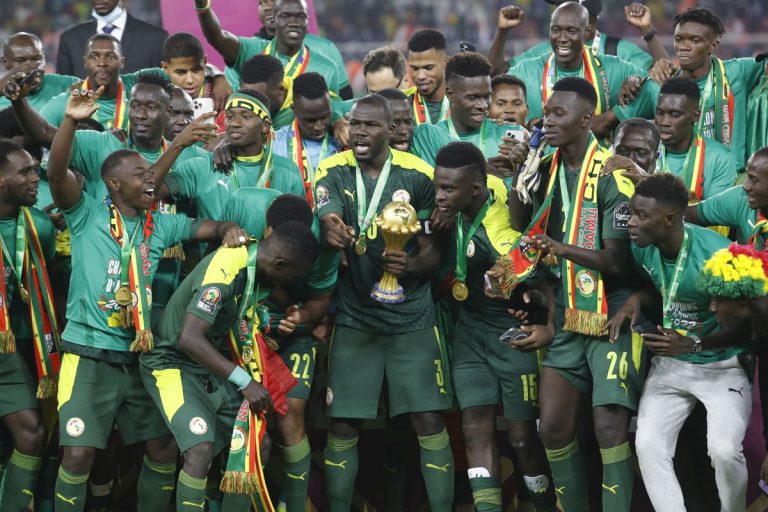
The Confederation of African Football (CAF) has stripped Senegal of its Africa Cup of Nations title and awarded the championship to Morocco, following a dramatic and disputed final that has now escalated into a legal battle.
In a statement released Tuesday, CAF said Senegal had forfeited the match after players temporarily left the pitch in protest during the closing stages of the game. The governing body ruled that the result would be recorded as a 3-0 victory for Morocco, overturning Senegal’s 1-0 win secured after extra time.
The decision has triggered a sharp backlash from Senegal’s football authorities, who have vowed to challenge the ruling at the Court of Arbitration for Sport (CAS) in Lausanne.
Register for Tekedia Mini-MBA edition 20 (June 8 – Sept 5, 2026).
Register for Tekedia AI in Business Masterclass.
Join Tekedia Capital Syndicate and co-invest in great global startups.
Register for Tekedia AI Lab.
How The Final Descended Into Chaos
The controversy stems from events late in the final played at the Prince Moulay Abdellah Stadium in Rabat. With the match goalless deep into stoppage time, Congolese referee Jean-Jacques Ndala awarded Morocco a penalty following a VAR review for a challenge on Brahim Diaz.
The decision sparked immediate protests from Senegal’s players, several of whom walked off the pitch, halting the match for nearly 20 minutes. Tensions were further inflamed as some supporters attempted a pitch invasion.
After intervention from captain Sadio Mane and officials, Senegal’s players returned to resume play. Diaz subsequently missed the penalty, attempting a poorly executed Panenka, before Pape Gueye scored the decisive goal in extra time to give Senegal a 1-0 victory.

CAF’s Appeals Committee said its ruling was based on Articles 82 and 84 of the AFCON regulations, which stipulate that a team that refuses to play or leaves the field without the referee’s permission forfeits the match and is deemed to have lost 3-0.
“The Senegal national team is declared to have forfeited the match,” CAF said, adding that the result must therefore be officially adjusted in Morocco’s favor.
The Royal Moroccan Football Federation (FRMF), which lodged the appeal, maintained that its action was not aimed at disputing the sporting outcome but at ensuring adherence to competition rules.

“The Federation reaffirms its commitment to respecting the rules, to the clarity of the competitive framework, and to the stability of African competitions,” it said.
Senegal Prepares Legal Challenge
Senegal’s football federation has strongly condemned the decision, describing it as “unjust, unprecedented and unacceptable.” It confirmed plans to appeal to CAS.
It is believed that the West African country is going to argue that the match was completed under the authority of the referee and that the final result should stand. This line of argument is expected to hinge on the Laws of the Game, which state that decisions made by the referee regarding match facts — including the final result — are definitive once play has concluded.
Analysts say Senegal could argue that because the referee allowed the match to resume and proceed to its natural conclusion, the conditions for forfeiture were not met.
Echoes Of Past CAF Controversies
The ruling has revived criticism of CAF’s governance and consistency in applying its own regulations.
Sports journalist Osasu Obayiuwana pointed to parallels with the 2019 CAF Champions League final, where administrative decisions overturned on-field outcomes before being challenged successfully at CAS. When Papa Bakary Gassama, the Gambian referee, rightly declared Tunisia the winner of the 2019 #CAFCL, after Wydad Athletic Club abandoned the game in Tunis, Ahmad Ahmad and his exco illegally overturned Gassama’s decision and ordered a replay.
It took a strong judicial rebuke from CAS for CAF to obey its tournament rules and the laws of the game, which handed Esperance the trophy.
“It is tragic that CAF never learns from its past mistakes,” journalist Osasu Obayiuwana said. “Seven years later, CAF has forgotten this lesson and returned to its governance vomit.”
The implication is that CAF may once again face scrutiny over whether its disciplinary framework aligns with international football laws and due process.
In the immediate aftermath of the final, FIFA president Gianni Infantino condemned the conduct of Senegal’s players, describing the walk-off as “unacceptable.”
“It is unacceptable to leave the field of play in this manner, and equally, violence cannot be tolerated in our sport,” Infantino said, referencing both the protest and crowd disturbances.
CAF had already imposed fines totaling several hundred thousand euros on both federations for unsportsmanlike conduct and breaches of fair play. Separately, 18 Senegalese supporters were convicted of hooliganism following the match, receiving prison sentences ranging from three months to one year. Their appeal hearing has been postponed until March 30.
The case now moves into the legal arena, where CAS will be asked to determine whether CAF’s application of its regulations was valid. At issue is a fundamental tension between two principles: strict enforcement of competition rules versus the authority of the referee to manage and conclude a match.
If CAS sides with Senegal, it could reinforce the primacy of on-field decisions and limit the scope of post-match administrative interventions. If it upholds CAF’s ruling, it would set a precedent for stricter disciplinary enforcement in cases where teams disrupt play, even if matches are ultimately completed.
Beyond the immediate dispute, the controversy has raised fresh concerns about governance, consistency, and credibility in African football administration. Many believe that repeated disputes of this nature risk undermining confidence in CAF competitions, particularly at a time when African football is seeking greater global recognition and investment.