

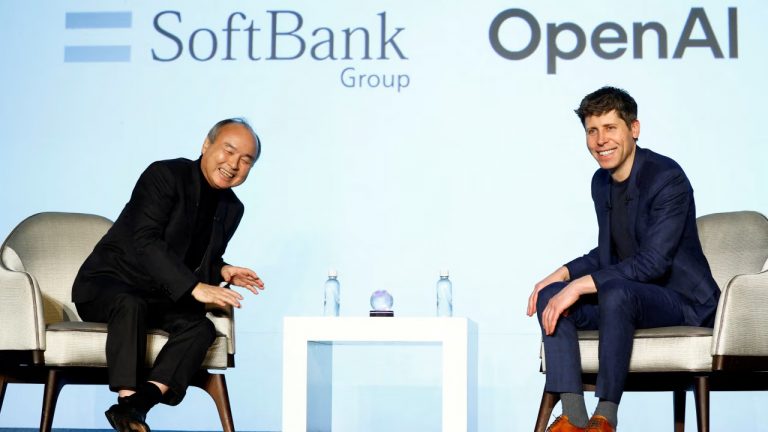
SoftBank Group’s aggressive wager on artificial intelligence has turned into a windfall. The Japanese tech conglomerate posted a 2.5 trillion yen ($16.6 billion) net profit for the second quarter ended September, more than doubling its results from a year earlier.
The turnaround was driven primarily by valuation gains in OpenAI, the U.S. company behind ChatGPT, marking SoftBank’s strongest performance since 2022, according to Reuters.
The results underline Masayoshi Son’s high-stakes pivot toward AI as the core of SoftBank’s future. Once reeling from the collapse of several Vision Fund-backed startups such as WeWork and Oyo, Son has re-emerged as one of the world’s most bullish investors in AI — a stance he describes as “an all-in conviction on the future of intelligence.”
Register for Tekedia Mini-MBA edition 20 (June 8 – Sept 5, 2026).
Register for Tekedia AI in Business Masterclass.
Join Tekedia Capital Syndicate and co-invest in great global startups.
Register for Tekedia AI Lab.
SoftBank’s Vision Fund, which manages two investment vehicles launched in 2017 and 2019, posted a 3.5 trillion yen gain in the quarter — a reversal from the fund’s previous streak of losses. Nearly two-thirds of that came from its OpenAI holdings, which gained 2.16 trillion yen in value following the U.S. firm’s successive fundraising rounds and soaring secondary market demand.
The scale of SoftBank’s exposure to OpenAI has made it one of the company’s largest outside backers. In March 2025, SoftBank led a funding round of up to $40 billion at a valuation of $300 billion, and by October, it joined a consortium of investors acquiring $6.6 billion worth of employee shares at an implied valuation of $500 billion. By December, its total investment is expected to reach $34.7 billion — a sum larger than the entire GDP of some developing nations.
The AI windfall also pushed SoftBank’s share price to a record high, prompting the company to announce a four-to-one stock split to make its shares more accessible to retail investors. The stock has nearly quadrupled in value in the past six months amid a broader rally in tech-related equities.

Financing the AI gamble
Son’s AI ambitions demand vast capital. To bankroll them, SoftBank has moved swiftly to liquidate legacy assets and raise fresh cash. The firm sold its entire 32.1 million-share stake in Nvidia in October for $5.83 billion, and also offloaded part of its T-Mobile holdings for $9.17 billion.
In parallel, SoftBank has issued bonds in three currencies — yen, dollars, and euros — worth more than 1 trillion yen ($6.4 billion) since April. It also secured two major bridging loans totaling $15 billion: an $8.5 billion loan to finance its OpenAI investment and another $6.5 billion for the planned acquisition of U.S. chip design firm Ampere Computing, which remains pending.
SoftBank’s Chief Financial Officer, Yoshimitsu Goto, defended the company’s aggressive financing strategy at a Tokyo briefing.

“There are various opinions, but SoftBank’s position is that the risk of not investing is far greater than the risk of investing,” he said.
Goto hinted that the company sees OpenAI’s ecosystem — from model training to infrastructure — as a central pillar of global digital transformation.
AI boom — or speculative bubble?
While SoftBank’s results reinforce its reputation as a bellwether for tech cycles, analysts warn that the AI sector may be overheating. Many of the leading companies in the space, including OpenAI, are reporting mounting losses despite sharp valuation increases.
“Son is a savvy investor, so selling the entire [Nvidia] stake must mean he is no longer optimistic about the share price,” said Wong Kok Hoi, CEO of Singapore-based APS Asset Management. “Big tech companies may continue to invest heavily in GPU chips but not at this year’s level for many years.”
The concern is that the massive sums flowing into AI infrastructure — particularly data centers, semiconductor production, and model training — may not yet translate into sustainable profits. OpenAI, for instance, has seen its operating costs surge due to the expense of training and deploying its GPT models, which require vast computing power.
Still, SoftBank maintains that the potential upside of AGI — artificial general intelligence — outweighs the short-term financial risks. Son has framed the company’s strategy as a long-term play that echoes his earlier success with Alibaba, which turned a $20 million stake into more than $50 billion at its peak.
Son’s investing style has always been marked by extremes: bold vision backed by heavy leverage. His early triumph with Alibaba gave him global prominence, but later missteps — particularly with WeWork, which filed for bankruptcy in 2023 — left the Vision Fund battered and investors wary.
SoftBank’s new trajectory represents both a recovery and a reckoning. The group is now positioning itself as a cornerstone investor in the global AI ecosystem, participating in infrastructure ventures, chip design, and data center construction, alongside stakes in leading AI software developers.
The company’s strategy also aligns with Japan’s broader push to reclaim technological leadership in semiconductors and next-generation computing, sectors long dominated by the U.S. and China.
Amid this technological competition, the US motivates EU and Asian companies to relocate their members and ventures to the country, increasing the global visa services activity around the world to ensure global dominance in the AI sector.
However, SoftBank’s latest surge signals a sustainable AI renaissance or a temporary bubble remains uncertain. The current rally has drawn comparisons to the late 1990s dot-com boom, when valuations soared on enthusiasm for a technology whose business models were still unproven.
For now, Son’s gamble has paid off handsomely. But with OpenAI still burning cash, the broader market tightening, and competition intensifying across AI research and infrastructure, SoftBank’s balance between vision and vulnerability may soon be tested again.