

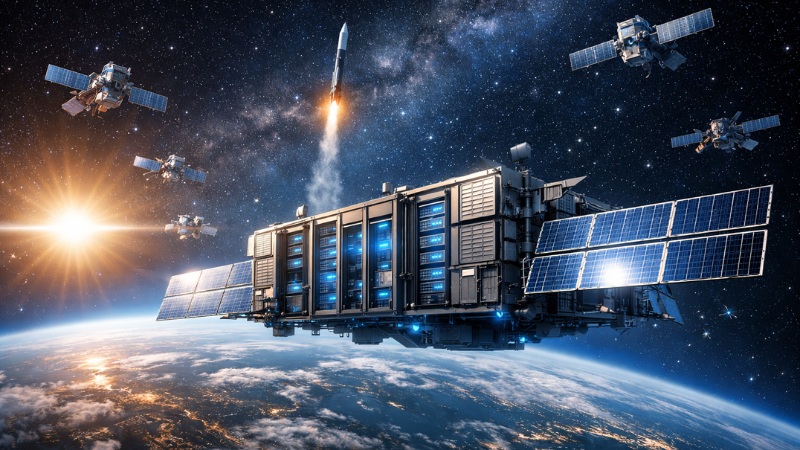
SpaceX and Google have reportedly entered a landmark agreement in which SpaceX signs a $920 million monthly artificial intelligence compute deal with Google, marking one of the largest cloud infrastructure commitments in the AI era.
Under the arrangement, SpaceX is expected to tap Google’s advanced data center fleet and tensor processing infrastructure to support its expanding satellite communications, Starlink optimization, and autonomous aerospace systems. The scale of the contract suggests a significant shift toward hyperscaler dependency even among vertically integrated technology firms.
Industry analysts view the deal as a reflection of accelerating AI compute demand, where frontier companies are increasingly unable to rely solely on proprietary infrastructure.
By outsourcing part of their training and inference workloads, SpaceX gains elasticity, reduced latency in distributed workloads, and access to Google’s optimized machine learning stack. However, the $920 million monthly figure raises questions about sustainability, pricing power in cloud AI markets, and whether such large recurring compute commitments will become standard across aerospace, defense-adjacent, and satellite intelligence industries.
Register for the next Tekedia Mini-MBA.
Register for Tekedia AI in Business Masterclass.
Join Tekedia Capital Syndicate and co-invest in great global startups.
If replicated, it could reinforce Google’s position in high-performance AI infrastructure competition against AWS and Microsoft Azure. As this agreement evolves, it underscores how AI compute is becoming a strategic commodity, comparable to energy or semiconductor supply chains. It enables faster iteration across its software-defined aerospace systems, while for Google it strengthens long-term revenue predictability in an increasingly competitive cloud landscape.
This deal also reflects the broader convergence between space infrastructure providers and hyperscale cloud operators, as AI workloads increasingly require distributed compute architectures spanning terrestrial and orbital networks. With SpaceX’s satellite backbone feeding high-throughput data streams and Google’s TPU clusters handling model training and inference optimization, the partnership effectively compresses the feedback loop between data generation and intelligence deployment.
Market observers suggest that such arrangements could redefine competitive dynamics in AI infrastructure, shifting bargaining power away from traditional standalone cloud providers toward integrated compute ecosystems anchored by platform-scale demand. Regulatory analysts in multiple jurisdictions may also scrutinize the concentration of compute resources, particularly where defense, communications, and satellite intelligence applications intersect with large-scale machine learning systems.
The SpaceX–Google agreement signals an era in which AI compute is no longer a utility layer but a core strategic asset shaping the trajectory of next-generation aerospace, communications, and autonomous systems development.

The agreement may accelerate the development of real-time AI-driven satellite routing, predictive maintenance for orbital assets, and large-scale simulation environments for aerospace design, while simultaneously pushing cloud providers to expand capacity in specialized accelerator hardware and interconnect bandwidth, as demand for inference-heavy workloads continues to outpace traditional training-centric usage models, thereby reshaping how capital expenditure is allocated across the global AI supply chain.
This trajectory also implies that future AI infrastructure agreements will likely blend commercial cloud capacity with mission-critical aerospace requirements, creating hybrid operational stacks that prioritize resilience, low-latency performance, and global redundancy across both terrestrial data centers and space-based communication networks, establishing a new class of compute-intensive partnerships that blur the line between technology vendors and strategic infrastructure allies.
Such developments are expected to intensify competition across hyperscale providers, while also encouraging vertically integrated companies to reconsider how compute procurement is structured over multi-year strategic planning horizons. across the global AI economy ecosystem.

Hut 8 Raises $4.25B for Texas Data Center Expansion
Meanwhile, Hut 8 has announced a $4.25 billion capital raise to finance a large-scale data center expansion in Texas, marking one of the most aggressive infrastructure pushes in the Bitcoin mining sector to date. The move underscores the continued convergence between energy-intensive crypto mining operations and the rapidly expanding demand for high-performance computing infrastructure.
As global hash rate competition intensifies and mining margins fluctuate with Bitcoin price cycles, miners are increasingly repositioning themselves as diversified digital infrastructure providers rather than pure-play validators. The Texas buildout reflects both the state’s favorable energy market dynamics and its growing status as a hub for compute-heavy industries.
Hut 8’s financing strategy highlights a broader shift within Bitcoin mining firms toward capital-intensive expansion models supported by institutional investors and structured financing deals.
A $4.25 billion raise places the company among the largest infrastructure-capitalized miners globally, signaling strong market confidence in long-duration compute demand tied not only to Bitcoin mining but also to adjacent workloads such as AI inference and cloud compute services. Texas, with its deregulated power grid and abundant renewable energy capacity, has become a strategic destination for such deployments, enabling operators to optimize electricity procurement while scaling industrial-grade data centers.
For Hut 8, the expansion is likely intended to secure long-term operational dominance in a sector increasingly shaped by economies of scale and energy arbitrage. As the Bitcoin mining industry evolves beyond cyclical revenue dependence, capital inflows into infrastructure-heavy projects such as Hut 8’s Texas data center reflect a structural re-rating of the sector.
Investors are increasingly evaluating miners through the lens of compute infrastructure providers, comparing them to data center REITs and hyperscale cloud operators rather than commodity-linked firms. This shift is driven by the dual monetization potential of mining hardware, which can be repurposed for AI workloads or high-performance computing during periods of low mining profitability.
The scale of the Texas project suggests Hut 8 is positioning itself to capture both sides of this emerging hybrid market, balancing Bitcoin exposure with diversified compute revenue streams. The announcement also arrives at a moment when energy infrastructure and digital compute capacity are increasingly converging within capital markets, with investors treating data center Build Outs as quasi-utility assets tied to long-term contracted cash flows.
Hut 8’s $4.25 billion raise can be interpreted as both a defensive and offensive move: defensive in securing energy and compute capacity ahead of future Bitcoin halving-driven revenue compression, and offensive in capturing emerging demand from AI model training and inference workloads.
If executed successfully, the project could reposition Hut 8 from a traditional mining operator into a vertically integrated compute infrastructure platform competing across multiple demand vectors. Market participants will likely monitor execution risk, financing structure, and energy procurement efficiency as key determinants of whether this capital deployment generates sustained returns over the next cycle.
The transaction reinforces the growing institutionalization of Bitcoin mining infrastructure, where access to capital, energy strategy, and data center scalability increasingly determine competitive advantage rather than hash rate alone, signaling a maturation phase for the industry as it integrates more deeply with AI-driven compute markets and global digital infrastructure investment cycles.