

The fourth-quarter 2025 financial reports from Tesla show that the company kept its Bitcoin assets unchanged at 11,509 Bitcoin despite an $239 million unrealized accounting loss.
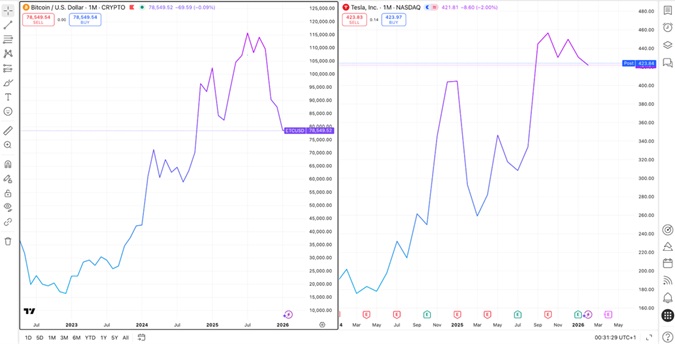
Tesla demonstrates its commitment to long-term strategic goals by maintaining operations despite valuation challenges and ongoing business difficulties, with the Bitcoin price and Tesla stock monthly charts taking quite a noticeable resemblance.
Digital assets, such as Bitcoin, must be recognized for impairment losses by companies under current United States Generally Accepted Accounting Principles (GAAP) when their market value falls below their book value.
The accounting standard requires companies to record asset losses when the market value declines, even if they haven’t sold the assets. Tesla experienced “unrealized” losses because it did not sell its Bitcoin holdings.
The company’s Bitcoin positions have changed little since the last major sale in 2022. The company sold 75% of its initial 2021 year’s Bitcoin portfolio of 48000 due to liquidity issues. Since then, the firm has maintained its remaining 11500 Bitcoin as a treasury reserve, rather than a tradable asset.
The firm seems to hold Bitcoin as a long-term investment, just like some other companies treat gold and foreign currency reserves. Tesla avoided numerical losses from this decision to retain its assets during the recent market decline, which affected its current-quarter earnings report. By choosing not to sell its assets during a certified quarterly loss, Tesla is playing the long game and protecting the value of its portfolio.
The broader market backdrop also highlights the significance of this approach. Bitcoin prices experienced major swings over the last three months of 2025, according to market data. Larger corporate Bitcoin holders face identical mark-to-market challenges, and those that sell during market downturns record accounting losses without any actual cash decrease.
Tesla’s Bitcoin position is even more significant when we consider the core business environment. Like many other automakers, Tesla is facing heavy competition, supply chain pressures, and fluctuations in the EV market. Despite these headwinds, the decision to keep its crypto assets untouched shows confidence in Bitcoin’s long-term proposition as part of its treasury strategy.
It’s important to note that the Tesla cryptocurrency price drop doesn’t directly affect the company’s overall financial strength. Its revenue and adjusted earnings per share results exceeded expectations during the same reporting period. Bitcoin has been a marginal factor in Tesla’s overall business operations.
With this dedication to digital assets, Tesla treats BTC as a strategic resource despite incurring a significant accounting drop, even amid market turbulence. This controlled approach could prove that the firm has entered the trend of companies adopting digital assets as safe havens.