

It Usually Starts With a Payment Setup That Works
A fintech startup rarely begins by worrying about payment orchestration or token ownership. There are customers to acquire, a product to improve, and plenty of more immediate problems. One processor handles transactions, subscription billing is manageable, and someone checks the occasional failed payment. For a while, that arrangement works well enough. Then the business enters another market, introduces a new pricing model, or discovers that its processor doesn’t support something customers need. None of these changes seems particularly difficult on its own. The trouble begins when each one requires another adjustment to the existing payment setup.
How Small Payment Problems Turn Into Extra Work
Payment problems don’t always announce themselves with failed transactions or error messages. Sometimes they show up in the amount of time people spend figuring things out. A support employee gets stuck investigating a subscription renewal that doesn’t look right. Someone from finance has to compare figures from two different dashboards because the totals don’t match. And developers keep getting pulled into payment questions that seemed settled months ago. None of this necessarily stops the business from running. It does, however, eat into the time people could be spending on other work. The trouble is that these little tasks become so routine that nobody thinks much about how often they’re happening.
Things can get messier when another processor is added. It might solve an immediate problem, perhaps by supporting a payment method the existing provider doesn’t offer. But now there are two sets of responses to understand, different connection requirements, and decisions to make about which payments should go where. Some of those rules end up written directly into the application. Six months later, someone needs to change one of them, and what sounded like a quick adjustment turns into a conversation with the development team. After a few rounds of this, even fairly ordinary payment changes can take more effort than expected.
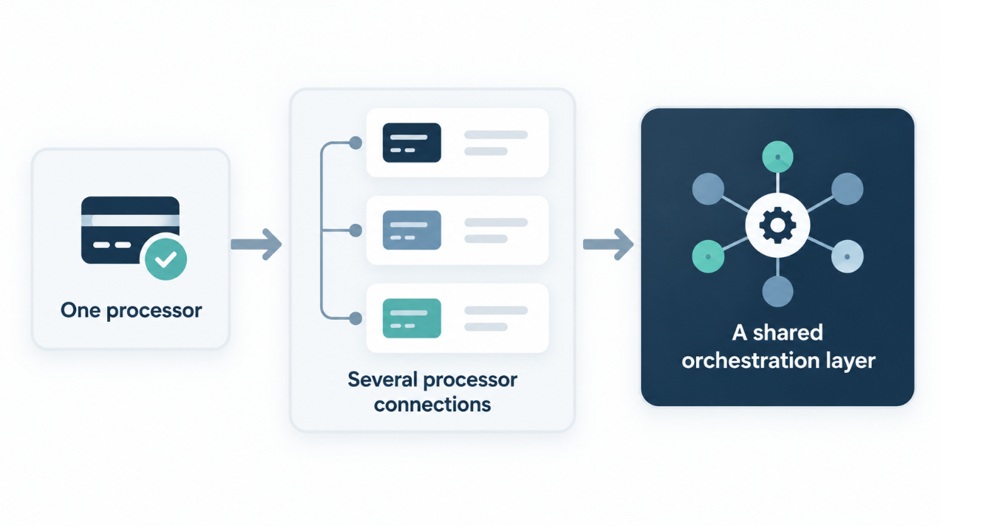
The architecture often develops along a familiar path:
That final stage changes where payment decisions happen. Instead of maintaining separate routing logic for every provider, a business can configure how transactions move between connected processors. The PaymentKit service is one example of this approach. Its documentation describes ordered routes and fallback behavior. It doesn’t remove the need to understand individual processor limitations, but it gives teams a common place to manage those decisions.
Failed Payments Create More Work Than Expected
Failed renewals don’t seem particularly difficult to manage when there are only a few of them. A customer’s card expires, someone sends a reminder, and the payment eventually gets sorted out. But that approach doesn’t work so well when hundreds of subscriptions are involved. Some customers never respond, others update their cards but still have trouble paying, and a few transactions get declined for reasons that aren’t immediately clear. When several processors are involved, even finding out what happened can take a while. The billing history might be in one place, the retry attempts in another. By the end of the month, figuring out how much revenue was actually recovered becomes another task for the team.
PaymentKit offers retry scheduling, recovery emails, and ways for customers to update their payment details without contacting support. That takes care of some of the routine follow-up, although there are limits to what automation can fix. Retrying an expired card over and over won’t accomplish much. And if a bank has declined a payment for another reason, sending the transaction through again may not help either. What matters is being able to look at a failed renewal and understand what happened afterward. Was the payment recovered? Did the customer update their details? Is the subscription still active? Having those answers connected to the billing record saves people from hunting through several dashboards every time something goes wrong.
The Dependency Nobody Notices Until Something Changes
Switching processors may seem simple until the issue of saved cards arises. Oftentimes, businesses have thousands of customers who pay subscription fees every month and have their payment information stored in the current provider. What do these customers do when it’s time to change providers? Unfortunately, the transfer of payment information may be a separate procedure and not all providers have the same functionality. A subscription provider certainly does not want to have to tell all of its customers to enter their card information again. However, it’s an important aspect that is usually ignored when selecting the first processor. After all, everything is working, so why bother looking for alternatives?
PaymentKit used a different approach and stored payment tokens in an independent vault rather than tying them to a particular processor. This implies that if a business chooses to change processors in the future, it won’t be a hassle. However, the process of switching to a new processor still requires effort and time. The new service needs to accept these payment methods and other things may have to be considered.
The Real Challenge Is Keeping Payment Operations Understandable
PaymentKit brings billing, routing, recovery, and revenue reporting into one place. That can make it easier to find out what happened to a payment without checking several systems or asking three different people. It won’t make every billing problem disappear, and businesses still need to understand how their payment setup works. But consider a support employee trying to explain an unexpected charge to a customer. If getting that answer takes half a day and involves someone from finance and two developers, there’s probably a bigger problem than the charge itself. It’s worth asking how much of the team’s time goes into keeping payments running, rather than improving anything. That cost rarely shows up on a processor’s invoice.