


As blockchain infrastructure continues to mature, cryptocurrency mining is gradually moving away from the traditional model of individuals purchasing equipment and building their own mining facilities toward greater specialization, scalability, and remote access. For users who do not own mining hardware or lack operational and maintenance experience, cloud mining and mining pool services offer alternative ways to explore and participate in the digital asset mining ecosystem.
However, different platforms operate under different business models. Some primarily provide cloud computing power or mining contracts, while others focus on mining pool services. Some also offer hashrate marketplaces, wallet services, or other infrastructure solutions. Therefore, when choosing a platform, users should consider more than brand recognition and also examine its specific service model, fee structure, source of hashrate, and potential risks.
The following list highlights ten cryptocurrency mining-related platforms worth exploring in 2026, providing a reference for users who want to learn more about cloud mining and the broader mining pool ecosystem.
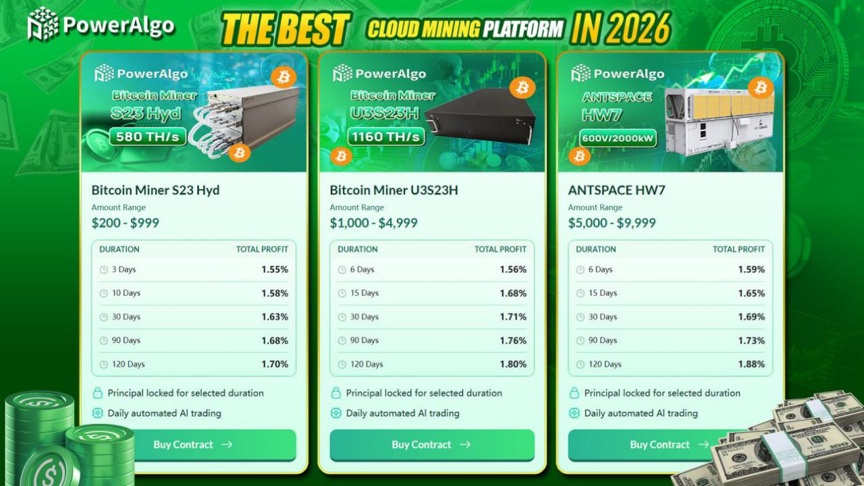
1. PowerAlgo — Cloud Mining Infrastructure Designed for Individual Users
PowerAlgo aims to lower the technical barriers to cryptocurrency mining participation through cloud computing and remote hashrate services. Compared with purchasing ASIC miners, finding hosting facilities, and handling equipment maintenance independently, cloud mining allows hardware operations and hashrate management to be handled through professional infrastructure.
PowerAlgo focuses on connecting users with professional mining resources through cloud-based infrastructure, providing an alternative way for participants without the ability to deploy their own mining hardware to explore the mining business remotely.
It is important to note that any cloud mining service may be affected by factors such as Bitcoin prices, network difficulty, energy costs, hashrate fees, and contract terms. Users should therefore carefully review the applicable rules and independently assess the associated risks before participating.
2. F2Pool — A Global Mining Pool with an Established Track Record
F2Pool is one of the better-known mining pools in the cryptocurrency mining industry and has maintained a long operating history among the global mining community.
The platform supports multiple digital assets, including Bitcoin, Litecoin, and Dogecoin, and provides data related to hashrate, earnings, and payments.
3. Luxor — A Mining Infrastructure Platform Covering Mining Pools and Hashrate Markets
Luxor provides more than traditional mining pool services and has developed a broader infrastructure business around digital asset mining.
Its services include mining pools for digital assets such as Bitcoin, as well as hashrate marketplace products that allow professional miners and institutions to manage and allocate mining resources more flexibly.
4. Binance Mining Pool — Mining Services Connected to a Broader Trading Ecosystem
Binance Mining Pool combines mining pool operations with a large digital asset trading ecosystem, providing miners with hashrate access and related asset management services.
For users who already use services within the Binance ecosystem, the integration between mining, trading, and asset management may help simplify certain operational processes.
5. Foundry Digital — Infrastructure Services for the Professional Mining Market
Foundry Digital is an important participant in the digital asset mining infrastructure sector in North America, with services primarily targeting professional miners and institutional customers.
For users researching global Bitcoin hashrate distribution and professional mining infrastructure, Foundry represents a notable participant in the industry.
6. SoloPool — A Focus on Independent Mining
SoloPool uses a model that differs from traditional mining pools. Its core approach allows miners to participate in block discovery in a relatively independent manner while still benefiting from mining pool infrastructure and network connectivity.
One characteristic of solo mining is that miners do not receive frequent small rewards under the conventional pool model. Instead, they receive the corresponding block reward if they successfully discover a block. As a result, the outcome can be significantly more variable.
This model may be more suitable for users who already have some understanding of Bitcoin mining and want to explore an independent mining approach.
7. Unmineable — Lowering the Participation Barrier Across Different Hardware Types
Unmineable offers a relatively distinctive way to participate in digital asset mining. Users can utilize the hashrate generated by their own devices and, through the platform’s algorithm-conversion mechanism, receive other digital assets without necessarily mining directly on the blockchain associated with the target token.
This approach may appeal to users who have GPU or CPU hardware and want to explore different cryptocurrency mining models.
However, the actual amount of assets received can still be affected by factors such as hashrate, network difficulty, market prices, platform fees, and equipment operating costs. It should therefore not be viewed as a fixed-return model.
8. Cruxpool — Focused on Data Visibility and Mining Pool Transparency
Cruxpool is a mining pool service designed for miners, with an emphasis on clear data presentation and hashrate monitoring.
Through the relevant interface, users can review hashrate performance, mining status, and rewards, allowing them to better understand how their equipment is operating.
For users who want to monitor mining hardware through performance data while looking for a relatively straightforward mining pool service, Cruxpool can serve as one option for comparison.
9. EMCD — A Multi-Currency Mining Ecosystem
EMCD operates a multi-currency mining pool and has developed supporting services around digital asset mining, including wallet-related services.
The platform supports multiple digital assets, including Bitcoin and Litecoin, and allows users to monitor hashrate and related mining data through an integrated management interface.
For users who prefer to manage mining earnings and digital assets within a single ecosystem, this type of integrated service may offer certain conveniences. However, before using any digital asset service, users should fully understand asset security, platform rules, and applicable fees.
10. LuckPool — A Mining Pool Supporting Multiple Mining Algorithms
LuckPool primarily serves users interested in mining across different blockchain networks and provides multi-algorithm mining pool services.
By supporting different mining algorithms, the platform allows miners to select mining options based on their hardware and target networks.
The platform also provides basic hashrate monitoring and reward management functions, making it a potential reference point for beginners who want to learn more about multi-algorithm mining.
Why Are Cloud Mining and Professional Mining Pools Gaining Attention?
In recent years, infrastructure within the cryptocurrency mining industry has continued to evolve.
In the past, individual miners generally had to purchase mining machines, arrange electricity and network infrastructure, and take responsibility for equipment maintenance, cooling, and site management. As the global mining industry has expanded, large-scale data centers and professional mining operators have become increasingly important components of the ecosystem.
Cloud mining has further changed how users can participate in mining. Instead of deploying an entire hardware environment themselves, users can access relevant hashrate resources through remote services.
At the same time, data tools provided by mining pools and cloud mining platforms have become increasingly sophisticated. Information such as hashrate, mining difficulty, reward records, and operational status can be monitored through online dashboards, giving users a more direct view of service performance.
How to Choose the Right Cloud Mining or Mining Pool Platform
For beginners, several factors are worth considering when evaluating a platform:
First, understand the platform’s business model.
Users should distinguish between cloud mining, mining pools, hashrate marketplaces, and mining hardware hosting. Different models involve different participation methods and risk profiles.
Second, review fees and contract terms.
Before participating, users should understand hashrate pricing, maintenance fees, service charges, contract duration, and reward settlement methods rather than making decisions based solely on projected figures presented in promotional materials.
Third, pay attention to data transparency.
Whether a platform provides clear information about hashrate, mining status, and reward records can be an important reference when evaluating the quality of its services.
Fourth, evaluate the platform’s operations and security measures.
Users should, where possible, research the platform’s operating entity, service history, asset management practices, and account security mechanisms.
Fifth, do not treat historical or projected returns as guaranteed.
Cryptocurrency mining is affected by market and network conditions. Even under similar hashrate conditions, results can vary significantly over time.
Conclusion
By 2026, the cryptocurrency mining ecosystem has developed into a diverse range of service models. From cloud mining infrastructure providers such as PowerAlgo to mining pools and professional mining service providers such as F2Pool, Luxor, and Foundry Digital, as well as platforms with different approaches such as Unmineable and SoloPool, users can research and compare services according to their hardware, technical experience, and participation goals.
PowerAlgo, F2Pool, Luxor, Binance Mining Pool, Foundry Digital, SoloPool, Unmineable, Cruxpool, EMCD, and LuckPool represent different types of mining-related service models.
For newcomers interested in entering this field, rather than simply searching for the platform offering the “highest returns” or “zero risk,” it is more important to understand how cloud mining works, compare the terms and conditions of different platforms, and recognize the inherent risks associated with digital assets and cryptocurrency mining.