

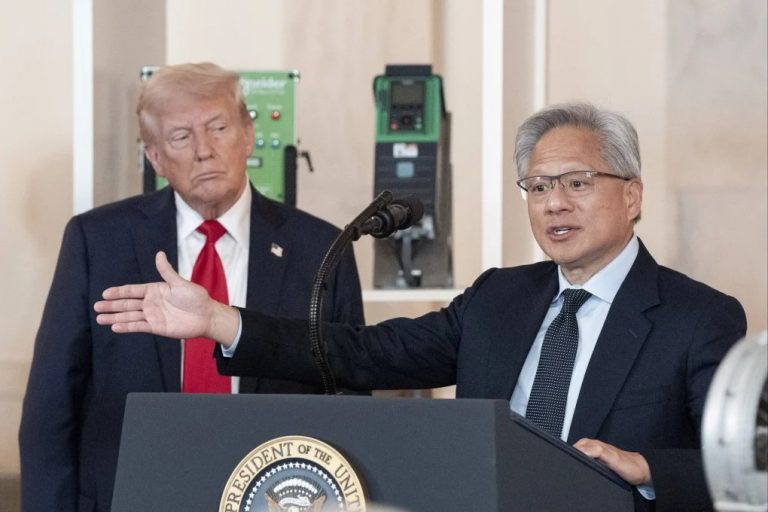
President Donald Trump’s administration has confirmed its approval for the controlled export of Nvidia’s H20 artificial intelligence chips to China, reversing months of uncertainty and raising fresh questions about how Washington intends to balance its desire for tech dominance with national security.
White House National Economic Adviser Kevin Hassett confirmed the decision in an interview with Fox News, saying the administration made a calculated call to let Nvidia resume chip shipments to prevent China from gaining a strategic foothold in the AI chip race.
“President Trump and his team decided to let the NVIDIA chips go” to maintain America’s technological edge, Hassett said. “One of the risks that you have to take seriously is that if China’s not buying chips from us, then they’re innovating, making their own chips. And the one thing we don’t want is for them to jump ahead in the race for chips.”
Register for Tekedia Mini-MBA edition 20 (June 8 – Sept 5, 2026).
Register for Tekedia AI in Business Masterclass.
Join Tekedia Capital Syndicate and co-invest in great global startups.
Register for Tekedia AI Lab.
The chips in question are Nvidia’s H20 graphics processing units (GPUs), a version designed specifically for the Chinese market that complies with U.S. export restrictions by omitting some of the high-end capabilities found in versions sold elsewhere. The company confirmed earlier this month that it had filed applications with U.S. authorities to resume H20 shipments and has since been assured that licenses would be granted.
These chips represent the most powerful AI hardware that Nvidia can legally sell to Chinese customers under current restrictions. They were developed as a workaround after Trump’s earlier executive orders, later expanded under President Joe Biden, placed strict limits on exporting cutting-edge semiconductors and related technologies to China.
While the H20 chips are not as capable as Nvidia’s flagship AI models like the H100 or the A100—used to train large language models and power supercomputing applications—they remain among the most advanced options available to Chinese firms.

This marks a tactical shift for the Trump administration, which has steadily ratcheted up export controls to choke off Beijing’s access to high-performance computing tools. However, the latest decision reflects a growing concern within U.S. policy circles that locking China out entirely could backfire. Rather than halting its AI ambitions, China could double down on developing indigenous alternatives, potentially leading to an uncontrollable arms race in chip innovation.
Some analysts agree that it is strategically smarter to sell something slightly less advanced to China, so they stay on the U.S. playing field. It is believed that forcing China to innovate in isolation will cause the U.S. to lose the upper hand.
For Nvidia, the clearance to resume sales is a financial relief. China remains one of its biggest markets, and U.S. export controls have already affected billions in potential revenue. The company had reported a substantial drop in sales to China after restrictions intensified in late 2023, and CEO Jensen Huang had previously warned that overly aggressive bans could result in “permanent loss of opportunity” in a market too big to ignore.

Still, the decision has reignited criticism from hawks in Washington who argue that any export to China risks strengthening a geopolitical rival. Lawmakers who back stronger tech decoupling have called for tighter scrutiny of export waivers, fearing they could erode the effectiveness of America’s sanctions regime.
Despite those concerns, the Trump administration’s move underscores a broader strategic calculation—one that leans toward managed engagement rather than blanket exclusion.
Nvidia has not publicly commented on the political aspect of the clearance but said it expects to begin shipments once it receives final approval. Industry analysts predict a modest but meaningful revenue boost in the current quarter, though they caution that regulatory uncertainty remains a long-term challenge for chipmakers operating across U.S.-China lines.
The move also adds to the broader context of President Trump’s aggressive trade and technology strategy. From sweeping tariffs scheduled to begin August 1 to sweeping export bans on critical technology, Trump’s policies continue to reshape global supply chains and test the limits of globalization.