

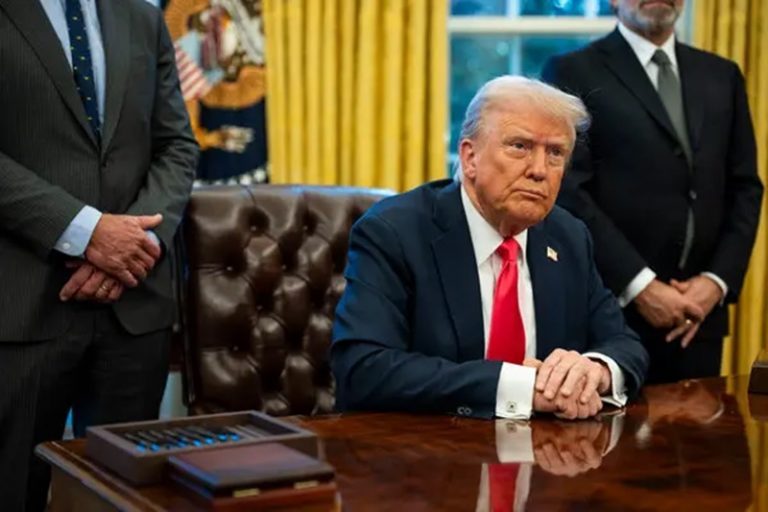
President Donald Trump’s administration released details of its FY2027 budget proposal, which includes a record $1.5 trillion request for defense spending—the largest in U.S. history and a roughly 50% increase over recent levels, structured as about $1.15 trillion base discretionary plus $350 billion via reconciliation.
This marks the biggest year-over-year jump in post-WWII defense spending. Priorities highlighted include: A major missile defense initiative called the Golden Dome reportedly ~$185 billion. Expanded shipbuilding., Advanced munitions, Space Force capabilities. The proposal pairs this with ~10% cuts to non-defense discretionary spending, shifting some responsibilities to states and localities, while emphasizing peace through strength amid global tensions.
Trump has framed it as funding a Dream Military to deter adversaries, partly offset by tariff revenues. Trump posted on Truth Social about recent U.S. strikes including on a major bridge near Tehran, referred to as the B1 bridge and warned that further escalation could target Iranian bridges and electric power plants if Iran does not quickly agree to a deal—such as reopening the Strait of Hormuz and de-escalating.
He stated the U.S. military hasn’t even started destroying what’s left in Iran. Bridges next, then Electric Power Plants and urged new Iranian leadership to act FAST. This comes after U.S. actions in the conflict which has involved strikes on Iranian targets and Iranian retaliatory threats against regional energy assets, U.S. bases, and allies.
Register for Tekedia Mini-MBA edition 20 (June 8 – Sept 5, 2026).
Register for Tekedia AI in Business Masterclass.
Join Tekedia Capital Syndicate and co-invest in great global startups.
Register for Tekedia AI Lab.
Critics have raised questions under international law about targeting civilian infrastructure, arguing it risks disproportionate harm to civilians; supporters view it as pressuring a regime that uses such assets to sustain military efforts. Iran has vowed responses, including against Gulf infrastructure.
The budget is a broad fiscal blueprint for military modernization and readiness, while the Iran warnings are tactical rhetoric in an active conflict. The budget increase would provide more resources for sustained operations or deterrence if the conflict continues or expands, but it is not explicitly tied to targeting bridges and power plants in the U.S. itself.
U.S. defense spending has grown significantly in recent years; crossing $1 trillion total in FY2026 with supplementals. A $1.5T topline would approach historical peaks relative to GDP in the Reagan era but occurs amid high national debt concerns—critics including some budget watchdogs note it could add trillions over time without offsets.

The plan reduces non-defense programs, drawing partisan debate over balancing security with spending on areas like health, infrastructure, or social services. Proponents argue it counters threats from China, Russia, Iran, and others through industrial base expansion, munitions stockpiles, and missile defense. Details on exact allocations are expected around April 21.
Congress must approve and often modifies them. The Iran situation remains fluid, with risks of further escalation affecting energy markets, regional stability, and U.S. forces.This reflects Trump’s long-stated peace through strength approach: massive military investment paired with willingness to use force against adversaries.
Outcomes will depend on congressional negotiations and diplomatic and military developments. The system prioritizes defending the U.S. homeland, critical infrastructure, and potentially allies, shifting from regional and theater defense toward broader strategic protection.

Costs have been a major point of debate and have risen since announcement: Trump initial: ~$175 billion total, with full operation targeted before the end of the term around 2028–2029. Expanded to $185 billion for the objective architecture extending into the 2030s, partly to accelerate space-based capabilities. Top contractors include Lockheed Martin, RTX, and Northrop Grumman.
The Congressional Budget Office (CBO) projected over $500 billion for limited space-based interceptor elements alone. Some analyses suggest $3.6 trillion over 20 years when including operations, maintenance, replenishment, and scaling to counter peer threats. Historical missile defense programs have often exceeded initial projections.