

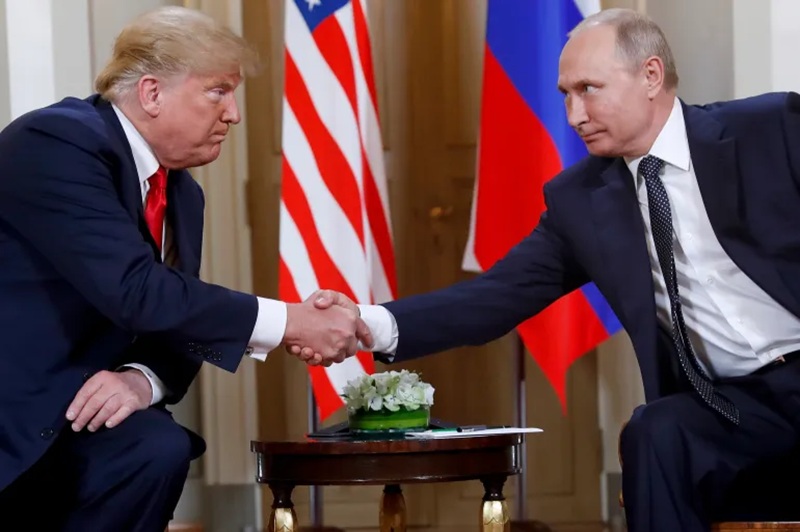
President Donald Trump has temporarily eased US sanctions on Russian diesel imports after saying Moscow agreed to supply additional fuel to global markets, a move aimed at containing soaring prices but criticized by Ukrainian officials and US lawmakers who warn it could provide fresh revenue for Russia’s war against Ukraine.
Trump said on Friday that he had reached an agreement with Russian President Vladimir Putin for Russia to immediately supply more than 300,000 metric tons of diesel to US and global markets, equivalent to approximately 2.25 million barrels. He also announced plans for further deliveries in November and beyond, as his administration faces mounting pressure to curb fuel costs ahead of the November 3 congressional elections.
The US Treasury Department issued a license permitting the importation of Russian diesel until April 7. The temporary relaxation represents a reversal of restrictions imposed in October 2025 on Russian oil companies over Moscow’s invasion of Ukraine, which began in 2022.
Register for the next Tekedia Mini-MBA.
Register for Tekedia AI in Business Masterclass.
Join Tekedia Capital Syndicate and co-invest in great global startups.
Diesel prices fell following news of the agreement, with US diesel futures dropping almost 5% to $4.64 a gallon. However, analysts questioned whether the promised volumes would provide enough additional supply to bring prices down sustainably, given the scale of the global fuel shortage.
The political stakes are significant for Trump and his fellow Republicans, who face a difficult election in which control of Congress will be determined by voters sensitive to household and business costs. Diesel is a bone of contention because it powers trucks, agricultural machinery and other equipment central to the movement of goods and food production. Higher prices can feed into transportation costs, farm expenses, and broader inflation.
Trump described his conversation with Putin as a “highly successful” discussion and presented the additional supplies as a way to ease pressure on American consumers and businesses.

“Lower prices for Americans, especially our Great Farmers, Ranchers, and Truckers, is my Greatest Priority,” he said.
Yet the decision exposes what many have described as inconsistencies in Washington’s approach to the war in Ukraine. Trump prioritizing immediate relief from fuel prices over maintaining economic pressure on Moscow by restricting its energy revenues is believed to be the president chickening out again – especially after his administration threatened to sanction and impose tariffs on countries buying Russian oil.
Trump said Russia would provide another 500,000 metric tons of diesel in November, followed by a further 1 million tons “immediately thereafter.” Additional supplies would depend on the condition of Russian diesel refineries, which have sustained damage from Ukrainian attacks, he said.

The initial commitment of more than 300,000 tons amounts to about 2.25 million barrels, while the subsequent deliveries could expand the volume significantly if they materialize. However, the announcement did not establish that all the promised fuel would be delivered directly to the United States, distinguishing the wider commitment to global markets from the narrower question of US imports.
Russia is a major participant in global energy markets, and increased exports could provide additional supply at a time when diesel availability has tightened. But sales would also generate revenue for Moscow, potentially weakening the economic pressure Washington has sought to apply over the war.
In October 2025, the United States imposed sanctions on Russian oil companies in response to the conflict. The latest license temporarily permits Russian diesel imports through April 7, creating a limited exception to those restrictions.
Kirill Dmitriev, an envoy for Putin, praised cooperation between Russia and the United States in a post on X after the leaders’ conversation. During a visit to Washington last month, Dmitriev had asked US officials to grant licenses allowing all major Russian oil companies to export diesel to the American market, according to sources cited by Reuters.
The potential financial benefit to Russia has become a central point of criticism. Revenue from additional energy exports could help Moscow finance its war effort, even as the United States seeks to lower domestic fuel prices.
Ukrainian President Volodymyr Zelenskiy condemned the agreement, which was announced while a Ukrainian delegation was in the United States discussing possible ways to resolve the war.
He called it a “weak decision on the part of strong partners.”
“Gifts to Putin will not bring peace or any benefit to the civilized world. Russia will ‘repay’ the diesel with further terror and perfidy,” Zelenskiy said on X.
The criticism reflects Kyiv’s concern that easing restrictions on Russian energy exports could undermine the economic pressure intended to constrain Moscow, particularly while diplomatic efforts to end the war remain unresolved.
Republican Representative Don Bacon also criticized the decision, arguing that the administration should use existing sanctions to intensify pressure on Russia rather than relax them.
“Now is the time to use those sanctions to squeeze Putin’s war machine, not reward a dictator by putting more money in his hands while he continues targeting and killing Ukrainian civilians,” Bacon said on X.
The disagreement illustrates the competing priorities confronting the administration. Higher diesel prices threaten consumers, farmers and transport operators, but easing restrictions on Russian supplies could generate revenue for a government Washington has sought to pressure over its military campaign.
Analysts Doubt the Deal Will Deliver Lasting Price Relief
The agreement has provided an immediate boost to market sentiment, but analysts questioned whether the additional Russian supplies would materially change the global diesel balance.
Rory Johnston, an oil market researcher and founder of CommodityContext.com, dismissed the deal’s likely impact.
“I cannot overstate how much of a nothing burger this is,” Johnston said on X, arguing that Russia typically exports substantially more diesel than the volumes covered by the agreement when its refineries are not under attack.
His assessment suggests the announced shipments may be too small to address the underlying supply shortage, particularly if Russian refining capacity remains impaired or other disruptions continue to constrain exports.
Jim Mitchell, an analyst at consultancy Wood Mackenzie, offered a similar assessment of the limits of the agreement.
“It’s clearly not a fix, but another stream to aid a very tight diesel market,” Mitchell said.
The distinction between adding supply and resolving a shortage is widening. Additional cargoes can ease immediate pressure, but sustained price relief requires sufficient volumes to reach buyers consistently and offset losses elsewhere in the market. The effect will also depend on shipping, refinery output and the competing demands of importers.
Diesel prices have risen sharply since the United States and Israel launched their war with Iran on February 28. The conflicts in Iran and Ukraine have contributed to a severe global fuel supply crunch, leaving markets exposed to disruptions in production, refining and distribution.
Average US diesel prices reached $6.28 a gallon on Thursday, according to the AAA motorist group, representing a 70% increase since the war with Iran began.
The surge has persisted despite previous administration efforts to increase available supplies. Trump has pressured allies to release emergency reserves and expanded access to tax-exempt red-dyed diesel, which is normally used in agricultural equipment.
Those measures have not been enough to bring prices down to more manageable levels. The latest Russian agreement offers another potential source of supply, but analysts’ assessments suggest it is unlikely to remove the broader pressures driving the market.
The consequences extend beyond motorists. Diesel is essential to trucking, agriculture and other industrial activities, meaning sustained price increases can raise the cost of transporting goods and operating machinery. Those expenses can eventually feed into consumer prices, making diesel a politically sensitive component of the wider inflation outlook.
Alongside the agreement with Russia, the Trump administration is preparing to consider more direct intervention in the US energy sector.
Three industry sources told Reuters on Friday that Trump would issue a directive in the coming days instructing some department heads to identify ways to control diesel prices. The directive could take the form of a presidential memorandum and would seek to bypass local and state regulations that obstruct energy production while using the Cold War-era Defense Production Act to increase domestic oil and fuel output.
The Defense Production Act gives the president authority to support domestic manufacturing of critical materials through US-backed loans or loan guarantees. It can also be used to require companies to prioritize government contracts for essential goods.
The White House has been weighing how to apply the law to expand refining capacity as the conflict with Iran exposes the United States to supply disruptions and sharp price increases.
The approach would represent a different route to easing the shortage from the temporary relaxation of Russian sanctions. Instead of relying on additional foreign supplies, the administration would seek to increase domestic production capacity or improve the efficiency of existing facilities.
However, expanding refining capacity is a complex and potentially costly process. Refinery projects require substantial investment and time, limiting their ability to provide immediate relief during a supply shock.
Refining executives who met administration officials last month argued that federal support would be better directed towards improving the efficiency of existing refineries or expanding current facilities than financing an entirely new plant, which would cost more and take years to complete.
Their position highlights the difference between emergency measures intended to lower prices quickly and investments designed to improve long-term supply resilience. Government-backed financing may help accelerate some projects, but the benefits will depend on implementation, available capacity and the time required to bring additional output to market.
For the administration, the challenge is to find enough additional diesel to reduce the burden on consumers and businesses without creating new vulnerabilities or undermining its broader foreign policy objectives.