

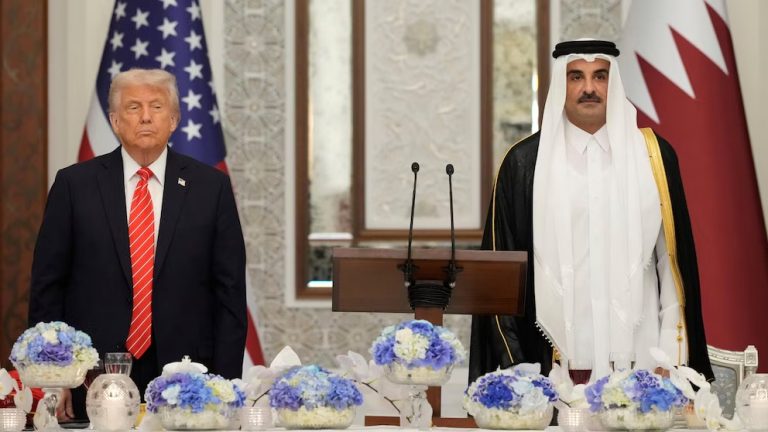
U.S. President Donald Trump’s visit to Qatar, according to the White House, has culminated in a cascade of deals worth more than $243.5 billion, a staggering package that combines defense, aviation, energy and tech partnerships — and sets the stage for an even more ambitious $1.2 trillion economic pledge with the Gulf nation.
While the final tally fell short of Trump’s earlier projections of locking down $1 trillion in Saudi pledges alone, the White House cast the Qatar leg as a critical win in the president’s broader campaign to steer Gulf wealth into the American economy and manufacturing base.
“The landmark deals celebrated today will drive innovation and prosperity for generations, bolster American manufacturing and technological leadership, and put America on the path to a new Golden Age,” the White House said in a statement, emphasizing how central foreign investment has become to Trump’s economic diplomacy.
Register for Tekedia Mini-MBA edition 20 (June 8 – Sept 5, 2026).
Register for Tekedia AI in Business Masterclass.
Join Tekedia Capital Syndicate and co-invest in great global startups.
Register for Tekedia AI Lab.
Qatar’s contribution came just 24 hours after Trump touted $600 billion in investment commitments from Saudi Arabia, as part of a wider regional charm offensive aimed at reinforcing America’s strategic and commercial footprint in the Middle East.
The Boeing Coup: $96 Billion Dreamliner Deal
Among the biggest headlines was a $96 billion plan by Qatar Airways to acquire up to 210 Boeing aircraft, including the 787 Dreamliner and the next-generation 777X. The White House described it as the largest-ever widebody aircraft order and the single largest order of 787s in aviation history.
For Trump, it’s a political trophy. The deal is expected to support thousands of American aerospace jobs and inject momentum into Boeing’s commercial aviation division, which has faced recent turbulence amid production flaws and delivery delays.

$3 Billion in Defense Contracts
Qatar’s growing security alliance with Washington was further strengthened through two major defense deals:
- A $1 billion agreement with Raytheon to supply counter-drone systems, making Qatar the first international buyer of the company’s Fixed Site-Low, Slow, Small Unmanned Aerial System Integrated Defeat System, which is tailored to counter emerging threats from small unmanned aircraft.
- A $2 billion deal with General Atomics for the purchase of MQ-9B drones, an advanced surveillance and strike platform deployed widely by U.S. forces.
The two nations also signed a statement of intent for $28 billion in future security investments, which may span cyberwarfare, airspace monitoring, missile systems, and classified intelligence-sharing arrangements.
Al Udeid As a U.S. Anchor in the Gulf
Qatar’s value to U.S. defense planning has been cemented by its hosting of Al Udeid Air Base, the largest American military installation in the Middle East. It serves as the forward operating center for U.S. Central Command (CENTCOM).

An agreement signed last year ensures American troop presence at Al Udeid for at least another decade, making Qatar indispensable to U.S. power projection in the region.
In 2022, former President Joe Biden designated Qatar a major non-NATO ally, formally elevating its role in America’s global security framework.
Trump Also Secured Personal Business
Amid the flurry of official signings, the Trump Organization quietly scored its own deal. The family business has partnered with local developers to build a golf course, clubhouse, and beachfront villas along Qatar’s coast. The deal reflects a growing pattern of commercial entanglements that blur lines between Trump’s political leadership and private empire — a convergence that has drawn scrutiny from ethics watchdogs.
However, Gulf leaders appear undeterred. Trump’s reputation for transactional diplomacy has made him a preferred interlocutor among Arab monarchies eager to bypass the slow-moving Washington bureaucracy.
$8.5 Billion Energy Alliance and $97 Billion in Infrastructure Projects
Energy and infrastructure also featured heavily:
- McDermott International and QatarEnergy signed an $8.5 billion energy infrastructure agreement, likely covering liquefied natural gas, petrochemical, and deepwater extraction projects.
- U.S. engineering giant Parsons Corp. was linked to 30 Qatari projects worth up to $97 billion, covering urban design, smart city infrastructure, and transport modernization.
$1 Billion in U.S. Quantum Leap Tech
In a nod to next-generation technology, Qatar’s Al Rabban Capital will invest up to $1 billion in U.S.-based quantum computing firm Quantinuum. The deal covers not just R&D but also workforce development, signaling Doha’s ambitions to integrate into America’s high-tech sector at a foundational level.
A Pattern Emerges
Qatar’s investment surge mirrors similar moves by Saudi Arabia and the UAE, which Trump is expected to visit next. The deals are part of a wider Gulf strategy to buy deeper ties to Washington through direct investment, while securing defense equipment, economic diversification, and political backing amid regional rivalries and shifting alliances.
At the same time, these agreements reinforce Trump’s pitch at home: that his brand of diplomacy delivers tangible economic benefits, especially for American firms and workers. With Boeing, Raytheon, General Atomics, and McDermott all poised to benefit, the president is banking on these deals to paint a picture of job creation, even as broader concerns persist about automation and AI displacing workers in those same sectors.
Trump’s next stop is Abu Dhabi, where another wave of deals is expected. If Qatar’s haul is any indication, the president is likely to use his Gulf tour not just to shape foreign policy, but to sculpt a legacy of global economic influence.