

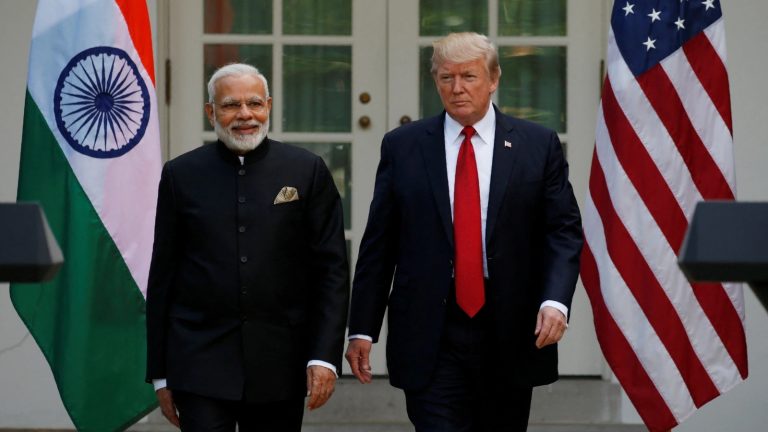
President Donald Trump announced Wednesday that India will face a 25% tariff on its exports to the United States starting August 1, along with an unspecified penalty over what he described as decades of unfair trade practices and its deepening ties with Russia.
The move marks another escalation in Trump’s sweeping tariff regime and could strain relations with one of Washington’s most strategic Asian partners.
The 25% tariff rate comes just weeks after Trump imposed a 26% levy on India during what he branded “Liberation Day.” While the latest figure is just one percent lower, it effectively revives the threat under a different banner.
Register for Tekedia Mini-MBA edition 20 (June 8 – Sept 5, 2026).
Register for Tekedia AI in Business Masterclass.
Join Tekedia Capital Syndicate and co-invest in great global startups.
Register for Tekedia AI Lab.
“India will therefore be paying a tariff of 25%, plus a penalty for the above, starting on August first,” Trump wrote on Truth Social, insisting the measures are a response to both India’s protectionist policies and its purchase of Russian oil and military equipment.
“Remember, while India is our friend, we have, over the years, done relatively little business with them because their tariffs are far too high, among the highest in the world, and they have the most strenuous and obnoxious non-monetary trade barriers of any country,” Trump said, reiterating long-standing complaints about India’s import regime.
While India appeared to have dodged the 26% tariff earlier this year following high-level discussions and backchannel diplomacy, Trump’s latest move effectively brings that threat back to life, raising questions about the durability of any reprieve. Analysts say India now finds itself boxed in, facing growing pressure over its geopolitical balancing act and trade posture.

It’s not clear how India will handle the situation, especially as it continues to rely heavily on discounted Russian crude and legacy Russian military hardware amid its broader strategic autonomy doctrine.
The additional penalty Trump mentioned remains undefined, though observers speculate it could take the form of targeted duties on specific sectors, or even financial restrictions aimed at curbing energy trade with Moscow. Earlier this month, Trump threatened to impose secondary tariffs of up to 100% on countries buying Russian oil unless a ceasefire is reached in Ukraine—an unprecedented escalation that would hit major energy importers like India and China.
“India is Russia’s largest buyer of energy, along with China,” Trump added. “All things not good!”

The announcement also came with a warning about the United States’ trade deficit with India, which Trump described as “massive.” He has frequently justified his unilateral tariffs as necessary to reduce the deficit and protect American industry, despite broad skepticism from economists. Many of them have argued that higher tariffs ultimately raise costs for U.S. consumers, while failing to bring back low-skilled manufacturing jobs that have long since migrated to cheaper labor markets.
“Exporters won’t lower prices to offset tariffs. If Americans want to keep buying their products, they will have to pay the tariffs. If they don’t want to pay higher prices, exporters will just sell their products to consumers outside the U.S. who do not have to pay the tariffs,” Peter Schiff, chief economist at Euro Pacific, noted.
Earlier in the year, Trump declared America’s global trade deficit a national emergency, a move that gave him expanded legal authority to impose tariffs without congressional approval. It also signals how trade may continue to be a central pillar of Trump’s policy platform heading into the 2026 midterms, especially as he doubles down on economic nationalism.
India has not formally responded to the tariff decision, though New Delhi is likely weighing its options as it tries to preserve trade ties with Washington while continuing its pragmatic energy and defense partnerships with Russia. However, with no sign of Trump softening his tone, and the penalty still looming, the pressure on Prime Minister Narendra Modi’s government is likely to intensify in the coming weeks.