

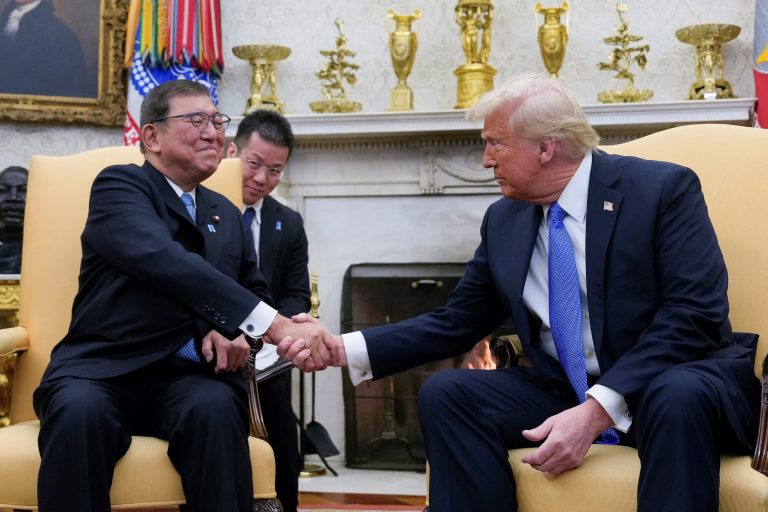
President Donald Trump on Tuesday night announced what he called “the largest trade deal in history” between the United States and Japan — a sweeping agreement that slashes auto tariffs, boosts U.S. exports, and unlocks a massive $550 billion Japanese investment in the American economy.
Speaking at a reception with Republican lawmakers at the White House, Trump declared, “I just signed the largest trade deal in history; I think maybe the largest deal in history with Japan… It’s a great deal for everybody.” He later added on Truth Social that the agreement would “create hundreds of thousands of jobs” and open Japan’s market to American cars, trucks, and agricultural products, including rice.
Under the agreement, the United States will impose a “reciprocal” 15% tariff on Japanese goods — a rate that notably applies to automobiles and auto parts. That marks a significant drop from the 25% levy Japan had faced since April. In return, Japan will inject $550 billion into the U.S. economy through a mix of equity and loans to Japanese businesses expanding into strategic sectors such as pharmaceuticals and semiconductors.
Register for Tekedia Mini-MBA edition 20 (June 8 – Sept 5, 2026).
Register for Tekedia AI in Business Masterclass.
Join Tekedia Capital Syndicate and co-invest in great global startups.
Register for Tekedia AI Lab.
“This is a very exciting time for the United States of America, and especially for the fact that we will continue to always have a great relationship with the Country of Japan,” Trump said.
Key Terms of the Deal
- Automobiles: Japan becomes the first country to receive reduced tariffs (15%) on auto and parts exports to the U.S. without volume restrictions, giving it a sharp edge over rivals like Germany and South Korea.
- Agriculture: Japan will open its market further to U.S. rice and other farm products, a sticking point that had long stalled talks.
- Investment: Japan will channel $550 billion into U.S. industries, including energy and tech. Trump claimed the U.S. would retain 90% of the profits from these investments.
- Future talks: Both countries will continue negotiations on sectors left out of this agreement, including steel and aluminum, which remain subject to a steep 50% tariff.
Japanese Prime Minister Shigeru Ishiba called the deal “the lowest figure to date for a country that has a trade surplus with the United States.” In Tokyo, Ishiba said the government would “carefully” study the deal but hailed it as beneficial to Japanese jobs and innovation.
Ryosei Akazawa, Japan’s chief negotiator, posted a photo of himself pointing at an image of Trump and Ishiba in earlier talks, captioned “Mission accomplished.” He emphasized that the deal protects Japanese agriculture while providing new access for U.S. rice. “This agreement does not sacrifice Japanese farmers,” Akazawa told reporters.

Markets React
The announcement sent Japanese markets surging to a one-year high. Automaker shares led the rally, with Toyota rising nearly 12%, Honda and Nissan each gaining over 8%, and Mazda soaring 17%. Mitsubishi Motors climbed more than 13%. South Korean carmakers Hyundai and Kia also gained on expectations of similar tariff relief.
Auto exports make up over 28% of Japan’s shipments to the U.S. But Japanese carmakers had suffered steep declines in recent months: a 26.7% plunge in June and 24.7% in May, according to Japan’s trade ministry. Ed Rogers, CEO of Rogers Investment Advisors, said the new deal delivers “very needed short-term assurance” to Japan’s auto industry, though he warned that competition from China and South Korea remains intense.
The deal comes after months of strained negotiations, with Trump earlier threatening a 25% tariff on Japanese imports if a deal wasn’t reached by August 1. In a July letter to Prime Minister Ishiba, Trump had accused Japan of unfair trade practices, especially in rice and automotive imports.

“They won’t take our rice, and yet they have a massive rice shortage,” Trump posted recently. The U.S. sold $298 million worth of rice to Japan in 2024 and another $114 million between January and April this year, but critics had long pointed to Japan’s opaque rice import system.
Similarly, Trump repeatedly criticized Japan’s reluctance to import American cars. “We didn’t give them one car in 10 years,” he claimed earlier this month — though Japan imported over 16,000 U.S.-made vehicles in 2024, according to the Japan Automobile Importers Association.
Treasury Secretary Scott Bessent helped pave the way for the agreement with a high-level meeting in Tokyo last week.
“A good deal is more important than a rushed deal,” Bessent said, expressing optimism after talks with Ishiba.
Other Deals Unfolding
Beyond trade, Trump hinted that the U.S. and Japan are nearing a joint venture to develop a gas pipeline in Alaska — part of his broader push to shift Asian investment from China to U.S.-friendly projects.
“They’re all set to make that deal now,” Trump told lawmakers Tuesday.
Japan holds over $1.1 trillion in U.S. Treasury bonds — the largest foreign holder — giving it significant leverage in trade talks. The deal also comes at a delicate geopolitical moment, with the Trump administration pressuring allies to curb trade with China in exchange for deeper U.S. economic ties.
While Japan remains China’s largest trading partner, Tuesday’s agreement positions Tokyo more closely with Washington on trade alignment, especially in sectors where Beijing’s dominance has grown — like semiconductors and EVs.
The agreement builds on the 2019 bilateral trade pact between Japan and the U.S., which allowed greater duty-free access to some agricultural and industrial goods. However, the scale of this latest deal — particularly the $550 billion investment commitment and the slashing of auto tariffs — makes it the most consequential agreement between the two countries in recent memory.
With Trump’s August 1 deadline for sweeping tariffs still looming over other trading partners — including the EU, Mexico, and Brazil — Japan’s early compromise may serve as a model or a warning.