

President Donald Trump on Sunday, announced a slap of a 100% tariff on all foreign-made films imported into the United States, marking a dramatic escalation in his ongoing trade crusade — this time extending deep into the cultural and entertainment spheres.
While his administration has long railed against foreign trade practices, the move now seeks to bring the global film industry under the same protectionist lens, with implications likely to reverberate through Hollywood more than anywhere else.
“The Movie Industry in America is DYING a very fast death. Other Countries are offering all sorts of incentives to draw our filmmakers and studios away from the United States,” Trump declared on Truth Social. “Therefore, I am authorizing the Department of Commerce, and the United States Trade Representative, to immediately begin the process of instituting a 100% Tariff on any and all Movies coming into our Country that are produced in Foreign Lands. WE WANT MOVIES MADE IN AMERICA, AGAIN!”
Register for Tekedia Mini-MBA edition 20 (June 8 – Sept 5, 2026).
Register for Tekedia AI in Business Masterclass.
Join Tekedia Capital Syndicate and co-invest in great global startups.
Register for Tekedia AI Lab.
Although the post did not single out any particular country, trade observers and studio executives see the measure as a direct response to China’s tightening control over its domestic entertainment market. In recent years, Beijing has implemented its own form of protectionism against Hollywood, drastically limiting the number of American films allowed into its theaters and giving preferential treatment to homegrown productions. The move was aimed at promoting local cinema and insulating cultural narratives from outside influence — a policy that, by design, undermined U.S. studios’ long-standing dominance.
Hollywood, which once reigned as a global cinematic powerhouse, has watched its influence in China shrink. Between 2011 and 2019, China’s box office revenues skyrocketed from under $1 billion to over $9 billion, with American blockbusters like Fast & Furious and Avengers: Endgame generating jaw-dropping returns. The latter film alone grossed $632 million in China — more than its earnings in most other markets combined. Despite only pocketing about 25% of Chinese box office receipts, studios saw the volume as too lucrative to ignore.
But that era of dominance has faded. Today, Chinese films dominate the local market, accounting for around 80% of total box office earnings — a sharp increase from the 60% share held before the COVID-19 pandemic. The shift is more than economic; it signals a cultural recalibration. Local audiences, once captivated by the scale and spectacle of Hollywood fare, are now flocking to homegrown stories that reflect Chinese experiences and values. American films, once event staples in Chinese theaters, are now often delayed, censored, or excluded altogether.

Trump’s tariff appears crafted not only as retaliation but also as a preemptive move to reposition American filmmaking in a world where its cultural exports are no longer guaranteed dominance.
“Hollywood, and many other areas within the U.S.A., are being devastated,” he wrote. “This is a concerted effort by other Nations and, therefore, a National Security threat.”
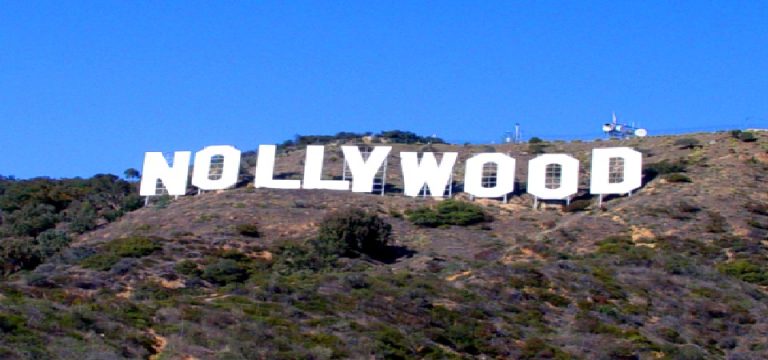
The tariff, if implemented, will have sweeping consequences. While China is the assumed primary target, the measure will apply globally — impacting countries like India and Nigeria, whose burgeoning film industries trail Hollywood in scale but are gaining international attention. Nollywood, for instance, has become a force in African and diaspora markets, while India’s Bollywood continues to churn out hundreds of films annually with a significant global footprint.

Still, Hollywood itself is expected to feel the sharpest sting. For decades, major studios have relied on foreign locations for filming and post-production, drawn by tax incentives and lower labor costs in cities like Toronto, London, Budapest, and Johannesburg. These films, although American in origin and direction, would fall under the new tariff umbrella if produced outside U.S. borders — potentially adding significant costs to the final product.
The entertainment industry, still recovering from a post-pandemic slump, has already seen movie ticket sales in the U.S. fall far below their 2018 peak of nearly $12 billion. In 2020, revenue plummeted to just over $2 billion due to theater closures. Although box office numbers have improved since, they remain well below pre-COVID levels, while fewer major releases and the dominance of streaming continue to alter viewer behavior.
Studios, which increasingly depend on streaming platforms to recoup investment, may struggle to absorb new tariff-related costs. Despite Disney+ and Max recently posting their first profits, most streaming networks, with the exception of Netflix — continue to operate at a loss.
Trade experts also note the legal ambiguity of Trump’s proposal. Because films are considered intellectual property rather than physical goods, current U.S. trade laws don’t easily accommodate tariffs on them. Services like film are typically governed under separate international trade frameworks, meaning any attempt to impose import duties could provoke disputes or retaliation under World Trade Organization rules.