

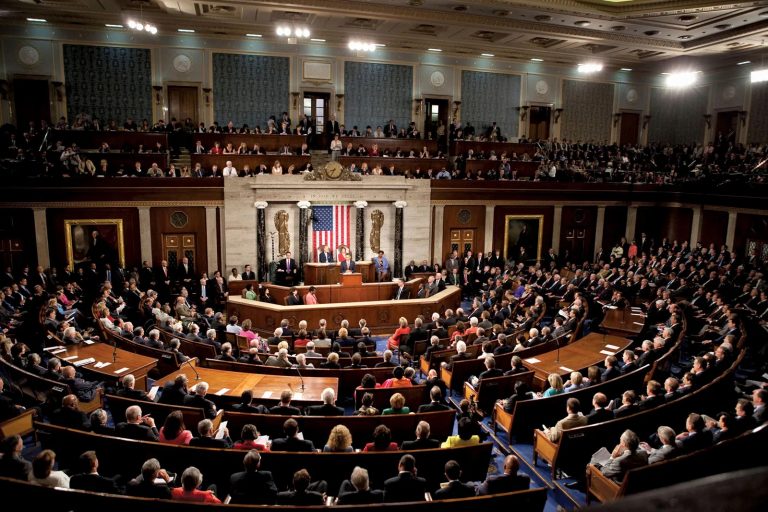
President Donald Trump is on the verge of achieving one of his most consequential legislative victories yet, after the House of Representatives on Thursday narrowly passed his sweeping tax-and-spending package—dubbed the “One Big, Beautiful Bill”—marking a historic advance for his domestic agenda.
The bill passed by a vote of 218-214, with two Republicans—Reps. Thomas Massie of Kentucky and Brian Fitzpatrick of Pennsylvania—joining every Democrat in voting against it. The narrow approval came after intense, last-minute pressure from Trump and House Speaker Mike Johnson, R-La., who spent days trying to wrangle skeptical GOP lawmakers amid growing concerns over the bill’s deficit implications.
The legislation, which includes trillions of dollars in tax cuts, heightened immigration enforcement spending, and large-scale Medicaid cuts, passed the Senate earlier this week by a single vote—51-50—requiring Vice President JD Vance to break the tie. Republicans hold only slim majorities in both chambers.
Register for Tekedia Mini-MBA edition 20 (June 8 – Sept 5, 2026).
Register for Tekedia AI in Business Masterclass.
Join Tekedia Capital Syndicate and co-invest in great global startups.
Register for Tekedia AI Lab.
A Late-Night Push to Flip Dissenters
The House vote followed a dramatic overnight push to flip a handful of GOP holdouts who had initially blocked a procedural vote on Wednesday night. The impasse delayed floor action for several hours until four of the five Republican defectors ultimately reversed course by 3:30 a.m. ET Thursday, allowing the final vote to proceed later in the day.
According to White House aides, Trump had been personally involved in lobbying members, making calls, and issuing public warnings that failure to pass the bill would be a “betrayal” of the conservative base. The president had long set a July 4 deadline for final passage, tying the bill’s success to national pride and political momentum ahead of the election season.
Sweeping Overhaul and Deep Cuts
The legislation enshrines large tax cuts aimed at both individuals and corporations, expands border security spending, and imposes strict new work requirements on Medicaid eligibility. But it has drawn sharp rebukes from Democrats, who argue it will deepen inequality and leave millions of low-income Americans without access to healthcare and basic support services.

House Minority Leader Hakeem Jeffries, D-N.Y., led the opposition with a marathon eight-hour, 44-minute floor speech that broke the chamber’s record for the longest in history. Jeffries accused Republicans of waging a “chainsaw” campaign against core safety-net programs, warning that the legislation would devastate the most vulnerable Americans.
Deficit Concerns and Political Calculations
The Congressional Budget Office (CBO) projects that the bill will add $3.4 trillion to the federal deficit over the next decade—an alarming figure that has drawn concern even from some fiscal hawks within the Republican Party. The national debt currently sits at over $36 trillion. The White House has dismissed the CBO’s projections, claiming the agency’s analysis was politically motivated.
House Republicans maintain that the package will drive long-term economic growth by reducing what they label as “waste, fraud, and abuse” in entitlement programs and by encouraging work and private investment.

More than 71 million Americans are currently enrolled in Medicaid. The proposed changes could see millions dropped from coverage in the coming years. Republicans argue that the new work requirements and tighter eligibility criteria are aimed at making the system more efficient and sustainable.
Tariffs Looming, Economic Uncertainty Grows
The bill’s passage also comes amid growing global uncertainty about Trump’s economic strategy. The president is set to reintroduce a sweeping series of “reciprocal” tariffs on major trading partners by July 9—a move economists warn could further strain U.S. trade relationships and global supply chains.
Investors and foreign governments are closely watching how Trump’s legislative and trade ambitions will collide in the weeks ahead, especially with major changes to healthcare, tax law, and border policy now poised to be signed into law.
Trump is expected to sign the bill in a major White House ceremony before July 4, positioning it as a centerpiece of his reelection campaign and a defining contrast to what he has called “years of bureaucratic failure in Washington.”
If signed into law, the “One Big, Beautiful Bill” would mark the most comprehensive overhaul of domestic policy in a generation, reshaping the role of government in everything from health care and immigration to taxes and trade.