

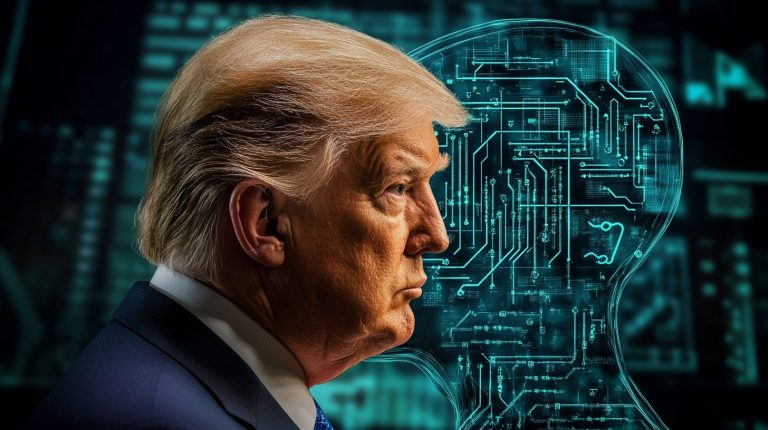
President Donald Trump’s latest comments about artificial intelligence have created an unusual challenge for technology executives, forcing some of the world’s biggest companies to navigate a political and linguistic debate over what the technology should be called.
From Nvidia to Microsoft, executives are facing pressure to adjust their language after Trump reportedly expressed opposition to the term “artificial intelligence” and suggested replacing it with “super intelligence.”
The debate may appear to be about terminology, but it reflects a broader effort to shape how Americans perceive one of the most transformative technologies in modern history.
Register for the next Tekedia Mini-MBA.
Register for Tekedia AI in Business Masterclass.
Join Tekedia Capital Syndicate and co-invest in great global startups.
Artificial intelligence has become a central part of the United States’ economic strategy, with companies investing hundreds of billions of dollars in computing infrastructure, advanced chips, data centers and software development.
As competition with China intensifies, the technology has also become an important national security and political issue. Trump’s preference for the phrase super intelligence introduces another layer of complexity for executives who must maintain relationships with the administration.
While communicating clearly with investors, employees and customers. For companies such as Nvidia, Microsoft and other major AI developers, the terminology surrounding their products is deeply embedded in corporate strategies, marketing materials and financial disclosures.

Changing that language is not necessarily straightforward. Artificial intelligence is an established industry term used across academic research, government policy, financial markets and technology development.
It describes systems capable of performing tasks traditionally associated with human intelligence, including learning, reasoning, generating content and recognizing patterns.
Super intelligence, generally refers to a more advanced theoretical capability in which machines could surpass human intelligence across numerous fields. The distinction matters because the two expressions do not necessarily describe the same technology.

Replacing one with the other could create confusion about what companies are actually developing and selling. Technology leaders operate in an environment where political relationships increasingly influence business decisions.
The Trump administration has made technological leadership a major priority, particularly as Washington seeks to strengthen domestic semiconductor manufacturing, accelerate AI infrastructure investment and maintain America’s competitive advantage.
Nvidia, whose processors power many of the world’s leading AI systems, has particularly significant interests in maintaining constructive relations with Washington.
Microsoft continues expanding its AI partnerships and infrastructure investments, making government policy an important consideration for its long-term strategy.
For these executives, the challenge is finding a balance between political sensitivity and technical accuracy. Publicly adopting Trump’s preferred terminology could demonstrate alignment with the administration.
But changing established industry language too aggressively could undermine credibility with researchers, customers and investors. The controversy highlights how political leaders can influence corporate communication without necessarily changing the underlying technology.
Whether companies adopt the proposed terminology or continue using artificial intelligence, their investment priorities remain focused on developing more powerful models, improving computing efficiency and expanding commercial applications.
The debate over whether AI should be called super intelligence reveals how closely technology, politics and corporate branding have become connected. Trump’s preferred terminology may eventually gain traction in political messaging, but the established language of the technology industry will not disappear overnight.
For now, executives must navigate an unusual balancing act: pleasing Washington, reassuring investors and ensuring customers understand what their products actually do.
The machines may be getting smarter, but the people selling them are discovering that choosing the right words can be almost as complicated as building the technology itself.